Achillean
MLM · Vincian · Uranian
Added 16 Jul 2026 · Updated 22 Aug 2026
Umbrella term for men and masculine-aligned people attracted to men, spanning gay, bisexual, pansexual and other queer identities. It is named for Achilles's bond with Patroclus in Homer's Iliad.
- Prevalence
- Common
- Type
- Sexual orientation
- Also known as
- MLM, Vincian, Uranian
- Confidence
- Low confidence
- Sources
- 8 cited
- Added
- 16 Jul 2026
- Updated
- 22 Aug 2026
Overview
Achillean is an umbrella term for men and masculine-aligned people who are attracted to men, encompassing gay, bisexual, pansexual, and otherwise queer men, along with nonbinary and transgender people who identify with manhood or are attracted to men (UWM LGBTQ+ Resource Center). It functions as a broader alternative to "men-loving-men" (MLM): the LGBTQ+ glossary Identiversity defines MLM narrowly as men "romantically, emotionally and/or sexually attracted to other men" and notes the acronym "originated and [is] used most often within the Black community" (Identiversity), whereas Achillean is used more expansively to also cover people who do not identify as cisgender men but do identify with masculinity or are attracted to masculine-aligned people (PinkNews).
The label does not specify a single orientation. An Achillean person may be exclusively attracted to men (as in homosexuality) or attracted to men alongside other genders (as in bisexuality, pansexuality, or polysexuality); the term groups these together by the shared fact of male-directed attraction rather than by its exclusivity, which mirrors the structure of "Sapphic," the parallel umbrella term for women-loving-women identities (PinkNews). It also differs from the clinical sexological term "androphilia," which describes attraction to men without attaching any identity label or self-conception and is applied irrespective of the attracted person's own gender identity; Achillean, by contrast, is a self-selected community label that centers the attracted person's own masculine alignment, and by definition excludes cisgender, heterosexual women who are attracted to men (Wikipedia: Androphilia and gynephilia).
Examples
Achillean is an affinity label covering several orientations at once, so its edges are set by who it includes rather than by any single pattern of attraction.
What the term covers. A gay man; a bisexual or pansexual man, since exclusivity is not required; a trans man attracted to men; a non-binary person who identifies with manhood or is drawn to masculine-aligned people. It usually sits on top of a more specific label rather than replacing it: someone is gay and achillean, in the way that queer works as a layer of shared identity.
What the term does not cover. Sapphic is the structural counterpart for women-loving-women, and the two are built the same way. Androphilia is a research term for attraction to men that carries no identity and applies to anyone, including heterosexual women, which achillean explicitly excludes. "Men-loving-men" (MLM) overlaps heavily but originated and remains most used within Black LGBTQ communities, and is generally read more narrowly as cisgender men.
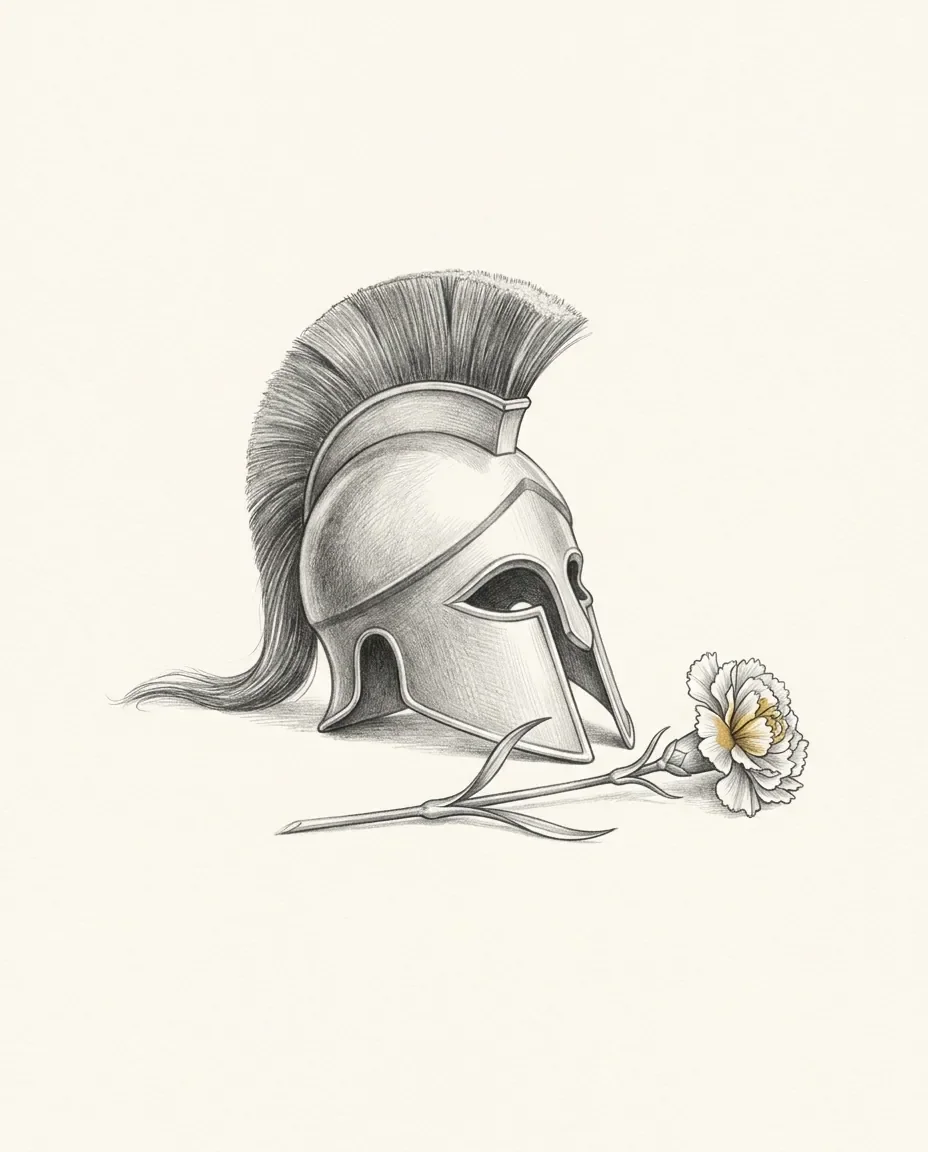
How the word is used. It is community vocabulary popularised on Tumblr from 2016 as a masculine counterpart to the already-established "Sapphic", with a flag whose central carnation nods to Oscar Wilde. The adjective is far older in other senses: John Addington Symonds wrote of an "Achilleian" ideal of comradeship in 1883, and a 1959 literary essay used "Achillean" in place of the then-pejorative "homosexual". "Vincian" and the nineteenth-century "Uranian" are occasional relatives.
History
The word derives from Achilles, the central hero of Homer's Iliad. The poem itself does not label Achilles's relationship with his companion Patroclus as romantic, but ancient and modern commentators have long read their intense mutual devotion (Achilles describes Patroclus as the man he "loved beyond all other comrades, loved as my own life") as encompassing a romantic and sexual bond, and later classical writers such as Aeschylus treated it explicitly as such (PinkNews).
The word's use to denote this reading of Achilles predates its current identity-label sense by more than a century. In A Problem in Greek Ethics (1883), one of the first extended English-language studies of ancient Greek same-sex love, John Addington Symonds describes an "Achilleian" ideal of manly comradeship modeled on Achilles and Patroclus, distinguishing it from effeminate love and centering loyalty and companionship in war (Symonds, A Problem in Greek Ethics, Project Gutenberg). The word resurfaces later still as a piece of academic vocabulary: a 1959 scholarly article by A. C. Hamilton on the poetry of Edmund Spenser used "Achillean" in place of the then-pejorative "homosexual" (Grindr).
Its use as a contemporary self-identifying label is unrelated to that academic lineage: it was popularized within LGBTQ+ communities on Tumblr starting in 2016, built explicitly as a masculine counterpart to the already-established "Sapphic," with an accompanying pride flag (two light-blue bars framing a pale sage-green stripe and center carnation, the carnation referencing Oscar Wilde) created by Tumblr users that same year and spreading from there into wider queer usage as shorthand for men-loving-men identities (PinkNews; Grindr).
Terminology & related identities
Achillean overlaps heavily with, and is often used interchangeably with, "men-loving-men" (MLM); the clearest documented distinction is that MLM emerged and is used most often within Black LGBTQ+ communities specifically, while Achillean was coined later as a general-purpose, Sapphic-style umbrella that more readily includes trans men and nonbinary people who identify with manhood, not only cisgender men (Identiversity; UWM LGBTQ+ Resource Center).
Some sources also list "Vincian" (after Leonardo da Vinci) and "Uranian" as related or occasionally interchangeable labels for male-directed attraction between men (Wikipedia: LGBT slang). Uranian is the older of the two by more than a century: the German lawyer Karl Heinrich Ulrichs coined "Urning" (anglicized as "Uranian," from Aphrodite Urania in Plato's Symposium) in a series of booklets published in 1864–65 arguing that male same-sex attraction was an innate, non-pathological condition rather than a crime; English writers including Symonds and Edward Carpenter later adopted "Uranian," and the term fell out of common use once the more assertive gay-liberation vocabulary that followed the 1969 Stonewall riots took hold (Wikipedia: Uranian (sexuality)).
As an umbrella rather than a specific orientation, Achillean does not replace more specific labels such as gay, bisexual, or pansexual; an Achillean person will typically also use one of those terms to describe the shape of their attraction, using "Achillean" as a broader affinity or community label rather than a stand-alone orientation category. In this respect it behaves the same way "queer" or "Sapphic" do elsewhere in LGBTQ+ vocabulary, as a layer of shared identity and community that sits above, rather than instead of, a person's more specific orientation label.
Common questions
What does achillean mean?
It is an umbrella term for men and masculine-aligned people attracted to men: gay, bisexual, pansexual and otherwise queer men, plus trans men and non-binary people who identify with manhood. It names the shared fact of male-directed attraction rather than its exclusivity, which is why it covers several orientations at once instead of being one.
What is the difference between achillean and sapphic?
They are mirror images. Sapphic, from the poet Sappho, covers women and feminine-aligned people attracted to women; achillean, from Achilles and his bond with Patroclus in the Iliad, covers men and masculine-aligned people attracted to men. Both are affinity umbrellas built from a proper name, and achillean was coined deliberately on the older term's pattern.
Do you have to be a cisgender gay man to be achillean?
No. That breadth is the point of the term. It is used to include trans men, and non-binary people who identify with manhood or are attracted to masculine-aligned people, alongside cisgender gay and bisexual men. It is also not limited to exclusive attraction, so bisexual and pansexual men are covered without any implication about their other attractions.
Is achillean the same as MLM?
Close, but with a documented difference in origin and scope. MLM (men-loving-men) is defined narrowly as men attracted to other men, and the acronym originated and is used most often within Black LGBTQ communities. Achillean was coined later as a general-purpose, Sapphic-style umbrella that more readily includes trans men and non-binary people, not only cisgender men.
What is the difference between achillean and androphilia?
Androphilia is a behavioural-science term for attraction to men that says nothing about who is doing the attracting: a heterosexual woman is androphilic. Achillean is a self-selected community label that centres the attracted person's own masculine alignment, and by definition excludes cisgender heterosexual women. One is a description applied from outside; the other is an identity claimed from inside.
Where does the word achillean come from?
From Achilles, whose devotion to Patroclus in Homer's Iliad has long been read as romantic; later classical writers such as Aeschylus treated it explicitly so. The adjective appears in John Addington Symonds's 1883 study of Greek same-sex love and in a 1959 essay on Edmund Spenser, but its use as an identity label is separate, arising on Tumblr from 2016.
 HomosexualitySexual orientation defined by enduring romantic and/or sexual attraction to people of the same sex or gender, such as gay men and lesbians. It also covers other same-gender-attracted people.
 SapphicUmbrella term for women who are romantically or sexually attracted to women, spanning lesbian, bisexual, pansexual and other orientation labels. In expanded usage it also covers non-binary people who feel a connection to womanhood.
 BisexualitySexual orientation defined by attraction to more than one gender, classically described as attraction to both men and women. Contemporary usage often defines it as attraction to two or more genders.
 PansexualitySexual orientation characterized by attraction to people regardless of sex or gender, rather than attraction bounded by a specific set of genders. Cisgender, transgender, intersex, and nonbinary people are all included.
 QueerUmbrella term for sexual orientations, romantic orientations and gender identities outside heterosexual and cisgender norms. It is also the name of the reclaimed word itself and of the academic field queer theory.
 AndrophiliaBehavioral-science term for sexual attraction to men or masculinity, used in place of "homosexual"/"heterosexual". It applies when the attracted person's own sex or gender is unspecified, non-binary, or not the relevant frame of reference.
From Achilles, the Greek hero of Homer's Iliad, whose bond with his companion Patroclus is widely read by classicists and later commentators as romantic and sexual. The adjective is formed on the same pattern as Sapphic (from Sappho), a proper name plus the -an suffix, and is used as its structural counterpart for male-aligned attraction. The earliest documented English-language use of the term in this sense is John Addington Symonds's "Achilleian" ideal of manly comradeship in A Problem in Greek Ethics (1883); a later, independent academic use appears in a 1959 literary essay by A. C. Hamilton on Edmund Spenser. The term's current identity-label usage developed separately within Tumblr-era LGBTQ+ vocabulary of the 2010s.
Prevalence is computed from the entry's cited population estimate. Rows marked ESTare indicative editorial estimates scored against a fixed anchor rubric, not measured quantities. Method & anchors: methodology.
Common · ≈ 1 in 20
Basis: Derived (not cited in-entry): Gallup 2023's 2.0% adult "gay" identification (essentially all male-attracted-to-men) plus the estimated male-identifying share of the 4.4% "bisexual" and smaller "other"/pansexual categories (bisexual and pansexual identification both skew markedly female in Gallup/Williams Institute breakdowns), yielding roughly 4% of US adults as a defensible umbrella point estimate.
- 01University of Wisconsin-Milwaukee LGBTQ+ Resource Center, Glossary of TermsContemporary institutional definition of Achillean as an umbrella term for men attracted to men, inclusive of nonbinary people who identify with manhood.
- 02Wikipedia, LGBT slang (Achillean)Umbrella-term definition; related alternate labels Vincian and Uranian.
- 03PinkNews, The fascinating meaning behind the MLM term 'Achillean'Etymology and the Achilles/Patroclus relationship; parallel to Sapphic; exclusion of heterosexual women; Tumblr flag origin in 2016.
- 04Grindr, Achillean Meaning: Where Myth Meets Identity1959 A. C. Hamilton essay as an early academic use of the term; flag design and the Oscar Wilde carnation symbol.
- 05Identiversity, MLM (Men Loving Men)Definition of MLM and its origin and predominant use within Black LGBTQ+ communities, contrasted with the broader Achillean umbrella.
- 06Wikipedia, Androphilia and gynephiliaDefinition of the clinical sexological term androphilia, distinguished from Achillean as a self-selected identity label.
- 07John Addington Symonds, A Problem in Greek Ethics (1883), Project GutenbergPrimary-source 1883 use of the "Achilleian" ideal of manly comradeship, predating the 1959 Hamilton essay.
- 08Wikipedia, Uranian (sexuality)History of Uranian/Urning as coined by Karl Heinrich Ulrichs (1864–65) and its later disuse after Stonewall.