Camming
Added 21 Jun 2026 · Updated 22 Aug 2026
Arousal from displaying oneself to a consenting remote audience via webcams, live streams, or images. Because viewers opt in, it is a consensual variation distinct from clinical exhibitionistic disorder, which targets non-consenting strangers.
- Prevalence
- Common
- Category
- Acts & Activities
- Domain
- Sexual interest
- Confidence
- Low confidence
- Status
- Consensual variation, not exhibitionistic disorder, because the remote audience opts in.
- Also known as
- online exhibitionism, camera exhibitionism, webcam display, live-stream exhibitionism, showing on camera, cam show, online/camera exhibitionism
- Added
- 21 Jun 2026
- Updated
- 22 Aug 2026
Featured in
Overview
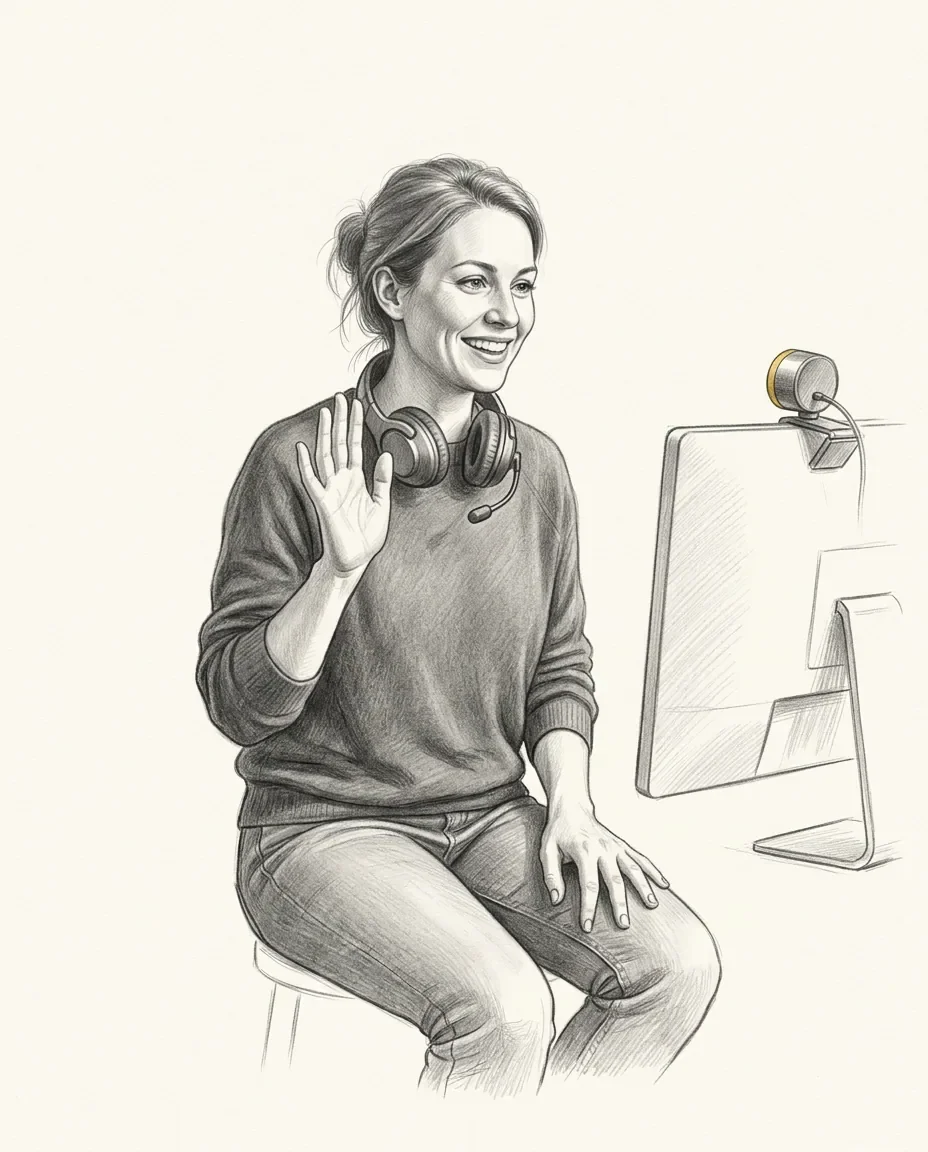
Camming, online or camera exhibitionism, is arousal from displaying oneself to a remote audience that has chosen to watch, typically through webcams, live-streaming platforms, or shared images. Because the audience opts in and actively seeks out the content, it differs fundamentally from exhibitionistic disorder, which involves exposing oneself to non-consenting strangers. That consent-based, opt-in viewer relationship is the defining feature placing camming among consensual variations rather than clinical paraphilias. This article covers the term, its history, how the interest is expressed, the proposed psychology, and its prevalence and legal frame.
Definition & scope
Is camming the same as exhibitionism?
No, not in the clinical sense. Camming and clinical exhibitionistic disorder both involve the wish to be seen, but they are separated by consent. Camming is directed at an audience that has sought out and opted in to the content; exhibitionistic disorder, as defined in the DSM-5-TR, specifically involves exposure to a non-consenting or unsuspecting person. The scope of camming ranges from private sharing between partners, through amateur streaming, to professional monetised performance. What unifies these is the reciprocal, consensual viewer relationship rather than the medium used.
Examples
What the term covers. A live stream to an audience that has sought it out, whether that audience is thousands of people on a commercial platform or a single remote partner. A monetised show with tipping and real-time chat, where viewer requests shape what happens. Private one-to-one sessions booked in advance. Subscription content, which is the same opt-in relationship without the live element. A large share of this is paid work: for professional performers it is a job with a schedule, a marketing side and an income, and the erotic interest that brings a viewer to the stream is not necessarily one the performer shares.
What the term does not cover. Exhibitionistic disorder is the non-consensual counterpart, and the audience's consent is the whole of the difference between them. Voyeurism is the same transaction seen from the watching side. Public sex and dogging put real bystanders who did not opt in within range. A recording fetish concerns the fact of being filmed rather than a live audience, while phone sex and instructional formats such as JOI are remote but not visual display. And "capping" (recording a stream and redistributing it elsewhere) is not camming but a violation of it.
How the word is used. Industry and community vernacular formed from webcam: the person is a cam model, cam performer or cam girl, and the session is a cam show. It is not a clinical term. Neither camming nor "online exhibitionism" appears in DSM-5-TR or ICD-11, which reserve exhibitionistic disorder for exposure to someone who has not consented, which is precisely why the consensual practice needed a name of its own.
History & origins
Clinical lineage
Camming is a digital-age expression of a much older interest in being watched. The clinical thread runs through exhibitionism, a term first used by the French physician Charles Lasègue in 1877 and absorbed into the broader sexological cataloguing of Richard von Krafft-Ebing's Psychopathia Sexualis (1886) and Havelock Ellis's Studies in the Psychology of Sex. Crucially, modern diagnostic frameworks, including the DSM-5-TR, reserve exhibitionistic disorder specifically for the urge to expose oneself to a non-consenting or unsuspecting person. A consenting, opt-in webcam audience is therefore excluded by definition, which is exactly why camming sits outside the disorder.
Digital evolution
The practical phenomenon emerged with consumer webcams and broadband at the turn of the millennium and then scaled enormously.
- 1996: Jennifer ("Jenny") Ringley launches JenniCam from her Dickinson College dorm room, becoming the first person to broadcast her daily life continuously online through a webcam that refreshed a still image every few minutes; the unfiltered feed occasionally included nudity, and at its peak the site was reported to draw up to several million visitors a day.
- 1997: Ringley introduces paid access, foreshadowing the subscription model.
- 1998: commercial sites add live viewer chat during performances, the innovation that defined interactive webcam modelling and distinguished it from passive broadcast.
- 2000s–2010s: dedicated platforms (LiveJasmin, MyFreeCams, Chaturbate, Cam4) turn camming into monetised, interactive live performance; by 2016 the sector was estimated at upwards of US$2 billion annually.
- 2020: pandemic lockdowns accelerate creator platforms, with OnlyFans reporting roughly US$2.4 billion in transactions, a steep rise over the prior year.
The conduct of wanting to be seen is old; the medium, the terminology, and the scale are new.
In practice
Camming is expressed through live sessions, amateur content creation, and interactive platforms where performers and viewers communicate in real time. It spans casual sharing with a single partner or small community through to professional, monetised performance. A defining advantage of the digital medium is control: performers manage their audience, anonymity, and boundaries far more readily than in physical settings, and the relationship overlaps with adjacent consensual interests such as sharing one's partner and public display. Where camming is paid work, those boundaries are also working conditions: what a performer will and will not do, which requests they decline and which viewers they block are decisions made by the person doing the work, not concessions owed to a paying audience.
Psychology
The appeal centres on being desired and watched, the validation supplied by audience attention and feedback, a sense of control over one's own self-presentation, and the relative safety of physical distance. For many participants the interactive, performative dimension matters as much as the display itself. As a research subject, camming-specific psychology is thinly studied; most inference is borrowed from the broader literature on consensual exhibitionism and from qualitative accounts of performers.
Prevalence & culture
How common is camming?
The rise of streaming and creator platforms has made camming highly visible and fast-growing, but precise prevalence is hard to measure: estimates rely on platform-usage proxies rather than dedicated population surveys. The underlying consensual interest, however, is common: in the general-population survey by Joyal & Carpentier (2017), interests in the exhibitionism/being-watched family were reported by a substantial minority of respondents, framing online display as a digital subset of a widespread taste. Industry figures underline the cultural footprint: by the mid-2010s leading cam platforms reported millions of unique monthly viewers each, and the sector as a whole was valued in the billions. Formal academic attention nonetheless remains modest relative to that visibility.
Safety, consent & law
Among consenting adults, camming is legal in most jurisdictions, subject to platform rules, content laws, and age-verification requirements. Ethical practice requires confirming that all parties are consenting adults, protecting privacy and identity, and guarding against non-consensual recording or redistribution ("capping"). The critical boundary is consent: the same display directed at non-consenting viewers would constitute unlawful exhibitionism rather than this consensual variation.
Common questions
Is camming sex work?
When it is done for money, yes: it is generally understood as sex work performed remotely rather than in person. That framing matters practically: it determines which platform rules and local laws apply, how the income is taxed, and what protections a performer does or does not have. Camming done privately with a partner and no payment is not sex work in any sense.
Is camming legal?
For consenting adults it is lawful in most jurisdictions, but the detail varies more than people expect, because it can fall under sex-work regulation as well as content law. Age verification is mandatory on reputable platforms and increasingly required by statute. Recording or redistributing someone's stream without their agreement is a separate matter and is unlawful in many places.
Do cam performers actually enjoy what they are doing?
Sometimes, and it varies as much as it does in any other line of work. For some, camming genuinely expresses the interest in being watched described here; for others it is a performance done for income, no more revealing of private taste than any other job. Assuming that a performer shares a viewer's arousal is the most common misreading of the exchange.
What is capping?
Capping is recording a live stream and redistributing it: on other sites, in group chats, or as paid content someone else profits from. It is the main harm performers face, it is prohibited by every mainstream platform, and distributing intimate images without consent is a criminal offence in a growing number of jurisdictions. It is not a form of camming; it is a violation of the consent camming rests on.
Do you have to be nude to cam?
No. Camming is defined by displaying oneself to an audience that has opted in, not by any particular degree of undress, and a great deal of streaming stays clothed or merely suggestive. Platforms differ sharply in what they permit: mainstream streaming services prohibit sexual content outright, while dedicated adult platforms are built around it and enforce their own limits.
How do cam performers protect their identity?
With a stage name kept entirely separate from legal identity, careful control of what appears in frame (post, documents, distinctive views, tattoos), and region-blocking so the stream is unavailable where they live and work. Many watermark their own content so redistributed copies are traceable. None of this is foolproof, which is why the risk of exposure is treated as an occupational one.
Is camming cheating?
There is no external standard that settles it, only the agreement between the people in the relationship. Some couples treat watching a stream as no different from watching any other adult content; others count the live, interactive element as a meaningful line. Performing rather than watching raises the question again. The workable approach is to agree explicitly rather than assume a shared default.
From the blog
- Exhibitionism72/100Acts & ActivitiesArousal from being seen, watched, or displaying oneself to willing audiences within agreed limits. As a consensual interest it is a common, non-pathological variation of erotic expression, distinct from the clinical disorder that involves exposure to non-consenting observers.72
- Voyeurism78/100Scopophilia · Acts & ActivitiesArousal from watching others who know they are being observed, or who consent to being viewed, such as a partner, performers, or participants in group settings. It is a common, benign facet of human sexuality.78
- Public Sex59/100Settings & SituationsA consensual interest in sexual activity in outdoor or public settings, where the change of environment or a slim chance of discovery heightens arousal. The appeal centres on novelty and risk rather than on being deliberately witnessed.59
- Sharing Your Partner47/100Candaulism · Acts & ActivitiesCandaulism is arousal from displaying one's partner, or images of them, to others, and from the partner being seen, desired, or admired. It requires the partner's consent. It blends exhibitionistic and voyeuristic elements and overlaps with hotwifing and cuckolding.47
- Swinging57/100Acts & ActivitiesA form of consensual non-monogamy in which committed partners engage in sexual activity with others, often by exchanging partners. The exchange happens largely within a couple-oriented social scene. It is typically recreational rather than romantic.57
- Barebacking58/100Acts & ActivitiesBarebacking is condomless penetrative sex, eroticized in its fetishistic sense for skin-to-skin sensation or unfiltered intimacy. For some, the charge is the risk itself. It is a behavior rather than a paraphilia, and it carries STI and pregnancy risk that harm-reduction tools can lower.58
"Camming" is a modern colloquial verb formed from "webcam" (itself "web" + "camera"); the clinical parent term "exhibitionism" derives from Latin *exhibere*, "to hold out, display," and was introduced to sexual medicine by Charles Lasègue in 1877.
being watched · digital/remote · consensual
Prevalence is computed from the entry's cited population estimate. Rows marked ESTare indicative editorial estimates scored against a fixed anchor rubric, not measured quantities. Method & anchors: methodology.
Common · ≈ 1 in 20
- 01Pornhub Insights, search-term popularity (search-interest proxy)search-interest proxy for live cam / camming content indicating a sizeable but niche audience
- 02Joyal & Carpentier (2017), The Prevalence of Paraphilic Interests and Behaviors in the General Population, J. Sex Research 54(2):161-171frames online exhibitionism as a digital subset of the broader (common) consensual exhibitionism/being-watched interest
- 03An A–Z of Kinks and Fetishes, Glamourcamming/online display described as a popular modern consensual kink
- 04Exhibitionism, Wikipediahistory of the term exhibitionism (Charles Lasègue, 1877) and the consent-based distinction from exhibitionistic disorder
- 05Webcam model, Wikipediadocumented digital history of camming (AmandaCam live chat 1998; LiveJasmin/MyFreeCams/Chaturbate/Cam4; ~US$2bn sector by 2016; platform viewer figures; OnlyFans 2020 growth)
- 06Jennifer Ringley (JenniCam), WikipediaJenniCam launched 1996 as the first continuous personal lifecast; paid access introduced 1997
- 07Psychopathia Sexualis, WikipediaKrafft-Ebing (1886) cataloguing of exhibitionism within early sexology
- 08Studies in the Psychology of Sex (Havelock Ellis), WikipediaEllis's place in the sexological lineage of the being-watched / exhibitionism interest
- 09DSM-5, WikipediaDSM-5-TR reserves exhibitionistic disorder for exposure to non-consenting persons, excluding a consenting webcam audience