Vee Relationship
Vee · V relationship · Poly V · Vee polyamory
Added 26 Jul 2026 · Updated 22 Aug 2026
A three-person relationship in which one person, the "hinge," is romantically or sexually involved with two partners who are not involved with each other.
- Prevalence
- Uncommon · 1% of adults
- Type
- Relationship structure
- Family
- Polyamorous structures
- Also known as
- Vee, V relationship, Poly V, Vee polyamory
- Confidence
- Low confidence
Overview
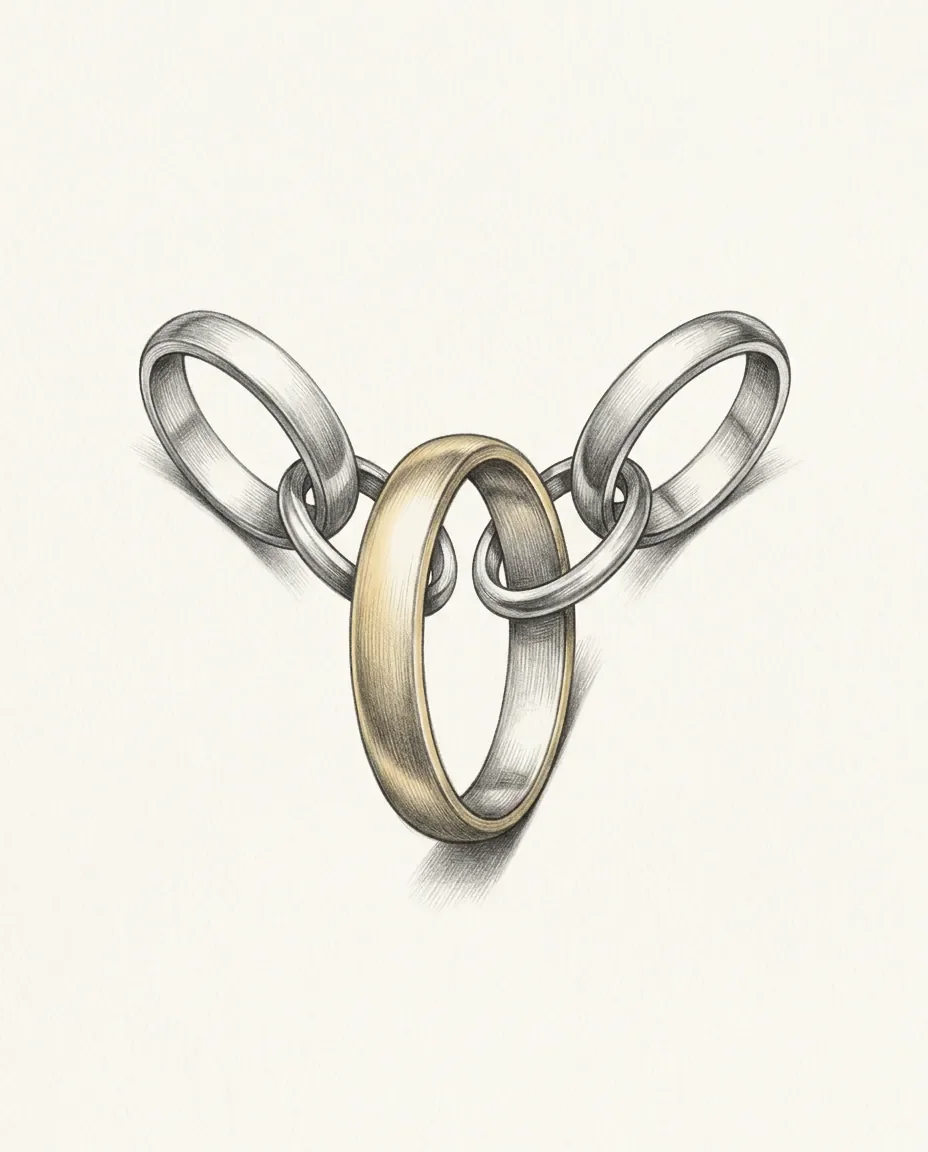
A vee relationship is a three-person configuration shaped like the letter it is named for: one person sits at the point, connected to two other partners who form the arms of the V. Those two outer partners (called metamours to each other) are not dating, sleeping with, or necessarily even close to one another; the only connection running between them is through the shared partner. That shared partner is called the hinge, or sometimes the pivot or fulcrum, and the term captures the mechanical reality of the role: a hinge is the single point everything else swings on.
A vee is not a triad. In a triad, all three people are romantically or sexually connected to each other; in a vee, exactly one of the three connections is missing. If the two metamours in a vee begin dating each other, the relationship becomes a triad by definition, a common enough transition that polyamory communities treat the two shapes as points on the same spectrum rather than unrelated categories (Feeld).
Examples
A vee is named for a missing line: two partners connected through one person, and not to each other. Everything distinctive about it follows from that gap.
What the term covers. One person dating two others who are metamours to each other and may be friendly, indifferent or barely acquainted; a closed vee, where all three date only within the arrangement; an open vee, where the hinge or the outer partners also see people outside it; and a hierarchical vee, where one of the hinge's two relationships is designated primary. Vees frequently form when someone in an established relationship starts a second one.
What the term does not cover. A triad has all three connections, so a vee whose outer partners begin dating stops being a vee. Parallel polyamory describes how much contact metamours have, which is a separate question from the shape. A vee also implies nothing about the hinge's orientation: dating a man and a woman is a fact about the relationship, not about attraction. A threesome is not a vee: a vee's defining feature is precisely that two of the three are not involved with each other.
How the word is used. It names the diagram: one point, two arms, no line across the top. The term has no credited coiner, arriving with the same wave of polyamory vocabulary (hinge, metamour, polycule) that community handbooks such as The Ethical Slut (1997) and More Than Two (2014) consolidated into shared usage. "Pivot" and "fulcrum" are occasional synonyms for the hinge.
History
Like much of contemporary polyamory's working vocabulary, "vee" has no single credited coiner or publication date; it emerged from lived practice and online discussion as polyamorous communities needed shorthand for describing who was involved with whom. The word "polyamory" itself dates to 1990, coined by Morning Glory Zell, and gave the broader movement a name under which configurations like vees and triads could be named and compared rather than treated as ad hoc arrangements (Loving More). Handbooks published from the late 1990s through the 2010s (The Ethical Slut and More Than Two among the best known) consolidated terms like hinge, metamour, and polycule into a shared reference vocabulary that spread well beyond the books' original readership and into general use (Wikipedia).
How it works in practice
The hinge in a vee carries a structural load the two outer partners do not. Every issue that surfaces anywhere in the vee eventually reaches the hinge: a conflict with one partner, tension between that partner and the metamour, a scheduling clash between two relationships that both want the same weekend. Writers on the dynamic describe the arithmetic bluntly: where two people in a normal relationship split one set of problems, the hinge can end up carrying the emotional weight of three relationships' worth of friction while enjoying only the direct benefit of two (Poly.Land). Hinges who try to opt out of that work, treating a metamour conflict as "not my problem" because it's technically between two other people, tend to find the arrangement destabilizes rather than simplifies.
Vees vary along the same open/closed axis as other polyamorous structures. A closed, or polyfidelitous, vee restricts all three people to dating only within the existing configuration. An open vee allows the hinge, the outer partners, or both to see people outside the arrangement, which adds its own layer of negotiation about disclosure and boundaries between relationships that already don't touch each other directly (3Fun). Hierarchical vees, where one of the hinge's two relationships is explicitly designated "primary" with more shared history, cohabitation, or decision-making weight, are common enough that researchers studying polyamorous couples have used primary/secondary language as their default frame for describing multi-partner relationships generally (Balzarini et al., 2017, PLOS ONE).
Demographics & research
As with other specific polyamorous configurations, no national survey measures how many people are currently in a vee as distinct from a triad, a hierarchical pair, or another arrangement. The broader baseline for consensual non-monogamy comes from two 2016 US Census-based quota samples of single adults, in which 21.9% and 21.2% reported having practiced some form of consensual non-monogamy at some point in their lives (Haupert et al., 2017, Journal of Sex & Marital Therapy). A narrower study of 3,438 single US adults specific to polyamory found 10.7% had previously been in a polyamorous relationship and 16.8% said they wanted to try one; that paper names vees, alongside triads and quads, as one of several recognized configurations within polyamory but reports no percentage split between them (Moors, Gesselman & Garcia, 2021, Frontiers in Psychology). Separately, a study of 1,308 self-identified polyamorous people who described one partner as primary and another as non-primary (a structure that, geometrically, is often a vee) found primary relationships averaged eight years four months against two years four months for secondary relationships, and that primary partners cohabited at far higher rates, evidence for how unevenly resources and commitment can distribute across the two arms of a vee even without a formal hierarchy label (Balzarini et al., 2017, PLOS ONE).
Common misconceptions
A vee is sometimes assumed to be an unstable or transitional stage on the way to a "real" triad, as though the missing connection between metamours is a problem to be solved. Polyamorous communities generally treat it as a legitimate, durable structure in its own right: plenty of vees remain vees indefinitely, by choice, because the two outer partners are simply not romantically or sexually interested in each other and have no obligation to be. A second misconception folds the vee into the vocabulary of orientation: describing someone as "bisexual because they're in a vee with a man and a woman" mistakes the shape of the relationship for the hinge's pattern of attraction, which is a separate fact about the person and not implied by the relationship structure itself.
Common questions
What does the hinge in a vee relationship do?
Everything passes through them. The hinge is the person dating both others, so every conflict, scheduling clash and piece of information between the two sides lands on them: the emotional weight of three relationships' worth of friction against the direct benefit of two. Hinges who treat tension between their partners as none of their business generally find the arrangement destabilises rather than simplifies.
Are the two partners in a vee dating each other?
No. That is what makes it a vee rather than a triad. The two outer partners are metamours: connected only through the person they share. They may be close friends, cordial acquaintances or people who have never met, and none of those states is more correct than the others.
Can a vee turn into a triad?
Yes, and it is common enough that the two shapes are treated as points on one spectrum rather than separate categories. If the two metamours become romantically or sexually involved, the missing connection closes and the relationship is a triad by definition. The reverse also happens when one of the three connections ends.
Is a vee an unstable version of a triad?
No, though it is often assumed to be one. Plenty of vees stay vees indefinitely by choice, because the two outer partners are simply not interested in each other romantically and are under no obligation to be. Treating the missing connection as a problem to be solved is a common misreading of a structure that works as it is.
Does being in a vee say anything about the hinge's sexual orientation?
No. Describing someone as bisexual because their two partners are of different genders mistakes the shape of a relationship for a pattern of attraction. Orientation is a separate fact about the person, and a vee can involve any combination of orientations among the three people in it.
Are both relationships in a vee equal?
Often not, whether or not anyone labels them. Balzarini and colleagues (2017, PLOS ONE), studying 1,308 polyamorous people who named one partner primary and another non-primary, found primary relationships averaged eight years four months against two years four months for the non-primary ones, with far higher rates of cohabitation. Time and shared infrastructure distribute unevenly across a vee's two arms even without a formal hierarchy.
 Triad (Throuple)Three people in a romantic and/or sexual relationship with one another, distinguished from other three-person arrangements. All three are mutually involved, rather than connected through a single shared partner.
 Hierarchical PolyamoryA polyamorous structure in which one relationship, usually called primary, is explicitly ranked above others, called secondary or tertiary. The ranking covers time, cohabitation, finances, or decision-making authority.
 Non-Hierarchical PolyamoryA polyamorous structure in which no relationship is designated primary or secondary by rule and no fixed rank governs decisions. Time, commitment, and major decisions are negotiated relationship by relationship instead.
 PolyamoryMaintaining multiple consensual romantic and/or sexual relationships at the same time, openly and with the knowledge of everyone involved. It is a relationship structure, not a sexual orientation.
 Consensual Non-MonogamyAn umbrella term for any arrangement in which everyone involved knowingly agrees that partners may have additional romantic or sexual relationships. That knowing agreement is what separates it from cheating.
 PolyfidelityA closed group of three or more partners, typically a triad or quad, who are romantically and sexually exclusive with each other. No one takes lovers outside the group.
- Threesome70/100Acts & ActivitiesAn interest in consensual sexual activity involving three people at once, whether as a one-time encounter or a recurring arrangement. It is one of the most commonly reported sexual fantasies among adults.70
- Group Sex78/100Acts & ActivitiesSexual interest or fantasy involving more than two consenting adults at once, from threesomes to larger gatherings. It is among the most reported fantasies and a consensual practice within negotiated, lawful settings.78
- Troilism49/100Troilism · Acts & ActivitiesArousal from observing one's own partner engage with another person, with everyone's consent. It overlaps with voyeurism, candaulism, and cuckold or hotwife dynamics, and is often associated with compersion.49
"Vee" describes the shape the relationship makes when drawn as a diagram: one person at the point, two partners extending outward as the arms of the letter V, with no line connecting the two outer points. The term comes out of the same wave of English-language polyamory vocabulary that produced "metamour" and "polycule" in online and print discussion from the 1990s onward, including community handbooks such as Dossie Easton and Janet Hardy's The Ethical Slut (1997) and Franklin Veaux and Eve Rickert's More Than Two (2014), which helped popularize a shared descriptive language for polyamorous structures (Wikipedia: More Than Two).
Prevalence is computed from the entry's cited population estimate. Rows marked ESTare indicative editorial estimates scored against a fixed anchor rubric, not measured quantities. Method & anchors: methodology.
Uncommon · ≈ 1 in 100
Basis: No population survey isolates vees specifically; this figure is derived as roughly one-tenth of Moors et al. (2021, Frontiers in Psychology)'s 10.7% lifetime-polyamory figure among single US adults, on the reasoning that hierarchical hinge-centered structures (which are geometrically vees) were the most commonly described configuration in Balzarini et al. (2017)'s study of self-identified polyamorous people; treat as a rough, low-confidence estimate.
- 01Wikipedia, More Than TwoPublication history of a key polyamory handbook (2014) that helped popularize shared structure vocabulary.
- 02Poly.Land, With Great Hinges, Comes Great ResponsibilityDescription of the hinge role's disproportionate emotional and conflict-resolution load in a vee.
- 03Feeld, A Guide to the Different Poly DynamicsDistinction between a vee and a triad, and the transition from one to the other.
- 043Fun, What Is a Vee Relationship? The Polyamory Structure ExplainedOpen vs. closed (polyfidelitous) vee distinction.
- 05PubMed, Haupert et al. (2017), Journal of Sex & Marital TherapyLifetime consensual non-monogamy prevalence figures (21.9% / 21.2%) among single US adults, used as the population baseline.
- 06Moors, Gesselman & Garcia (2021), Frontiers in Psychology10.7% lifetime polyamory-practice figure, 16.8% desire figure, and the paper's naming of vees/triads/quads as recognized configurations.
- 07Balzarini et al. (2017), PLOS ONEPrimary/secondary relationship duration and cohabitation figures used to illustrate uneven distribution across a hinge's two relationships.
- 08Loving More Nonprofit, 2012 Polyamory Survey overviewBackground on the 1990 coinage of the word "polyamory" by Morning Glory Zell.