Autosexuality
automonosexualism
Added 7 Sep 2026
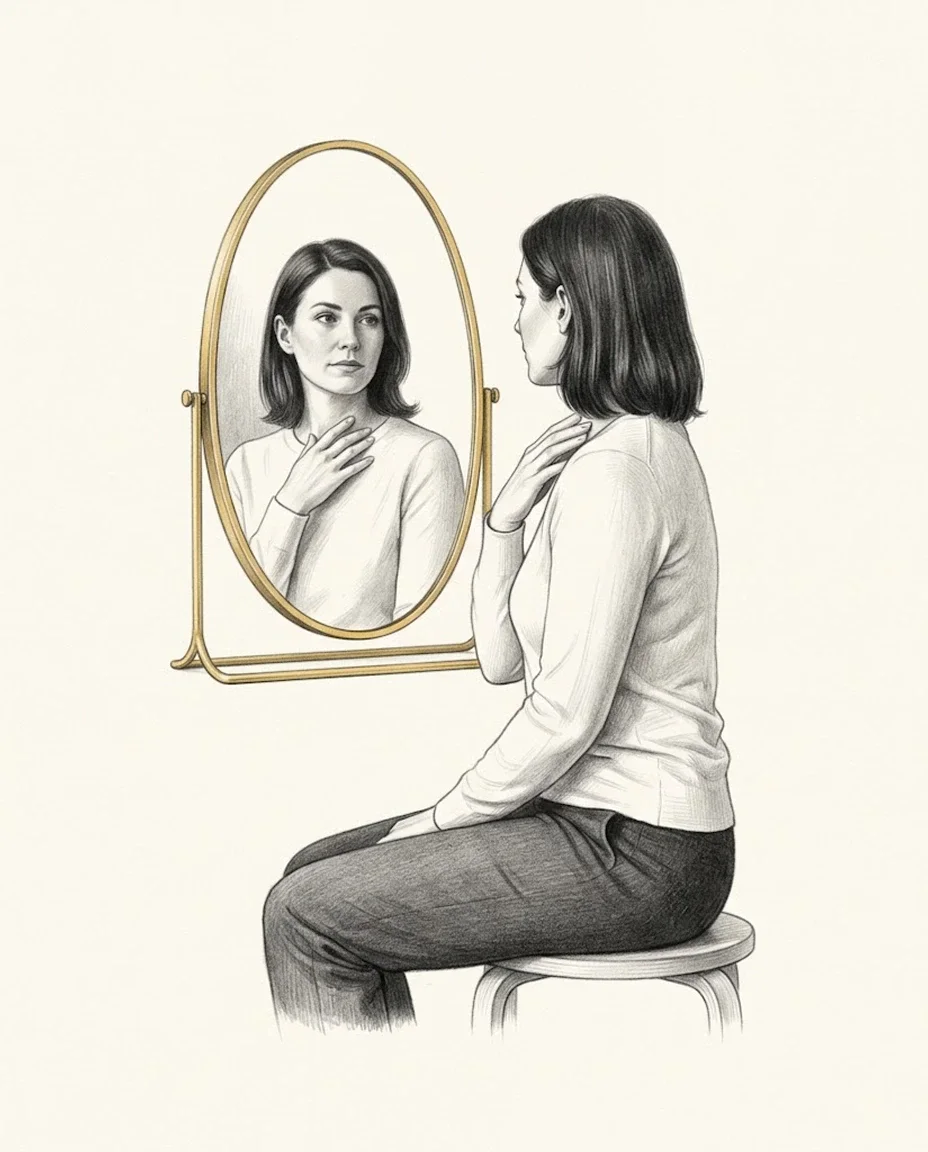
Sexual attraction directed at oneself: arousal from one's own body, image or touch that stands on its own and does not depend on a partner. An identity label in modern use, filed in older sexology as automonosexualism.
- Prevalence
- Uncommon
- Category
- Identity & Transformation
- Clinical term
- automonosexualism
- Domain
- Sexual interest
- Confidence
- Low confidence
- Status
- An identity label with no diagnostic status. Neither DSM-5-TR nor ICD-11 lists autosexuality or automonosexualism, and the pattern is solitary and consensual by nature.
- Also known as
- autosexual, self-attraction, autoeroticism as an orientation, automonosexuality, self-directed attraction
- Added
- 7 Sep 2026
Overview
Autosexuality is sexual attraction directed at oneself: arousal from one's own body, image or touch that stands on its own and does not depend on a partner. In everyday use the word names an identity that some people adopt alongside or instead of a partnered orientation; in the older clinical vocabulary the same idea appears as automonosexualism. The interest sits close to masturbation and to the mirror fetish, and it differs from both in what it claims: a direction of desire, and neither one act nor one prop.
Definition & scope
The object of attraction defines the term. Autosexual people report arousal from their own body, from watching themselves, from their own touch, or from the idea of themselves as a sexual being, and they report that partnered sex adds less than it does for most people or nothing at all. The Wikipedia article on autosexuality records that the term has not been widely studied and that some writers place it on the asexual spectrum, since it describes a low or absent pull toward partners. Others treat it as an orientation in its own right. The catalog files it as an identity because that is how the people who use the word use it.
The band is wide. At one end sits a person who enjoys their own touch, prefers it, and also has partnered sex. At the other sits a person for whom partners hold no erotic interest at all. Both call themselves autosexual, and the word does not settle where a given person sits.
Examples
What the term covers. A standing preference for solo sex over partnered sex; arousal from one's own reflection, photographs or filmed image; sexual fantasy in which the self is the object; and an identity label chosen to describe any of these. The clinical sexologist Cyndi Darnell, quoted in the Wikipedia article, describes autosexual people as those who prefer solo erotic practice and self-touch to partnered activity.
What the term does not cover. Masturbation is an act that most adults perform and says nothing about orientation. A mirror fetish is arousal from watching sex in a mirror and usually involves a partner. Narcissism is a personality pattern of grandiosity and a need for admiration, and the Wikipedia article separates it from autosexuality in so many words: an autosexual person may be modest about everything except their own desirability, and a narcissist may have no particular interest in their own body. Exhibitionism wants an audience; in autosexuality the person is the audience. Asexuality names an absence of sexual attraction to anyone, and some autosexual people identify with it while others do not.
How the word is used. It is a community and identity term. Neither DSM-5-TR nor ICD-11 lists autosexuality, automonosexualism or any related diagnosis, and the older literature that used the words treated them as descriptions of where desire points and never as pathology. Online it appears as a flag, a label on dating profiles and the subject of magazine explainers.
History & origins
Ellis and the auto-erotic
The idea is older than the word. Havelock Ellis coined auto-erotism in 1898 for sexual feeling that arises without an external stimulus, in a paper of that name, and the Online Etymology Dictionary dates the coinage to that year. Ellis used the term for a whole family of solitary phenomena, from erotic dreams to masturbation, and he reached for the myth of Narcissus as the image of the extreme case. A year later, in 1899, the German psychiatrist Paul Näcke turned that image into Narzissmus, as the Wikipedia article on narcissism records, and the two words parted: Ellis's named a class of behaviour and Näcke's a disposition of the personality.
Hirschfeld's automonosexualism
Magnus Hirschfeld used Automonosexualismus in his 1918 Sexualpathologie for people whose arousal centred on the image of themselves, a usage Ray Blanchard returned to in 1989 when he coined autogynephilia, as the Wikipedia article on Blanchard's typology records. Hirschfeld's cases concerned people aroused by themselves in the clothes of the other sex, so the clinical word carried a specific meaning that the modern identity term has shed.
The identity label
Autosexual as a self-description belongs to the 2010s. It spread through the same online spaces that produced the wider vocabulary of orientation labels, and by the early 2020s magazine explainers and sex-education sites were defining it for a general readership. The Wikipedia article's 2022 citation of Darnell marks the point at which clinicians began to describe it in the community's own terms.
In practice
Autosexual people describe solo sex as complete in itself: a preferred and sufficient practice, sometimes elaborate, often involving their own image in a mirror or on camera, and sometimes involving self-directed fantasy in which they are both the desiring and the desired party. Some are in relationships and arrange a partnered life around a solo preference; some are single by choice. Nothing in the practice is unusual in kind. The weight it carries is what sets it apart.
Psychology
No mechanism is established, and the literature is thin. The Wikipedia article states that autosexuality has not been widely studied. Learning accounts, the same ones offered for most preferences, hold that self-touch and self-observation become the reliable route to arousal and stay that way. Accounts from the asexuality literature treat it as one shape that low partner-directed attraction can take. Psychodynamic readings that tied self-love to arrested development have no modern standing, and neither manual pathologises the pattern.
Prevalence & culture
No survey measures autosexuality as an identity. The catalog's estimate of about 1 percent of adults is an editorial figure, anchored to the size of the online communities that use the label and to the share of adults who report preferring solo sex, which no general survey isolates. Masturbation itself is near universal in surveys, which is why the act cannot serve as a proxy for the orientation. Cultural visibility grew in the late 2010s through explainers in mainstream magazines and through the wider public conversation about orientation labels.
Safety, consent & law
The practice is solitary and raises no legal question. Neither manual lists it, and the only clinical question that ever arises is the general one: whether a pattern causes the person distress, which most autosexual people say it does not. Where a partner is involved, the ordinary rules of consent and honesty about what each person wants apply.
Common questions
Is autosexuality a real sexual orientation?
It depends on whose definition of orientation you use. The people who adopt the label treat it as one, a standing direction of desire toward the self, and some writers place it on the asexual spectrum instead, as a shape that low attraction to partners can take. No manual lists it either way, and the Wikipedia article records that it has not been widely studied. The catalog files it as an identity because that is how it is used.
What is the difference between autosexuality and masturbation?
Masturbation is an act that most adults perform whatever their orientation. Autosexuality is a preference and a direction of desire: the person's own body, image or touch is what attracts them, and partnered sex adds little or nothing. An autosexual person masturbates; so does almost everyone else, which is why the act cannot stand in for the identity.
Is being autosexual the same as being a narcissist?
No. Narcissism is a personality pattern built on grandiosity and a need for admiration, and the Wikipedia article on autosexuality separates the two in so many words. An autosexual person can be modest in every respect except their own desirability, and a person with narcissistic traits may have no erotic interest in their own body at all.
Can autosexual people be in relationships?
Yes. Many are, and they arrange a partnered life around a solo preference: some keep partnered sex as an occasional part of it, some keep the relationship romantic and the sex solitary. Others are single by choice. The label describes where desire points, and it leaves the shape of a person's relationships to them.
Is autosexuality part of the asexual spectrum?
Sometimes, and it depends on the person. Some autosexual people identify with asexuality because they feel little or no attraction to partners, and the Wikipedia article notes that the term is sometimes described as belonging to the asexual spectrum. Others feel strong attraction, directed at themselves, and reject the asexual label. Both usages are current.
How common is autosexuality?
No survey measures it. The catalog's estimate of about 1 percent of adults is an editorial figure anchored to the size of the communities that use the label, and it should be read as an order of magnitude. Masturbation is near universal in surveys, so the act tells you nothing about how many people hold the identity.
- Masturbation72/100Autoeroticism · Acts & ActivitiesAn interest in solo sexual activity and self-stimulation as a preferred or significant source of pleasure, distinct from partnered sex. Clinically called autoeroticism, it is a near-universal, benign aspect of human sexuality.72
- Mirror Fetish35/100Catoptrophilia · Acts & ActivitiesAn interest in using mirrors during intimacy to observe oneself or a partner, finding the reflected view of bodies and activity arousing. It is a common, benign visual preference rather than a clinical condition.35
- Exhibitionism72/100Acts & ActivitiesArousal from being seen, watched, or displaying oneself to willing audiences within agreed limits. As a consensual interest it is a common, non-pathological variation of erotic expression, distinct from the clinical disorder that involves exposure to non-consenting observers.72
- Martymachlia (Being Watched)5/100Martymachlia · Power, Roles & ScenariosMartymachlia is sexual arousal from having other people watch one's own sexual activity: the being-watched counterpart of voyeurism. It is treated here as a consensual subset of exhibitionism with a willing audience, not as a clinical disorder.5
- Jerk-Off Instruction55/100Acts & ActivitiesA consensual interest in giving or receiving verbal, written, or recorded step-by-step instructions for solo masturbation, dictating pace and timing. It centres on guidance, anticipation, and a mild power-exchange dynamic between consenting adults.55
- Sissy Hypno39/100Autogynephilic Persuasive Pornography (AGPP) · Identity & TransformationAn internet pornography and meme genre that suggests a male viewer adopt a submissive, feminized "sissy" persona. Looped audio, on-screen captions, and trance-style visuals carry the suggestion. It spread across Tumblr, iFunny, and Reddit through the 2010s and has drawn academic study as a distinct online subculture.39
From the Greek autos, "self", on the pattern of the orientation words; Havelock Ellis's auto-erotism (1898) supplied the model, and Magnus Hirschfeld's Automonosexualismus (1918) the clinical synonym, which adds monos, "alone".
orientation labels · solo sexuality · self-directed attraction
Prevalence is computed from the entry's cited population estimate. Rows marked ESTare indicative editorial estimates scored against a fixed anchor rubric, not measured quantities. Method & anchors: methodology.
Uncommon · ≈ 1 in 100
- 01Autosexuality, Wikipediadefinition; the term has not been widely studied; placement by some writers on the asexual spectrum; the distinction from narcissism; Cyndi Darnell's 2022 description of autosexual people as preferring solo erotic practice
- 02autoerotic, Online Etymology DictionaryHavelock Ellis's coinage of auto-erotism in 1898
- 03Narcissism, WikipediaPaul Näcke's 1899 coinage of Narzissmus after Ellis's use of the Narcissus image in 1898
- 04Blanchard's transsexualism typology, WikipediaHirschfeld's automonosexualism (1918) as the precursor Blanchard revisited when coining autogynephilia in 1989
- 05DSM-5-TR, Paraphilic Disorders (American Psychiatric Association, 2022)no listing for autosexuality or automonosexualism; no diagnostic status
- 06ICD-11, Paraphilic disorders (World Health Organization)no listing for autosexuality; the pattern is outside the paraphilic disorders