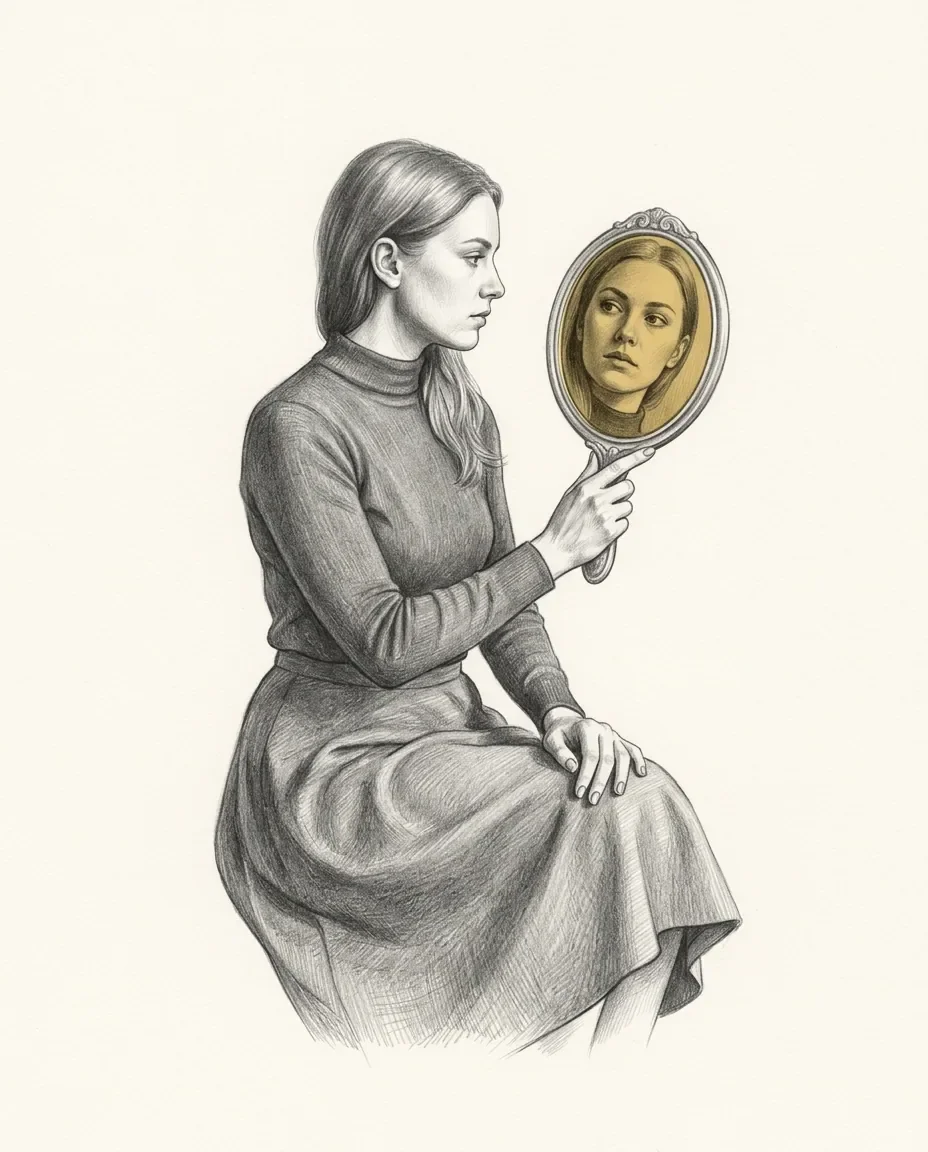
Mirror Fetish
Catoptrophilia
Added 21 Jun 2026 · Updated 7 Sep 2026
An interest in using mirrors during intimacy to observe oneself or a partner, finding the reflected view of bodies and activity arousing. It is a common, benign visual preference rather than a clinical condition.
- Prevalence
- Common
- Category
- Acts & Activities
- Clinical term
- Catoptrophilia
- Domain
- Sexual interest
- Confidence
- Low confidence
- Status
- Benign visual preference, not a recognized paraphilia or disorder.
- Also known as
- catoptrophilia, mirror interest, mirror play, self-watching, reflection arousal, self-observation, katoptronophilia
- Added
- 21 Jun 2026
- Updated
- 7 Sep 2026
Overview
Mirror interest, sometimes given the lay clinical-style label catoptrophilia, is a sexual preference for incorporating mirrors into intimacy so that one can watch oneself, a partner, or the whole encounter from an external vantage point. The appeal is visual and perspective-based: the reflection adds spectacle, novelty, feedback, and a way of seeing what is usually only felt. The label catoptrophilia (also spelled katoptronophilia) appears in popular fetish glossaries, but the interest is far too ordinary to warrant a diagnostic category. This article covers the long cultural history of the erotic mirror, how the interest is expressed, its psychology, and its prevalence.
Examples
What the term covers. A wardrobe or bedside mirror angled to catch the bed; a mirrored wall or ceiling; a hand mirror used deliberately during a particular moment; a full-length mirror used alone. What people report finding compelling varies: some want to see their own body and expressions, some want to watch a partner's face, and some want the whole encounter framed as an outside observer would see it. All of it happens live and leaves nothing behind, which is the feature that distinguishes it from most of its neighbours.
What the term does not cover. Voyeurism is arousal at watching other people, and exhibitionism at being watched by them; a mirror supplies neither an audience nor a stranger. Recording fetish and camming both create something durable or send it to someone else, which raises consent questions a mirror does not. Pictophilia is arousal that depends on erotic images, and couple watching involves other couples. Nor is it object sexuality: the mirror is a vantage point, not the object of desire. The self-directed pleasure some people describe is also not narcissism in the clinical sense, which names a personality pattern rather than a preference about where to look. Autosexuality is the case where the person in the mirror is the partner, arousal directed at oneself as the object; a mirror fetish keeps the partner and adds the reflection.
How the word is used. Everyday speech says "mirror kink" or "mirror play". The Greek-derived catoptrophilia, also written katoptronophilia, appears in lay A–Z listicles and paraphilia catalogues, attaches to no founding author or study, and is not a term any clinician uses. It appears in neither the DSM-5-TR nor the ICD-11, and the behaviour it names is far too ordinary to have attracted a diagnostic category.
History & origins
The mirror as an erotic object in art
The mirror itself is ancient: polished obsidian and bronze mirrors are documented from antiquity, and the silvered Venetian glass mirror of the Renaissance turned self-reflection into a domestic luxury. Long before any clinical vocabulary, the mirror carried erotic and moral symbolism in European painting. The most famous example is the Rokeby Venus by Diego Velázquez (c. 1647–1651), also titled The Toilet of Venus, Venus at her Mirror, or La Venus del espejo, in which a reclining nude gazes into a mirror held by Cupid. It belongs to a recurring "Venus at her toilet" tradition with earlier precedents in Titian's several Venus compositions and in Rubens's Venus at the Mirror (c. 1614–15): images that fused beauty, self-regard, vanity and desire in a single reflective surface.
The "Venus effect" and the psychology of reflections
Those paintings later lent their name to a perceptual finding directly relevant to mirror play. The Venus effect, described by Bertamini, Latto and Spooner (2003), is the common misjudgement that a figure looking into a mirror sees the same reflection the viewer sees. In fact, because the observer is not standing directly behind the figure, the two lines of sight differ. The effect shows how non-intuitive, and how compelling, the third-person, externalised view a mirror offers really is, which is part of what makes mirror play feel novel rather than redundant.
Clinical lineage and the term itself
Early sexology touched the underlying psychology only indirectly. In Studies in the Psychology of Sex, Havelock Ellis ranked the senses in human eroticism and treated vision as "the most important of all the senses from the human sexual point of view," folding visually driven arousal into the foundations of the field. The label catoptrophilia is a modern coinage built from Greek roots. It appears in lay taxonomies such as the list of paraphilias rather than in any foundational clinical text, and it is not attached to a single author or dated study. The precise coinage is not well documented, and the term is best understood as a descriptive name for a long-observed, everyday behaviour rather than a recognised disorder.
In practice
Mirror interest is typically expressed through bedroom or wardrobe mirrors, mirrored ceilings, or angled placement to capture a particular view. Some people are drawn to seeing their own body and expressions, others to watching a partner's responses, and some to the combined, third-person framing of the moment as an outside observer would see it. It frequently overlaps with broader visual arousal, with enjoyment of one's own appearance, and with consensual self-recording such as a recording fetish, and it is a common companion to solo masturbation.
Psychology
Psychologically the interest connects to the powerful role of vision in human arousal, to self-image and body confidence, and to a mild self-focused or observational element. For some it heightens presence and immediate visual feedback. For others it relates to pleasure in one's own appearance, or to the slightly dissociated thrill of seeing the encounter from the outside. It is generally learned and contextual, shaped by setting, mood and confidence, rather than a fixed or exclusive requirement for arousal.
Prevalence & culture
Mirror use is widely recognised in popular culture and adult media, giving it modest mainstream visibility, and it features routinely in lay "A–Z of kinks" listicles as a common, beginner-friendly interest. There is, however, very little dedicated academic study of it as a discrete category. Large fantasy surveys tend to fold it into general visual or self-observation arousal rather than counting it separately. Estimates therefore rely on proxies and broader visual-arousal data, so confidence is low.
Safety, consent & law
The interest is benign and involves consenting adults and ordinary household equipment, with no safety or legal concerns beyond mutual consent and basic privacy. One consent point is worth stating plainly: a reflected image must not be captured, recorded or shared without everyone's explicit agreement. The distinction between a private mirror and a recording is exactly the distinction between an in-the-moment view and a durable, shareable file.
Common questions
Is a mirror kink normal?
Yes, and it is one of the most common interests catalogued here. Vision does a great deal of the work in human arousal, and a mirror simply supplies a view that is otherwise unavailable. It requires nothing unusual, involves no risk, and appears routinely in beginner-facing lists of things couples try. There is no threshold at which liking it becomes a problem, unless arousal came to depend on it entirely and that troubled the person.
Is watching yourself during sex narcissistic?
No. Narcissism in the clinical sense describes a durable personality pattern involving grandiosity and a lack of empathy, and it has nothing to do with wanting to see what is happening in your own bedroom. People report all sorts of reasons for the appeal (visual feedback, body confidence, the novelty of an outside vantage), and self-regard is only one of them, and not the most common.
Is using a mirror the same as filming yourselves?
No, and the difference matters more than it might seem. A mirror produces a view that exists only in the moment and cannot be kept, forwarded or leaked. A recording produces a file, and a file has a life of its own. People who are entirely comfortable with the first are often not comfortable with the second, which is a coherent position rather than an inconsistency.
Does using a mirror need a partner's consent?
Yes, and asking is straightforward. The serious version of this question is about mirrors a partner does not know are there: a concealed mirror, a two-way mirror or one positioned so that someone else can see in. That is not a variation on the interest, it is observation without consent, and depending on the jurisdiction it can be a criminal offence. An agreed mirror in a shared bedroom raises none of these problems.
What if I do not like what I see in the mirror?
That is a common reaction and not a failing. A mirror during intimacy pulls attention toward appearance at a moment when most people would rather be attending to sensation, and for anyone with body-image difficulties that can be actively unpleasant. The preference is not universal and nobody needs to acquire it. Turning the mirror away, or leaving it out, costs nothing.
Is catoptrophilia a real paraphilia?
Not in any formal sense. The word was assembled from Greek roots for popular glossaries rather than coined in a clinical text, and no diagnostic manual lists it. Interest in mirrors is ordinary enough that treating it as a paraphilia would be a category error; the label mostly serves the internet's appetite for a Greek name for everything.
- Recording Fetish44/100Acts & ActivitiesAn interest in photographing or recording one's own consensual sexual activity, where capturing the moment and later viewing the imagery is itself arousing. It is benign when every adult depicted consents and the material is kept private.44
- Masturbation72/100Autoeroticism · Acts & ActivitiesAn interest in solo sexual activity and self-stimulation as a preferred or significant source of pleasure, distinct from partnered sex. Clinically called autoeroticism, it is a near-universal, benign aspect of human sexuality.72
- Bootblacking36/100Acts & ActivitiesThe ritual cleaning, conditioning, and shining of boots and leather gear as an act of service, with deep roots in the gay leather subculture. Bootblacking is both a genuine craft and an erotic exchange of attention, care, and authority.36
- Hotdogging36/100Coitus Interglutealis · Acts & ActivitiesA non-penetrative act in which the penis is moved along the cleft between a partner's buttocks. Catalogued as coitus interglutealis, it mimics the motion of anal sex without any penetration and is widely practised but sparsely documented.36
- Toejob34/100Acts & ActivitiesA non-penetrative sexual act in which the toes, rather than the soles or arches, stimulate a partner. It is the toe-focused form of the footjob and a common expression of foot interest, benign between consenting adults.34
- Lift and Carry (L&C)38/100Acts & ActivitiesAn erotic or playful interest in one person physically lifting and carrying another, or in being lifted and carried. It centres on strength, weight contrast, and the dynamic of being supported or overpowered.38
From Ancient Greek 'katoptron' (κάτοπτρον, 'mirror') + '-philia' (φιλία, 'love, affection'); literally 'love of mirrors'. A modern descriptive coinage rather than a term traceable to a single sexologist.
self-observation · visual arousal · consensual
Prevalence is computed from the entry's cited population estimate. Rows marked ESTare indicative editorial estimates scored against a fixed anchor rubric, not measured quantities. Method & anchors: methodology.
Common · ≈ 1 in 20
- 01List of paraphilias, Wikipediadefinition/existence of catoptrophilia (mirror/self-observation arousal)
- 02An A–Z of Kinks and Fetishes, Glamourlay framing of mirror play as a mainstream, common kink
- 03Google Trends, relative search interest (search-interest proxy)search-interest proxy indicating mirror play is a relatively popular mainstream interest
- 04Havelock Ellis, Studies in the Psychology of Sexhistorical sexology ranking vision as the most important sense in human eroticism, underpinning visually driven arousal
- 05Rokeby Venus, WikipediaVelázquez's c.1647–1651 'Venus at her Mirror' / 'The Toilet of Venus', a reclining figure gazing into a mirror held by Cupid, exemplifying the 'Venus at her toilet' tradition in European painting alongside earlier Titian and Rubens (c.1614–15) precedents
- 06Bertamini, Latto & Spooner (2003), 'The Venus effect: people's understanding of mirror reflections in paintings', Perceptionthe Venus effect, the common misjudgement that a figure in a mirror sees the same reflection the viewer sees, illustrating the non-intuitive third-person view a mirror offers