Tsundoku
Added 10 Jul 2026 · Updated 22 Aug 2026
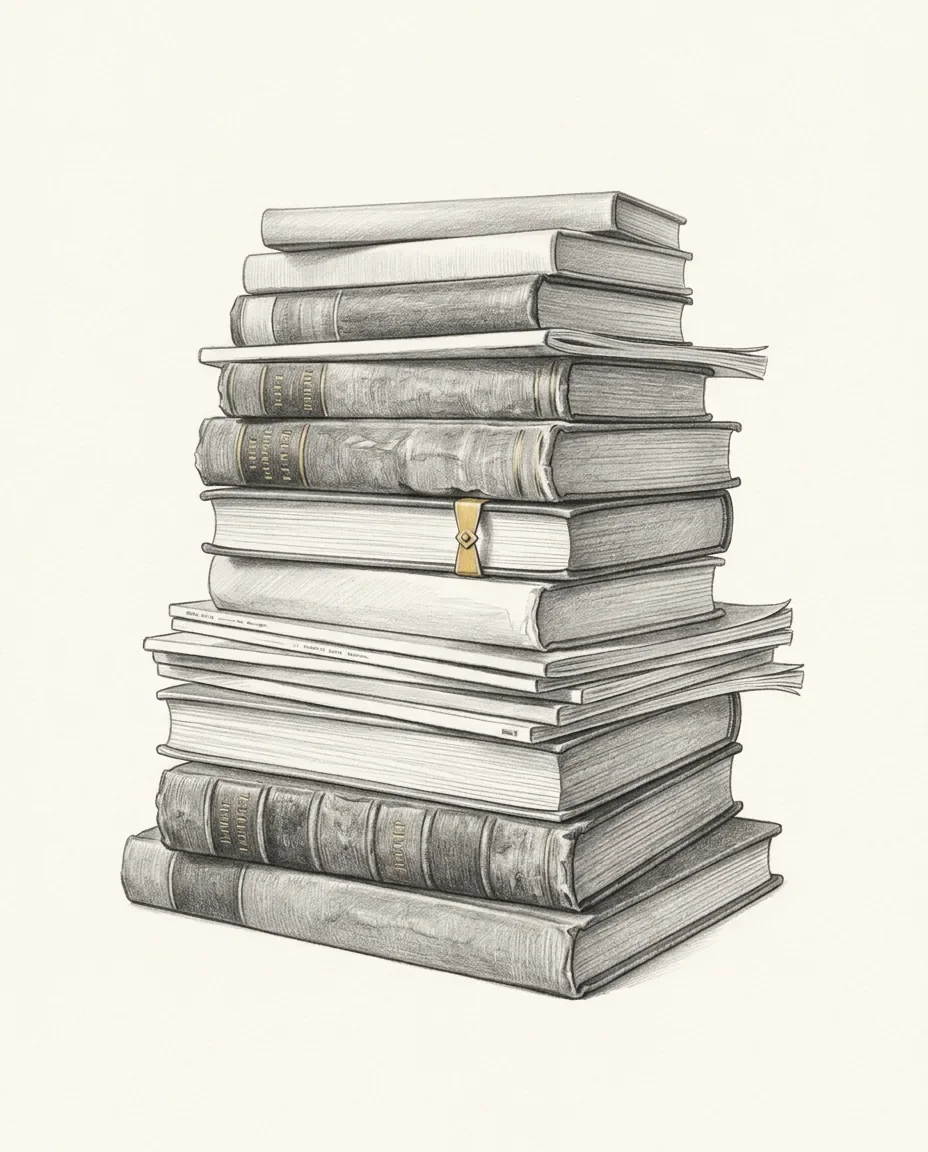
The Japanese habit of acquiring books and letting them pile up unread. It is an affectionate, non-pathological description of book-buying enthusiasm, not a disorder and not a sexual interest.
- Prevalence
- Very common
- Category
- Non-Sexual Fetishism
- Domain
- Non-sexual interest
- Confidence
- Medium confidence
- Status
- Not a clinical condition, disorder, or paraphilia. An affectionate everyday term for accumulating unread books; distinct from the recognised diagnosis of hoarding disorder.
- Also known as
- book hoarding, 積ん読, unread book piles, tsundoku
- Added
- 10 Jul 2026
- Updated
- 22 Aug 2026
Featured in
Overview
Tsundoku (Japanese: 積ん読) is the habit of buying or acquiring books and other reading material and letting them accumulate, unread, in the home. The word names a familiar and largely benign predicament of book lovers: the gap between the desire to read and the shelf space, time, and attention actually available. This entry documents tsundoku as a non-sexual, non-pathological cultural and behavioural phenomenon, an affectionate cousin of ordinary collecting rather than an erotic interest or a clinical condition. Unlike its heavier neighbours, it carries no built-in judgment: in Japanese it reads closer to "bookworm" than to "hoarder."
Definition & scope
Tsundoku describes the acquisition-outpaces-reading pattern specifically for books and reading material. It is defined by good intentions as much as by the pile: the books are bought to be read "later," and later keeps receding. This distinguishes it from bibliomania, the driven collecting of rare books and first editions as objects, where reading is often beside the point, and from compulsive hoarding, a recognised disorder marked by distress and functional impairment. Tsundoku, by contrast, is ordinarily untroubled and even fond.
Is tsundoku a bad thing?
No. The term is not pejorative. The essayist Nassim Nicholas Taleb, in his 2007 book The Black Swan, popularised a kindred idea, the antilibrary: a collection of unread books, associated with Umberto Eco's vast personal library, that is valuable precisely because it represents what you have yet to learn. Under that reading, a tsundoku pile is a map of curiosity rather than a failure of will.
Examples
The word is precise about a very ordinary situation, and most of the confusion around it comes from the heavier English words standing nearby.
What the term covers. The stack on the nightstand that has not moved in a year; three books bought at a festival and shelved unopened; a second copy acquired because the first was forgotten; the shelf mentally labelled someday; a reading list growing faster than the reading. The intention matters to the definition: the books were genuinely wanted and are genuinely meant to be read, which is what separates the pile from a heap of things nobody chose.
What the term does not cover. Bibliomania is the driven pursuit of books as objects (rarity, condition, completeness), where whether a volume is ever read is beside the point. Compulsive hoarding is a recognised disorder defined by distress and unusable living space, neither of which tsundoku implies. Ordinary collecting organises and completes sets, while a tsundoku pile has no set to complete and no arrangement to maintain. Compulsive buying concerns the act of purchase rather than the residue it leaves. And bibliophilia (plain love of books) is broader still, implying nothing at all about whether they get read.
How the word is used. A Japanese loanword written 積ん読 and pronounced roughly tsoon-doh-koo. In both languages the register is light and self-deprecating: it is used almost exclusively about oneself, as a confession offered with some pride, and calling someone else's shelves tsundoku is closer to teasing than to criticism. It is not a clinical term and appears in no diagnostic manual, whereas hoarding disorder does, which is the reason the two words should not be swapped.
History & origins
Etymology and coinage
Tsundoku is a compact and clever bit of wordplay. It fuses tsunde-oku (積んでおく, "to pile things up and leave them for later") with doku (読, "reading"), so that the reduced tsun(de) + doku also puns on tsunde + oku. The written form 積ん読 mirrors dokusho (読書, "reading books"), swapping the sense so that the books are stacked rather than read.
- Meiji era (1868-1912): The term arises as Japanese slang, when literacy and cheap print were expanding rapidly and personal book buying became common. The bibliographer Mori Senzo traced an early printed appearance to 1879, in the phrase tsundoku sensei (a teacher who owns many books but reads none), as noted in the Wikipedia account of the word. From the outset the joke was gentle, without malice.
- Twentieth century: Tsundoku settles into everyday Japanese as a self-mocking label for a common habit, never acquiring the clinical or shameful overtones of hoarding.
- 2010s: The word crosses into English through internet lists of "untranslatable" words and coverage by outlets such as the BBC and literary sites, becoming a beloved shorthand among readers worldwide for their own guilty stacks.
Cultural evolution
Once it entered English-language book culture, tsundoku became a badge worn with rueful pride. It appears in bookshop marketing, reading-community discussion, and essays defending the unread pile, including the Literary Hub reflection on learning to love book stacks. Earlier Western writers had already circled the same feeling: the American bibliophile A. Edward Newton wrote in 1921 about owning more books than he could ever read, and the poet Robert W. Service treated the theme in his verse "Book Lover."
Psychology
Tsundoku sits at the intersection of aspiration and acquisition. Buying a book is a small, cheap act of optimism, a bet on a future self with the time and appetite to read it, and the low cost per volume lets the intentions accumulate faster than the reading. Related tendencies include curiosity, identity signalling (a shelf as a portrait of the mind one wishes to have), and simple availability, since online stores make acquiring far easier than reading. None of this implies pathology; only when accumulation produces genuine distress, financial strain, or unusable living space does it shade toward compulsive buying or hoarding.
Prevalence & culture
There is no clinical prevalence figure for tsundoku, because it is not a clinical entity and is rarely surveyed formally. Informally it is close to universal among regular book buyers, and its wide adoption in English-speaking reading communities reflects how many people recognise themselves in it. Its cultural footprint is large relative to any measured incidence: a well-known word, but a light one.
Related interests
Tsundoku belongs to a family of non-erotic object and consumption behaviours catalogued here, from ordinary collecting to the heavier, distress-marked compulsive hoarding and the impulse-driven oniomania.
Common questions
How do you pronounce tsundoku?
Roughly tsoon-doh-koo, four even beats with no stressed syllable, the initial ts- pronounced as a single sound like the ending of “cats”. It is written 積ん読 in Japanese. English speakers commonly say tsun-DOH-koo with a stress the Japanese does not have, which is understood without difficulty.
Is tsundoku a real Japanese word or an internet invention?
It is a real and old one. The term arose as Meiji-era slang, and the bibliographer Mori Senzo traced an early printed appearance to 1879, in the phrase tsundoku sensei, a teacher who owns many books and reads none. What the internet added was its spread into English, roughly in the 2010s, through lists of supposedly untranslatable words.
What is the difference between tsundoku and bibliomania?
Tsundoku is about intention outrunning time: the books were bought to be read, and reading is still the point. Bibliomania is about acquisition itself (the hunt for rare editions, fine bindings and complete runs), where a book may be valued precisely as an object and never opened. One is a scheduling failure among readers; the other is a collector's compulsion.
Is tsundoku a form of hoarding?
No. Hoarding disorder is a recognised diagnosis defined by difficulty discarding possessions, marked distress, and living space that stops being usable. Tsundoku carries none of that: it is untroubled, often cheerful, and confined to a category of thing people are glad to own. It shades toward compulsive hoarding only if the accumulation itself starts producing real distress, financial strain or unusable rooms.
Does tsundoku include unread ebooks and audiobooks?
English usage has stretched to cover them, and the underlying pattern is identical: samples downloaded, titles bought in a sale, a queue growing faster than it empties. The original pun sits less comfortably there, since the verb at the root of the word means to pile things up and an unread ebook makes no pile. Nothing in the definition rules it out.
How many unread books count as tsundoku?
There is no threshold, and looking for one misreads the word. Tsundoku describes a relationship between buying and reading rather than a quantity: someone with twelve unread books whose stack keeps growing qualifies, while someone with two hundred who steadily works through them does not. It is a direction of travel, not an inventory count.
From the blog
- Collecting57/100Non-Sexual FetishismA strong, non-sexual drive to acquire, organize, and complete sets of objects: from stamps and coins to figures, records, and memorabilia. It is a widespread hobby and behavioral pattern, not a clinical disorder, and is distinct from hoarding.57
- Compulsive Hoarding57/100hoarding disorder · Non-Sexual FetishismA persistent difficulty discarding possessions, regardless of their value, that leads to clutter overwhelming living spaces and significant distress. It is a recognised mental-health condition and an object-attachment phenomenon, not a sexual interest.57
- Compulsive Shopping59/100compulsive buying-shopping disorder · Non-Sexual FetishismA persistent, hard-to-resist urge to shop and buy, marked by excessive purchasing that a person cannot control despite mounting debt, clutter, and distress. It is an impulse-control and behavioural-addiction phenomenon, not a sexual interest.59
- Limerence56/100Non-Sexual FetishismAn involuntary state of intense romantic infatuation centred on one person, marked by obsessive intrusive thoughts. It brings emotional dependency on that person's responses and an aching craving for reciprocation. It is an affective experience, not a fetish or a recognised disorder.56
- Topophilia56/100Non-Sexual FetishismTopophilia is the affective bond between a person and a place: the love of a landscape, home, or setting. Drawn from human geography rather than sexuality, it names a strong non-sexual attachment to physical environments.56
- Car Enthusiasm57/100Non-Sexual FetishismA strong, non-sexual fascination with automobiles, including their engineering, aesthetics, performance, history, and the culture surrounding them. It is a widespread hobby and identity rather than a clinical condition.57
"Tsundoku" (積ん読) blends "tsunde-oku" (積んでおく, to pile up and leave for later) with "doku" (読, reading), punning on "dokusho" (読書, reading books): literally piling-up-reading, i.e. stacking books rather than reading them. It arose as Meiji-era (1868-1912) Japanese slang, with an early printed use dated to 1879.
object attachment · collecting behaviour · cultural concept
Prevalence is computed from the entry's cited population estimate. Rows marked ESTare indicative editorial estimates scored against a fixed anchor rubric, not measured quantities. Method & anchors: methodology.
Very common · ≈ 1 in 7
- 01Tsundoku, Wikipediathe definition, etymology (tsunde-oku + doku, punning on dokusho), Meiji-era origin, Mori Senzo's dating of tsundoku sensei to 1879, the antilibrary comparison and Taleb/Eco reference, A. Edward Newton (1921) and Robert W. Service, and distinction from bibliomania
- 02The Pleasures of Tsundoku, Literary Hubthe cultural framing of tsundoku as an affectionate, non-pathological habit celebrated in reading communities