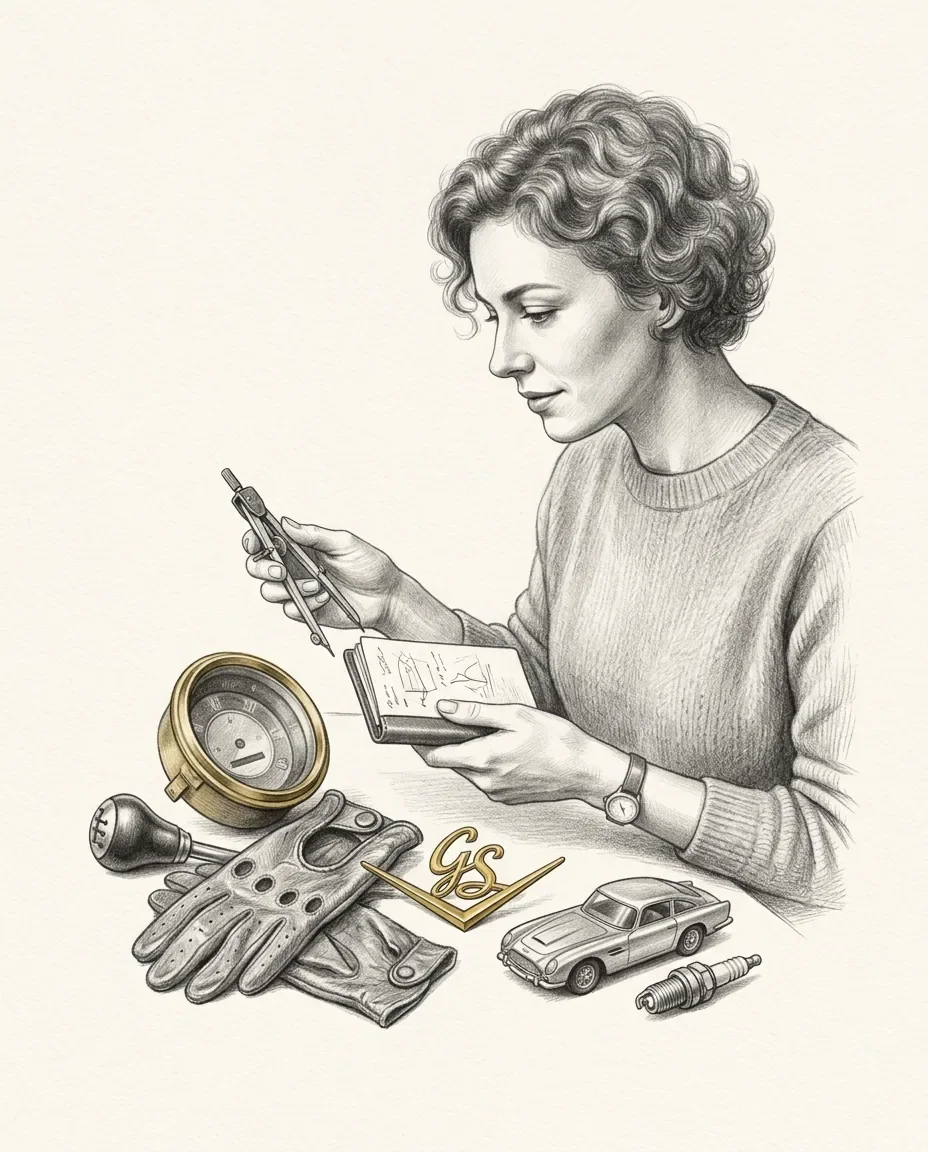
Car Enthusiasm
Added 21 Jun 2026 · Updated 22 Aug 2026
A strong, non-sexual fascination with automobiles, including their engineering, aesthetics, performance, history, and the culture surrounding them. It is a widespread hobby and identity rather than a clinical condition.
- Prevalence
- Very common
- Category
- Non-Sexual Fetishism
- Domain
- Non-sexual interest
- Confidence
- High confidence
- Status
- Not a paraphilia or disorder; a common non-sexual hobby and cultural identity.
- Also known as
- Automobile Obsession (Car Enthusiasm), car obsession, petrolhead, gearhead, car enthusiast, auto fanaticism, automobile obsession
- Added
- 21 Jun 2026
- Updated
- 22 Aug 2026
Featured in

Overview
Car enthusiasm is an intense, enduring, non-sexual fascination with automobiles as objects of engineering, design, and culture, its devotees widely known as "petrolheads" (British) or "gearheads" (American). It centres on the mechanics, sound, styling, performance, and heritage of vehicles, and on the emotional attachment people form to particular makes, models, or eras. It is a "fetish" only in the colloquial sense of a cherished object of devotion: a hobby and an identity, not an erotic paraphilia. This article traces how car fandom grew alongside the automobile, how enthusiasts express it, and why it sits entirely outside the clinical paraphilia framework.
Examples
The word describes a temperament more than a single activity, and it turns up in very different forms.
What the term covers. The owner who spends a decade returning a rusted shell to factory specification; the tuner chasing tenths of a second on a track day; the spectator who can name every winner of an endurance classic; the person who owns nothing and still knows an engine by its note; the die-cast and scale-model collector who never drives at all. Marque loyalty, era loyalty and a lasting attachment to one particular first car are all typical, and none of it requires a garage or even a licence.
What the term does not cover. It is not mechanophilia, the genuinely erotic attraction to vehicles and machines, which is a separate and far rarer interest. It is not the sensory affinity for new-car smell, nor the maker-directed devotion of brand worship or the broader idea of commodity fetishism. It overlaps with general collecting and with technology enthusiasm without being either, and it has obvious siblings in trainspotting and plane spotting: the same documentary, taxonomic pleasure aimed at a different machine.
How the word is used. Plain vernacular, and usually worn as a badge: people call themselves petrolheads and gearheads with pride, and "car nut" or "car guy" carry the same affectionate sense. Neither the interest nor its slang appears in the DSM-5-TR or ICD-11, because there is nothing clinical to record; the only reason the word "fetish" attaches to it at all is its everyday sense of a cherished object of devotion.
History & origins
Birth of the automobile and early motoring culture
Enthusiasm for the automobile is almost exactly as old as the automobile itself. The German engineer Karl Benz patented the Patent-Motorwagen on 29 January 1886, widely regarded as the first practical automobile, and Bertha Benz's 1888 long-distance drive from Mannheim to Pforzheim helped prove the machine's promise. Ownership broadened fast once the Ford Model T arrived in 1908 and Ford's moving assembly line (1913) drove down the price, turning driving into both a pastime and a sport.
Organised motoring culture took shape early, giving fans heroes, machines, and a shared calendar:
- 1890s: the first city-to-city races and the earliest automobile clubs.
- 1911: the inaugural Indianapolis 500, won by Marmon engineer Ray Harroun, who fitted what is often called the first rear-view mirror to run without a riding mechanic.
- 1923: the first 24 Hours of Le Mans, an endurance race conceived to prove the durability of cars ordinary buyers could own.
The post-war enthusiast identity
The decades after the Second World War cemented the modern enthusiast identity. Affordable cars, surplus military mechanical know-how, and a booming economy produced the American hot-rod and custom-car scenes, the muscle-car era, and parallel tuning cultures worldwide. Print magazines, and later television programmes and online video, built a vast popular media around cars, a development surveyed in the history of car culture. Motorsport's global television audience turned car fandom into a recognisable mainstream subculture rather than a niche pursuit.
Naming the fan
The label "petrolhead" is a 20th-century coinage: the Oxford English Dictionary records its earliest evidence from 1973, in the University of New South Wales student paper Tharunka, formed from British "petrol" plus the "-head" suffix denoting an obsessive enthusiast. British automotive media adopted it through the 1980s and 1990s, where it acquired its positive, identity-affirming sense; the American equivalent "gearhead" runs in parallel. Neither term carries any clinical or pathological derivation.
In practice
Car enthusiasm is expressed through a wide range of activities:
- Collecting: restoring and preserving classic or rare vehicles, an outgrowth of the broader hobby of collecting.
- Events: attending car shows, meets, auctions, and races.
- Modifying: tuning, building, or meticulously detailing cars.
- Following motorsport: and consuming automotive media.
- Community: participating in owners' clubs and online forums.
For many enthusiasts the car becomes part of personal identity and a primary social and recreational outlet.
Psychology
The appeal draws on mastery and technical curiosity, the sensory pleasure of sound and motion, nostalgia, status and self-expression, and the bonding that shared enthusiasm provides. Childhood exposure, family influence, and an early formative experience with a specific vehicle frequently seed a lifelong interest. As a non-sexual interest it sits entirely outside the paraphilia framework used in clinical sexology: the word "fetish" is borrowed here only in its everyday sense, and the interest involves no erotic component. A genuinely sexual attraction to vehicles, mechanophilia, is a separate and far rarer phenomenon and is not what "car enthusiasm" denotes.
Prevalence & culture
Car enthusiasm is one of the most visible and economically significant hobbies worldwide, sustaining large media, motorsport, aftermarket, and collector-vehicle industries. Sustained relative interest is reflected in Google Trends search data, and mainstream lay coverage such as Glamour's A–Z of kinks routinely distinguishes non-sexual enthusiast "obsessions" of this kind from sexual fetishes. Dedicated communities are large and global; because the interest is benign and unremarkable, it has attracted comparatively little dedicated psychological study.
Safety, consent & law
The interest is benign and legal. The only ordinary considerations are practical: illegal street racing, dangerous modifications, and excessive spending can cause real-world harm, so responsible enthusiasts confine performance driving to tracks and observe vehicle-safety and traffic laws.
Common questions
Is car enthusiasm a fetish?
Only in the everyday sense of a cherished object of devotion. Car enthusiasm has no erotic component whatever: the appeal is engineering, sound, design, history and community. A genuinely sexual attraction to vehicles and machinery does exist and is catalogued separately as mechanophilia, but it is a different and far rarer interest. Calling someone a car fetishist in casual speech means only that they are unusually devoted to cars.
Is being obsessed with cars a mental disorder?
No. It appears in no diagnostic manual and has attracted very little psychiatric study, because there is nothing to treat. An intense hobby becomes a clinical question only when the behaviour around it causes harm: unmanageable spending, neglected obligations, or acquisition of the compulsive kind seen in compulsive shopping. The enthusiasm itself is an ordinary and extremely widespread interest.
What is the difference between a car enthusiast and a car collector?
Scope and emphasis. A collector acquires and preserves vehicles as objects, which makes it a branch of collecting, with the same concerns for provenance, originality and condition. An enthusiast may own nothing at all and still follow motorsport, attend meets, argue about engines and know a marque's history in detail. Most serious collectors are enthusiasts; most enthusiasts are not collectors, usually for reasons of money and space.
Do you need to be good with mechanics to be a car enthusiast?
No, and many are not. The hobby divides roughly into people who build and maintain cars, people who drive them, and people who study and follow them. Restoration and tuning reward hands-on skill, but motorsport fandom, marque history, design appreciation and club life require none of it. The shared thread is sustained attention to the machine rather than the ability to rebuild one.
Why do people name their cars or get attached to them?
Naming a car and talking to it is ordinary anthropomorphism: the same attachment people form to any possession they use daily and depend on, amplified by the fact that a car has a face, a voice and a history of shared journeys. It becomes something categorically different only in object sexuality, where the bond is romantic or erotic. Affection for a machine is not that, and is entirely unremarkable.
When does car enthusiasm become a problem?
When the money or the driving starts doing damage. Restoration, modification and collecting absorb far more than most people intend. The more serious risk is behavioural: illegal street racing, and modifications that defeat safety systems or emissions equipment, are traffic and vehicle-safety offences in most jurisdictions and carry real consequences. Responsible enthusiasts keep performance driving to closed circuits and track days, where the same appetite is legal and vastly safer.
From the blog

- Collecting57/100Non-Sexual FetishismA strong, non-sexual drive to acquire, organize, and complete sets of objects: from stamps and coins to figures, records, and memorabilia. It is a widespread hobby and behavioral pattern, not a clinical disorder, and is distinct from hoarding.57
- New Car Smell36/100Non-Sexual FetishismA non-sexual fondness for the distinctive smell of new manufactured goods, most famously the interior of a new car. Freshly printed books, electronics, or packaging carry it too. It is a common, pleasurable sensory and nostalgic experience, not a clinical condition.36
- Tech Fetish50/100Non-Sexual FetishismA non-sexual fascination with gadgets, devices, and technology, marked by a drive to acquire, upgrade, and master the newest gear. Often called technophilia, its appeal lies in novelty, capability, and the identity of being an early adopter.50
- Car & Machine Fetish20/100Mechanophilia · Objects & MaterialsMechanophilia (mechaphilia) is a rare sexual or romantic attraction to machines, most often motor vehicles such as cars, motorcycles, or aircraft. A machine's form, sound, vibration or attributed personality is eroticized. It is distinct from ordinary car enthusiasm.20
- Compulsive Hoarding57/100hoarding disorder · Non-Sexual FetishismA persistent difficulty discarding possessions, regardless of their value, that leads to clutter overwhelming living spaces and significant distress. It is a recognised mental-health condition and an object-attachment phenomenon, not a sexual interest.57
- Misophonia57/100misophonia · Non-Sexual FetishismA sound-tolerance condition in which specific repetitive trigger sounds provoke disproportionate irritation, anxiety, disgust or anger. Chewing, breathing, sniffing and tapping are common triggers. It is a non-sexual sensory aversion, not an erotic interest.57
A plain-English descriptive label: "car" (from Latin "carrus," a wheeled wagon, via Old North French) plus "enthusiasm" (Greek "enthousiasmos," "possession by a god, inspiration"). The colloquial "petrolhead" and American "gearhead" arose in the later 20th century from automotive culture and carry no clinical derivation.
hobby · collecting · subculture
Prevalence is computed from the entry's cited population estimate. Rows marked ESTare indicative editorial estimates scored against a fixed anchor rubric, not measured quantities. Method & anchors: methodology.
Very common · ≈ 1 in 7
- 01Google Trends, relative search interest (search-interest proxy)sustained relative search interest in car/automobile enthusiast topics (search-interest proxy)
- 02An A–Z of Kinks and Fetishes, Glamourlay framing distinguishing non-sexual enthusiast obsessions from sexual fetishes
- 03Paraphilia, Wikipediadefinitional contrast establishing this as a non-paraphilic, non-sexual interest
- 04Car culture, Wikipediahistorical development of automobile enthusiasm, motorsport, and car subcultures since the early 20th century
- 05Benz Patent-Motorwagen, WikipediaKarl Benz's 1886 patent for the first practical automobile, the origin point of motoring and car fandom
- 06History of the automobile, Wikipediathe Ford Model T (1908) and the moving assembly line (1913) that democratised car ownership and broadened enthusiast culture
- 07petrolhead, n., Oxford English Dictionaryetymology and earliest dated evidence (1973, Tharunka, UNSW) of the term 'petrolhead' for a car enthusiast
- 081911 Indianapolis 500, Wikipediathe inaugural 1911 Indianapolis 500 won by Ray Harroun, an early milestone that gave car fandom heroes and a shared calendar
- 0924 Hours of Le Mans, Wikipediathe first 24 Hours of Le Mans (1923), an endurance race founded to prove the durability of consumer cars