Collecting
Added 21 Jun 2026 · Updated 22 Aug 2026
A strong, non-sexual drive to acquire, organize, and complete sets of objects: from stamps and coins to figures, records, and memorabilia. It is a widespread hobby and behavioral pattern, not a clinical disorder, and is distinct from hoarding.
- Prevalence
- Very common
- Category
- Non-Sexual Fetishism
- Domain
- Non-sexual interest
- Confidence
- High confidence
- Status
- Not a paraphilia; a common non-sexual hobby. Distinct from clinical hoarding disorder, which involves distress and impairment.
- Also known as
- Collecting (Object Acquisition & Completionism), collectomania, collector's drive, completionism, acquisitiveness, object acquisition, collecting mania
- Added
- 21 Jun 2026
- Updated
- 22 Aug 2026
Featured in
Overview
Collecting is the enduring, non-sexual drive to acquire, curate, and complete categories of objects valued for their rarity, history, craftsmanship, or personal meaning. Completionism is the closely related impulse to finish a defined set: a coin series, a line of figures, every issue of a publication. The word "fetish" applies here only in its everyday sense of a devoted, almost reverent attachment to objects, never as an erotic interest; this article covers collecting strictly as a hobby and behavioural pattern, and carefully separates it from the clinical condition of hoarding.
Examples
Almost any class of object will support a collection, and the hobby's vocabulary is unusually specialised.
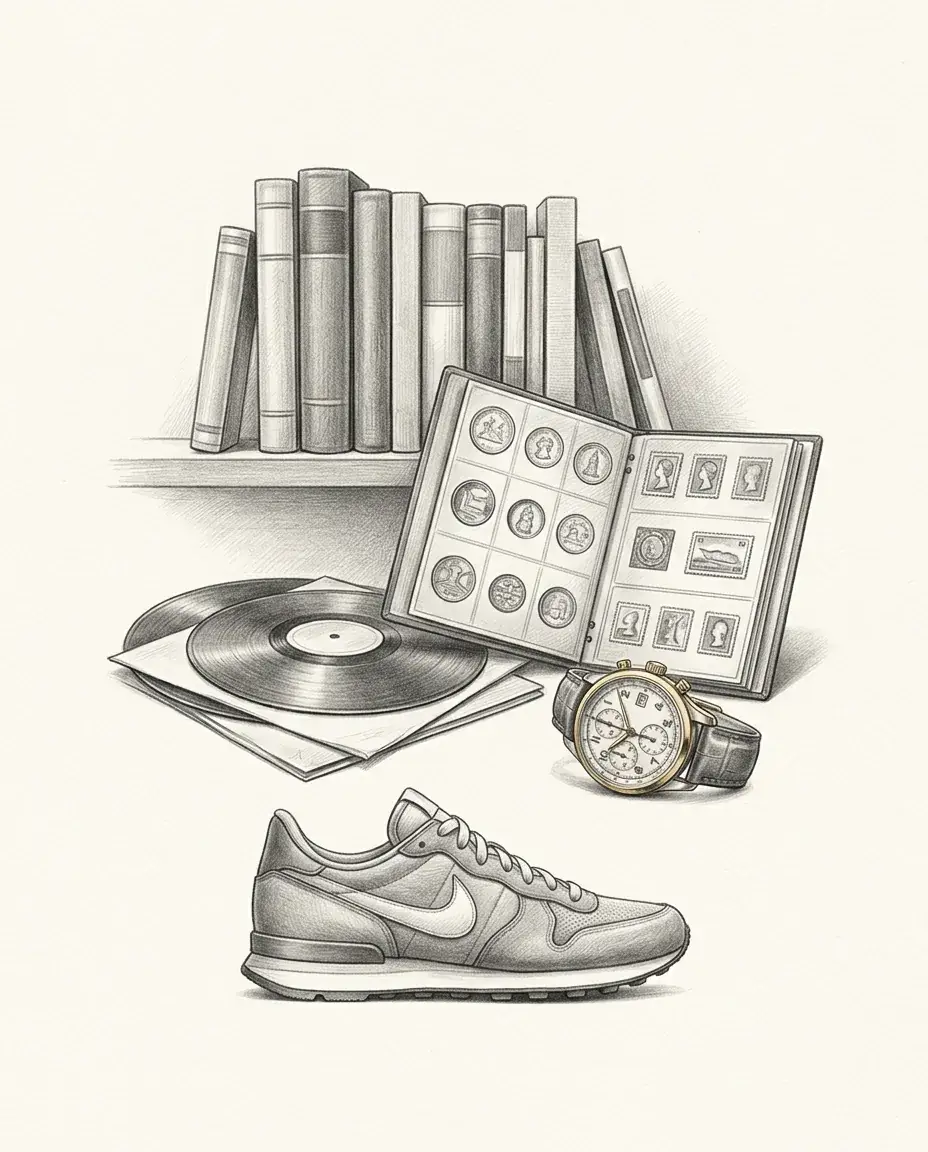
What the term covers. Stamps and coins, the two disciplines that gave collecting its catalogues and grading scales; postcards; books, whose extreme form is bibliomania and whose gentlest is tsundoku, the habit of buying faster than one can read; rocks and minerals; vinyl records; watches; knives; sneakers; antiques; preserved specimens; and whole vehicles, where it merges with car enthusiasm. Completionism is the same drive aimed at a bounded target: every issue, every variant, every year.
What the term does not cover. Ordinary collecting is not hoarding disorder; the difference is selectivity, order and distress, not volume. It is not compulsive shopping, where the buying is the point and the objects need bear no relation to one another. It is not brand worship or commodity fetishism, which attach meaning to the maker or the market rather than to a set. And it is emphatically not object sexuality, the rare romantic or erotic attraction to objects: a collector's love of a thing is aesthetic and proprietary, never sexual.
How the word is used. Plain English, and entirely neutral. "Collector" is a settled, respectable self-description, and the individual disciplines carry dignified names of their own: philately for stamps, numismatics for coins, deltiology for postcards. "Collectomania" and "collector's drive" are informal colour rather than diagnoses; no manual of medicine lists collecting at all, though the DSM-5 has listed hoarding disorder since 2013.
History & origins
The impulse to gather and keep meaningful objects is ancient, but the recognisably modern collection (assembled for knowledge, status, or pleasure rather than ritual or storage) has a traceable European lineage.
From treasuries to cabinets of curiosities
- 16th–17th centuries: The Renaissance Wunderkammer, or "cabinet of curiosities," gathered naturalia, antiquities, and exotica into ordered private rooms; the Danish scholar Ole Worm's Museum Wormianum (catalogued 1655) is a celebrated example. Per Wikipedia's history of collecting, such cabinets were "common among scholars with the means and opportunities to acquire unusual items from the 16th century onwards," and many later seeded today's public museums.
- 17th century: Distinctive personal collections appear: George Thomason amassed ephemeral pamphlets during the English Civil War, and the diarist Samuel Pepys built a famous library. The modern art and antiquities market took shape in Paris, Amsterdam, and London.
The 19th-century hobbyist boom
Industrial prosperity, cheap printing, and standardised goods turned collecting from an elite pursuit into a mass pastime.
- 1840: Britain issued the Penny Black, the world's first adhesive postage stamp, under Rowland Hill's postal reforms. Its arrival is widely credited with launching philately, stamp collecting, as a structured hobby.
- 1865: The first Stanley Gibbons price catalogue gave philatelists a shared reference for rarity and value, a template later mirrored by numismatics (coins), and by trading-card and record markets, with clubs, graded condition scales, and price guides.
Twentieth century to the online era
Mass production added toys, comics, trading cards, vinyl records, and brand memorabilia. From the late 1990s, online marketplaces and auction platforms globalised the trade, professionalised grading and authentication, and made once-local hunts worldwide.
Scholarly understanding
Collecting has been studied chiefly by consumer psychologists and cultural theorists, not psychiatrists. Carl Jung speculated that its appeal echoes ancestral hunting and gathering. The psychoanalyst Werner Muensterberger's Collecting: An Unruly Passion (1994) offered an early in-depth psychological treatment, framing the urge as a search for relief from anxiety. Russell Belk's Collecting in a Consumer Society (1995) analysed it as a form of material consumption bound up with identity. Crucially, every modern account distinguishes ordinary collecting from the clinical hoarding disorder recognised as a distinct diagnosis only in the DSM-5 (2013).
In practice, how the interest is typically expressed
Collecting is expressed through searching, trading, cataloguing, displaying, and maintaining a body of objects, and through participation in fairs, auctions, specialist dealers, and dedicated online communities. Collectors typically develop deep domain expertise, prize provenance and condition, and often value the ritual of the hunt (the discovery, the negotiation, the "chase" for a missing piece) as much as the items themselves. Completionists in particular organise their effort around finishing a bounded set.
Psychology, proposed mechanisms and appeal
The drive is usually explained through several overlapping mechanisms rather than one. Acquisition and mastery deliver pleasure; order and completeness satisfy a desire for control; and nostalgia, memory, and personal identity anchor a collection to the self, the central theme of Belk's work. Reward-anticipation and goal-completion processes help account for the sustained, sometimes intense motivation: the dopamine "hit" of the find. Muensterberger emphasised affect regulation, viewing collecting as soothing anxiety. The evidence base is largely qualitative and theoretical; collecting is not a clinical category, so claims about underlying mechanisms remain interpretive rather than experimentally settled.
Prevalence & culture
Collecting is among the most common hobbies worldwide and is highly visible across markets for art, antiques, stamps, coins, trading cards, toys, comics, and records. Because it is a benign hobby rather than a sexual interest, it is not measured by the paraphilia surveys (Scorolli, Joyal) that quantify other entries in this directory; its prevalence is inferred from market scale, club membership, and search interest rather than clinical study. Communities are large, well organised, and long-lived, spanning national philatelic and numismatic societies, hobby forums, and platforms such as eBay and Discogs.
Safety, consent & law
The interest is benign and legal; it involves no consent or harm dimension. It becomes a concern only when it shades into compulsive over-acquisition that causes financial strain, or into the clutter and distress of hoarding disorder: a separate clinical condition defined by persistent difficulty discarding possessions and significant impairment. Ordinary, well-managed collecting, however passionate, is not a disorder.
The two are routinely confused but differ across every axis:
| Feature | Collecting | Hoarding disorder |
|---|---|---|
| Objects | Selective, themed, valued for rarity or meaning | Indiscriminate, often low-value or duplicated |
| Organisation | Catalogued, curated, displayed | Cluttered, spaces made unusable |
| Emotional tone | Pleasure, pride, mastery | Distress, shame, functional impairment |
| Clinical status | A hobby, not a diagnosis | A DSM-5 diagnosis since 2013 |
Variations & related interests
Collecting overlaps with focused enthusiast hobbies such as car enthusiasm, where domain expertise, acquisition, and community converge on a single class of valued objects.
Common questions
When does collecting become hoarding?
At the point where the objects stop being chosen and start merely being kept. The clinical test is not how much there is but what it does: hoarding disorder involves persistent difficulty discarding regardless of value, clutter that makes rooms unusable for their intended purpose, and genuine distress or impairment. A vast, catalogued, displayed collection its owner enjoys and could part with is a hobby, however alarming it looks to a visitor.
What are stamp and coin collecting properly called?
Philately and numismatics respectively. Most established fields carry a formal name of this kind (deltiology for postcards, for instance), and the terminology is not affectation: these are the areas with published catalogues, agreed condition grading and dealer networks, which is what lets collectors in different countries describe the same object in the same terms. Stamps and coins remain the model the rest follow.
Are collections actually worth anything?
Some are, most are worth rather less than their owners hope, and none is worth anything until somebody buys it. Value in the established fields turns on rarity, condition and provenance, which is exactly why price catalogues and grading services exist. But a collection is an illiquid asset in a market that has to still be there when you sell, and tastes move. Assembling one for pleasure is reliable; assembling one as an investment is speculation.
Can you ever finish a collection?
It depends whether the set is bounded. Completionists deliberately choose finite targets (one country's issues for a given reign, a numbered series, every variant of a single model) precisely because those can be finished. Open-ended collecting has no finish line by design, and many collectors treat the last missing piece as something to pursue rather than to obtain, because the hunt is a large part of the pleasure.
Is collecting the same as a shopping addiction?
No. Compulsive shopping is defined by the buying: relief comes from the transaction, and what is bought is often incidental and sometimes never used. Collecting is defined by the objects and the set they belong to, and involves study, cataloguing, waiting and long stretches of buying nothing. The two can coexist, since a collector can shop compulsively within a collecting field, but they are separate behaviours with different drivers.
Is collecting a fetish?
Not in any clinical sense. The word is used here only in its everyday meaning of a devoted, almost reverent attachment to objects. Collecting has no erotic component, is not a paraphilia, and is never assessed as one. A genuinely sexual or romantic attraction to inanimate objects does exist and is documented as object sexuality, but it has nothing to do with the hobby.
From the blog
- Car Enthusiasm57/100Non-Sexual FetishismA strong, non-sexual fascination with automobiles, including their engineering, aesthetics, performance, history, and the culture surrounding them. It is a widespread hobby and identity rather than a clinical condition.57
- Compulsive Hoarding57/100hoarding disorder · Non-Sexual FetishismA persistent difficulty discarding possessions, regardless of their value, that leads to clutter overwhelming living spaces and significant distress. It is a recognised mental-health condition and an object-attachment phenomenon, not a sexual interest.57
- Tsundoku56/100Non-Sexual FetishismThe Japanese habit of acquiring books and letting them pile up unread. It is an affectionate, non-pathological description of book-buying enthusiasm, not a disorder and not a sexual interest.56
- Antiquing53/100Non-Sexual FetishismA non-sexual hobby of shopping for, sourcing, identifying, and collecting antiques: old furniture, decorative objects, and everyday artifacts. They are valued for age, craftsmanship, and history. It centers on the hunt, connoisseurship, and the tactile appeal of aged material.53
- Rockhounding42/100Non-Sexual FetishismA non-sexual hobby of searching for, collecting, and studying rocks, minerals, gemstones, and fossils gathered from the natural environment. Cutting and polishing, known as lapidary work, often follows. It centers on outdoor discovery, identification, and the aesthetics of stone.42
- Compulsive Shopping59/100compulsive buying-shopping disorder · Non-Sexual FetishismA persistent, hard-to-resist urge to shop and buy, marked by excessive purchasing that a person cannot control despite mounting debt, clutter, and distress. It is an impulse-control and behavioural-addiction phenomenon, not a sexual interest.59
From the Latin *colligere*, "to gather together" (com- "together" + legere "to gather, pick out"), via the noun *collectio*; "collecting" as a named hobbyist pursuit is plain English with no specialist coinage.
hobby · consumer culture · behavioral
Prevalence is computed from the entry's cited population estimate. Rows marked ESTare indicative editorial estimates scored against a fixed anchor rubric, not measured quantities. Method & anchors: methodology.
Very common · ≈ 1 in 7
- 01Google Trends, relative search interest (search-interest proxy)search-interest proxy for collecting hobbies (cards, figures, stamps, etc.) confirming widespread non-sexual prevalence
- 02Paraphilia, Wikipediadefinition/boundary that ordinary collecting is a non-sexual hobby, not a paraphilia
- 03Collecting, Wikipediahistory of collecting from 16th-century cabinets of curiosities (Wunderkammer, Ole Worm) through Thomason and Pepys to modern hobbyist collecting; the 1865 Stanley Gibbons catalogue; Jung's hunting-and-gathering speculation; distinction from hoarding
- 04Penny Black, Wikipediathe world's first adhesive postage stamp, issued in Britain in 1840 under Rowland Hill's postal reforms, credited with launching philately as a structured hobby
- 05Werner Muensterberger, Collecting: An Unruly Passion: Psychological Perspectives (Princeton University Press, 1994), Internet Archiveearly in-depth psychoanalytic treatment of collecting, framing the urge as relief from anxiety and helplessness
- 06Russell W. Belk, Collecting in a Consumer Society (Routledge, 1995)analysis of collecting as material consumption bound up with personal identity in consumer culture
- 07DSM-5 / DSM-5-TR (American Psychiatric Association)hoarding disorder recognised as a distinct diagnosis in DSM-5 (2013), separating clinical hoarding from ordinary collecting