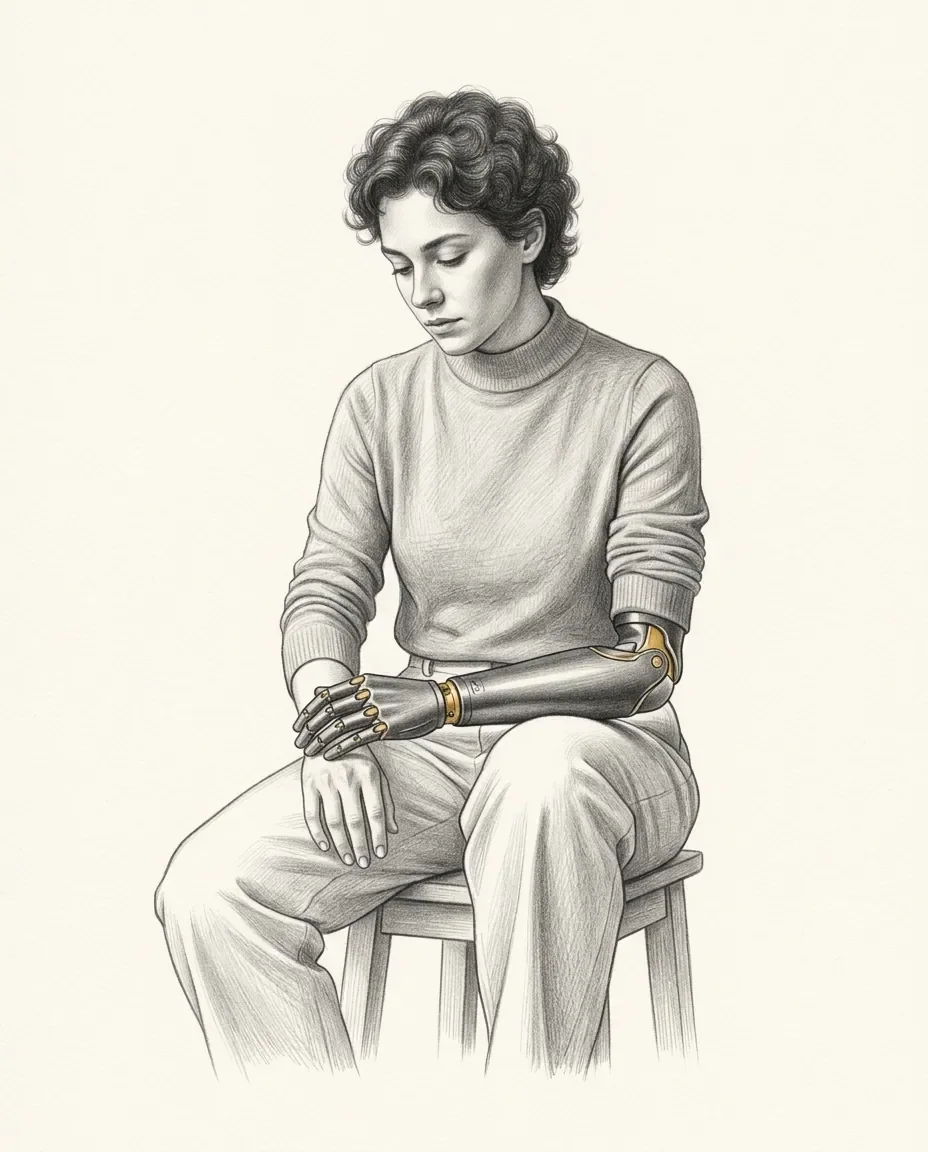
Body Integrity Dysphoria
Body integrity dysphoria
Added 26 Jul 2026 · Updated 22 Aug 2026
A clinical condition, coded 6C21 in the ICD-11, in which a healthy limb or bodily function is felt not to belong to one's true body. The sense is persistent and distressing, and brings a lasting wish to become disabled to match it. It is a distress condition, not a kink, though it borders the paraphilia apotemnophilia.
- Prevalence
- Very rare
- Category
- Identity & Transformation
- Clinical term
- Body integrity dysphoria
- Domain
- Non-sexual interest
- Confidence
- Low confidence
- Status
- Recognized as a standalone diagnosis in the ICD-11 (6C21, 'disorders of bodily distress or bodily experience') since its 2018 stable release; absent from the DSM-5-TR and the ICD-10. Treated as a distress and identity condition, distinct from a paraphilia, though the two can coexist.
- Also known as
- BID, body integrity identity disorder, BIID, xenomelia, amputee identity disorder
- Added
- 26 Jul 2026
- Updated
- 22 Aug 2026
Overview
Body integrity dysphoria (BID) is a persistent, distressing mismatch between a person's felt sense of their own body and its actual physical form: most often an enduring conviction that a specific, otherwise healthy limb is not truly part of the self, paired with a lasting wish to become an amputee, paraplegic, blind, or otherwise disabled in that specific way. The World Health Organization added it to the ICD-11 in 2018 as a standalone diagnosis, code 6C21, under "disorders of bodily distress or bodily experience." This article is a clinical overview, not a discussion of methods; it treats BID as a genuine distress condition rather than a kink, while tracing how it overlaps with, and differs from, the erotic paraphilia apotemnophilia.
Definition & scope
The ICD-11 defines BID as "an intense and persistent desire to become physically disabled in a significant way," with onset by early adolescence, accompanied by ongoing discomfort or a felt sense of wrongness about one's non-disabled body, and either functional impairment from the preoccupation or dangerous attempts at self-inflicted disability, according to the criteria summarized by findacode.com's ICD-11 reference. Crucially, the diagnosis excludes presentations better explained by another mental or medical disorder, or by malingering, and is coded separately from gender incongruence.
Relationship to apotemnophilia and acrotomophilia
BID and apotemnophilia describe overlapping but distinct territory. Apotemnophilia names the paraphilic, erotically-charged version of the desire for self-amputation; BID names the identity- and distress-based version, whether or not any erotic component is present. First's 2005 sample showed the two frequently coexist in the same person, which is why clinical writing increasingly separates the bodily-identity dimension (handled as BID) from any paraphilic dimension, rather than picking one label for the whole picture. Both are conceptually distinct again from acrotomophilia, sexual attraction to other people who are amputees, which points outward at a partner rather than at one's own body; the inward-facing desire is what both apotemnophilia and amputation fetish describe. Abasiophilia points outward in the same way, at people who use braces, casts or mobility aids, and outward-facing interests of that kind sometimes intersect with the clinical atmosphere sought in medical-setting kink. BID itself carries no erotic requirement at all.
Examples
What the diagnosis covers. A persistent sense that a specific, healthy part of the body is not truly one's own, together with a lasting wish to bring the body into line with the shape that is felt to be right. Most documented cases concern a single limb at a single level, usually a leg, with a left-side bias noted across several case series, although the ICD-11 wording is broader and a desire to become paraplegic or blind meets the same criteria. Onset is by early adolescence. "Pretending" is characteristic: using crutches, a wheelchair or bindings to simulate the desired state, in some accounts for years.
What it does not cover. Where the desire is erotically driven, the reading is paraphilic rather than dysphoric and is catalogued as apotemnophilia or amputation fetish; First's 2005 series found the two frequently coexist in one person without reducing to each other. Interests directed at other people's bodies are different again, including acrotomophilia and abasiophilia, as is the clinical atmosphere sought in medical-setting kink. BID is not body dysmorphic disorder, in which the complaint concerns how a part looks rather than whether it belongs; the ICD-11 codes it separately from gender incongruence; and it is not a delusion, since the person knows the limb is anatomically theirs.
How the term is used. Clinically, and recently. Body integrity dysphoria is the ICD-11 name, entered as code 6C21 at the 2018 stable release, and it displaced Michael First's 2005 body integrity identity disorder (BIID), which had in turn displaced John Money's purely paraphilic framing. Neuroscientists writing about the same phenomenon often prefer xenomelia, "foreign limb". The DSM-5-TR carries no equivalent entry, and the older BIID is still widely used in journalism and community writing.
History & origins
From a sexual paraphilia to an identity condition
The modern clinical story begins with the sexologist John Money, who in 1977, with Russell Jobaris and Gregg Furth, coined apotemnophilia for a desire for self-amputation he framed as erotic. For nearly three decades the wish to become an amputee was described almost exclusively in that paraphilic vocabulary. That changed with psychiatrist Michael First's 2005 study in Psychological Medicine, Desire for amputation of a limb: paraphilia, psychosis, or a new type of identity disorder, a structured-interview survey of 52 people who wanted a limb removed. First found the desire was, for many respondents, tied not to sexual arousal but to a felt discrepancy between body and self-image, most often targeting a leg on the left side, and proposed the label body integrity identity disorder (BIID), deliberately echoing "gender identity disorder" to recast the condition as a disturbance of identity rather than of desire.
A parallel neurological account
A second explanatory thread emerged from neuroscience. Researchers including V. S. Ramachandran and Paul McGeoch proposed that the affected limb is simply under-represented in the brain's internal body map, centred on the right superior parietal lobule, so that it never feels claimed as part of the self. In 2011, McGeoch and colleagues coined the term xenomelia ("foreign limb") in the Journal of Neurology, Neurosurgery & Psychiatry to describe this as a parietal-lobe syndrome, deliberately framing it as neurological rather than psychiatric. Today the psychiatric-identity and neurological accounts are treated as complementary rather than competing.
Formal recognition
The non-erotic, identity- and distress-driven presentation was formally recognized by the World Health Organization when the ICD-11 reached its stable release in 2018, entering as body integrity dysphoria (6C21). It has never appeared in the DSM-5-TR or the ICD-10, and one 2024 case report from England described the shift bluntly: "a once misunderstood and misdiagnosed disorder, body integrity dysphoria has been appreciated by the ICD-11 as a separate entity" (Athar, Johnstone and Udegbe, 2024).
In practice
Onset is typically reported in childhood or early adolescence, sometimes traced to early contact with an amputee, and the desire commonly targets a specific limb, most often a leg, with a left-side bias noted across several case series. People with BID often describe "pretending," using crutches, wheelchairs, or bindings to simulate the desired disability, sometimes for years, alongside chronic distress, depression, and anxiety tied to living in a body they experience as wrong. A 2024 English case report described a lifelong desire for amputation from pre-school age, escalating over decades to genuinely dangerous self-harm attempts and significant psychiatric comorbidity, illustrating how severe the functional impact can become (Athar, Johnstone and Udegbe, 2024). Treatment approaches described in the literature include SSRIs for co-occurring depression and anxiety, psychotherapy focused on risk reduction rather than eliminating the desire outright, and management of common comorbidities; elective surgical amputation of a healthy limb is not standard medical care and is rarely, if ever, offered.
Psychology
Two explanatory frames coexist, and current writing treats them as complementary rather than rival. The psychiatric-identity account, which the ICD-11 listing follows, reads BID as a mismatch between the body a person has and the body they experience as theirs, closer in structure to a dysphoria than to a desire. The neurological account, set out by McGeoch and colleagues in 2011, locates the mismatch in the right superior parietal lobule: the affected limb is under-activated in the brain's body map, so it can be felt when touched yet never registers as incorporated into the self. That the desire so often targets one specific limb, with a documented left-side bias, is the observation both frames have to account for.
What neither frame supports is reading BID as a preference. Onset is typically in childhood or early adolescence, the desire is stable over decades, and First's 2005 series found it coexisting with, but not reducible to, any erotic component. The distress reported is characteristically about the body's wrongness rather than about anything the person wants to do.
Prevalence & culture
BID is very rare and almost entirely documented through small clinical case series rather than population surveys; researchers studying it consistently note that most affected people never come to the attention of health services, given the shame and stigma involved, so true prevalence is unknown and likely underestimated. Cultural visibility is limited to documentary and case-report coverage rather than everyday awareness, and dedicated research remains a small, specialist literature that has grown steadily only since First's 2005 study and the 2018 ICD-11 listing gave the condition a stable clinical name.
Safety, consent & law
The central concern is serious, sometimes life-threatening self-harm risk: people with intense, treatment-resistant BID have attempted to injure or destroy a healthy limb by dangerous means in hopes of forcing amputation. Because elective removal of healthy tissue sits outside standard surgical ethics, responsible clinical care emphasizes compassionate assessment, harm reduction, and treatment of co-occurring conditions rather than facilitation. This entry is descriptive only; anyone experiencing these urges or related distress should seek qualified mental-health support.
Common questions
Is body integrity dysphoria a real diagnosis?
Yes. The World Health Organization added it to the ICD-11 as a standalone diagnosis, code 6C21, under "disorders of bodily distress or bodily experience", effective with the 2018 stable release. It has never appeared in the DSM-5-TR or the ICD-10, so a clinician working from the American manual has no equivalent code to reach for. That split is the main reason recognition of the condition still varies between health systems.
Is body integrity dysphoria the same as wanting to be an amputee for sexual reasons?
No, though the two overlap. The erotically driven desire is the paraphilic reading, named apotemnophilia by John Money in 1977. BID names the identity- and distress-based version, whether or not any erotic element is present. First's 2005 structured-interview study of 52 people found the desire was, for many, tied to a felt discrepancy between body and self-image rather than to arousal, which is precisely why he proposed a separate identity-based label.
What is xenomelia?
It is the neurological name for the same phenomenon, coined by McGeoch and colleagues in 2011 in the Journal of Neurology, Neurosurgery & Psychiatry. It means "foreign limb" and frames the condition as a right parietal lobe syndrome: the affected limb is under-represented in the brain's internal body map, centred on the right superior parietal lobule, so it can be felt when touched yet never registers as part of the self.
What causes body integrity dysphoria?
Two accounts coexist and are now treated as complementary rather than rival. The psychiatric-identity account, which the ICD-11 listing follows, reads it as a mismatch between the body a person has and the body they experience as theirs. The neurological account locates that mismatch in the brain's body map. Both have to explain the same striking observation: that the desire so often targets one specific limb at one specific level, with a documented left-side bias.
Do surgeons ever amputate a healthy limb to treat it?
Elective amputation of a healthy limb is not standard medical care and is rarely, if ever, offered, because removing healthy tissue sits outside ordinary surgical ethics. What the literature describes instead is compassionate assessment, harm reduction, psychotherapy aimed at reducing risk rather than at eliminating the desire outright, and treatment of co-occurring depression and anxiety, with SSRIs where indicated. Anyone experiencing these urges should seek qualified mental-health support.
How common is body integrity dysphoria?
Nobody knows. It is very rare and is documented almost entirely through small clinical case series rather than population surveys, and researchers consistently note that most affected people never come to the attention of health services at all, given the shame and stigma involved. True prevalence is therefore unknown and probably underestimated. The specialist literature has only grown steadily since First's 2005 study and the 2018 ICD-11 listing gave the condition a stable name.
Is body integrity dysphoria similar to gender dysphoria?
The resemblance is structural, and the classification is separate. Michael First coined "body integrity identity disorder" in 2005 deliberately echoing "gender identity disorder" to recast the condition as one of identity rather than desire, and the ICD-11 name kept the dysphoria framing. But the ICD-11 explicitly codes BID apart from gender incongruence, they are different diagnoses with different literatures, and BID has no established affirming care pathway.
- Desire to Be an Amputee21/100Apotemnophilia · Clinical ParaphiliasApotemnophilia is a rare condition in which a person desires to become an amputee, experiencing the absence of a specific limb as arousing. It may equally be felt as essential to their true body image. It overlaps closely with body integrity dysphoria, in which a healthy limb is felt as not belonging to the self.21
- Amputation Fetish12/100Apotemnophilia · Clinical ParaphiliasApotemnophilia is a rare interest in which the desire to be, or to become, an amputee is felt as arousing, or as necessary to one's true body image. It overlaps closely with body integrity dysphoria, recognised in ICD-11, and carries serious self-harm risk.12
- Abasiophilia (Braces & Mobility Aids)13/100Abasiophilia · Clinical ParaphiliasAbasiophilia is a paraphilic attraction to people who use orthopaedic braces, casts, calipers, or mobility aids such as wheelchairs. The impaired gait that goes with them is part of the attraction. It is one named branch of devoteeism, the broader erotic interest in physical disability.13
- Medical Setting Kink50/100Settings & SituationsAn erotic interest in the imagery, props, and atmosphere of medical or clinical settings, enacted consensually between adults. Examination rooms, white coats, instruments, and the doctor-patient dynamic are typical. Arousal comes from the setting's blend of authority, vulnerability, care, and ritual.50
- Clinical Lycanthropy6/100Clinical lycanthropy · Identity & TransformationA rare psychiatric syndrome defined by the delusional belief that one is transforming, has transformed, or can transform into a non-human animal. It is not a kink or a sexual interest; it is a symptom of psychosis, most often schizophrenia, bipolar disorder or severe depression.6
- Ghost Fetish13/100Spectrophilia · Identity & TransformationGhost fetish, clinically spectrophilia, is an erotic or romantic attraction to ghosts, spirits, or the idea of intimacy with the supernatural. It is a fantasy-only interest, expressed through imagination, folklore, and themed media rather than any real-world act.13
"Body integrity" describes the felt wholeness and completeness of one's own body; "dysphoria" derives from Greek dysphoria, "hard to bear, distress," the antonym of euphoria. The compound term was adopted by the ICD-11 in 2018 to replace the earlier, more contested label "body integrity identity disorder," coined by Michael First in 2005 on the model of "gender identity disorder."
body image · clinical distress condition · ICD-11 diagnosis · identity
Prevalence is computed from the entry's cited population estimate. Rows marked ESTare indicative editorial estimates scored against a fixed anchor rubric, not measured quantities. Method & anchors: methodology.
Very rare · fewer than 1 in 10,000
- 01Body integrity dysphoria, Wikipediadefinition, John Money/First/Ramachandran-McGeoch historical lineage, ICD-11 recognition in 2018, and the neurological body-map account
- 02First (2005), Desire for amputation of a limb: paraphilia, psychosis, or a new type of identity disorder, Psychological Medicine 35(6):919-9282005 study of 52 subjects, the BIID label, left-limb/leg targeting pattern, and separation of identity-driven cases from a purely paraphilic account
- 036C21 Body integrity dysphoria, ICD-11 MMS reference (findacode.com)exact ICD-11 6C21 diagnostic wording: onset by early adolescence, functional impairment or dangerous self-disabling attempts, and the exclusion from gender incongruence
- 04Athar, Johnstone and Udegbe (2024), The Emotional and Ethical Dilemmas of Body Integrity Dysphoria: A Case Report From England, Cureus (9 October 2024)clinical presentation, self-harm risk, comorbidities, treatment approaches, and the note that BID often escapes healthcare attention, keeping true prevalence unknown
- 05McGeoch et al. (2011), Xenomelia: a new right parietal lobe syndrome, J Neurol Neurosurg Psychiatry 82(12):1314-13192011 coinage of 'xenomelia' and the right superior parietal lobule / body-map neurological account of the desire to become disabled
- 06ICD-11, World Health Organizationofficial classification source for the 2018 stable-release listing of body integrity dysphoria as 6C21