Medical Setting Kink
Added 21 Jun 2026 · Updated 22 Aug 2026
An erotic interest in the imagery, props, and atmosphere of medical or clinical settings, enacted consensually between adults. Examination rooms, white coats, instruments, and the doctor-patient dynamic are typical. Arousal comes from the setting's blend of authority, vulnerability, care, and ritual.
- Prevalence
- Common
- Category
- Settings & Situations
- Domain
- Sexual interest
- Confidence
- Low confidence
- Status
- Not a paraphilia or disorder; a common consensual role-play and setting interest.
- Also known as
- Medical / clinical scenario interest, medical play, doctor-patient role-play setting, clinical setting kink, examination scenario, clinical scenario interest, vaccinophilia
- Added
- 21 Jun 2026
- Updated
- 22 Aug 2026
Featured in

Collection
Roleplay & Scenario Fantasies
Stepping into a role (teacher, doctor, stranger), and the costumes and settings that bring it to life.
17 entries
Collection
Medical & Clinical Play
The clinic as a scene: examinations, instruments and the particular charge of clinical authority, each defined and ranked.
7 entries
Overview
Medical setting kink is an erotic attraction to the setting and trappings of clinical care used as a backdrop for consensual play: examination rooms, white coats and scrubs, instruments, charts, and the structured doctor-patient or nurse-patient relationship. In kink communities it is most often called medical play. As a settings-and-situations interest it centres on atmosphere, ritual, and the power-and-care dynamic rather than on any single object, and it is enacted between consenting adults performing fictional roles. This article traces its lineage, how it is expressed, its proposed psychology, and the practical safety and consent considerations around it.
Definition & scope
The interest is a scenario rather than an object fetish: what carries the charge is the whole framed situation of examination and treatment, along with its costumes and props. It sits inside the broad family of authority-and-care role-play, overlapping uniform interest and doctor-and-nurse role-play, and it should be distinguished from specific procedure-focused paraphilias such as klismaphilia (enemas) that live within the same clinical imagery. Neither the DSM-5-TR nor the ICD-11 lists a medical-setting paraphilia; among consenting adults it is a normal-variation interest, not a disorder.
Examples
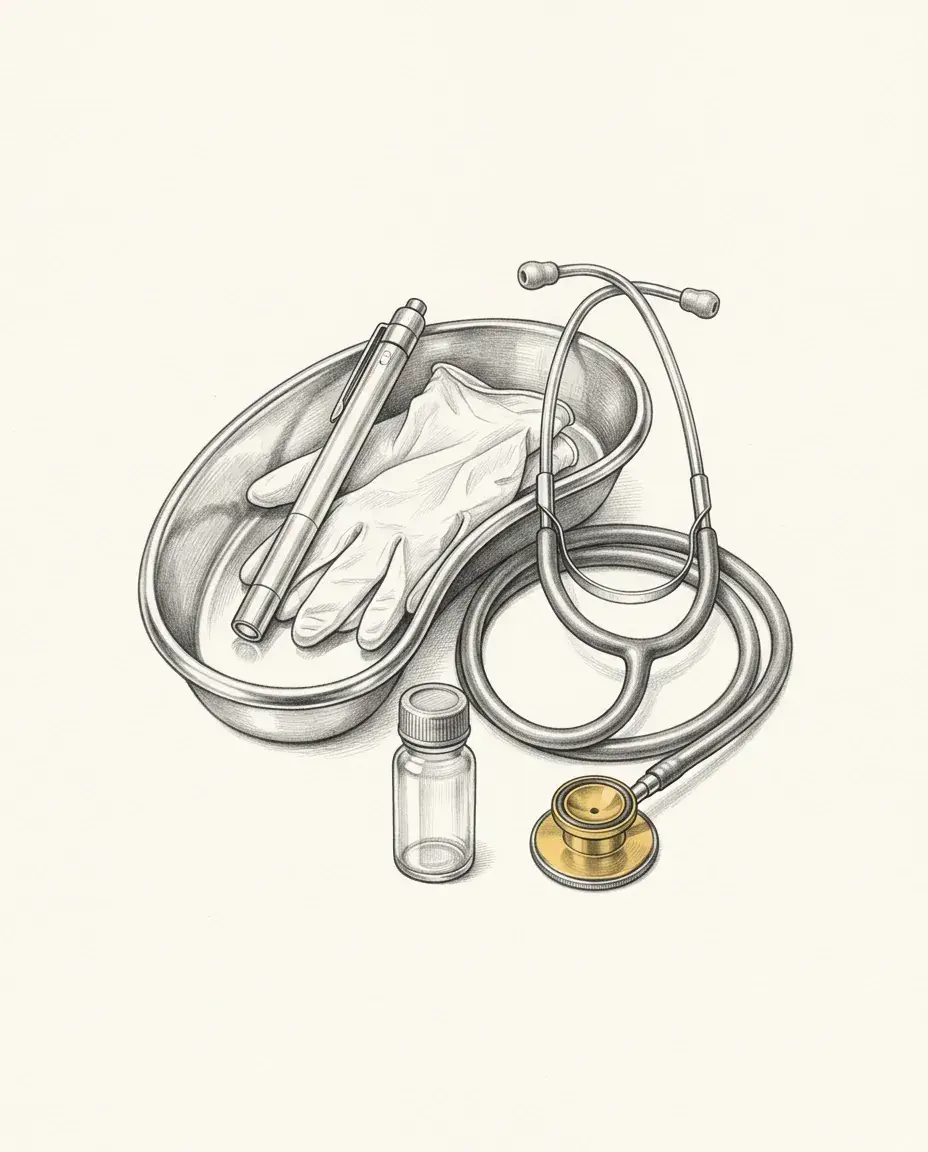
What the term covers. A negotiated examination scene: a mock consultation, a check-up, a "treatment" with an agreed script and ending. Costume and props carry the atmosphere: a white coat or scrubs, gloves, a stethoscope, a clipboard, a paper gown, and the flat clinical register of the language itself. Some scenes stay at the level of setting and vocabulary; others borrow sensation from temperature play or electro play. The recurring shape is a knowledgeable, unhurried figure and an exposed, compliant one, with the exposure framed as procedure rather than seduction.
What the term does not cover. It is role-play, not medicine: nothing in it involves practising healthcare, being qualified in it, or examining, diagnosing or treating anybody. It is broader than doctor and nurse role-play, which names one character pairing inside the same setting, and it is not teacher role-play, the same authority structure relocated to a classroom. It is not a uniform fetish, where the garment carries the charge and could as easily be military. And it is distinct from the procedure-focused interests that borrow the same imagery: an enema fetish (klismaphilia), needle play, urethral sounding, each centred on a specific act and its physical risks rather than on the atmosphere. A latex interest overlaps at the glove and the mask but is a material interest, not a scenario.
How the word is used. "Medical play" is the community term, used in workshop listings and scene negotiation; "medical setting kink" is descriptive shorthand for the scenario as a whole. Neither is clinical vocabulary, and no medical-setting paraphilia is listed in DSM-5-TR or ICD-11. Narrower coinages circulate online ("vaccinophilia" among them) with no standing in the literature; the one formally named interest inside this imagery is klismaphilia, coined in 1973.
History & origins
Clinical lineage
The interest has no single documented coinage as a named diagnosis; "medical play" is a community term rather than a clinical one. Its conceptual roots run deep in early sexology, which treated the doctor-patient encounter as an emotionally charged scene of authority, exposure and care.
- 1886: Richard von Krafft-Ebing's Psychopathia Sexualis catalogued how situations of dominance, submission and exposure could become eroticised, laying groundwork for later reading of the examination scene.
- 1897-1928: Havelock Ellis's Studies in the Psychology of Sex documented how costume, role and authority, including the uniform interest that overlaps medical play, could acquire erotic meaning.
- 1905: Sigmund Freud's Three Essays on the Theory of Sexuality examined scopophilia (pleasure in looking and being looked at) and the eroticisation of vulnerability, concepts that map directly onto being examined and attended to.
- 1973: the closely related enema interest was named klismaphilia by psychiatrist Joanne Denko in her paper "Klismaphilia: Enema as a Sexual Preference," one of the few medical-themed interests with a formal clinical coinage, showing how a specific procedure within the clinical world can become a focus.
Cultural & subcultural evolution
Through the late 20th and early 21st centuries, BDSM educators formalised "medical play" as its own scene category, complete with strong safety conventions and a recognised aesthetic of latex gloves, masks and chrome instruments. In parallel, mainstream culture kept the imagery highly visible: long-running hospital dramas, the perennial doctor-and-nurse costume tradition, and a large body of doctor-patient role-play in adult media. The result is a scenario that is at once a niche kink scene and a near-universal piece of cultural shorthand.
In practice
Medical setting kink is typically expressed through role-play built around a mock examination, consultation or "treatment," supported by themed costuming and props that signal a clinical environment. It overlaps substantially with authority and care-giving dynamics, with doctor-and-nurse role-play and teacher role-play, and with broader uniform interest. Partners generally negotiate the script, tone and limits in advance, and the "clinical" framing is understood by both as fiction.
Psychology
The appeal is most often traced to the steep power-and-trust gradient of the medical encounter (a knowledgeable authority figure paired with an exposed, compliant patient) combined with the eroticisation of being attended to, inspected and cared for. Freud's notion of scopophilia offers one classical frame for the pleasure of being examined; learning and conditioning models add that the charged emotions of real clinical settings can attach to later fantasy. The ritualised, rule-bound structure of role-play is itself part of the draw: it provides a contained way to explore vulnerability and control. Direct empirical research on this specific scenario is thin, so these accounts remain plausible rather than firmly established.
Prevalence & culture
How common is it?
Medical and doctor-patient role-play is a recognisable, fairly common scenario in fantasy surveys and adult media, though it remains niche relative to role-play overall. In Justin Lehmiller's Tell Me What You Want (2018) survey of over 4,000 Americans, role-play and BDSM-adjacent fantasies were extremely widespread, with only a small minority reporting they had never had a BDSM-type fantasy, and clinical and authority scenarios sit within that broad role-play space. Lay reference guides routinely list the medical or clinical setting as a familiar kink environment, and search-interest data confirm steady demand for examination-themed content. Its visibility on mainstream television and in costume traditions gives it moderate cultural presence despite limited dedicated academic study.
Safety, consent & law
Among consenting adults performing fictional roles, the interest is legal and benign. The first thing to be clear about is that this is role-play and not the practice of medicine: nothing in a scene examines, diagnoses or treats anyone, and nothing in this article is medical guidance. The practical cautions are physical rather than legal. Genuine instruments, needles, urethral sounding and enemas carry real infection and injury risk, should never be improvised, and are treated in kink communities as edge play requiring training, sterile single-use equipment, and a plan for what happens if something goes wrong. Because the scenario is built on exposure and compliance, the script, the limits and the stopping signal are agreed before anyone puts on a coat. Critically, the fiction must never leak outward: impersonating a licensed clinician, or using a clinical pretence to obtain someone's agreement to be touched or examined, is a criminal offence in most jurisdictions, and it is precisely what the negotiated frame exists to exclude. It is a normal-variation interest, not a disorder.
Common questions
Is medical play the same thing as medical setting kink?
Effectively yes. "Medical play" is what practitioners and workshops call it; "medical setting kink" is the descriptive name for the same interest viewed as a scenario. The community term leans towards what happens in a scene, and the descriptive one towards what generates the appeal, which is the whole framed situation of examination and care rather than any single act or object.
Do you need medical knowledge or real equipment for medical play?
No, and most scenes deliberately use neither. The setting is carried by costume, props, vocabulary and pacing; a white coat, a clipboard and a clinical tone of voice do more work than any instrument. Anything genuinely invasive (needles, urethral sounding, enemas) belongs to a different and much higher-risk category that kink communities treat as edge play requiring training and sterile single-use equipment.
Is it normal to feel aroused during a real medical examination?
Involuntary arousal in a clinical setting is common, rarely means anything, and is not what this entry describes. This interest is a negotiated fiction between partners; a real appointment is neither negotiated nor a scene. A clinician's professional boundaries are unchanged by anything a patient feels, and a patient troubled by the reaction can say so; it is a recognised and unremarkable phenomenon rather than a scandal.
Is medical play safe?
Role-play with costume and props carries essentially no physical risk; the risk arrives entirely with real instruments and real procedures, which is where injuries and infections happen and why the community treats them as an advanced specialism rather than a scene element. The other safeguard is psychological: examination scenes trade on exposure and compliance, so a clear stopping signal matters more here than in play with less built-in passivity.
Is a medical setting kink a paraphilia or a disorder?
No. Neither DSM-5-TR nor ICD-11 recognises a medical-setting paraphilia, and an interest in a scenario is not a diagnosis. As with every interest in this catalog, clinical relevance would depend on distress, impairment or a non-consenting person, none of which is implied by enjoying an examination role-play with a willing partner.
Is it legal to dress up as a doctor for role-play?
In private, between consenting adults, yes: it is costume. The line is impersonation directed at someone outside the scene: presenting yourself as a licensed clinician to a real patient, or using a clinical pretence to obtain someone's agreement to be touched or examined, is a criminal offence in most jurisdictions. Some places also restrict public wear of particular uniforms. The fiction is lawful precisely because everyone inside it knows it is fiction.
How do you bring medical play up with a partner?
Usually as a scenario rather than as a request. Describing the setting and the roles is easier than naming a kink, and it lets a partner respond to the idea rather than to a label. Practical negotiation then covers who plays which role, how the scene starts and ends, what the "examination" does and does not include, whether any prop touches skin, and the signal that stops everything at once.
- Doctor/Nurse Role-Play58/100Power, Roles & ScenariosDoctor/nurse role-play (medical play) is a consensual role-play sub-genre set in a clinical scenario, such as a doctor or nurse examining a patient. Arousal draws on the authority, vulnerability and ritual of a medical setting, enacted as fiction between adults.58
- Teacher Roleplay62/100Power, Roles & ScenariosAn authority role-play sub-genre built around an imagined power gap between a figure of rank and a subordinate: teacher and student. Professor, boss and employee, and coach are other pairings in the same mode. Arousal comes from the eroticized hierarchy enacted between consenting adults inside a fictional frame.62
- Uniform Fetish60/100Uniform Fetishism · Clothing & GarmentsAn erotic interest in uniforms and the authority, role, or status they signal: military, police, medical, school, or service dress. A common clothing-and-role fetish rather than a clinical disorder.60
- Naturism Fetish48/100Gymnophilia · Settings & SituationsAn erotic interest in being nude, or in nude social settings such as clothing-optional or naturist environments. Arousal comes from consensual openness and exposure. Distinct from the non-consensual paraphilia of exhibitionistic disorder.48
- Glory Hole46/100Settings & SituationsAn opening cut in a wall or booth partition that allows anonymous, face-obscured sexual contact between people on opposite sides. The appeal centers on anonymity rather than on any specific act.46
- Office Sex Fantasy54/100Settings & SituationsAn erotic interest in the office or workplace as a fantasy setting: drawing on dress codes, the boss-employee dynamic, and the taboo of mixing work with desire. A common, benign situational role-play enacted consensually between adults playing fictional roles.54
medical setting · examination scenario · consensual
Prevalence is computed from the entry's cited population estimate. Rows marked ESTare indicative editorial estimates scored against a fixed anchor rubric, not measured quantities. Method & anchors: methodology.
Common · ≈ 1 in 20
- 01Lehmiller (2018), Tell Me What You Want, survey of 4,175 Americanssetting/scenario-based fantasies are common; clinical/examination settings feature within role-play fantasy themes
- 02An A–Z of Kinks and Fetishes, Glamourlay framing of the medical/clinical setting as a recognized common kink environment
- 03Pornhub Insights, search-term popularity (search-interest proxy)search-interest proxy for medical/clinical examination settings
- 04Freud, S. (1905), Three Essays on the Theory of Sexualitypsychoanalytic framing of scopophilia and the eroticization of vulnerability and being examined
- 05Havelock Ellis, Studies in the Psychology of Sex, Wikipediaearly sexological documentation (1897–1928) of how costume, role and authority (including uniform interest overlapping medical play) acquire erotic meaning
- 06Medical fetishism, Wikipediadefinition of medical-scenario interest; BDSM medical play as a recognized scene category with safety conventions
- 07Sexual fetishism, WikipediaDSM-5-TR / ICD-11 classification context; no medical-setting paraphilia listed as a distinct diagnosis
- 08Klismaphilia, Wikipedia1973 coinage of klismaphilia by psychiatrist Joanne Denko in 'Klismaphilia: Enema as a Sexual Preference'; a medical-themed interest with a formal clinical name
- 09Krafft-Ebing, R. von (1886), Psychopathia Sexualisearly cataloguing of eroticized dominance, submission and exposure relevant to the examination scene