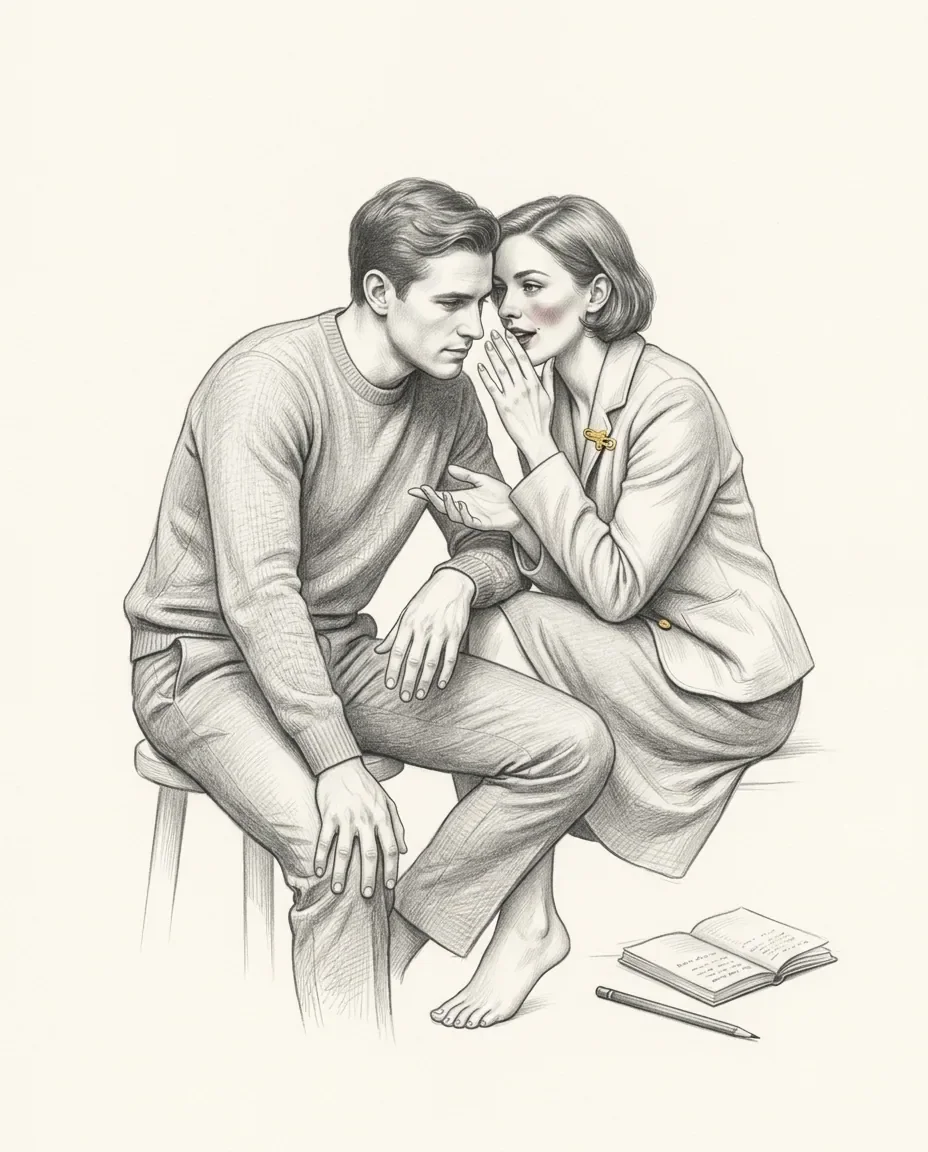
Dirty Talk
Narratophilia
Added 21 Jun 2026 · Updated 22 Aug 2026
Sexual arousal from using, hearing, or exchanging explicit, suggestive, or taboo language before or during intimacy. It ranges from light verbal play to a more central reliance on erotic words and narration (clinically, narratophilia).
- Prevalence
- Ultra-common
- Category
- Acts & Activities
- Clinical term
- Narratophilia
- Domain
- Sexual interest
- Confidence
- Medium confidence
- Status
- A common erotic behavior; narratophilia is a non-pathological variation unless it becomes distressing or compulsive.
- Also known as
- dirty talk, narratophilia, erotic talk, talking dirty, verbal sex, sexting (verbal form), phone sex
- Added
- 21 Jun 2026
- Updated
- 22 Aug 2026
Overview
Dirty talk (the use, hearing, or exchange of explicit, suggestive, or taboo language with a partner for arousal) is one of the most widely practiced forms of erotic expression. For the great majority of people it is a common and benign enhancement to intimacy rather than anything clinical. In its narrower clinical sense, narratophilia describes a stronger, more specific reliance on erotic words and narration as a primary source of arousal. This article traces the term's history, how the interest is expressed, the psychology behind the appeal of language, and its prevalence.
Examples
Dirty talk is defined by its channel, words, rather than by any particular content, which is why its range is so wide and its neighbours so easily confused with it.
What the term covers. Describing what one is doing or about to do; narrating a fantasy aloud; the command-and-response of an instruction and its answer, formalised in JOI; a register of encouragement, as in a praise kink; or a harsher register borrowed from degradation and humiliation play. It travels well at a distance: phone sex, voice notes, and the scripted audio erotica that grew into an industry are the same behaviour by other means.
What the term does not cover. The defining condition is a listener who wants to hear it. Obscene phone calls to a non-consenting stranger are the inverted counterpart, a criminal act rather than a variation on this one. Erotic writing rather than speech is graphoerotica. ASMR turns on the texture and proximity of a voice and is usually non-sexual whatever the words are. And role-play is defined by the assumed character, not by explicit language: the two often occur together, and neither requires the other.
How the word is used. "Dirty talk" is plain vernacular, at home in mainstream sex advice and in ordinary conversation. Narratophilia is the clinical-register label, attributed to John Money and Anke Ehrhardt, that appears in descriptive catalogues of paraphilias; it names only the narrow case in which erotic language is close to a requirement for arousal, and it appears in neither DSM-5-TR nor ICD-11. Someone who says they like dirty talk is almost never claiming the clinical term.
History & origins
Erotic speech before sexology
Arousing language is far older than any clinical vocabulary for it. Surviving Greek and Latin erotic verse, the bawdy graffiti of Pompeii, and the frank love poetry of many literary traditions show that explicit and playful sexual talk has always been part of human courtship and intimacy. What changed in the modern era was not the behavior but the impulse to name and catalogue it.
The sexological lineage
The systematic medical interest in unusual sources of arousal began with Richard von Krafft-Ebing's Psychopathia Sexualis (1886) and was broadened by Havelock Ellis's Studies in the Psychology of Sex, who treated the erotic power of words and suggestion as a normal part of human courtship rather than a pathology. The compact label narratophilia belongs to the later family of -philia terms: it combines Latin narrāre ("to tell, recount") with Greek -philia ("love of"), literally "love of telling." It is commonly attributed to the American sexologist John Money and Anke Ehrhardt, in the same prolific neologising that filled out Money's "lovemap" framework: though, as with many such coinages, the precise first use is not firmly documented and the word is best understood as a descriptive label rather than a diagnosis.
Technology and commercialisation
Twentieth- and twenty-first-century media turned private erotic speech into industries: the telephone made "phone sex" a commercial service; recorded audio and, later, the internet enabled audio erotica apps and text-based exchanges. Today narratophilia sits among the descriptive paraphilia lists rather than being recognised as a stand-alone disorder, and the everyday behavior it points to is firmly mainstream.
In practice
Dirty talk is expressed through whispered or spoken descriptions of desire, praise or affectionate degradation themes, command-and-response exchanges, narrated fantasy scenarios, phone calls, voice messages, and audio erotica. It can occur in person or at a distance, and depending on the words chosen it overlaps with consensual humiliation play, praise kink, and role-play. The same vocal and acoustic appeal underlies the popularity of soothing, intimate audio such as ASMR.
Psychology
Language adds anticipation, intimacy, and a sense of mutual permission; voicing desires can lower inhibition and focus attention on a partner. The appeal often turns on the contrast between everyday social restraint and taboo speech, and on the validation of being explicitly wanted, named, or praised. Hearing one's own desires reflected back can intensify connection as much as the content itself. As Justin Lehmiller notes, the cognitive and emotional dimensions of arousal mean that words can be as potent as physical stimulation.
Prevalence & culture
Dirty talk is widely practiced and culturally visible. In Justin Lehmiller's survey of 4,175 Americans for Tell Me What You Want, 91% of participants reported having fantasised about dirty talk, and about half said they fantasised about it often: making it one of the most common fantasy themes in the data. Its mainstream footprint is reinforced by the popularity of audio-erotica platforms, phone-sex services, and the visibility of "talking dirty" in mainstream sex advice. The overwhelming majority of people who enjoy it would not be described as having a paraphilia; narratophilia applies only to the small minority for whom erotic language is a relatively necessary or central condition for arousal.
Safety, consent & law
The practice is legal and benign between consenting adults. Ethical considerations are largely about negotiation and word choice, since some preferred language touches on humiliation or taboo themes that can land very differently for different people. Checking comfort beforehand, agreeing on limits and off-limits words, and respecting a safeword keep verbal play consensual and pleasurable.
Common questions
How do I start dirty talk without feeling awkward?
Start descriptive rather than explicit: say what you are noticing, what you like, or what you are about to do. Those sentences are true, easy to say, and use no vocabulary you would be embarrassed to hear back. Agreeing in advance that either of you can do it badly removes most of the pressure, since self-consciousness rather than content is what usually stops people.
Does dirty talk have to be crude?
No. The register that works is the one both people can say without flinching, and for many that is descriptive or affectionate rather than crude: telling a partner what you want, what you are enjoying, or what you plan to do next. The taboo charge that makes explicit words effective for some people is exactly what makes them ridiculous or alienating for others.
What if I don't like being talked to that way?
Say so, ideally before rather than during. Plenty of people find explicit language distancing, silly, or too close to things once used against them, and none of that needs justifying. Naming specific off-limits words is more useful to a partner than a blanket refusal, and a partner who continues after being asked to stop has a consent problem rather than a difference in style.
Is narratophilia a disorder?
No. It is a descriptive label for the narrow case in which erotic language is close to a requirement for arousal rather than one ingredient among many, and it appears in catalogues of paraphilias rather than in DSM-5-TR or ICD-11. The everyday behaviour it points at is among the most widely reported sexual interests there is.
Is sexting or dirty talk with someone else cheating?
That depends on the agreement rather than the medium. Most people treat explicit conversation with a third party as a sexual act, so within a monogamous arrangement it usually counts as a breach; in an open relationship it may be explicitly permitted or explicitly excluded. The useful conversation is about which contacts are in bounds, held before rather than after.
What is the difference between dirty talk and humiliation play?
Register and purpose. Dirty talk covers any explicit or suggestive language, praise and plain description included. Humiliation play uses language to produce one specific feeling, embarrassment or lowered status, as the point of the exercise, and it carries its own negotiation: agreed vocabulary, named off-limits themes, and aftercare. Harsh words used casually are not the same as a negotiated scene.
Is phone sex the same thing as dirty talk?
Phone sex is dirty talk conducted at a distance, and the phrase also names a commercial service in which a paid performer supplies it. The behaviour is the same; what changes is the channel and, sometimes, the transaction. Voice notes, live audio and produced audio erotica all sit on the same spectrum.
- ASMR69/100Autonomous Sensory Meridian Response · Non-Sexual FetishismA non-sexual, pleasant tingling sensation that typically begins on the scalp and moves down the neck and spine. Soft sounds, gentle attention, or close personal care trigger it. It underpins a large online relaxation-media subculture.69
- Audiophilia39/100Non-Sexual FetishismA non-sexual devotion to high-fidelity sound reproduction and the equipment behind it: amplifiers, speakers, turntables, headphones, and cables. It is a hobby and connoisseurship interest, not a clinical condition or sexual paraphilia.39
- Humiliation Play60/100Power, Roles & ScenariosA psychological power-exchange interest in which consenting adults eroticize feelings of embarrassment, degradation, or being put down. Arousal arises from the negotiated experience of vulnerability rather than from real harm.60
- Face-Sitting59/100Acts & ActivitiesFace-sitting is a consensual sexual position in which one partner lowers their pelvis onto another partner's face, usually for oral stimulation. It often carries a dominance dynamic. Called queening or kinging in BDSM contexts, it is a common practice rather than a paraphilia.59
- Handjob59/100Acts & ActivitiesA non-penetrative act in which one person stimulates a partner's penis by hand. It is among the most common partnered sexual behaviours, used as foreplay, as a complete act in itself, and as a lower-risk alternative to intercourse.59
- Pegging59/100Acts & ActivitiesPegging is a consensual act in which a woman penetrates a male partner anally using a strap-on dildo, often for prostate stimulation. It inverts conventional penetrative roles, is now used across genders and sexualities, and is not a paraphilia.59
Clinical coinage from Latin narrāre ('to tell, recount') plus Greek -philia ('love of'), literally 'love of telling'; one of the descriptive -philia terms of twentieth-century sexology, commonly attributed to John Money and Anke Ehrhardt within Money's 'lovemap' framework, though the precise first use is not firmly documented.
verbal · audio · fantasy play
Prevalence is computed from the entry's cited population estimate. Rows marked ESTare indicative editorial estimates scored against a fixed anchor rubric, not measured quantities. Method & anchors: methodology.
Ultra-common · ≈ 1 in 5 or more
- 01List of paraphilias, Wikipediadefines narratophilia as arousal from obscene or erotic language used with a partner
- 02Lehmiller (2018), Tell Me What You Want, survey of 4,175 Americanssurvey context showing verbal and fantasy-driven eroticism is highly common among adults
- 03Havelock Ellis, Studies in the Psychology of Sexearly sexology treating suggestion and the erotic power of words as a normal part of courtship and arousal
- 04Narratophilia, Wikipediadefinition, Latin/Greek etymology, and attribution of the coinage to John Money and Anke Ehrhardt; classified as a paraphilic interest, not a discrete disorder
- 05Krafft-Ebing, Psychopathia Sexualis (1886), Wikipediathe classificatory sexology tradition from which descriptive -philia labels such as narratophilia emerged
- 06John Money, Wikipediathe sexologist credited with the 'lovemap' framework and many -philia neologisms, the milieu in which narratophilia is placed
- 07Talk Dirty To Me: The Psychology of Dirty Talk, Sex and Psychology (Justin Lehmiller)Lehmiller's finding that 91% of participants in his survey of 4,175 Americans reported fantasising about dirty talk, about half of them often; the cognitive/emotional psychology of arousal from words
- 08Sexuality in ancient Rome, Wikipediaexplicit erotic verse and graffiti showing that arousing sexual language long predates any diagnostic vocabulary