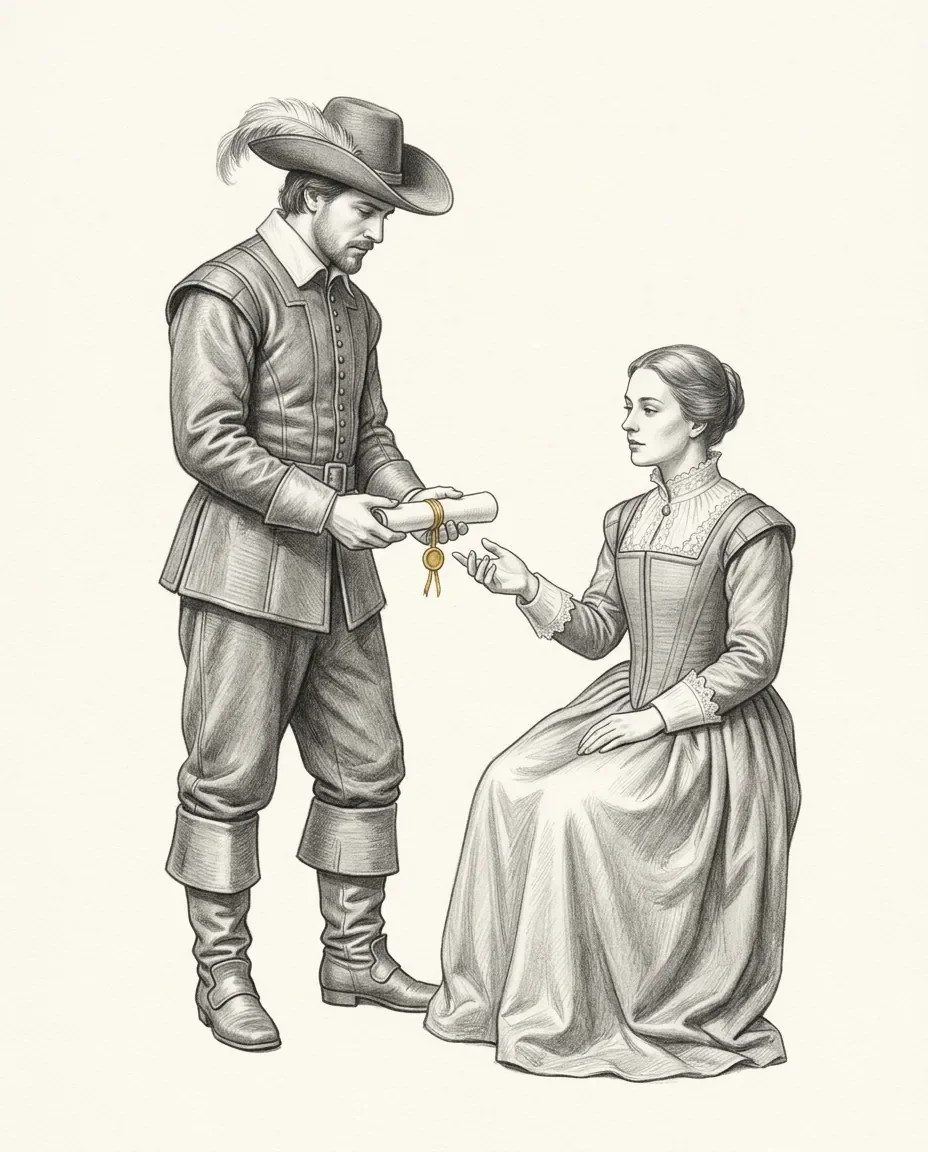
Roleplay
Added 21 Jun 2026 · Updated 6 Sep 2026
Adopting characters, personas, or imagined scenarios to enact sexual fantasy with a partner. One of the most common and versatile sexual interests, role-play frames or heightens arousal through story, character, and pretend.
- Prevalence
- Ultra-common
- Category
- Power, Roles & Scenarios
- Domain
- Sexual interest
- Confidence
- High confidence
- Status
- A common, benign expression of sexual fantasy and play; neither manual lists it as a paraphilia or disorder.
- Also known as
- sexual role-play, fantasy scenario play, character play, scening, character adoption, fantasy enactment
- Added
- 21 Jun 2026
- Updated
- 6 Sep 2026
Featured in

Overview
Sexual role-play is the consensual enactment of an imagined scenario, or the adoption of characters and personas, to frame, structure, or intensify intimate play between adults. It is an umbrella interest spanning countless scripts, from simple persona swaps and "strangers meeting" scenes to elaborate costumed narratives, and it underpins many more specific kinks involving authority, professions, captor/captive dynamics, or transformation.
Definition & scope
Role-play is defined by the pretend frame: partners agree to treat one another as characters, or to treat a setting as something other than what it is, for the duration of a scene. That frame can be thin (a single line of dialogue setting up a premise) or thick (named characters, costumes, props, and a plotted arc). It is a method, so it overlaps with, and often hosts, other interests: a power-exchange dynamic, a uniform, or an age-gap dynamic can all be staged through it. Its defining feature is that everyone knows it is play, with a real person behind each character and an agreed point where the scene ends.
Examples
Its edges show in the scripts it hosts and in the neighbouring interests that need no pretend frame.
What the term covers. The occupational scripts that have become standards (teacher and student, doctor and nurse, boss and secretary), and the narrative ones built on jeopardy, such as captor and captive or a staged abduction. It covers animal personas including pet play, kitten play and pup play; the age-framed dynamics of age play and DDlg; costume-led cosplay; text-only enactment conducted over messaging; and the modest, common case of an established couple playing strangers who have just met.
What the term does not cover. A uniform fetish attaches to the garment itself and needs no scene or character. Dirty talk describes a scenario without anyone stepping into it. Consensual non-consent is a consent framework rather than a story, and while it is often staged through role-play, what defines it is the structure of the agreement. And partners conduct dominance and submission as themselves in most cases: the roles are real positions, not characters.
How the word is used. It is everyday English, hyphenated inconsistently ("role-play," "roleplay," "RP" online, "ERP" for the erotic variety). "Scene" and "scening" are borrowed from theatre through BDSM community usage. Nothing here is clinical: neither DSM-5-TR nor ICD-11 attaches any diagnosis to enacting a fantasy, whatever its content.
History & origins
Pretend as an ancient human practice
Role-play has no single inventor. Pretend, costume, and make-believe are ancient features of human courtship, theatre, and festival, from masked carnival and Saturnalian role-reversal traditions to the disguise-driven plots of Greek and Renaissance comedy. Erotic literature has staged seduction through assumed roles for centuries. The recent part is the framing: fantasy enactment as a distinct, healthy dimension of sexuality, where earlier centuries read it as a symptom or a moral failing.
Clinical lineage
Late-nineteenth-century sexologists catalogued fantasy and the symbolic staging of desire, and treated elaborate scenarios as features of other conditions:
- 1886: Richard von Krafft-Ebing's Psychopathia Sexualis documented the theatrical staging of dominance, submission, and symbolic scenes within his case studies, framing them pathologically.
- 1897–1928: Havelock Ellis's Studies in the Psychology of Sex took a more descriptive, less condemnatory view of fantasy and erotic imagination.
- 1905: Sigmund Freud's Three Essays on the Theory of Sexuality placed fantasy at the centre of sexual life, which gave the imaginative component of desire a legitimacy it had lacked.
- 1948 / 1953: Alfred Kinsey's reports documented the breadth of ordinary fantasy among American adults, and with it the assumption that imaginative variation was rare or disordered lost its footing.
Cultural & subcultural evolution
The normalisation of role-play accelerated across the twentieth century through the sex-positive movement and through the BDSM community's vocabulary of the "scene": a negotiated, time-bounded enactment with an agreed beginning and end. That framework gave casual partners a shared language for stepping in and out of character. Modern fantasy research has since confirmed the interest's ordinariness: large surveys by Justin Lehmiller and by Christian Joyal and colleagues (2015) place scenario, character, and power-themed fantasies among the most reported, which puts role-play among the everyday interests.
In practice
Partners express role-play through agreed characters, dialogue, costumes, props, and settings, stepping into roles for the duration of a scene. Play can be improvised or scripted, light and playful or detailed and immersive, and it often combines with other interests such as power exchange or dressing up. Common conventions include establishing the premise in advance, choosing names or personas, and signalling when the scene begins and ends. The directory's more specific scenarios (teacher/student, doctor/nurse, and instinct-driven primal play) are all specialised expressions of this broader interest.
Psychology
What makes role-play appealing?
Role-play draws on imagination, novelty-seeking, and the freedom that a fictional frame provides. Stepping into a character can lower inhibition, let people explore identities or dynamics at a safe remove, and add narrative tension and anticipation. The pretend frame also offers psychological distance: because "it isn't really me," exploration feels safer and self-conscious barriers relax. Researchers point to that combination of distance and structured novelty as part of why the interest is so durable and so widespread, and why it serves as a gateway into more specific kinks. The evidence for these mechanisms is descriptive and survey-based; nobody has tested them experimentally.
Prevalence & culture
How common is sexual role-play?
Role-play ranks among the most reported sexual fantasies and activities. The nationally representative U.S. study Herbenick et al. (2017) (N = 2,021) found that at least 22% of adults had role-played or pretended to be someone else during sex at least once, with no significant difference between men and women. A 2015 US survey reported by Joyal and colleagues found that a large majority of adults endorse scenario and power-themed fantasies, and Lehmiller's 4,175-person survey found BDSM and novelty fantasies, categories that lean on role-play, close to universal. Wikipedia's overview of sexual roleplay cites that same ~22% lifetime figure. Mainstream advice writing treats it as standard couple play; lay guides such as Glamour's A–Z of kinks list it as a widespread, non-paraphilic interest. In this directory it functions as a calibration anchor, with roughly 30% of adults reporting at least mild interest, and its cultural footprint runs from "date night" framing to costume play.
Safety, consent & law
Role-play among adults is consensual, benign, and legal. Best-practice safety is the standard kink toolkit: negotiating the scene and limits beforehand, agreeing a way to pause or stop (such as a safeword), and providing aftercare once the scene closes. Clear separation between the character and the real person keeps in-scene dynamics from spilling into the relationship. Neither manual lists it as a disorder.
Common questions
How do you start roleplay with a partner without it feeling awkward?
Start small and low-stakes: a single premise, a couple of lines of dialogue, no costume. Agreeing the setup in advance removes most of the awkwardness, because neither person is improvising a plot while trying to stay in the moment. Expect to laugh: most people do the first time, and couples who treat the laughter as part of it get to a second attempt.
Is it cheating to roleplay as someone else?
That depends on what a couple has agreed, since the relationship defines its own fidelity. Playing an invented character with your own partner is seldom contentious. It becomes fraught when a specific real person is named, or when the play involves someone outside the relationship, and both are worth settling out loud.
Does enjoying a dark roleplay scenario mean you secretly want it in real life?
No, and this is one of the best-supported findings in the fantasy literature: enjoying a fantasy predicts very little about wanting the corresponding reality. Fantasies of capture, danger or coercion are common, and their safety is what structures them: the person imagining them controls everything. The desire attaches to the feeling the scenario produces.
What is the difference between roleplay and cosplay?
Cosplay is about costume and portrayal, in most cases of an existing fictional character, and it is a public, non-sexual hobby practised at conventions. Roleplay is about enacting a scenario, needs no costume at all, and is private by nature. They overlap when a couple brings a character costume into private play (see cosplay fetish), and most cosplay has nothing to do with sex.
How do you stop a roleplay scene if it stops being fun?
By breaking character, out loud. Because the scene has a fictional frame, "no" and "stop" may belong to the character rather than the person, which is why couples agree an out-of-character signal beforehand: a safeword, or a plain phrase such as "pausing for a second." Anything that could not be mistaken for a line of dialogue works.
Is roleplay only for people who are into BDSM?
No. The scene vocabulary comes from BDSM, and the practice itself is much broader; mainstream relationship advice treats it as standard couple play. Plenty of role-play involves no power dynamic: strangers meeting, a reunion, a fictional setting. The BDSM connection is that its communities formalised the language for starting and ending a scene.
What if my partner is not interested in roleplay?
Then it stays off the table, and pressing makes it permanently unattractive. Find out what the objection is: some people dislike performing, some fear being judged for the content, some find one specific script uncomfortable while the idea itself is fine. A thinner frame, no characters and no dialogue, is sometimes acceptable where a full scenario is not.
From the blog

How common6 min read
Do men and women have different kinks, and by how much
Do men and women have different kinks? Bondage appeals to 29.5% of men and 29.2% of women, threesomes to 34.1% and 11.1%. Where the surveys find a gap.

Relationships8 min read
How to tell a partner about a kink, and how partners respond
How to tell a partner about a kink: 71% who shared a favourite fantasy got a positive response, and only 28% who never shared expected one.
Definitions8 min read
Kink vs fetish, the difference and where the words come from
Kink is the everyday word for any unconventional sexual interest. Fetish means arousal tied to an object or body part. Where they overlap and where they part.
How common7 min read
The most common kinks, ranked by what the surveys found
The most common kinks, ranked by evidence: dominance and submission, bondage, foot fetish, roleplay and voyeurism lead 474 entries, read tier by tier.
- Teacher Roleplay62/100Power, Roles & ScenariosAn authority role-play sub-genre built around an imagined power gap between a figure of rank and a subordinate: teacher and student. Professor, boss and employee, and coach are other pairings in the same mode. Arousal comes from the eroticized hierarchy enacted between consenting adults inside a fictional frame.62
- Doctor/Nurse Role-Play58/100Power, Roles & ScenariosDoctor/nurse role-play (medical play) is a consensual role-play sub-genre set in a clinical scenario, such as a doctor or nurse examining a patient. Arousal draws on the authority, vulnerability and ritual of a medical setting, enacted as fiction between adults.58
- Primal Play33/100Identity & TransformationA consensual style of intimacy in which partners drop social restraint and act from an instinctual, animalistic headspace. It most often takes the form of predator-and-prey dynamics. In its feral register it overlaps with therian identity and inner-animal embodiment rather than scripted scenes.33
- Dominance85/100Power, Roles & ScenariosTaking the leading, controlling role in a consensual power-exchange dynamic. One of the two halves of dominance and submission (D/s) within BDSM, in which a person directs the scene, sets the rules, and guides a willing partner who has agreed to yield control.85
- Submission90/100Power, Roles & ScenariosTaking the yielding, following role in a consensual power-exchange dynamic. One of the two halves of dominance and submission (D/s), in which a person cedes control to a trusted partner under negotiated limits.90
- Dominance and Submission92/100Power, Roles & ScenariosA consensual erotic dynamic in which one partner takes a dominant role and the other a submissive role, exchanging power within agreed limits. It is one of the most widespread elements of BDSM and of human sexual fantasy.92
A plain-English compound of "role" (a part played by an actor, from French rôle, originally a roll of paper on which an actor's part was written) and "play." The "scene" and "scening" vocabulary derives from theatre via BDSM community usage; there is no specialist clinical coinage.
scenario enactment · fantasy · character adoption
Prevalence is computed from the entry's cited population estimate. Rows marked ESTare indicative editorial estimates scored against a fixed anchor rubric, not measured quantities. Method & anchors: methodology.
Ultra-common · ≈ 1 in 5 or more
- 01Lehmiller (2018), Tell Me What You Want, survey of 4,175 Americansfantasy prevalence anchor: scenario/fantasy enactment is among the most common sexual fantasy themes in the 4,175-person U.S. survey
- 02Joyal, Cossette & Lapierre (2015), What Exactly Is an Unusual Sexual Fantasy?, J. Sexual Medicine 12(2):328-340framing of role-play and scenario fantasies as common rather than statistically rare
- 03An A–Z of Kinks and Fetishes, Glamourmainstream lay framing of roleplay as a widespread, non-paraphilic kink
- 04Sexual roleplay, Wikipediahistory and cultural framing of sexual role-play, the ~22% lifetime-prevalence figure from a 2015 US survey, scene vocabulary, and its relation to BDSM and fantasy enactment
- 05Psychopathia Sexualis, WikipediaKrafft-Ebing's 1886 documentation of the symbolic staging of dominance and submission within a pathologising frame
- 06Studies in the Psychology of Sex, WikipediaHavelock Ellis's descriptive treatment of fantasy and erotic imagination (1897–1928)
- 07Three Essays on the Theory of Sexuality, WikipediaFreud's 1905 placement of fantasy at the centre of sexual life, legitimising the imaginative component of desire
- 08Kinsey Reports, WikipediaKinsey's 1948/1953 documentation of the breadth of ordinary sexual fantasy among American adults
- 09Herbenick et al. (2017), Sexual Diversity in the United States, PLOS ONE 12(7):e0181198 (2,021 adults)nationally representative lifetime prevalence: at least 22% of adults had role-played/pretended to be someone else during sex, no significant gender difference