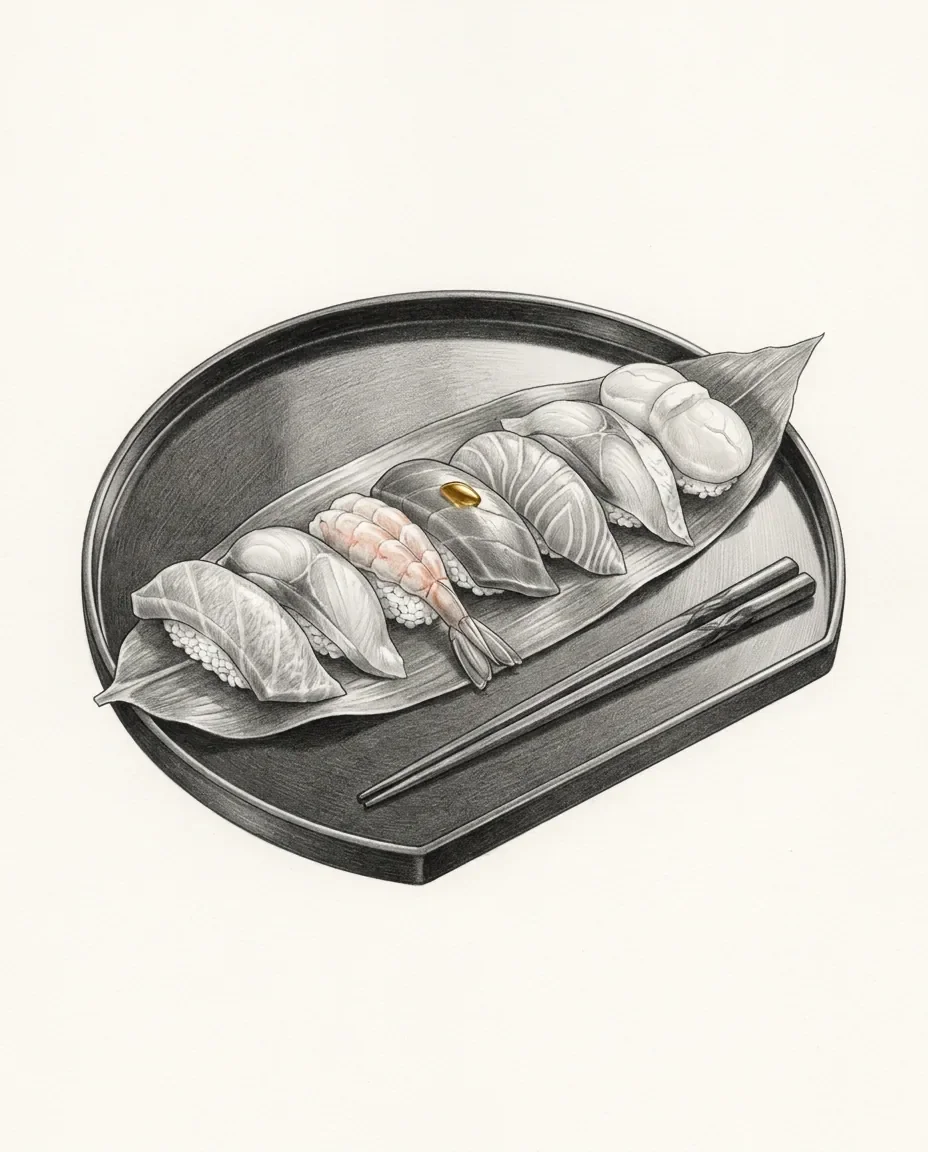
Nyotaimori
Added 26 Jun 2026 · Updated 22 Aug 2026
Nyotaimori, known in English as body sushi, is the practice of eating sushi or sashimi presented on a reclining nude or near-nude person. The Japanese name means "served on a female body"; the male-body variant is called nantaimori. It is a food-play and presentation interest, not a clinical paraphilia.
- Prevalence
- Rare
- Category
- Acts & Activities
- Domain
- Sexual interest
- Confidence
- Low confidence
- Status
- Not a recognised paraphilia; a culturally documented food-presentation practice ranging from catering novelty to consensual erotic theatre.
- Also known as
- 女体盛り, body sushi, nantaimori, food on the body
- Added
- 26 Jun 2026
- Updated
- 22 Aug 2026
Featured in
Overview
Nyotaimori (女体盛り, literally "served on a female body"), known in English as body sushi, is the practice of eating sushi or sashimi laid out on a reclining nude or near-nude person who stays still and silent while diners take food with chopsticks. The male-body version is called nantaimori (男体盛り). This article covers what the practice is, its documented Japanese roots, how it is staged, and why it is contested.
Definition & scope
Nyotaimori is a presentation ritual rather than a sexual act. The model functions as a living serving platter: pieces of sushi or sashimi are arranged on the flat planes of the body, usually over sanitised leaves or other barriers, and guests eat with decorum and chopsticks. The appeal mixes several threads: the aesthetics of Japanese food presentation, the taboo of dining from a human surface, mild objectification framed as art, and for some participants an erotic charge tied to enforced stillness and proximity. It overlaps with the broader category of food fetishism, though many treat it as theatre or novelty catering rather than a fetish.
Examples
What the term covers. The canonical form is a restaurant or banquet service: sushi and sashimi arranged over hygienic barriers on the flatter planes of a model who lies still and silent while guests eat with chopsticks. The male-body version, nantaimori, is the same service with a male model. Outside Japan the format has been adapted for parties, product launches and club promotions, usually with more covering and plastic underlays, and often staged as spectacle rather than dinner.
What the term does not cover. It is not a sexual service: the canonical form involves no sexual contact, and house rules typically forbid diners from touching or speaking to the model. It is close to the opposite of wet and messy play, where food is smeared and spoiled on purpose; here it must be eaten unspoiled, which is why hygiene is central. It is not feederism, which concerns feeding and weight gain, and it is only loosely a food fetish, since the charge, where there is one, sits in the presentation rather than in the food. Its closest relative is human furniture, or forniphilia, which shares the enforced stillness and the person-as-object framing but not the meal; it also borrows from objectification play and from the stillness that defines a statue or doll fetish.
How the word is used. Nyotaimori is a Japanese loanword (女体盛り, "served on a female body") that English adopted along with the practice, alongside the plain English calque "body sushi." It is not a clinical term and appears in no diagnostic manual: it names a catering format and a cultural argument, not something a person is diagnosed with. Within Japan the word attaches to a niche, stigmatised adult-venue novelty, a nuance that largely did not survive the term's export.
History & origins
The practice has a documented Japanese lineage, though several popular claims about it are weaker than often stated.
- Edo period (1603–1868): the most cited antecedent is wakamezake, a form of food and drink play in the licensed pleasure quarters (yūkaku) in which sake was drunk from the body of a courtesan, per the Wikipedia account of nyotaimori. This is the practice nyotaimori is usually traced back to, rather than a continuous samurai-era ritual.
- 1960s: during Japan's postwar economic expansion, hot-spring resorts in Ishikawa Prefecture are reported to have developed body-presentation service as a draw for travelling businessmen.
- 1980s: as family tourism grew, the resort form declined, and the practice migrated into adult-entertainment and specialist catering settings.
- 2000s onward: nyotaimori spread to restaurants and event catering outside Japan as an "exotic" offering, which is where it became internationally visible and controversial.
Claims that the custom is an ancient, widely practised Japanese tradition are not well supported: within modern Japan it is a niche, stigmatised novelty confined mostly to adult venues.
In practice
The staging is formal and constrained. The model typically lies still for a long period, trained to stay motionless and silent so the arrangement is not disturbed. Food sits on hygienic barriers such as treated leaves or film, placed on flatter areas of the body, and intimate areas are avoided or covered. House rules commonly bar diners from touching the model or speaking to them, reframing the person as a presentation surface rather than a participant in conversation. Western adaptations often add more covering and plastic underlays, and sometimes use the format purely as spectacle at parties or promotions.
Prevalence & culture
There are no population statistics for nyotaimori specifically: it is rare and event-bound rather than a standing personal interest, so large surveys of sexual fetishism do not isolate it. Its cultural footprint comes from media coverage and controversy rather than scale. International appearances drew protest from feminist and human-rights groups from around 2003, and China banned the practice in 2005 on public-health and morality grounds. It also surfaces in film and television as shorthand for decadence or exoticised "otherness," a portrayal critics note often misrepresents its actual rarity in Japan.
Safety, consent & law
The two real concerns are hygiene and dignity. Food rested directly on skin raises food-safety questions about temperature and bacterial transfer, which is why barriers and short serving windows matter, and which underpinned several regulatory bans. The ethical debate centres on consent and objectification: critics argue the format reduces a person, usually a woman, to furniture, while defenders frame it as consensual performance among informed adults. Where practised legally, it depends on a willing, paid or volunteering model and venue rules that protect them.
Common misconceptions
The widespread idea that nyotaimori is a revered ancient ceremony is the main myth: the historical thread runs through Edo-era pleasure-district play and a 20th-century resort revival, not a formal classical tradition. It is also not, in its standard form, a sexual service; the defining elements are presentation, stillness and etiquette.
Common questions
Is nyotaimori an ancient Japanese tradition?
No, and this is the most persistent myth about it. The documented thread runs back to wakamezake, a form of food-and-drink play in the licensed pleasure quarters of the Edo period, not to any formal classical ceremony. The modern service form is a twentieth-century development, reported to have emerged at hot-spring resorts in Ishikawa Prefecture in the 1960s and to have faded again in the 1980s as family tourism grew.
Is nyotaimori sexual?
In its canonical form, no. The model functions as a presentation surface: there is no sexual contact, guests eat with chopsticks, and venue rules usually bar touching or conversation. That said, it is staged in adult-entertainment settings far more often than in ordinary restaurants, and some participants describe an erotic charge in the enforced stillness, the proximity and the nudity. It is best read as theatre with an erotic edge rather than as a sexual service.
Is it safe to eat sushi off someone's body?
Only with real precautions, which is why regulators have taken an interest. Raw fish resting on a person warms toward skin temperature, well above the range sashimi is meant to be held at, and direct skin contact adds a route for bacterial transfer. Reputable presentations place the food on treated leaves, film or other barriers rather than on bare skin, and keep the serving window short. Food-hygiene concerns underpinned several of the bans the practice has attracted.
Is nyotaimori legal?
In most places yes, among consenting adults, but it is subject to ordinary food-hygiene regulation, which is the usual sticking point. Some jurisdictions have prohibited it outright: China banned the practice in 2005 on public-health and morality grounds. Where it is permitted it depends on a willing model, paid or volunteering, and on venue rules written to protect them.
What is nantaimori?
Nantaimori (男体盛り) is the male-body version: the same practice, the same staging, with a male model. The distinction lies entirely in the word, since nyo (女) means woman and nan (男) means man. It is far less common and far less discussed than the female form, which is part of why the debate about the practice is almost always framed as a debate about women.
What does the model actually have to do?
Lie still, for a long time, and say nothing. The role is closer to modelling than to hospitality work: the person is trained to stay motionless so the arrangement is not disturbed, and to stay silent for the duration of the meal. Food is placed over barriers on the flatter areas of the body, with intimate areas covered or avoided, and diners are generally forbidden from touching them or speaking to them.
Why is nyotaimori controversial?
For two separate reasons. The first is hygiene: food held at skin temperature on a human surface is a food-safety problem, and that is what several bans were formally based on. The second is dignity: critics, including the feminist and human-rights groups who protested international appearances from around 2003, argue that the format reduces a person, almost always a woman, to furniture. Defenders answer that the model is an informed, consenting adult performing a role.
- Food Fetish37/100Sitophilia · Objects & MaterialsAn erotic interest in food and eating, in which edible items, their taste and texture, or the act of food contact become a focus of arousal. Often expressed as playful, messy, sensory-led intimacy between consenting partners; its messy variant is known as sploshing.37
- Objectification Play41/100Power, Roles & ScenariosA consensual power-exchange dynamic in which one partner is treated, by agreement, as an object or a possession. That can mean serving as a piece of "furniture," being addressed in object terms, or being framed as an owner's property. Arousal comes from the eroticized, negotiated loss of personhood.41
- Object Sexuality17/100Objectophilia · Objects & MaterialsObject sexuality (objectophilia, objectum sexuality, OS) is a romantic and sometimes sexual attraction directed at specific inanimate objects or structures. Those who identify with it describe committed, often reciprocal-feeling love for one particular object rather than a generic interest in things.17
- Autagonistophilia30/100autagonistophilia · Acts & ActivitiesArousal from being on stage or on camera: performing, being filmed or being watched in a setting the person arranged for an audience that chose to watch. A John Money term for the performer's side of voyeurism.30
- Sumata30/100Acts & ActivitiesA Japanese non-penetrative practice in which a partner stimulates the penis with the thighs and external genitals. It became a fixture of Japan's commercial sex trade because it falls outside the 1956 Anti-Prostitution Law's definition of intercourse.30
- Graphoerotica (Erotic Writing)19/100Acts & ActivitiesSexual arousal connected to written text. The term spans two loosely related senses: arousal from reading or writing erotic prose (closely tied to narratophilia), and the eroticised act of writing words on a partner's skin (body writing).19
From Japanese 女体盛り: 女 (nyo, "woman") + 体 (tai, "body") + 盛り (mori, "serving, heaped portion"), literally "serving on a female body." The male variant nantaimori substitutes 男 (nan, "man").
food play · presentation & ritual · objectification
Prevalence is computed from the entry's cited population estimate. Rows marked ESTare indicative editorial estimates scored against a fixed anchor rubric, not measured quantities. Method & anchors: methodology.
Rare · ≈ 1 in 1,000
- 01Nyotaimori, Wikipediadefinition, etymology, wakamezake Edo-period antecedent, 1960s Ishikawa resort revival and 1980s decline, hygiene practices, 2003 protests, and China's 2005 ban
- 02Sexual fetishism, Wikipediaframing of food/presentation interests within the broad category of fetishism; absence of nyotaimori-specific prevalence data