Vincilagnia
Vincilagnia
Added 10 Jul 2026 · Updated 22 Aug 2026
Vincilagnia is sexual arousal centred on bondage: being tied or restrained, restraining a willing partner, or viewing images of restraint. It names the arousal pattern behind the "B" of BDSM and, between consenting adults, is a common benign interest rather than a disorder.
- Prevalence
- Very common
- Category
- Power, Roles & Scenarios
- Clinical term
- Vincilagnia
- Domain
- Sexual interest
- Confidence
- Medium confidence
- Status
- Not a recognised diagnosis; a glossary label for arousal from consensual bondage, which is non-pathological in DSM-5-TR and ICD-11 absent distress, impairment, or non-consent.
- Also known as
- arousal from bondage, arousal from being bound, bondage arousal
- Added
- 10 Jul 2026
- Updated
- 22 Aug 2026
Featured in
Overview
Vincilagnia is sexual arousal centred on bondage: being aroused by being tied or bound, by restraining a willing partner, or by seeing images of restraint. The word is a pseudo-clinical -lagnia label for the arousal pattern behind the "B" of BDSM, and it lives almost entirely in sexual-vocabulary glossaries rather than in psychiatry. Between consenting adults it names a common, benign interest, not a diagnosis. This article covers the term and its roots, the documented history behind the interest, what the arousal actually attaches to, how it is expressed, the psychology, how common it is, and where the real limits lie.
Definition & scope
Vincilagnia is best read as a name for an arousal focus rather than a distinct condition. It overlaps heavily with the practice of bondage and with submission and masochism, yet it does not require pain: restraint can be light and symbolic or fully immobilising, and for many people the charge is the immobility and surrender itself. The interest runs in both directions, toward being restrained and toward restraining, and it includes a purely visual or fantasy register (arousal from restraint imagery) that needs no partner at all.
What it is not: a formal psychiatric category. There is no DSM-5-TR or ICD-11 diagnosis called vincilagnia, and consensual bondage is not classed as a disorder in either system absent distress, impairment, or non-consent. It is also narrower than BDSM as a whole. Where sadism or masochism turn on giving or receiving sensation, vincilagnia turns specifically on the fact of being bound.
Examples
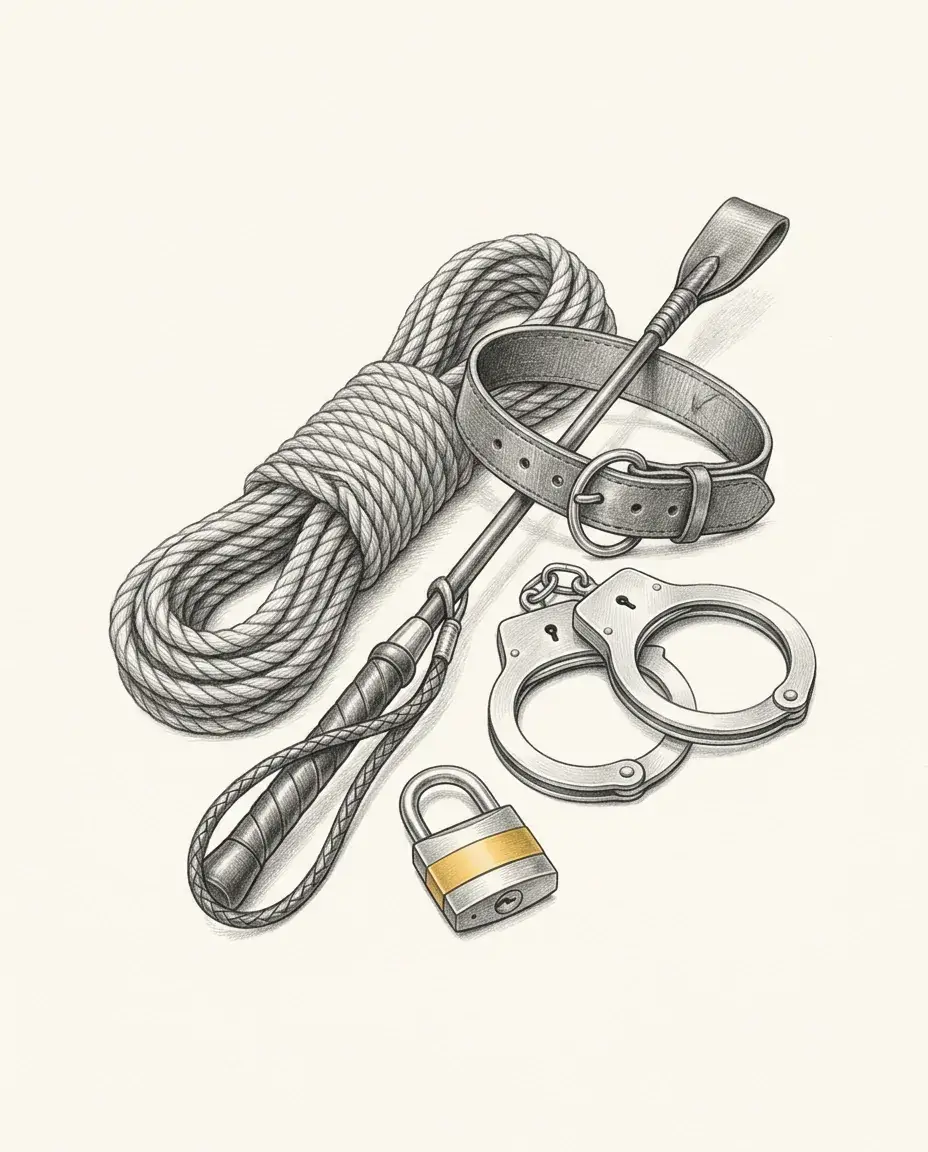
What the term covers. Arousal at being bound, whether by rope in the shibari tradition, by cuffs, by tape, or in a hogtie; arousal at doing the binding, the position occupied by a rope top; the light and symbolic end, where a collar or a single wrist tie carries the whole charge; and the purely visual register, in which restraint imagery is arousing with no intention of ever handling rope. It applies to self-bondage as readily as to partnered play, and reaches mummification and suspension at the elaborate end.
What the term does not cover. This is where the word earns its existence. Bondage names the practice; vincilagnia names the arousal, and the two come apart in both directions: a rope top may tie as craft, service or performance with no erotic charge in it at all, and a person may find the idea of being bound intensely arousing and never own a length of rope. Restraint is likewise incidental to several neighbours that often include it: sensory deprivation works by cutting off input rather than movement, claustrophilia by enclosure, predicament play by making discomfort the engine, and total power exchange by ceding authority rather than mobility. In each of those, someone may well be tied without that being the thing arousing them.
How the word is used. Almost nowhere out loud. It is a written label: people encounter it in term lists and glossaries, not in a rope class or a negotiation, where the vocabulary is "bondage," "rope," "kinbaku," or simply "being tied up." Nothing is lost by never using it; its value is as an index entry that gathers a pattern the practical vocabulary leaves unnamed.
Terminology & etymology
The term joins Latin vincire "to bind, fetter" (the verb vincio) with Greek lagneia "lust," giving a literal "lust for binding." It follows the nineteenth-century sexological habit of minting Greek-and-Latin -lagnia and -philia labels for specific arousal patterns, though its own coinage is not well documented and it never entered the standard diagnostic manuals. It survives chiefly in sex-vocabulary references such as the medical-dictionary glossary entry, which defines it as arousal from bondage "whether seeing images of it, being tied up or tying up a (hopefully willing) partner." The main Wikipedia article on bondage (BDSM) does not use the word at all, a fair signal of how marginal the label is next to the practice it names.
History & origins
The word itself is modern and its coinage undocumented (no nineteenth-century sexologist used vincilagnia), but the arousal pattern it names has a long paper trail. Restraint carried an erotic charge in fine art centuries before it had any clinical label, as in Rembrandt's Andromeda Chained to the Rocks (c. 1630). When sexology first catalogued the interest it gave it no separate name: Richard von Krafft-Ebing's Psychopathia Sexualis (1886) filed arousal from being bound and subjugated inside his new category of masochism. A parallel tradition matured in Japan, where hojōjutsu, the Edo-period (1603–1868) martial craft of restraining prisoners with cord, was reworked in the early twentieth century by the painter Seiu Itō (1882–1961) into erotic kinbaku, the ancestor of modern shibari. In the West, John Willie's fetish magazine Bizarre (1946–1959) circulated bondage illustration and technique to a mail-order readership, and Bettie Page, posing for Irving Klaw from 1952 to 1957, became the first famous bondage model. The DSM-5's 2013 separation of paraphilias from paraphilic disorders formally depathologised the consensual interest, and the 2015 fantasy survey by Joyal and colleagues (see below) confirmed how common it had been all along.
In practice
Expressed consensually, vincilagnia looks like bondage generally. Restraint may use rope, cuffs, tape, or improvised materials; it can be decorative or functional; and it is often combined with dominance and submission or with sensation play. For the restrained partner the appeal typically centres on surrender, trust, and the focused, quiet headspace immobility can bring, overlapping with the calm some describe as subspace. For the restraining partner it can centre on care, control, and responsibility. The point, in either role, is that the arousal attaches to the fact of restraint.
Psychology
What causes it?
There is no single settled cause. Mainstream sexology treats arousal from consensual restraint as a normal-variation expression of power-exchange and sensation interests rather than a sign of pathology. Proposed mechanisms include the eroticising of surrender and trust, the way sensory restriction sharpens touch and anticipation, and ordinary learning and association. Evidence for any one pathway is thin, and honest accounts leave the origin open.
Are people who enjoy it well-adjusted?
Yes, on the available data. Wismeijer & van Assen (2013), comparing 902 BDSM practitioners with 434 controls, found the practitioners were on average less neurotic, more extraverted, more open to experience, more conscientious, less rejection-sensitive and higher in subjective well-being. The authors concluded BDSM is better read as recreational leisure than as an expression of psychopathology. That study covers BDSM broadly, and restraint interest sits inside it.
Prevalence & culture
How common is arousal from bondage?
The arousal pattern is widespread, even where the label is not. Joyal, Cossette & Lapierre (2015), an internet survey of 1,516 adults, found being tied up ranked among the most common erotic fantasies in the general population.
| Fantasy (Joyal 2015) | Women | Men |
|---|---|---|
| Being tied up (sexually) for pleasure | ~52% | ~46% |
| Being dominated sexually | ~65% | ~54% |
Those figures put restraint firmly in the "common," not "unusual," band the study defined. Restraint imagery is thoroughly mainstream in fashion, film, and popular fiction, and large communities sustain rope art and bondage practice worldwide. The obscure Latin term travels far less widely than the interest it describes.
Safety, consent & law
Restraint carries genuine physical risk: nerve compression, restricted circulation, rope burns, and positional or postural asphyxia where the chest, posture, or neck is involved. Standard risk reduction includes explicit negotiation and safewords, keeping safety shears within reach, never leaving a bound person alone, avoiding solo self-bondage, and checking limbs for colour, temperature, and sensation. Between consenting adults it is generally lawful; restraining a non-consenting person is assault or unlawful imprisonment, and in some jurisdictions consent does not legally cover serious bodily injury. Related practices such as suspension bondage and collaring carry the same ethic of care.
Common questions
Is vincilagnia a real diagnosis?
No. It appears in sexual-vocabulary glossaries and dictionary aggregators, not in DSM-5-TR, ICD-11 or the research literature, and no clinician would write it in a note. Consensual bondage is not a disorder under either manual. It would become clinically relevant only through marked distress, impairment, or a non-consenting person, and the language used then would be about fetishistic or coercive behaviour, not this word.
Do you have to enjoy pain to enjoy being tied up?
No. Restraint and pain are separate appeals that often travel together and are frequently confused because of it. Many people who find being bound arousing want the binding to be comfortable and would rather it did not hurt at all; soft rope, a padded cuff and a position that can be held for a while are ordinary preferences. Masochism is a distinct interest, and how much the two overlap is a matter of individual taste.
Does liking restraint mean you are submissive?
Not necessarily. Being physically unable to move and choosing to obey are different experiences, and people sort themselves along the two axes independently. Some enjoy restraint while staying verbally combative or in practical control of the scene (brat play is built on exactly that gap), and some who identify strongly with submission have no particular interest in rope at all.
Is self-bondage safe?
It is the highest-risk form of restraint, and rope communities generally advise against it. The hazard is structural rather than exotic: nobody is present to notice a limb going numb, a position collapsing, or a release mechanism failing, and the restraint that makes it appealing is what prevents self-rescue. People who do it anyway build in redundant releases and keep cutting tools within reach, but neither removes the underlying problem. See self-bondage.
How long is it safe to stay tied up?
There is no fixed number, because the limiting factor is circulation and nerve pressure rather than the clock. A tight binding around the wrist or upper arm can compress a nerve within minutes, while a loose, well-distributed tie may be comfortable for far longer. The practical rule is to check regularly for colour, warmth, tingling and numbness and to release at once on any of them; suspension in particular is measured in minutes rather than hours.
Are handcuffs safer than rope for beginners?
Not automatically. Rigid metal cuffs are quicker to apply but have no give, and pressure on the wrist can compress the nerves running through it, which is why handcuff nerve injury is a recognised phenomenon. Wide padded cuffs are the more forgiving option. Whatever is used, the rule that matters is that it comes off fast: a key kept within reach, or shears that will cut the rope without cutting the person.
- Bondage86/100Acts & ActivitiesConsensual binding or restraint of a partner with rope, cuffs, tape or other materials for erotic, aesthetic or sensory pleasure. It is the "B" of BDSM and one of the most widely fantasised-about kinks.86
- Suspension Bondage49/100Sensation & PainA form of consensual bondage in which a restrained person is partly or fully lifted off the ground from one or more overhead suspension points. Rope, webbing, cuffs, or chain carry the load. It is a technically demanding, higher-risk practice within the wider rope-bondage and BDSM world.49
- Masochism69/100Sexual Masochism Disorder · Clinical ParaphiliasA DSM-5-TR paraphilic disorder defined by recurrent, intense arousal from being humiliated, beaten, bound, or otherwise made to suffer. It is diagnosed only when that arousal causes the person clinically significant distress or impairment. Consensual masochistic interest without distress is not a disorder.69
- Submission90/100Power, Roles & ScenariosTaking the yielding, following role in a consensual power-exchange dynamic. One of the two halves of dominance and submission (D/s), in which a person cedes control to a trusted partner under negotiated limits.90
- Subspace64/100Sensation & PainAn altered, often euphoric or trance-like headspace that some submissive or bottoming partners enter during intense BDSM play. It is marked by floating sensations, time distortion, reduced pain awareness and impaired verbal responsiveness.64
- Collaring63/100Power, Roles & ScenariosThe consensual act of placing a collar on a submissive partner as a negotiated symbol of ownership, commitment, protection or submission. It takes place within a Dominant/submissive relationship and is often likened to a wedding band.63
From Latin *vincire* "to bind, fetter" (verb *vincio*) + Greek *lagneia* "lust," literally "lust for binding." The coinage is not well documented and never entered the standard diagnostic manuals; it survives mainly in sexual-vocabulary glossaries.
restraint & immobilisation · power exchange · arousal pattern
Prevalence is computed from the entry's cited population estimate. Rows marked ESTare indicative editorial estimates scored against a fixed anchor rubric, not measured quantities. Method & anchors: methodology.
Very common · ≈ 1 in 7
- 01Vincilagnia, Medical Dictionary (TheFreeDictionary)definition of vincilagnia as sexual arousal from bondage (images, being tied, or tying a willing partner) and its status as a glossary term
- 02Bondage (BDSM), Wikipediadefinition and practice of consensual bondage, its physical risks, and the fact that the main article does not use the term vincilagnia
- 03Joyal, Cossette & Lapierre (2015), What Exactly Is an Unusual Sexual Fantasy?, PubMedgeneral-population fantasy prevalence: ~52% of women and ~46% of men reported fantasies of being tied up; ~65%/~54% domination
- 04Wismeijer & van Assen (2013), Psychological Characteristics of BDSM Practitioners, PubMed902 BDSM practitioners vs 434 controls: practitioners less neurotic, more extraverted/open/conscientious, higher subjective well-being; BDSM read as recreational leisure not psychopathology
- 05Psychopathia Sexualis (Krafft-Ebing, 1886), Wikipedianineteenth-century sexology had no separate label for arousal from restraint; Krafft-Ebing's 1886 work filed being bound and subjugated under his new category of masochism
- 06Japanese bondage, WikipediaEdo-period hojōjutsu as martial prisoner restraint and its early-20th-century reworking into erotic kinbaku by Seiu Itō (1882–1961)
- 07John Willie, WikipediaJohn Willie published the fetish magazine Bizarre (1946–1959), which circulated bondage illustration and technique
- 08Bettie Page, WikipediaBettie Page posed for Irving Klaw from 1952 to 1957 and is regarded as the first famous bondage model