Suspension Bondage
Added 22 Jun 2026 · Updated 22 Aug 2026
A form of consensual bondage in which a restrained person is partly or fully lifted off the ground from one or more overhead suspension points. Rope, webbing, cuffs, or chain carry the load. It is a technically demanding, higher-risk practice within the wider rope-bondage and BDSM world.
- Prevalence
- Uncommon
- Category
- Sensation & Pain
- Domain
- Sexual interest
- Confidence
- Medium confidence
- Status
- Consensual advanced BDSM/bondage practice; a benign variation in consenting adults, not a disorder absent distress or non-consent, but recognised as higher-risk.
- Also known as
- rope suspension, suspension play, aerial bondage, partial suspension, full suspension, shibari suspension, kinbaku suspension
- Added
- 22 Jun 2026
- Updated
- 22 Aug 2026
Featured in
Overview
Suspension bondage is a form of consensual bondage in which a restrained person is partly or wholly lifted off the ground from one or more overhead suspension points using rope, webbing, chain, or padded cuffs. It sits at the advanced end of bondage, prized for the loss of control, the spectacle of the body in the air, and the intense trust placed by the suspended "bottom" in the rigger who ties and hangs them. This article traces its documented Japanese and Western lineage, how it is practised, its psychology, and the substantial physical risks that set it apart from ground-based restraint.
Examples
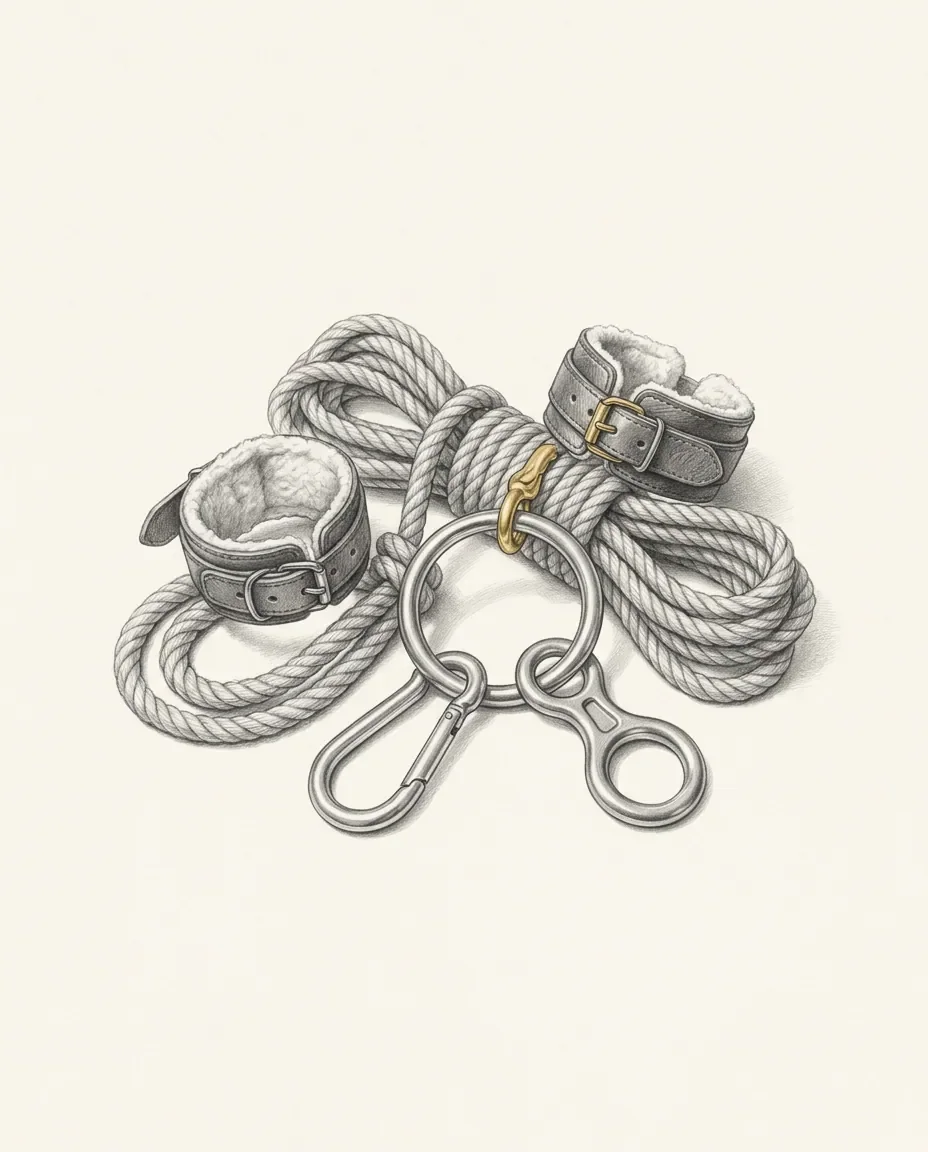
What the term covers. A partial suspension in which a chest harness carries some of the weight while the feet or knees stay on the floor; a full suspension held face-up or face-down with the load shared between chest, hip and leg harnesses; a short inverted hang by the ankles; and the same forms performed on stage or shot for photography rather than as private erotic play. Chain, webbing and padded cuffs are all used from a rated overhead point; rope is simply the most common and by far the most taught.
What the term does not cover. Ground-based bondage and floor ties are not suspension however elaborate, because the defining feature is that the rigging, not the floor, carries the body's weight. Shibari names the Japanese rope aesthetic, most of which is done on the ground; suspension is one advanced thing that can be done with it, and the person tying is the rigger or rope top. Named positions such as a hogtie, a strappado or a spread-eagle tie describe how the limbs are arranged rather than whether the body has left the ground. Mummification and the vacuum bed immobilise without lifting. Self-bondage and suspension are a particularly dangerous combination, since suspension's first safety rule is that the suspended person is never alone.
How the word is used. "Suspension bondage" is plain descriptive English, used in community teaching and safety literature rather than in any nosology; it appears in neither DSM-5-TR nor ICD-11. Practitioners usually just say "suspension", with "partial" or "full" attached, and reserve the longer phrase for writing.
History & origins
"Suspension bondage" is a plain-English descriptor with no single coiner; the technique has two intertwined documented lineages, one Japanese and one Western.
Japanese lineage: from hojōjutsu to kinbaku
The best-documented thread is Japanese. The aesthetic rope arts of shibari (縛り, "to tie/bind") and kinbaku (緊縛, "tight binding") descend from hojōjutsu, the Edo-period (c. 1600–1868) martial art of restraining and transporting prisoners with cord, techniques significantly modified for erotic use because the originals were designed to harm captives.
- 1882–1961: Itō Seiu, widely called the "father of kinbaku," reworked hojōjutsu ties into an erotic art, drawing on kabuki and ukiyo-e torture imagery; his 1928 Seme no Kenkyū (Research on Torture) set out his framework, and he repeatedly depicted suspended figures in his paintings and photographs, including a celebrated inverted-suspension photograph of his pregnant second wife first attempted around 1920.
- August 1952: The term kinbaku, distinguishing erotic bondage from mere tying, was first developed in the August 1952 issue of the post-war magazine Kitan Club by Minomura Kō and the bakushi Tsujimura Takashi; through the 1950s Kitan Club and similar magazines spread erotic rope bondage and published some of the first naked bondage photography in Japan.
- 1990s: Load-bearing suspension was systematised by riggers such as Akechi Denki (1940–2005), founder of the Akechi-ryū style, who developed the upper-and-lower-kannuki cinched chest harness (takate-kote) for dynamic suspensions; the form then reached the West through magazines and touring teachers including Yukimura Haruki, Osada Steve, and Midori.
Western lineage
A parallel Western tradition ran through fetish illustrator and publisher John Willie (J. A. S. Coutts, 1902–1962), whose magazine Bizarre (first 20 issues c. 1946–1956 under Willie) popularised pulley rigs and suspension imagery decades before the Japanese forms were widely known abroad; Coutts inspired much of the fetish art of the later twentieth century, including the work of Eric Stanton and Gene Bilbrew. From the 1990s the two streams merged in the global BDSM scene, where shibari-style suspension became a prestige skill with its own teachers, workshops, and safety literature.
In practice
Practitioners distinguish partial suspension, where some body weight remains on the ground, from full suspension, where the body is supported entirely aloft with no contact with the floor. Common orientations are vertical, horizontal (face-up or face-down), and inverted (hung by the ankles, which is time-limited because blood pools in the head). Load is carried by harnesses around the chest, hips, or limbs and transferred through a rated overhead anchor or "hard point." Suspension is non-explicit in itself and is frequently pursued as performance art, photography, or meditative ritual as much as erotic play; it overlaps with related restraint interests such as claustrophilia and the immobilisation of a vacuum bed.
Psychology
The appeal blends surrender and the eroticism of helplessness, the trust of literally placing one's physical safety in another's hands, the meditative dissociative calm bottoms often call "rope space" (akin to subspace), and the pure aesthetic of the suspended body. For the rigger, the draw is skilled control, attentive care, and three-dimensional composition. Like consensual BDSM generally, it is understood as a benign variation rather than a disorder: in the DSM-5-TR and ICD-11, consensual interest in restraint is not pathologised absent distress, impairment, or non-consent.
Prevalence & culture
General bondage fantasies are extremely common (in Lehmiller's (2018) survey of 4,175 Americans, bondage and restraint were among the most widely reported fantasies) but suspension is a specialised minority practice requiring training, hardware, a skilled partner, and a tolerance for risk, so actual engagement is far narrower. Its cultural footprint comes mainly through professional shibari performance, fine-art and editorial photography, and a small, dedicated international community of riggers who teach the craft.
Safety, consent & law
Suspension is one of the more hazardous activities in BDSM. The best clinical evidence comes from a 2023 case series in Cureus (Khodulev et al.), which found that acute compression of the radial nerve is the most common injury induced by Japanese rope bondage, occurring at that level in 90% of the injured individuals studied. In one documented case a 25-minute jute-rope suspension of a 29-year-old woman produced a temporary wrist-and-finger drop with a conduction block that took roughly five months to fully resolve. Other documented dangers include circulation problems and fainting, suspension trauma or harness-hang syndrome (orthostatic intolerance from venous pooling when a person hangs motionless and upright), positional asphyxia, and catastrophic falls from rigging failure; a fall from an inverted position can cause death or spinal injury.
Responsible practice therefore depends on anatomy knowledge (identifying nerve-vulnerable wrap points), rated hard points, immediately accessible safety shears, clear negotiation and a safeword, and never leaving a suspended bottom unattended. Between consenting adults the activity is lawful in most jurisdictions, but consent has limits: in England and Wales, the R v Brown ruling (following Operation Spanner) held that consent is not a defence to the infliction of actual bodily harm, and any non-consensual restraint is a serious crime everywhere.
Common questions
Is suspension bondage safe?
Not in the sense that most kink is. Skill, anatomy knowledge, rated hardware and a sober, attentive rigger reduce the risk substantially, but they do not remove it: nerve compression, fainting, positional asphyxia and rigging failure are all documented outcomes, and a fall from an inverted position can kill. That is the honest reason the practice is taught as advanced rather than beginner material, and why community safety literature treats it differently from ground-based rope.
What are the actual risks of rope suspension?
Four distinct things, all documented. Nerve compression where rope crosses a vulnerable point, which is the most commonly reported injury and one that can take months to resolve. Restricted circulation and fainting. Suspension trauma, in which blood pools in the legs of someone hanging motionless and upright. And falls: if a rope, knot, hardware component or anchor fails, the drop is uncontrolled, and from an inverted position it can cause spinal injury or death.
What is suspension trauma?
Also called harness hang syndrome, it is an orthostatic problem borrowed from the climbing and rescue world. When a person hangs upright and motionless in a harness, blood pools in the legs instead of returning to the heart, and consciousness can be lost. Movement and shifting weight slow it down; being left in one position, or suspended without anyone watching, does the opposite. It is one of several reasons a suspended bottom is never left unattended.
How long can someone stay suspended?
There is no fixed number, and anyone offering one is guessing. The limit is set by the position and by the person. Inverted suspensions are the most sharply time-limited, because blood pools in the head. Chest harnesses become uncomfortable and then dangerous as they load the ribs and shoulders. Nerve symptoms can appear within minutes at an unlucky rope placement. Riggers work to continuous check-ins and come down at the first numbness, tingling or weakness, not to a clock.
What is the difference between shibari and suspension bondage?
Shibari is the Japanese rope aesthetic (the patterns, the ties, the way rope is laid on a body), and the great majority of it happens with the bottom on the floor. Suspension is something those ties can be put to once the harnesses are load-bearing and there is a rated anchor overhead. Neither implies the other: you can tie shibari with no suspension at all, and you can suspend with webbing and cuffs and no shibari.
Can beginners try suspension bondage?
Not straight away, and this is close to universal advice within the community rather than gatekeeping. Suspension puts a person's airway, circulation and nerves under load from rope the rigger has tied, so the prerequisites are solid floor-rope competence, anatomy knowledge, an understanding of hardware ratings, and ideally in-person instruction. Partial suspensions, where the ground still carries most of the weight, are the usual first step and are learned well before anything leaves the floor.
Is suspension bondage legal?
Between consenting adults it is lawful in most jurisdictions, and the activity itself is unremarkable in law. What varies is how far consent stretches once someone is injured: in England and Wales the R v Brown ruling held that consent is not a defence to the infliction of actual bodily harm, so a serious suspension injury could in principle be prosecuted despite agreement. Non-consensual restraint of any kind is a serious crime everywhere.
Why do people find suspension appealing if it is that risky?
The draw is usually described in three parts: the helplessness of having no contact with the ground and no way to change your own position, the trust of handing your physical safety to another person literally rather than figuratively, and the floating, dissociative calm that bottoms call rope space. Riggers describe something quite different: a craft problem, three-dimensional and unforgiving, with a person inside it. The aesthetic pull of the suspended body matters to both.
- Bondage86/100Acts & ActivitiesConsensual binding or restraint of a partner with rope, cuffs, tape or other materials for erotic, aesthetic or sensory pleasure. It is the "B" of BDSM and one of the most widely fantasised-about kinks.86
- Aftercare66/100Acts & ActivitiesThe deliberate emotional, physical and psychological care partners give one another after intense sex or a BDSM scene. It helps everyone come down from heightened arousal and return to a calm, grounded baseline. A widely shared best practice rather than a kink in itself.66
- Subspace64/100Sensation & PainAn altered, often euphoric or trance-like headspace that some submissive or bottoming partners enter during intense BDSM play. It is marked by floating sensations, time distortion, reduced pain awareness and impaired verbal responsiveness.64
- Vacuum Bed / Encasement Fetish27/100Objects & MaterialsAn interest in being sealed inside an airtight latex envelope from which the air is pumped out, shrink-wrapping and immobilising the body. It sits within total-enclosure fetishism and is a higher-risk form of bondage and sensory deprivation.27
- Claustrophilia (Confined Spaces)22/100Claustrophilia · Settings & SituationsClaustrophilia is sexual arousal or contentment from being confined in small, enclosed spaces: effectively the inverse of claustrophobia. It is an uncommon paraphilic interest that overlaps with bondage, restriction and sensory-control play.22
- Temperature Play49/100Sensation & PainConsensual sensation play that uses warmth and cold, such as ice, chilled or warmed objects, and contrasting temperatures, to heighten skin sensation. It is a gentle, accessible branch of BDSM sensation play centered on thermal contrast.49
A plain-English descriptive compound: "suspension" (from Latin *suspendere*, "to hang up") plus "bondage" (from Anglo-Latin *bondagium*, the state of being bound). It names the practice of hanging a bound person and has no separate clinical coinage; the Japanese tradition uses *shibari* (縛り, "to tie/bind") and *kinbaku* (緊縛, "tight binding").
rope bondage · restraint · aerial/suspension play · advanced BDSM
Prevalence is computed from the entry's cited population estimate. Rows marked ESTare indicative editorial estimates scored against a fixed anchor rubric, not measured quantities. Method & anchors: methodology.
Uncommon · ≈ 1 in 100
- 01Suspension bondage, Wikipediadefinition; partial vs full suspension; vertical/horizontal/inverted positions; named risks (falls, nerve compression, circulation/fainting, harness hang syndrome)
- 02Japanese bondage (Shibari/Kinbaku), Wikipediahojōjutsu origins; Itō Seiu as father of kinbaku; Kitan Club and post-war spread; nawashi terminology; peripheral nerve damage as most common reported injury
- 03John Willie, WikipediaWestern fetish-publishing lineage; J. A. S. Coutts (1902–1962) and Bizarre magazine (1946–1959); suspension imagery and pulley rigs
- 04Lehmiller (2018), Tell Me What You Want, survey of 4,175 Americansnear-universal BDSM/bondage fantasy prevalence, within which suspension is a specialised minority practice
- 05R v Brown / Operation Spanner, Wikipedialegal framing that consent may not be a defence for actual bodily harm in some jurisdictions
- 06Khodulev et al. (2023), Acute Radial Compressive Neuropathy: The Most Common Injury Induced by Japanese Rope Bondage, Cureuspeer-reviewed case series showing radial nerve compression is the most common injury from Japanese rope bondage, with a months-long recovery case from a 25-minute suspension
- 07Seiu Ito and the Bondage Revolution, Pen OnlineItō Seiu (1882–1961) as father of kinbaku; reworking of hojōjutsu into erotic art; suspended figures in his paintings and photography
- 08Suspension trauma (harness hang syndrome), Wikipediaorthostatic intolerance / venous pooling mechanism when suspended motionless and upright; alternative names
- 09DSM-5-TR, American Psychiatric Associationconsensual restraint interest is not pathologised absent distress, impairment, or non-consent
- 10ICD-11, World Health Organizationconsensual BDSM/restraint interest is not classified as a disorder absent distress or harm
- 11Denki Akechi, NawapediaAkechi Denki (1940–2005), founder of the Akechi-ryū style, developed the upper-and-lower-kannuki takate-kote chest harness for dynamic suspensions in the 1990s