Bondage
Added 22 Jun 2026 · Updated 6 Sep 2026
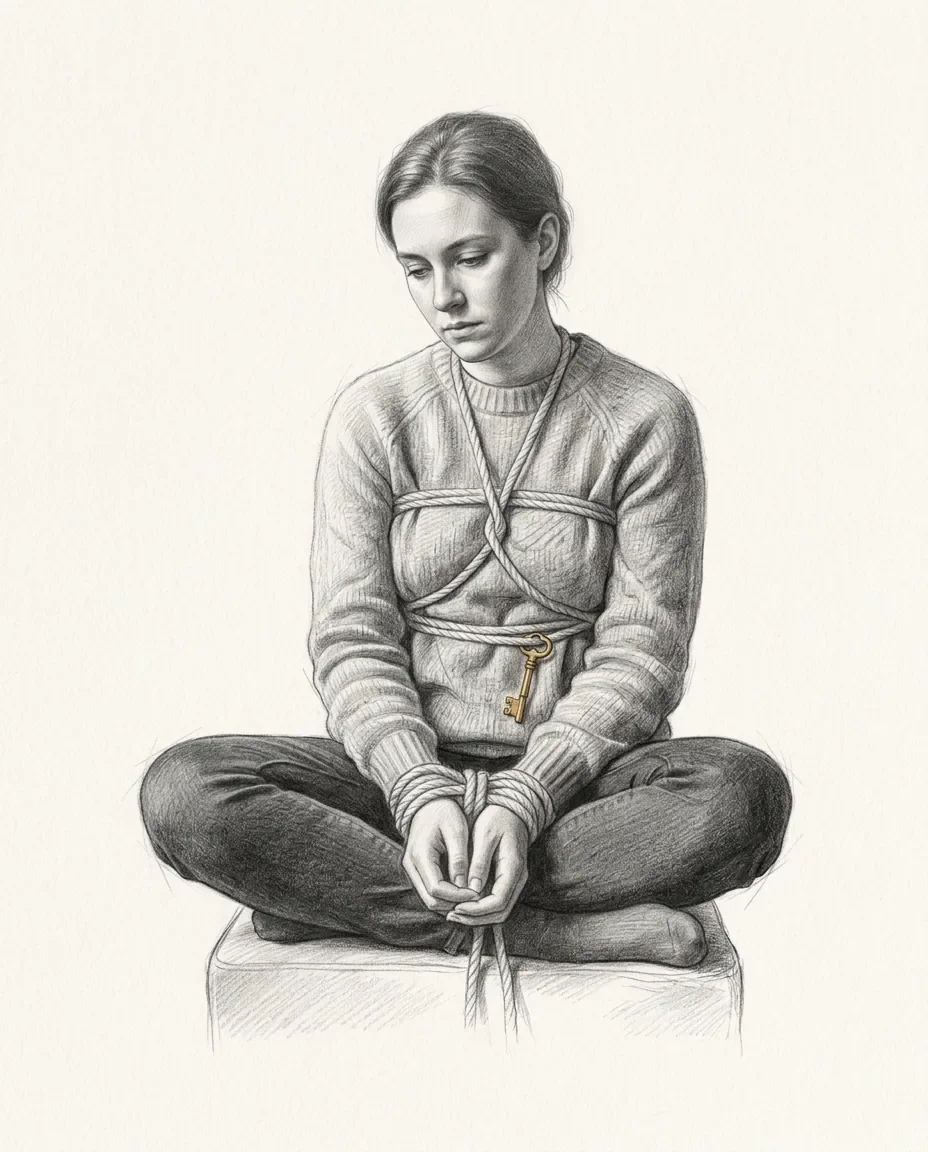
Consensual binding or restraint of a partner with rope, cuffs, tape or other materials for erotic, aesthetic or sensory pleasure. It is the "B" of BDSM and one of the most widely fantasised-about kinks.
- Prevalence
- Very common
- Category
- Acts & Activities
- Domain
- Sexual interest
- Confidence
- High confidence
- Status
- A common consensual variation. DSM-5-TR and ICD-11 treat bondage and BDSM as non-pathological absent distress, impairment, or non-consent.
- Also known as
- rope bondage, tie-up, restraint play, the "B" in BDSM, shibari, kinbaku
- Added
- 22 Jun 2026
- Updated
- 6 Sep 2026
Featured in
Overview
Bondage is the consensual practice of tying, binding, or otherwise restraining a partner for erotic, aesthetic, or somatosensory pleasure. It is the "B" in the acronym BDSM and can be enjoyed on its own or combined with discipline, dominance and submission, or sadomasochism. Restraint may be light and symbolic or elaborate and fully immobilising, and it does not involve pain by definition.
Examples
Restricted movement defines bondage. If a partner's movement is limited by consent, it is bondage.
What the term covers. Wrists bound with rope, cuffs or a scarf; limbs fixed to a bed frame or piece of furniture; decorative rope harnesses in the Japanese-derived styles known as shibari; positions with their own names, such as the hogtie, the spread eagle or the strappado; full-body wrapping, or mummification; partial and full suspension at the advanced end; and enclosure devices such as the vacuum bed or a zentai suit. Symbolic restraint counts too: a loop of rope the bound person could step out of, but does not.
What the term does not cover. Discipline (the other half of the older phrase "B&D") concerns rules and correction rather than restraint. Dominance and submission concerns authority, and one partner can tie another as an equal. Sensory deprivation restricts input rather than movement, though blindfolds and hoods so often accompany rope that people conflate the two. Chastity play restricts access, not motion. And restraint does not imply pain: much bondage is aesthetic or meditative.
How the word is used. Bondage is plain English with a legal origin (it meant serfdom from around 1300), and the sexual sense is recorded only from about 1961. English speakers use the Japanese loanwords shibari and kinbaku as near synonyms. None of the three appears in DSM-5-TR or ICD-11.
History & origins
Bondage has a far longer history as erotic imagery than as a named practice. Two independent traditions, Western fetish culture and Japanese rope art, converged only in the late twentieth century.
The word and its earliest imagery
The English word bondage dates to around 1300, meaning the legal state of a serf or unfree tenant, from Anglo-Latin bondagium; per the Online Etymology Dictionary its erotic "sexual restraint" sense is recorded only from about 1961. The visual fascination is much older: restraint appears in fine art such as Rembrandt's Andromeda Chained to the Rocks (c. 1630), where the chained-captive motif carries an unmistakable erotic charge.
Japanese rope tradition
- Edo period (1603–1868): hojojutsu, the martial art of restraining prisoners with cord, was codified across many schools as a functional law-enforcement craft.
- Early 20th century: the artist Itō Seiyū (often called the father of modern kinbaku) photographed and painted bound models, reworking restraint into an aesthetic erotic form that fed kinbaku and shibari. The popular claim of a smooth, continuous hojojutsu-to-kinbaku lineage is contested: the educator Midori describes it as partly a romanticised Western framing.
- Post-war era: kinbaku spread through Japanese fetish magazines such as Kitan Club, establishing the rope vocabulary used worldwide today.
Western fetish culture
- 1946–1959: the artist John Willie published the fetish magazine Bizarre, whose drawings and photographs mainstreamed bondage imagery.
- 1950s: pin-up model Bettie Page posed for Irving Klaw's bondage serials, becoming an enduring icon before 1957-era obscenity hearings shut much of the industry down.
- Late 20th century: the umbrella acronym BDSM consolidated earlier terms such as B&D (bondage & discipline) and S&M, and successive editions of the DSM and the ICD-11 narrowed "disorder" to cases involving distress, impairment, or non-consent, depathologising consensual kink.
In practice
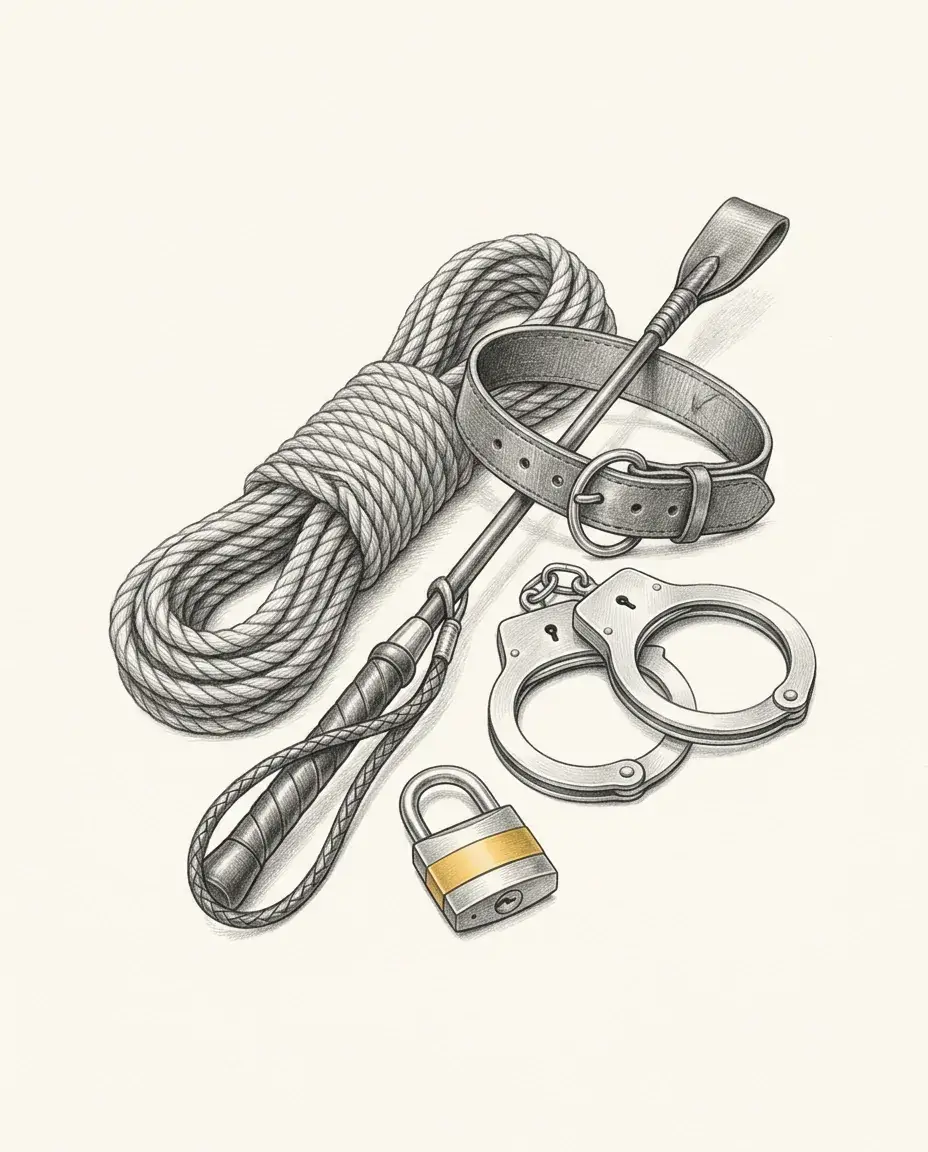
Bondage uses rope (jute or hemp are favoured in Japanese styles), leather or metal cuffs, chains, tape, or improvised items. Common forms, per the Wikipedia overview of bondage (BDSM), include binding limbs together or spreading them, fixing a partner to furniture or a frame, restricting movement, full-body wrapping ("mummification"), and, at the advanced end, suspension. It ranges from decorative tying to functional restraint that enables other negotiated activities, always with attention to position, duration, and circulation. Enclosure variants such as the vacuum bed extend the same principles to total sensory immobilisation.
Psychology
The appeal centres on trust, the surrender of control, and the focused, meditative headspace that immobility can produce, overlapping with the dissociative calm some describe as subspace. For the active partner it can centre on care, artistry, and responsibility. Mainstream sexology frames consensual restraint as a benign expression of power-exchange and sensation interests, and large general-population studies find BDSM practitioners to be psychologically well-adjusted.
Prevalence & culture
Bondage is among the most common kink interests. Joyal, Cossette & Lapierre (2015) found that roughly 52% of women and 46% of men reported fantasies of being tied up, and the broader survey by Joyal & Carpentier (2017) placed bondage and masochism-adjacent interests among the most prevalent in a general-population provincial sample. Pop culture, fashion shoots, and works such as Fifty Shades of Grey have pushed restraint imagery into the mainstream, while large fetish communities and the rope-art scene sustain it as a living practice.
Safety, consent & law
Bondage carries physical risk: nerve compression, restricted circulation, rope burns, and (if the chest, posture, or neck is involved) positional or postural asphyxia. Standard risk-reduction includes explicit negotiation and safewords, keeping safety shears within reach, never leaving a bound person alone, avoiding solo "self-bondage," staying sober, and checking limbs for colour, temperature, and sensation. Closely related practices such as collaring and post-scene aftercare embed the same ethic of care. Between consenting adults bondage is lawful in most jurisdictions; restraining a non-consenting person constitutes assault or unlawful imprisonment, and in some jurisdictions consent does not cover serious bodily injury.
Common questions
Is shibari the same thing as bondage?
Shibari is one style of bondage: the Japanese-derived rope tradition, with its own aesthetic conventions, characteristic patterns and preference for natural-fibre rope. English speakers use "shibari" for any decorative rope work; in Japanese the word means tying, and kinbaku is the term that carries the erotic sense. Cuffs, tape and cling film are all bondage and none of them are shibari.
What kind of rope is best for bondage?
For decorative and Japanese-style work, natural fibres (jute and hemp) are preferred for their grip and light weight, which is why they dominate the rope scene. Cotton and synthetic braids are softer and cheaper, forgiving for beginners, and slippery enough that knots need more care. Anything thin enough to cut in, such as paracord or twine, concentrates pressure on nerves and is a poor choice at any level of experience.
How do you tie someone up for the first time without hurting them?
Keep it simple and reversible: wide bands of rope, wrists in front, nothing weight-bearing, and a pair of safety shears within reach before the first wrap. Agree a safeword, stay in the room, and check colour, temperature and sensation in the hands every few minutes. Learning one or two ties well beats attempting an elaborate pattern from a photograph.
Where should rope never be tied?
Around the neck, without exception: it risks strangulation and no amount of care or experience makes it safe. Beyond that, rope over the front of the throat, across the outer upper arm, behind the knee, or in the crease of the groin sits over nerves and blood vessels close to the surface. Tingling, numbness, coldness or a hand that will not grip means the rope comes off at once.
How long is it safe to leave someone tied up?
There is no fixed number, because circulation, nerve pressure and position set the limit. Loose wrist ties in a comfortable position can be tolerated far longer than a tight or suspended one, which may become unsafe within minutes. The practical rule is to check sensation every few minutes, release at the first sign of numbness, and never leave a bound person alone for any length of time.
Does bondage have to be sexual?
No. A substantial part of the rope scene treats it as an art form or a physical discipline, practised at workshops and performed on stage with no sexual component at all. Others describe the appeal as meditative: the stillness and the pressure produce a focused, calm state closer to deep massage than to sex. Sexual and non-sexual practitioners share the same classes and events.
Is it safe to tie yourself up alone?
No, and it is the single riskiest form of the practice. Self-bondage removes the one safeguard that matters most: another person who can free you. The documented harms follow from that: a key dropped out of reach, a knot that tightens under load, a position that restricts breathing, with no one present to notice. Every safety guide in the field advises against it, and the workarounds people improvise fail in an emergency.
From the blog
Definitions5 min read
What a switch is, and how switching works
What is a switch in BDSM? A person who takes both dominant and submissive roles, estimated at 12 percent of adults, with survey shares and history.

How common6 min read
Do men and women have different kinks, and by how much
Do men and women have different kinks? Bondage appeals to 29.5% of men and 29.2% of women, threesomes to 34.1% and 11.1%. Where the surveys find a gap.
Relationships8 min read
How to tell a partner about a kink, and how partners respond
How to tell a partner about a kink: 71% who shared a favourite fantasy got a positive response, and only 28% who never shared expected one.

Definitions8 min read
What BDSM stands for, and what it covers
What does BDSM stand for? Bondage and discipline, dominance and submission, sadism and masochism: what each pair means, how common it is, where the lines are.
Mental health7 min read
Is my kink normal? One answer from the surveys, another from the manuals
Is my kink normal? By the surveys, yes for nearly everyone: two fantasies of 55 are rare. By the DSM-5-TR and ICD-11, a disorder needs distress or harm.
Definitions8 min read
Kink vs fetish, the difference and where the words come from
Kink is the everyday word for any unconventional sexual interest. Fetish means arousal tied to an object or body part. Where they overlap and where they part.
How common7 min read
The most common kinks, ranked by what the surveys found
The most common kinks, ranked by evidence: dominance and submission, bondage, foot fetish, roleplay and voyeurism lead 474 entries, read tier by tier.
- Suspension Bondage49/100Sensation & PainA form of consensual bondage in which a restrained person is partly or fully lifted off the ground from one or more overhead suspension points. Rope, webbing, cuffs, or chain carry the load. It is a technically demanding, higher-risk practice within the wider rope-bondage and BDSM world.49
- Vacuum Bed / Encasement Fetish27/100Objects & MaterialsAn interest in being sealed inside an airtight latex envelope from which the air is pumped out, shrink-wrapping and immobilising the body. It sits within total-enclosure fetishism and is a higher-risk form of bondage and sensory deprivation.27
- Collaring63/100Power, Roles & ScenariosThe consensual act of placing a collar on a submissive partner as a negotiated symbol of ownership, commitment, protection or submission. It takes place within a Dominant/submissive relationship and is often likened to a wedding band.63
- Subspace64/100Sensation & PainAn altered, often euphoric or trance-like headspace that some submissive or bottoming partners enter during intense BDSM play. It is marked by floating sensations, time distortion, reduced pain awareness and impaired verbal responsiveness.64
- Aftercare66/100Acts & ActivitiesThe deliberate emotional, physical and psychological care partners give one another after intense sex or a BDSM scene. It helps everyone come down from heightened arousal and return to a calm, grounded baseline. A widely shared best practice rather than a kink in itself.66
- Group Sex78/100Acts & ActivitiesSexual interest or fantasy involving more than two consenting adults at once, from threesomes to larger gatherings. It is among the most reported fantasies and a consensual practice within negotiated, lawful settings.78
From Middle English *bondage* "serfdom" (c. 1300), via Anglo-Latin *bondagium* "a tenure held by a bond tenant," from Middle English *bond* "tenant farmer, serf" (ultimately Old Norse *bóndi* "dweller, householder"); the sense was later coloured by the unrelated *bind/bond*. The specifically erotic "sexual restraint" sense is recorded from about 1961.
restraint & immobilisation · rope play · power exchange
Prevalence is computed from the entry's cited population estimate. Rows marked ESTare indicative editorial estimates scored against a fixed anchor rubric, not measured quantities. Method & anchors: methodology.
Very common · ≈ 1 in 7
- 01Bondage (BDSM), Wikipediadefinition, materials and methods, types/styles, historical figures (John Willie, Bettie Page), and core safety risks (postural asphyxia, nerve/circulation injury, self-bondage)
- 02Bondage, Etymology, Origin & Meaning, Online Etymology Dictionaryetymology: c.1300 'serfdom' from Anglo-Latin bondagium; erotic 'sexual restraint' sense dated to about 1961
- 03Joyal, Cossette & Lapierre (2015), What Exactly Is an Unusual Sexual Fantasy? J. Sexual Medicine 12(2):328-340general-population fantasy prevalence: ~52% of women and ~46% of men reported fantasies of being tied up
- 04Joyal & Carpentier (2017), The Prevalence of Paraphilic Interests and Behaviors in the General Population, J. Sex Research 54(2):161-171high reported prevalence of bondage/masochism interest in a general-population provincial sample
- 05Hojojutsu, Kinbaku and Shibari, ShibariNews historyJapanese lineage from Edo-period hojojutsu and Itō Seiyū's early-20th-century role in modern kinbaku/shibari
- 06Hojōjutsu, WikipediaEdo-period (1603–1868) martial art of restraining prisoners with cord, codified as functional craft rather than eroticism
- 07Kinbaku, WikipediaItō Seiyū as father of modern kinbaku, post-war spread via fetish magazines such as Kitan Club, and the contested hojojutsu-to-kinbaku lineage
- 08John Willie, Wikipediafetish magazine Bizarre (1946–1959) mainstreaming bondage imagery in the West
- 09Diagnostic and Statistical Manual of Mental Disorders (DSM), American Psychiatric AssociationDSM lineage narrowing paraphilic 'disorder' to cases with distress, impairment, or non-consent, depathologising consensual bondage
- 10ICD-11, WHO International Classification of DiseasesICD-11 framing consensual BDSM/bondage as non-pathological absent distress, impairment, or harm