
Collaring
Added 22 Jun 2026 · Updated 22 Aug 2026
The consensual act of placing a collar on a submissive partner as a negotiated symbol of ownership, commitment, protection or submission. It takes place within a Dominant/submissive relationship and is often likened to a wedding band.
- Prevalence
- Common
- Category
- Power, Roles & Scenarios
- Domain
- Sexual interest
- Confidence
- Medium confidence
- Status
- Common consensual D/s practice, not a disorder; recognised as non-pathological under DSM-5-TR and ICD-11 absent distress, impairment, or non-consent.
- Also known as
- BDSM collar, wearing a collar, collared, collar of consideration, training collar, formal collar, slave collar, day collar, collaring ceremony
- Added
- 22 Jun 2026
- Updated
- 22 Aug 2026
Featured in
Overview
Collaring is the consensual act of placing a collar around a submissive partner's neck as a symbol of a negotiated Dominant/submissive (D/s) relationship. The collar can signify ownership, commitment, protection, training or simply the start of a scene: its meaning is whatever the partners agree. A person in such a dynamic may be described as "collared" or "spoken for," and the collar itself, per the Wikipedia overview of collars in BDSM, functions "like a wedding band." This article traces the ritual's lineage, its staged forms, its psychology, and the consent and physical-safety considerations that give the symbol its weight.
Examples
A collar is an object, an act and a status at once, and which of the three is meant is usually clear from context. The confusion comes from the object, which turns up in plenty of places where none of the commitment meaning applies.
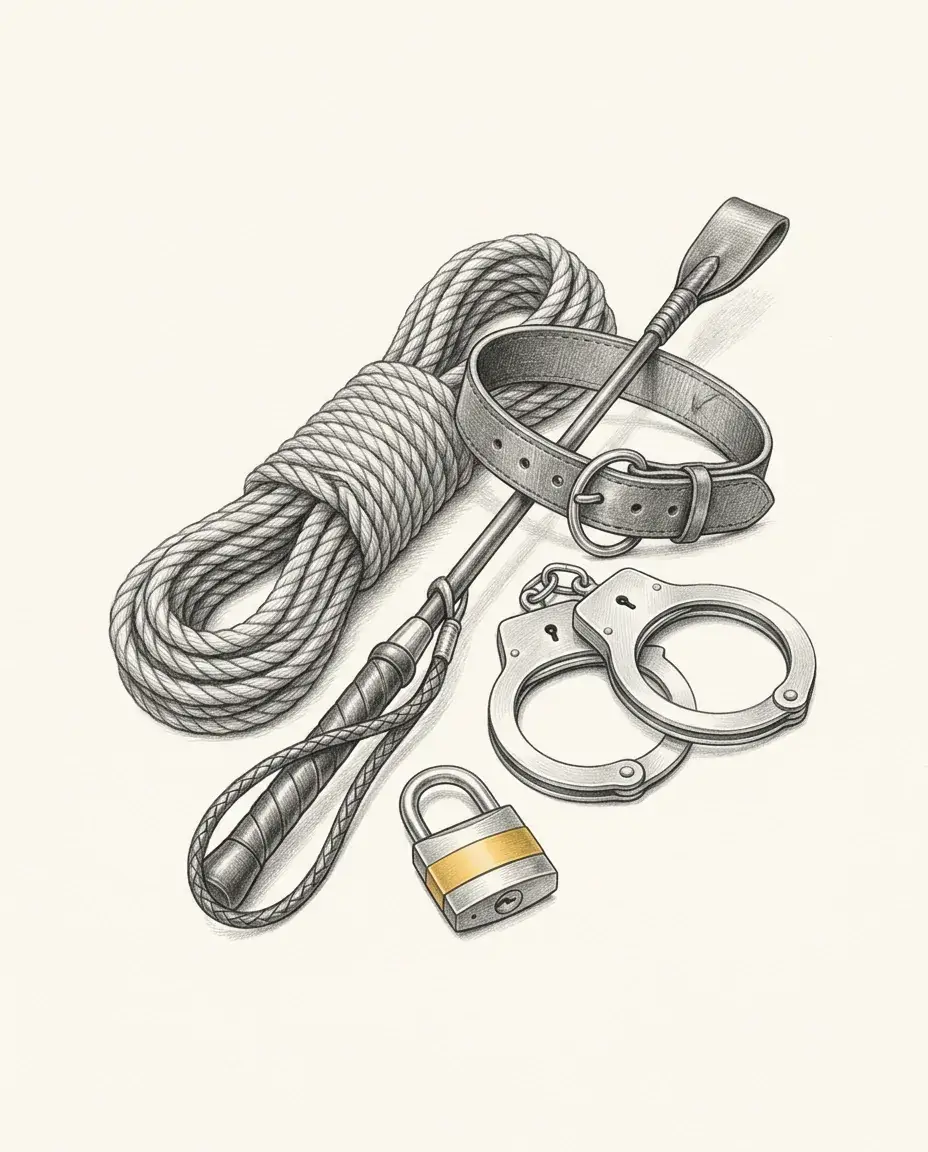
What the term covers. The act of putting the collar on, whether that is a private exchange of words or a ceremony with witnesses; the standing status it marks, described as being collared or spoken for; and the object itself, which may be a buckled leather band, a chain, a locking pendant, or an ordinary necklace the partners have agreed to treat as one. Because the meaning is set by the pair, an outsider who sees a collar can infer that something has been agreed but not what.
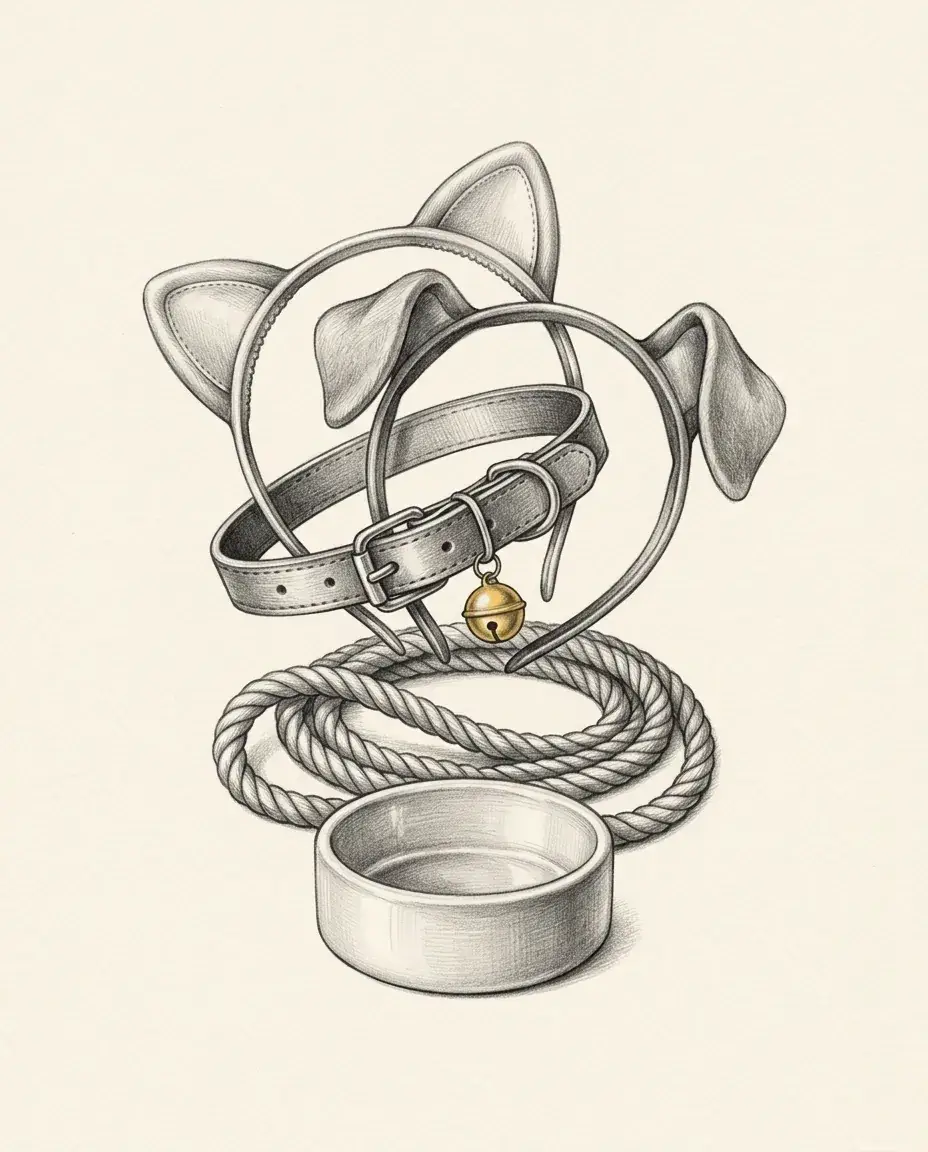
What the term does not cover. A collar worn as costume is not collaring. Animal-role dynamics such as kitten play, human pup play and pony play use collars as role gear, and a posture or scene collar in bondage is equipment; a fashion choker carries no claim at all. Nor does the collar create the relationship it marks: a master/slave dynamic or total power exchange is constituted by the agreement between the partners, and the Gorean tradition attaches its own separate meanings to the same object. A collar is also not an attachment point or a restraint: it is not a choking or breath play implement.
How the word is used. Community jargon throughout (the verb "to collar", the adjective "collared", the compound "collaring ceremony") with no clinical standing and no mention in DSM-5-TR or ICD-11.
History & origins
The collar as a neck-worn band is ancient, but its BDSM meaning is comparatively young, and there is no single coiner: "collaring" is plain-English jargon, the verb sense of collar applied within kink.
Clinical & sexological backdrop
The nineteenth-century sexologists who first catalogued dominance and submission, Krafft-Ebing's Psychopathia Sexualis (1886) and Havelock Ellis's Studies in the Psychology of Sex, described masochistic surrender and symbolic bondage but did not isolate the collar as a distinct ritual object; collaring as a codified practice is a community development rather than a clinical one.
The Old Guard and leather protocol
Much of the surrounding ritual is traced to the post-war gay leather "Old Guard." Accounts such as the Evil Monk history of the Old Guard describe a subculture coalescing among World War II veterans who returned around 1946 and carried military notions of hierarchy, protocol and earned rank into motorcycle and leather clubs; the style "jelled by the mid- to late 1950s," with firm rules in place by 1970. In that tradition a collar signified enslaved status: a bottom did not own a collar except as custodian of a particular Top's collar, and "a bottom wearing a collar is a slave, and belongs to the owner of the collar who, presumably, has the keys," with the collar returned if the relationship ended.
Elaboration and the staged-collar system
Later heterosexual and Gorean-influenced scenes elaborated a staged progression of collars, the consideration / training / formal sequence now common in community guides, and the practice spread through leather clubs, magazines and, from the 1990s, online communities such as forums and later FetLife.
In practice
Community convention often describes three stages: a collar of consideration (an early, exploratory commitment, loosely like a pre-engagement ring), a training collar, and a formal collar signifying a lasting, marriage-like bond, as set out in collar guides like Kneel's typology. A day collar is a discreet item (frequently jewellery such as a choker, chain or locking pendant) worn in public where an overt collar would be inappropriate; per Wikipedia, some collars are lockable or tamper-evident, fitted with a padlock spot or requiring a special tool such as a hex key to don or doff. A collaring ceremony may formalise the bond, ranging from a private exchange of words to a community event with witnesses, vows or poems and a written agreement. Collaring frequently sits alongside bondage, negotiated aftercare and, in deeper dynamics, total power exchange.
Psychology
The appeal centres on belonging, trust, devotion and the security of a clearly defined role. For the submissive a collar can externalise surrender and the experience of being cared for; for the Dominant it carries a reciprocal responsibility to guide and protect. Many describe it like a wedding ring: an ongoing, visible emblem of consent and commitment rather than a fetish object in the narrow sense. The mechanism is best understood through attachment and ritual meaning rather than any single arousal pathway, and the formal psychological literature on collaring specifically is sparse.
Prevalence & culture
Collaring is a common feature of D/s culture rather than a standalone paraphilia, so it is not measured directly; its prevalence is inferred from the broad popularity of dominance and submission. Joyal, Cossette & Lapierre (2015), surveying 1,516 adults, found submission and domination themes "common", present in more than half the sample, for both men and women, and Lehmiller's (2018) survey of 4,175 Americans likewise reports very high rates of submission and dominance fantasy. Within that population, collars are a near-universal shorthand for BDSM in fashion, film and fiction, and collaring ceremonies feature prominently in community life on platforms such as FetLife.
Safety, consent & law
Collaring is primarily symbolic, but a neck-worn collar carries physical considerations: it should never restrict breathing or blood flow, should not be used as a pulling or leash point under load, and locking or tall "posture" collars warrant a reliable means of quick release. Emotionally, the meaning rests on consent, negotiation and the standing option to revoke: protocol and agreement create the bond, not the lock. The practice is lawful between consenting adults; any "ownership" a collar signifies is purely symbolic, as no consent can create a literal property interest in a person.
Common questions
What does it mean when someone says they are collared?
That they are in a committed dominance and submission relationship which both partners have marked with a collar, and are not available for that kind of relationship with anyone else. In community spaces it works as a social signal in roughly the way a wedding ring does. The detail (how exclusive, how formal, what obligations attach) is set privately by the two people, so it cannot be read off the collar itself.
Is a collar really like a wedding ring?
The comparison is the one practitioners themselves reach for, and it captures the visibility and the seriousness well. It breaks down on everything institutional: a collar has no legal status, no registry, no procedure for ending it, and no default meaning a third party could assume or enforce. It is a private agreement given a public symbol, which makes it closer to a promise than to a contract.
Can you wear a collar without being in a D/s relationship?
Yes, and many people do. Collars appear as costume in pet play, as equipment in bondage, and as plain fashion carrying no kink meaning whatsoever. Some people wear one for themselves, as a private reminder rather than as any partner's mark. Inside kink spaces an obvious collar is usually read as significant, so it is worth knowing what it signals there.
Is it safe to sleep in a collar?
Only if it is one you could remove instantly and it cannot tighten or catch on anything. The concerns are pressure on the neck and snagging: a collar should never restrict breathing or blood flow, and anything with a dangling ring, a lock, or a fit that shifts as you move is a poor choice for unsupervised hours. Many people use a light day collar for this and keep heavier ones for waking hours.
Does being collared mean you are owned?
Symbolically yes, literally no. The word is used inside the dynamic and means whatever the partners have agreed it means. Legally it means nothing: consent cannot create a property interest in a person, no agreement transfers rights over anyone, and either party can end the arrangement at any time regardless of what was said at the ceremony. The symbol carries the weight; it carries no authority.
What happens to the collar if the relationship ends?
In the Old Guard tradition described above it goes back to the person who gave it. Outside that lineage there is no single rule and couples differ: some return it, some keep it, some hold a ceremony to mark the ending. Because it is an emotionally loaded question at the worst possible moment, it is usually settled as part of the original negotiation rather than improvised afterward.
Is a collar a fetish object?
For most people in a collared dynamic, no: it is a relationship symbol, and the meaning does the work rather than the material. It can be both, and often is where someone also has a leather fetish or responds to the weight and feel of the thing itself. The distinction matters because a collar bought for its look and a collar given as a commitment are not the same object socially, however similar they look.
- Total Power Exchange46/100Power, Roles & ScenariosA consensual BDSM relationship structure in which one partner cedes broad authority over their life to another on an ongoing basis. It extends dominance and submission beyond scenes into everyday living.46
- Bondage86/100Acts & ActivitiesConsensual binding or restraint of a partner with rope, cuffs, tape or other materials for erotic, aesthetic or sensory pleasure. It is the "B" of BDSM and one of the most widely fantasised-about kinks.86
- Aftercare66/100Acts & ActivitiesThe deliberate emotional, physical and psychological care partners give one another after intense sex or a BDSM scene. It helps everyone come down from heightened arousal and return to a calm, grounded baseline. A widely shared best practice rather than a kink in itself.66
- Subspace64/100Sensation & PainAn altered, often euphoric or trance-like headspace that some submissive or bottoming partners enter during intense BDSM play. It is marked by floating sensations, time distortion, reduced pain awareness and impaired verbal responsiveness.64
- Human Pup Play49/100Identity & TransformationA consensual adult role-play in which a participant adopts the mannerisms, body language, and headspace of a dog, usually a puppy. Participants are often paired with a handler or trainer. It is a form of animal role-play involving humans only and is explicitly distinct from any interest in real animals.49
- Praise Kink63/100Power, Roles & ScenariosAn erotic enjoyment of receiving verbal praise, affirmation, or encouragement from a partner, phrases such as "good girl/good boy" or "you're doing so well". The interest often, though not exclusively, sits within dominance and submission dynamics.63
Plain-English BDSM term from the noun *collar* (the act of putting one on). *Collar* entered English c. 1300 as *coler* / *coller*, from 12th-century Old French *coler*, from Latin *collare* "band or chain for the neck," from *collum* "neck" (PIE root *kwel-* "revolve, move round"; the neck as "that on which the head turns"). A verb sense "to grab by the collar" is attested from the 1550s; the BDSM gerund "collaring" applies that verb within kink, and has no single documented coiner.
Dominance & submission · ownership & commitment · ritual & protocol
Prevalence is computed from the entry's cited population estimate. Rows marked ESTare indicative editorial estimates scored against a fixed anchor rubric, not measured quantities. Method & anchors: methodology.
Common · ≈ 1 in 20
- 01Collars in BDSM, Wikipediacore definition of collaring; collars signify ownership/connection in a dom/sub relationship; day collars as jewellery; wedding-band analogy; lockable/tamper-evident collars
- 02The Old Guard: History, Origins and Traditions, Evil MonkOld Guard leather history; post-WWII military-influenced protocol; a bottom's collar marking ownership by a particular Top who holds the key
- 03BDSM Collar Types & Meanings: From Day Collars to Ceremony, Kneelthree-stage progression (collar of consideration, training collar, formal collar) and collaring ceremonies with vows and written agreements
- 04Collar, Online Etymology Dictionaryetymology of 'collar': c.1300 from Old French coler, Latin collare 'band for the neck,' from collum 'neck'
- 05Joyal, Cossette & Lapierre (2015), What Exactly Is an Unusual Sexual Fantasy? J. Sexual Medicine 12(2):328-340general-population prevalence of domination/submission fantasies underpinning the broad popularity of D/s contexts in which collaring occurs
- 06Lehmiller (2018), Tell Me What You Want, survey of 4,175 Americanshigh reported rates of submission/dominance fantasy in a large U.S. sample of 4,175, contextualising D/s prevalence
- 07Psychopathia Sexualis, WikipediaKrafft-Ebing's 1886 sexological catalogue of dominance/submission and masochistic surrender, the clinical backdrop predating codified collaring
- 08Studies in the Psychology of Sex, WikipediaHavelock Ellis's sexological work on submission and symbolic bondage, part of the lineage that did not isolate the collar as a ritual object
- 09FetLife, Wikipediathe online BDSM social platform through which collaring practice and ceremonies circulate in community life from the 2000s onward