Anthropological Fetishism
Added 26 Jul 2026 · Updated 22 Aug 2026
The original, pre-sexual sense of "fetish": an object credited with independent power or agency, a concept of European making. Traders and scholars built it out of contact with West African religious practice. It is the etymological root of every later use of the word, including the sexual one.
- Prevalence
- Common
- Category
- Non-Sexual Fetishism
- Domain
- Non-sexual interest
- Confidence
- Low confidence
- Status
- Not a clinical or psychological condition; a historical category in the comparative study of religion, and the etymological root of the later clinical and economic senses of "fetishism."
- Also known as
- fetishism (religion), fétichisme, object worship, fetish worship, religious fetishism
- Added
- 26 Jul 2026
- Updated
- 22 Aug 2026
Overview
Long before "fetish" meant anything sexual, it named a category in the study of religion: a material object, such as a carved figure, a bundle of charms, or an ordinary stone or bone, treated as if it possessed its own will, power, or personality, independent of any god or spirit that might also be worshipped. This sense is the trunk from which every other branch of the word grew, including the economic "commodity fetishism" of Karl Marx and the clinical sexual fetishism catalogued elsewhere in this directory. This entry is strictly non-sexual and describes an idea about religion and material culture, not a personal interest or a paraphilia.
Examples
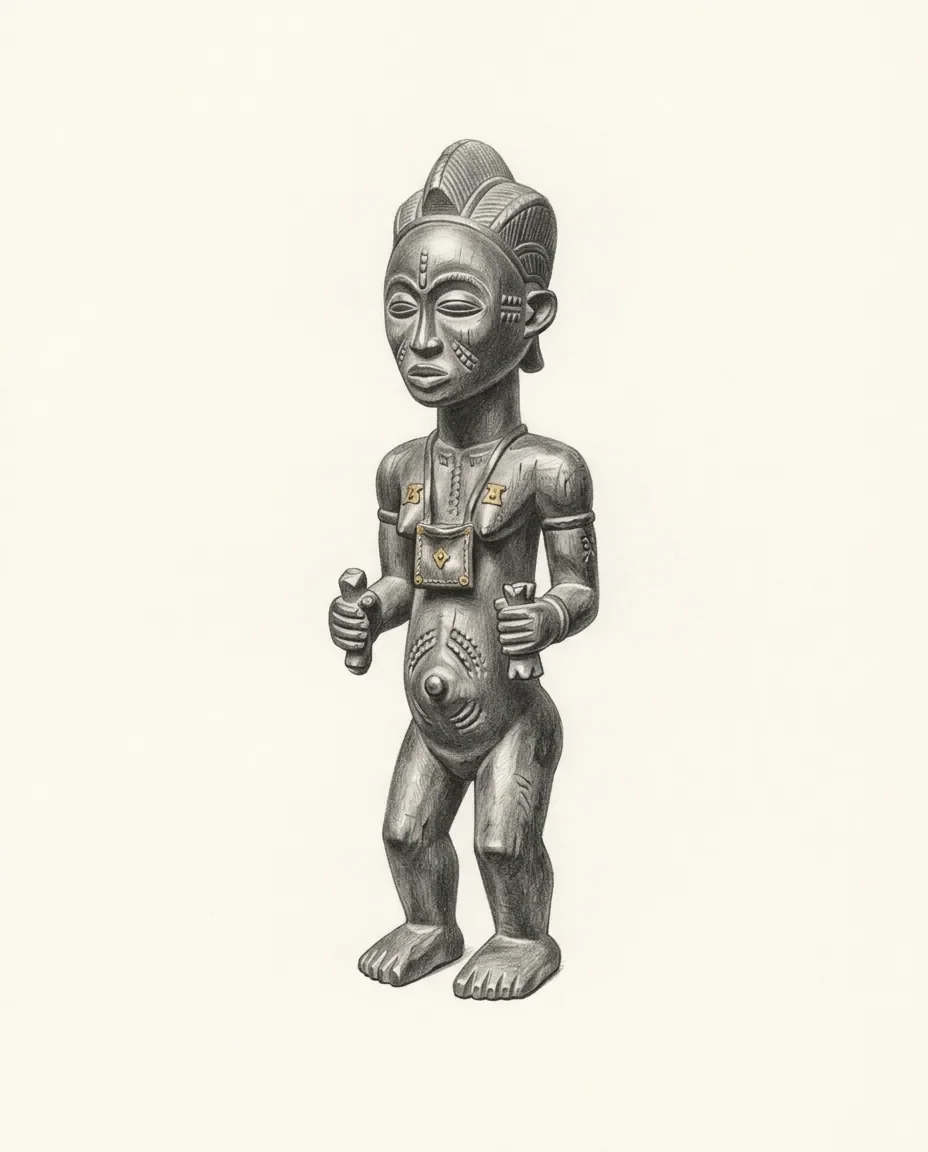
What the term covers. The objects eighteenth- and nineteenth-century European writers grouped under the label: carved wooden figures, bound charm bundles, amulets worn on the body, and unremarkable stones, teeth, horns or bones kept at a shrine, each credited with acting in the world through its own power rather than merely standing for a distant god. The category was always broader in European writing than in any single African tradition, and it covers the idea as much as the things: a scholarly claim about how other people relate to matter. The object class itself is treated separately under power object.
What it does not cover. It is not the clinical sexual fetishism, which borrowed the word in the nineteenth century, nor Marx's commodity fetishism, which borrowed it earlier for an argument about value and labour. It is not relic veneration, where a saint's remains are honoured as a conduit to a person rather than as an independently powerful thing, and it is not the secular attachment described under lucky charm or brand worship. It has nothing to do with object sexuality: nothing in this entry is erotic.
How the word is used. The register is scholarly and historical, and increasingly quarantined in quotation marks, because the term says as much about eighteenth-century European observers as about anything they observed. It is not a diagnosis and appears in neither DSM-5-TR nor ICD-11, which carry only the unrelated sexual sense. Writing that "de Brosses' fétichisme was a theory of Europe as much as of the Guinea coast" is idiomatic precisely because the category was assembled in the contact zone rather than found there.
History & origins
Contact on the Guinea coast
The word descends from Portuguese feitiço ("charm" or "sorcery"), itself commonly traced to Latin facticius, "made by art." Portuguese traders on the West African coast from the fifteenth century onward used feitiço for the amulets, bundles, and carved objects they saw local communities venerate, folding together the neutral idea of a "charm" with the more loaded European notion of "witchcraft." The Dutch merchant Willem Bosman's early eighteenth-century account of the Guinea coast trade became one of the most cited European sources on these objects; the scholar William Pietz built his influential three-part study "The Problem of the Fetish" (RES: Anthropology and Aesthetics, 1985–1988) around the argument that "fetish" was not a timeless anthropological category at all, but a concept invented in the friction of European–African trade contact, with Bosman's book as a key primary text.
De Brosses names it, 1760
The term entered scholarly French through Charles de Brosses (1709–1777), a Dijon magistrate and philologist who, in Du culte des dieux fétiches ("On the Worship of Fetish Gods," 1760), coined fétichisme to describe the worship of raw material objects, comparing West African practice to what he took to be an equally object-centred strand of ancient Egyptian religion. It is, by most accounts, the first recorded use of the word in this generalized theoretical sense, and it gave the emerging comparative study of religion a ready-made label for what looked, to its eighteenth-century readers, like the most "primitive" possible form of belief.
A stage in the evolution of religion
Nineteenth-century thinkers folded de Brosses' term into grand schemes for the history of religion itself. Auguste Comte made fetishism the earliest sub-stage of his "theological" phase in the law of three stages, the idea that religious thought moves from fetishism through polytheism to monotheism before societies mature into positive, scientific reasoning. Later, Edward Burnett Tylor, in Primitive Culture (1871), proposed animism, the belief that souls or spirits inhabit things, as a broader account of early religion; Tylor's animism was, by his own framing, "little different" from Comte's fetishism, and the two terms drifted toward distinct meanings only as later anthropology grew wary of ranking world religions on a single ladder from "primitive" to "advanced."
Two later borrowings
De Brosses' word proved useful well outside religious studies. Marx used it as early as 1842 and built the metaphor fully into Capital (1867), where commodity fetishism describes how manufactured goods seem to carry value as a property of the object itself rather than of the labour that made them; that sense is covered in full in Commodity Fetishism. Decades later, nineteenth-century sexologists borrowed the same word again, this time for erotic attachment to objects and body parts, a lineage traced in the Fetishism entry. Both descend from de Brosses' religious fétichisme, but neither is this entry's subject.
In practice
Outside the history of ideas, the anthropological sense survives chiefly in museum and religious-studies contexts describing objects from Central and West African traditions such as Vodun, and in occasional lay use for any object treated as though it holds power on its own, a lucky object kept for its felt effect being the everyday, secular cousin discussed under lucky charm. The underlying pattern, crediting an inert object with agency or protective force, also runs through modern brand worship and through the broader idea of a power object, though those entries describe distinct modern phenomena rather than the historical category itself.
Psychology
Attributing agency, personality, or power to inanimate things is a documented and near-universal cognitive tendency, not a disorder; developmental psychologists find it in young children's play long before any religious instruction, and it underlies everything from talismans to a favourite tool that "just works." The nineteenth-century theorists treated fetishism as evidence of a primitive mental stage that societies grow out of, a framing modern anthropology has mostly abandoned as ethnocentric, while the psychological tendency itself, attaching meaning and even a kind of agency to objects, is now understood as ordinary and lifelong.
Prevalence & culture
As a historical category rather than a personal trait, "prevalence" does not apply to anthropological fetishism the way it does to a fantasy or a hobby; what can be measured is the term's durability in scholarship. It remains a stock reference point in the history of religious studies and colonial history, name-checked wherever the vocabulary of "fetish," "fetishism," or "commodity fetishism" is explained, and its West African religious referents (bundles, altars, carved figures) are still displayed and discussed under that historical label in museum and academic writing, even as many scholars now prefer more specific, less loaded terminology for the objects themselves.
Safety, consent & law
The concept carries no consent, harm, or legal dimension; it names an idea about religion and material culture, not a practice performed on or with another person. Its main modern hazard is definitional: because the same four syllables now cover a religious category, an economic metaphor, and a sexual paraphilia, careless use of "fetish" can flatten a serious anthropological or historical discussion into an unintended sexual connotation.
Common questions
Is anthropological fetishism the same as a sexual fetish?
No. They share a word and an etymology and nothing else. The anthropological sense names an object credited with independent power, a category European traders and scholars built out of contact with West African religious practice. Nineteenth-century sexologists borrowed the same word for erotic attachment to objects and body parts, which is covered separately under sexual fetishism. The religious sense is the older one, and it is not erotic in any respect.
Who coined the word "fetishism"?
Charles de Brosses, a Dijon magistrate and philologist, in Du culte des dieux fétiches in 1760, where he used fétichisme for the worship of raw material objects and compared West African practice to what he took to be an object-centred strand of ancient Egyptian religion. The underlying word is older: Portuguese traders had been using feitiço, meaning charm or sorcery, for venerated West African objects since the fifteenth century.
Is it offensive to call an African religious object a fetish?
Many scholars and museums now avoid it, and say so openly. The word was applied from outside, by traders and colonial writers who treated the objects as evidence of a primitive stage of belief, and it flattens distinct traditions into a single European category. Current practice is to use a tradition's own terminology where it is known and to name objects specifically, keeping "fetish" for discussion of the concept's history rather than for the things themselves.
What is the difference between a fetish and an idol?
An idol is an image of a god: it represents a deity who exists independently of it, and worship travels through the image to that being. A fetish, in this older scholarly sense, was said to hold power in itself, so that it acts rather than refers. The distinction was drawn by European theorists rather than by the communities they described, and modern anthropology treats it as a feature of that theory rather than a reliable description of anyone's practice.
Is fetishism a religion?
No. No community has ever described its own practice as fetishism; the word is an outside label, invented in European scholarship for what its authors took to be the most primitive possible form of belief. Auguste Comte went further and made it the first stage of religion itself, a ranking later anthropology abandoned as ethnocentric. The traditions the label was applied to, such as Vodun, are religions in their own right and are better named as such.
What does commodity fetishism have to do with religion?
It is a deliberate metaphor. Marx took de Brosses' religious term and applied it to manufactured goods, arguing that they appear to carry value as a property of the object itself, the way a fetish was said to carry power, when that value in fact comes from the human labour that produced them. The borrowing, and what Marx did with it, is covered in full under commodity fetishism.
- Fetishism64/100Fetishistic Disorder · Clinical ParaphiliasA DSM-5-TR paraphilic disorder defined by recurrent, intense arousal from nonliving objects or a strong focus on non-genital body parts. The body-part form is partialism, and the arousal must cause clinically significant distress or impairment. An object or body-part preference without distress is not a disorder.64
- Commodity Fetishism34/100Non-Sexual FetishismA concept from Marxist economic and social theory describing how commodities appear to possess intrinsic value and social power. That appearance masks the human labor and social relations that actually produce them. It is a non-sexual, analytical use of the word "fetish."34
- Brand Worship44/100Non-Sexual FetishismA non-sexual fixation on brands, logos, and designer labels, in which the brand itself becomes a source of identity, status, and emotional attachment. Branded goods are valued largely for their symbolic and signalling power rather than their function.44
- Lucky Charm39/100Non-Sexual FetishismA non-sexual attachment to objects believed to carry protective, lucky, or supernatural power, such as amulets, talismans and charms. They are invested with personal or cultural meaning rather than erotic significance. This is the original anthropological sense of the word "fetish."39
- Power Object30/100Non-Sexual FetishismIn anthropology and religious studies, a power object is a crafted or found item believed to hold spiritual power or agency. It is the original sense of the word "fetish", and is used in ritual to heal, protect, bind oaths, or influence events. The term is non-sexual and concerns material religion, not erotic interest.30
- Bibliomania29/100Bibliomania · Non-Sexual FetishismAn excessive, driven compulsion to collect books, often prizing rarity, first editions and completeness over reading itself. It can reach a degree that strains finances or living space. It is a historical and colloquial term, not a standalone diagnosis in current clinical manuals.29
From Portuguese feitiço ("charm, sorcery"), from Latin facticius ("artificial, made by art"); applied by Portuguese and later Dutch traders to venerated objects encountered on the West African coast, and given its scholarly name, fétichisme, by the French historian Charles de Brosses in 1760.
religious studies · anthropology · history of ideas · etymology
Prevalence is computed from the entry's cited population estimate. Rows marked ESTare indicative editorial estimates scored against a fixed anchor rubric, not measured quantities. Method & anchors: methodology.
Common · ≈ 1 in 20
- 01Fetishism (religion), WikipediaPortuguese feitiço etymology, the colonial-trade origin of the term on the West African coast, and Comte's use of fetishism as the earliest stage of religious evolution
- 02Charles de Brosses, Wikipediade Brosses' dates (1709-1777), his 1760 Du culte des dieux fétiches as the first recorded use of 'fétichisme,' and the term's later adoption by Marx
- 03William Pietz, WikipediaPietz's 'The Problem of the Fetish' (1985-1988) and its argument that 'fetish' originated in West African-European trade contact, centered on Willem Bosman's account of the Guinea coast
- 04Law of three stages, WikipediaComte's placement of fetishism as the first sub-stage of the theological phase, preceding polytheism and monotheism
- 05Animism, WikipediaTylor's animism (Primitive Culture, 1871) as a theory 'little different' from Comte's fetishism, and the later divergence of the two terms
- 06Edward Burnett Tylor, WikipediaTylor's dates and his 1871 Primitive Culture as the source of his animism theory
- 07Paraphilia, Wikipediaconfirms the anthropological/religious sense of 'fetishism' is distinct from, and historically prior to, the clinical paraphilia of the same name