Relic Veneration
Added 21 Jun 2026 · Updated 22 Aug 2026
Relic veneration is the devotional honoring of sacred physical remains or objects as conduits of blessing or divine presence. The bones of a saint and items associated with holy figures are typical. It is a non-sexual religious practice, not an erotic interest.
- Prevalence
- Common
- Category
- Non-Sexual Fetishism
- Domain
- Non-sexual interest
- Confidence
- Medium confidence
- Status
- Not a clinical or psychological condition; a mainstream religious and devotional practice studied within religious studies and material religion.
- Also known as
- religious relic veneration, sacred object devotion, reliquary cult, veneration of relics
- Added
- 21 Jun 2026
- Updated
- 22 Aug 2026
Overview
Relic veneration is the devotional honoring of material remains or objects connected to a saint, prophet, or sacred figure (bones, ashes, garments, tools, or items they are believed to have touched) as channels of holiness, intercession, or divine power. It is a mainstream, non-sexual religious practice, prominent in Catholic and Eastern Orthodox Christianity and in Buddhism, where the bodily relics of the Buddha and revered teachers are enshrined in stupas. Theologically it is distinguished from worship: the relic is venerated as a focus of devotion, while adoration (latria) is reserved for the divine alone. This article traces the documented history of the practice, how it is expressed, and why it sits in this directory only as a matter of taxonomy.
The "fetishism" association here is purely terminological. In the anthropological sense, a fetish is an object invested with power and meaning; relics fit that frame without any erotic component. The entry is catalogued for completeness alongside other forms of non-sexual object devotion such as the power object, not because the practice is sexual. It carries none of the eroticized object-attachment of object sexuality whatsoever.
Is relic veneration the same as worship?
No. In Catholic and Orthodox theology the relic receives veneration (dulia), an honour that passes through the object to the holy person and ultimately to God, whereas adoration (latria) is reserved for God alone. The distinction was formalised at the Second Council of Nicaea in 787.
Examples
What the term covers. The category is wide and almost entirely material. Bodily remains come first: the bones of a martyr set beneath an altar, ashes, hair, a preserved hand or heart. Then objects a holy person owned or used, such as a habit, a chalice or a writing desk. Then things brought into contact with either, which is how a plain strip of cloth becomes a devotional item. Outside Christianity the same logic produces the Buddha's cremated remains enshrined in stupas across Asia, and the tooth relic carried in procession at Kandy. What unites them is not the substance but the claim of contact with a holy person.
What it does not cover. Nothing here is erotic. Hierophilia, a rare paraphilic interest in sacred objects, vestments and ritual imagery, is the one genuinely sexual neighbour and is a different phenomenon entirely, as is object sexuality, where the object is the partner. A lucky charm is a personal talisman with no saint behind it and no institution around it, and a power object is made to act on the world rather than to honour someone. Nor is this collecting, antiquing or taxidermy collecting: a relic in a private cabinet, prized for rarity, has left the practice this entry describes.
How the word is used. "Veneration of relics" is the ordinary term in theology, religious studies and museum conservation, and it is used in that neutral sense here. Its presence in a catalogue of fetishes is a matter of vocabulary alone: in its older anthropological sense a fetish is an object invested with power, the same sense at work in commodity fetishism. Neither DSM-5-TR nor ICD-11 mentions relic veneration, because it is a religious practice and not a psychological category.
History & origins
The veneration of relics is ancient and cross-cultural, with two great surviving traditions, Christian and Buddhist, both reaching back close to their founders.
Christian lineage
- c. 155–160 CE: The Martyrdom of Polycarp, describing the death of the bishop of Smyrna, records the faithful gathering up his bones, "more valuable than precious stones and finer than refined gold," and laying them in a fitting place to commemorate the anniversary of his martyrdom. It is among the earliest documented accounts of both relic veneration and the annual feast of a saint.
- Late antiquity: Through the patristic age the cult of the martyrs spread, relics were placed beneath altars, and shrines (martyria) drew pilgrims. The theologian John of Damascus (8th century) articulated the key defense: honor paid to a holy person, through a relic or image, ultimately ascends to God.
- 787 CE: The Second Council of Nicaea, settling the iconoclast controversy, affirmed the legitimacy of venerating relics and images while distinguishing veneration (dulia) from the worship owed to God alone; it also directed that altars contain relics.
- Middle Ages: Relics became central to the cult of saints, anchoring the prestige and wealth of churches and monasteries, motivating pilgrimage routes such as Santiago de Compostela, and prompting the goldsmithing of elaborate reliquaries. The booming trade also bred anxieties about authenticity and outright forgery-satirized in Chaucer's Pardoner.
- 1543: In his Treatise on Relics, the Reformer John Calvin mocked the proliferation of relics, claiming that the fragments of the True Cross venerated across Europe would together "form a whole ship's cargo." The treatise ran to at least ten sixteenth-century editions; the Council of Trent (1563) responded by reaffirming the practice and tightening oversight of authenticity.
Buddhist lineage
- 5th century BCE: After the cremation of the historical Buddha (died c. 483 BCE), his bodily relics (śarīra) were, by tradition, divided among eight claimants and enshrined in commemorative mounds (stupas), founding a relic-centered geography of pilgrimage.
- 3rd century BCE: The emperor Ashoka is said to have redistributed the relics among a vast number of new stupas, spreading the cult across the subcontinent and beyond.
- Continuing tradition: Tooth and bone relics remain major pilgrimage focuses; the Buddha's tooth relic at the Temple of the Tooth in Kandy, Sri Lanka, brought there in the 4th century CE, is honored with an annual procession and was historically tied to royal legitimacy.
The English word relic itself entered the language via Latin reliquiae, "remains, what is left behind."
In practice
- Pilgrimage to shrines, cathedrals, and stupas that house notable relics.
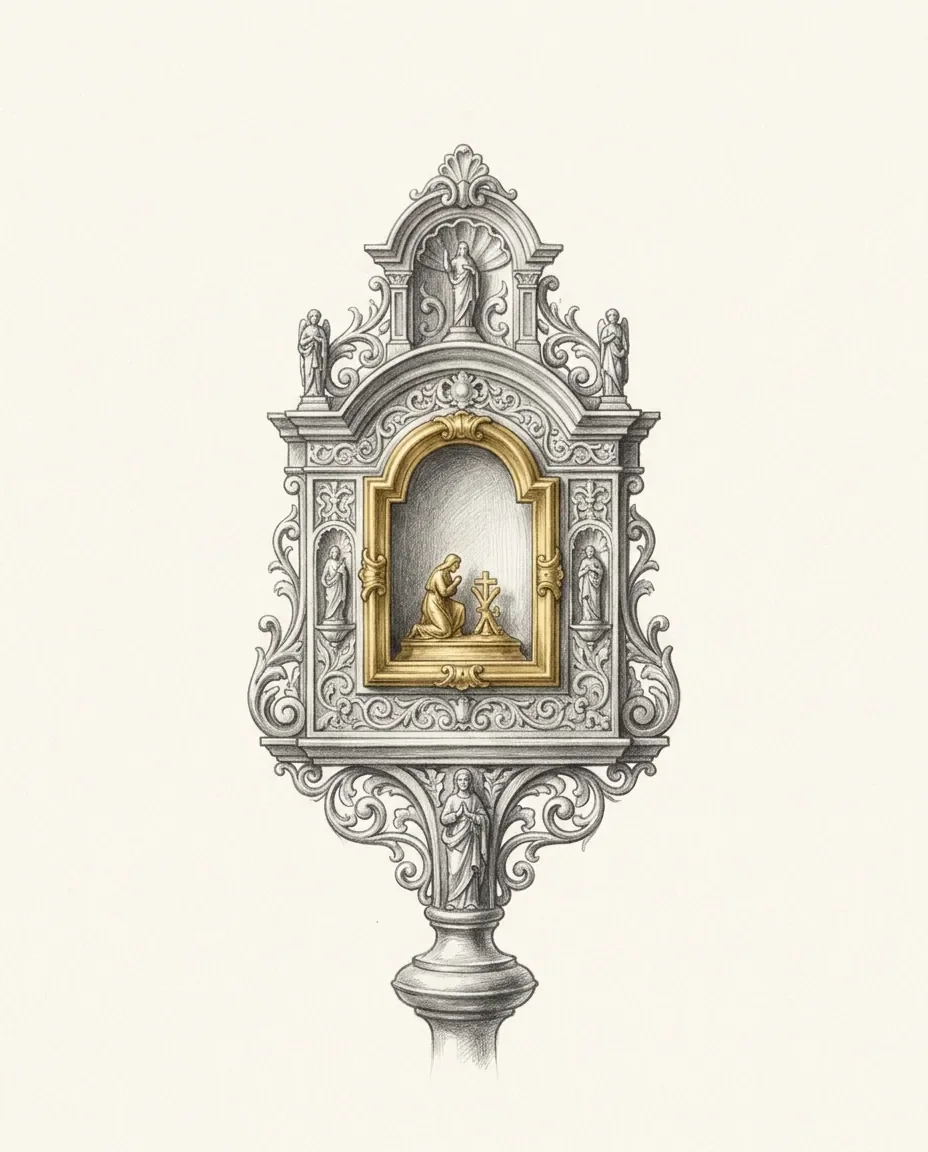
- Housing of relics in ornate reliquaries for protection and display.
- Public processions, exposition, and feast-day veneration.
- Touching, kissing, or praying near a relic, often seeking healing or intercession.
Relics are conventionally graded (first-class (the body or its parts), second-class (possessions or clothing), and third-class (objects touched to a first-class relic)) and major sites can draw enormous numbers of pilgrims, historically shaping the religious and economic life of churches and monasteries.
Psychology
The practice reflects a widespread human tendency to locate the sacred in tangible objects, to seek closeness to revered figures through physical proximity, and to find comfort, continuity, and communal identity in shared devotional material. Scholars of "material religion" and the anthropology of the sacred treat physical contact with a holy object as a way of making the abstract divine feel present and accessible. None of this is clinical or pathological: it is ordinary religious cognition, not a disorder, and stands apart from the eroticized object-attachment of object sexuality.
Prevalence & culture
Relic veneration is a large-scale, mainstream practice within several of the world's major religions, giving it broad familiarity and high cultural visibility through famous shrines, cathedrals, and pilgrimage routes-from the relics held in St. Peter's Basilica to the Temple of the Tooth at Kandy. Research attention is considerable across history, theology, religious studies, and museum conservation. As a religious devotional act it carries no clinical status and appears in no diagnostic manual.
Safety, consent & law
The practice is non-sexual and not harmful. Practical concerns are limited to authenticity, provenance, and the ethical handling and respectful stewardship of human remains and sacred items-matters of custodianship, conservation, and (for human remains) heritage and repatriation law, rather than personal conduct.
Common questions
Is relic veneration a sexual fetish?
No. It is a religious devotional practice, and nothing about it is erotic. The entry appears in a catalogue of fetishes only because "fetish" has an older anthropological meaning (an object invested with power) that predates the sexual one and still describes relics accurately. The sexual interest in sacred objects and vestments is a separate and much rarer phenomenon, hierophilia.
How do you know a relic is genuine?
Mostly you do not, at least not forensically. A relic is normally accompanied by a sealed certificate from the church authority that authenticated it, and its credibility rests on that documentary chain rather than on physical testing. The chain is often thin or broken, and modern scientific dating has undercut some famous claims. Doubt is not a recent intrusion: the medieval trade produced so many duplicate relics that it drew sustained satire from inside and outside the Church.
Can relics heal you?
There is no scientific evidence that a relic causes physical healing, and the practice's own theology does not claim the object has power of its own. In Catholic and Orthodox teaching any benefit comes from God, sought through the intercession of the saint the relic represents; the material is a point of contact rather than a cause. Reported cures at shrines are examined case by case within church processes, and most are not accepted.
Which religions venerate relics?
Most prominently Catholic and Eastern Orthodox Christianity, where relics are placed in altars and housed in reliquaries, and Buddhism, where the cremated remains of the Buddha and of revered teachers are enshrined in stupas across Asia. Most Protestant churches rejected the practice at the Reformation and keep no relics. Traditions of honouring the remains or possessions of holy figures exist in other religions too, though the vocabulary and theology around them differ.
Is it legal to buy and sell relics?
Catholic canon law forbids the sale of sacred relics outright, treating the traffic as an abuse rather than a transaction. Civil law is separate and varies: relics containing human remains can fall under rules on the handling, export and repatriation of human tissue and cultural property. In practice relics still circulate through dealers and online marketplaces, and collectors who consider the trade improper sometimes buy them in order to return them to a church.
Is displaying human remains in a church or museum ethical?
It is genuinely contested. Devotional display treats the remains as an honoured person rather than a specimen, which is the traditional defence and why the setting matters. Museums holding relics and other human remains now face sustained pressure over consent, provenance and repatriation, particularly where remains were taken from colonised communities. The practical questions (who agreed to this, who holds it now, and who should) apply to a saint's bones as much as to any other body.
- Power Object30/100Non-Sexual FetishismIn anthropology and religious studies, a power object is a crafted or found item believed to hold spiritual power or agency. It is the original sense of the word "fetish", and is used in ritual to heal, protect, bind oaths, or influence events. The term is non-sexual and concerns material religion, not erotic interest.30
- Object Sexuality17/100Objectophilia · Objects & MaterialsObject sexuality (objectophilia, objectum sexuality, OS) is a romantic and sometimes sexual attraction directed at specific inanimate objects or structures. Those who identify with it describe committed, often reciprocal-feeling love for one particular object rather than a generic interest in things.17
- Lucky Charm39/100Non-Sexual FetishismA non-sexual attachment to objects believed to carry protective, lucky, or supernatural power, such as amulets, talismans and charms. They are invested with personal or cultural meaning rather than erotic significance. This is the original anthropological sense of the word "fetish."39
- Hierophilia (Sacred Objects)10/100Hierophilia · Objects & MaterialsHierophilia is a rare paraphilic interest in which sexual arousal attaches to sacred, religious, or ritual objects and imagery. Vestments, icons, rosaries and ritual implements are typical. The charge comes from the symbolic and taboo weight of the holy, not from the items as ordinary things.10
- Coin & Stamp Collecting38/100Non-Sexual FetishismA non-sexual, focused interest in acquiring, organizing, and studying coins, banknotes, and postage stamps (numismatics and philately). It centers on heritage, completeness, and the tactile and historical appeal of small physical artifacts.38
- Handbag Fetish38/100Non-Sexual FetishismA non-sexual, intense interest in acquiring and curating designer handbags, prized for craftsmanship, brand prestige, and status. It blends collecting, consumer culture, and identity signaling rather than any clinical condition.38
From Latin reliquiae, "remains" or "what is left behind" (from relinquere, "to leave behind"); "veneration" derives from Latin venerari, "to regard with reverence."
religion & ritual · material culture · devotional practice
Prevalence is computed from the entry's cited population estimate. Rows marked ESTare indicative editorial estimates scored against a fixed anchor rubric, not measured quantities. Method & anchors: methodology.
Common · ≈ 1 in 20
- 01List of paraphilias, Wikipediacontext distinguishing non-sexual object devotion from sexual fetishism
- 02Sexual fetishism, Wikipedia (carries the Scorolli 2007 relative-frequency table)framing of non-sexual fetishism (devotional object attachment) versus sexual fetishism
- 03Relic, Wikipediahistory of relic veneration, classes of relics, and the Latin etymology reliquiae
- 04Polycarp, WikipediaMartyrdom of Polycarp (c. 155–160 CE) gathering his bones 'finer than refined gold' as an early account of relic veneration
- 05Second Council of Nicaea, Wikipedia787 CE affirmation of venerating relics/images and the veneration-vs-worship distinction
- 06John of Damascus, Wikipedia8th-century theological defense that honor paid via a relic or image ascends to the holy person and to God
- 07Reliquary, Wikipediaornate medieval containers built to house and display relics
- 08John Calvin, WikipediaReformation critic of the medieval relic trade
- 09A Treatise about relics of Jean Calvin (1543), Musée protestantCalvin's 1543 Treatise on Relics, the 'whole ship's cargo' True Cross critique, and its ten-plus sixteenth-century editions
- 10Śarīra, WikipediaBuddhist bodily relics (śarīra), division of the Buddha's cremated remains, and enshrinement in stupas
- 11Relic of the tooth of the Buddha, Wikipediathe Buddha's tooth relic at the Temple of the Tooth in Kandy and its annual procession
- 12Stupa, Wikipediacommemorative mounds enshrining Buddhist relics and Ashoka's redistribution
- 13Material religion, Wikipediascholarly framing of physical contact with sacred objects in the study of material religion
- 14Fetishism, Wikipediathe anthropological sense of a fetish as an object invested with power and meaning, distinct from erotic fetishism