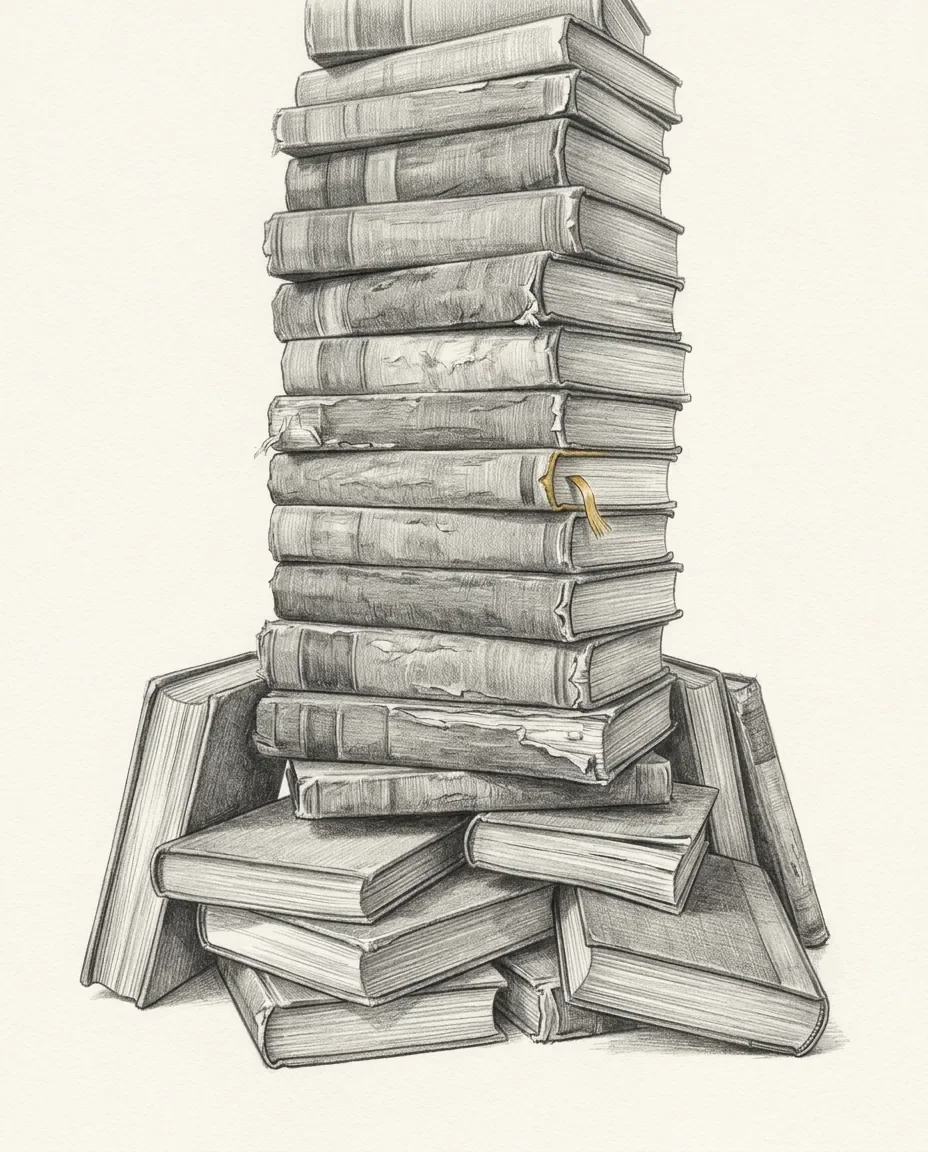
Bibliomania
Bibliomania
Added 26 Jul 2026 · Updated 22 Aug 2026
An excessive, driven compulsion to collect books, often prizing rarity, first editions and completeness over reading itself. It can reach a degree that strains finances or living space. It is a historical and colloquial term, not a standalone diagnosis in current clinical manuals.
- Prevalence
- Uncommon
- Category
- Non-Sexual Fetishism
- Clinical term
- Bibliomania
- Domain
- Non-sexual interest
- Confidence
- Low confidence
- Status
- Not an independent diagnosis in the DSM-5-TR or ICD-11; a historical/colloquial label for compulsive book-collecting, framed clinically today, where relevant, under hoarding disorder or obsessive-compulsive spectrum behaviour.
- Also known as
- book madness, book mania, bibliomane, book collecting mania
- Added
- 26 Jul 2026
- Updated
- 22 Aug 2026
Featured in
Overview
Bibliomania names an excessive, almost compulsive drive to acquire books, one that fixates on rarity, fine bindings, first editions and completeness rather than on reading. It sits at the far end of ordinary book love: enthusiasm curdled into a preoccupation that can outrun a household's shelf space or a collector's finances. This entry treats bibliomania as a non-sexual, non-erotic historical and cultural phenomenon, a colourful cousin of ordinary collecting rather than a modern psychiatric category, and traces the coinage of the term, the Regency-era book-buying frenzy it described, and where the behaviour sits (and does not sit) in clinical thinking today.
Definition & scope
Bibliomania is not to be confused with bibliophilia, the ordinary, well-adjusted love of books and reading. The distinguishing mark is less the size of a library than the character of the drive behind it: acquisition for its own sake, an emphasis on scarcity and physical object over content, and, in severe cases, real strain on money, relationships or living space. A milder, gentler relative is tsundoku, the Japanese habit of buying books faster than one reads them, which carries none of bibliomania's compulsive or financially ruinous edge.
Examples
What the term covers. In its historical sense, the Regency collector who bought at auction faster than he could shelve, prized uncut copies, large-paper issues and first editions, and pursued completeness for its own sake: Richard Heber filling eight houses, Sir Thomas Phillipps borrowing heavily to chase manuscripts he would never catalogue. In modern use the word is looser and mostly affectionate, applied to anyone whose book buying badly outruns their reading, and reserved for something more serious only where acquisition strains money, relationships or living space.
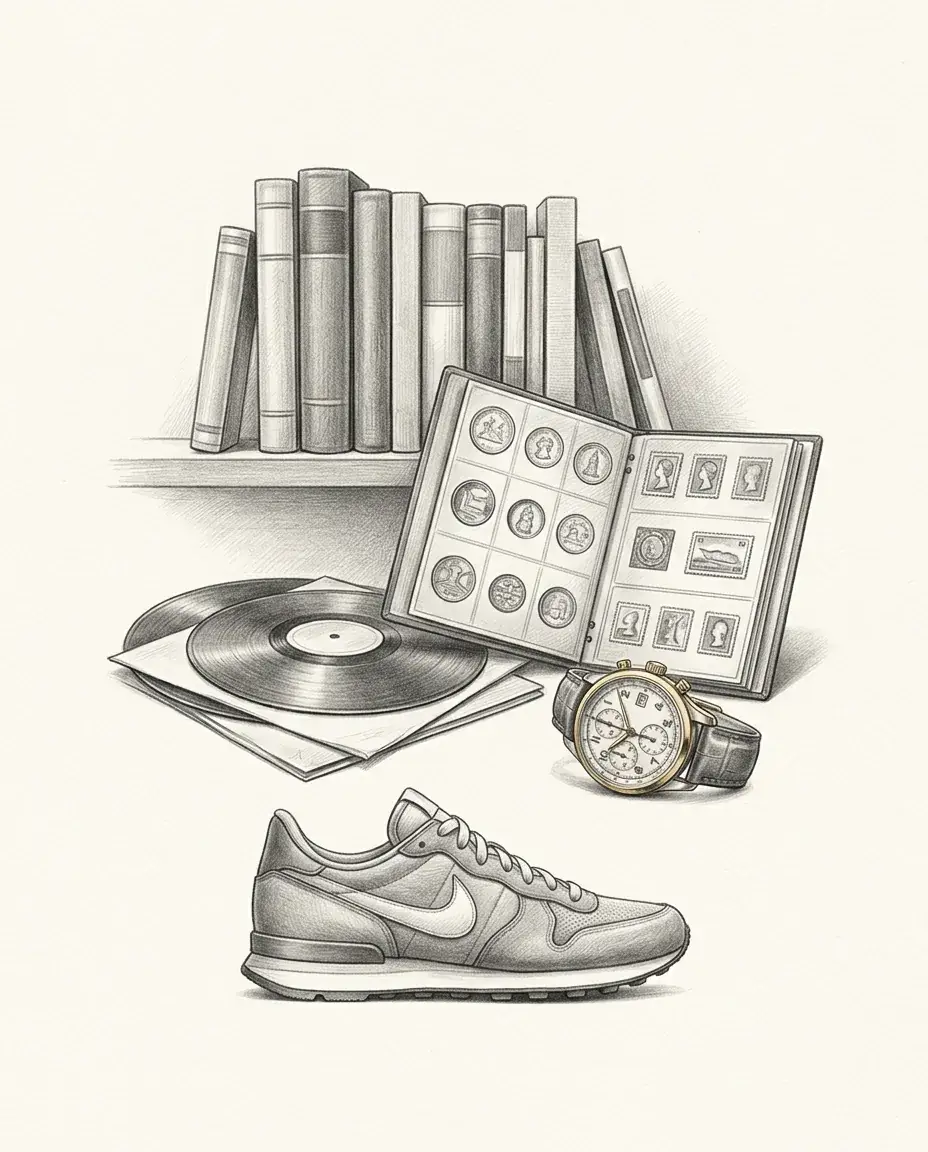
What it does not cover. Bibliophilia, the ordinary love of books and reading, is not bibliomania however large the resulting library, and neither is tsundoku, the habit of letting bought books pile up unread. It is not collecting in general, the broad non-sexual drive to acquire and complete sets, of which book collecting is one instance among coins and stamps, records and much else. Nor is it hoarding disorder, a recognised diagnosis defined by difficulty discarding and by real distress, which is the frame a clinician would actually reach for. And nothing about it is sexual.
How the word is used. It was mock-clinical from birth. John Ferriar coined it in 1809 inside a joking verse epistle to a collector friend, and Thomas Frognall Dibdin dramatised it the same year as a "book-madness" complete with symptoms. The -mania is literary hyperbole rather than a psychiatric suffix, and the word appears in neither DSM-5-TR nor ICD-11. In everyday register it is closer to a boast than a complaint: "a touch of bibliomania" is how a reader describes their own overflowing shelves.
History & origins
Coinage in a satirical poem
The word was coined in 1809 by John Ferriar (1761–1815), a physician at the Manchester Royal Infirmary, in a mock-serious poem titled The Bibliomania: An Epistle, to Richard Heber, Esq., addressed to his friend and fellow collector Richard Heber (1773–1833), who eventually filled eight houses with more than 150,000 books. Ferriar's poem treated compulsive book-buying as a kind of affectionate mock ailment, playful rather than clinical, aimed at the auction-haunting collectors of his own social circle.
Dibdin's Bibliomania and the Regency craze
That same year, the clergyman and bibliographer Thomas Frognall Dibdin (1776–1847) published his own book, Bibliomania; or Book-Madness, a series of rambling dialogues that the literary critic Philip Connell has described as a kind of "dramatized mock pathology," cataloguing collectors fixated on uncut copies, rare first editions and other bibliographic minutiae. Dibdin's book was, according to Wikipedia's account, "republished with large additions in 1811" and passed through numerous editions, cementing the term in the language. Dibdin went on to found the Roxburghe Club in 1812, generally regarded as the first bibliophile society of its kind, with the second Earl Spencer as its president and Dibdin as vice-president.
The timing was not accidental. Book auctions of the period saw genuinely inflated prices for rarities, and Dibdin's satire captured a real cultural moment: aristocratic and mercantile fortunes chasing scarce volumes at prices contemporaries found absurd. The behaviour, and the word for it, spread through the nineteenth-century periodical press as a recognizable type: the collector who bought books he would never read.
The Phillipps case
The best-documented case of severe bibliomania is Sir Thomas Phillipps, 1st Baronet (1792–1872), who assembled what is often called the largest collection of manuscripts and printed books ever built by a single individual: roughly 40,000 printed books and 60,000 manuscripts. Phillipps described his own drive as being a "vello-maniac" (after vellum), stated his ambition was "to own one of every book in the world," and financed the habit through inheritance and heavy borrowing that strained his family's finances for decades. His will restricted the collection's dispersal, a restriction a Court of Chancery overturned in 1885; his grandson then supervised sales to institutions and collectors, including J. Pierpont Morgan and Henry E. Huntington, that stretched across more than a century, with the final portion selling at Christie's in 2006.
Clinical framing, then and now
Bibliomania has never been an independent diagnosis in the DSM-5-TR or the ICD-11; no current clinical manual lists it as its own category, and where a case involves genuine distress or impairment, clinicians today would typically consider it under the broader lens of hoarding disorder (when the books create unmanageable clutter) or obsessive-compulsive spectrum behaviour, rather than as a diagnosis in its own right. The term survives mainly as a historical and literary label for an old, well-documented type of collector, not as a piece of modern psychiatric vocabulary.
In practice
Bibliomania in its historical sense expressed itself through relentless attendance at book auctions, a preoccupation with condition, edition and provenance over content, and libraries that outgrew any single collector's ability to read or even catalogue them. Modern usage of the word is looser and mostly affectionate, applied to enthusiastic book buyers whose acquisitions outpace their reading, distinguishing them from readers who buy narrowly and read what they own.
Psychology
As with collecting generally, the drive is best explained by overlapping, largely qualitative accounts rather than a single settled mechanism: the pleasure of the hunt and of completing a set, the status and identity value of rare and beautiful objects, and, in severe historical cases like Phillipps's, an anxious, near-obsessive relationship to scarcity and permanence. Because bibliomania has not been the subject of controlled psychiatric research, these explanations remain interpretive rather than empirically confirmed.
Prevalence & culture
Bibliomania has no measured clinical prevalence, since it is not a diagnosed condition and has not been the subject of population surveys; it survives instead in book history, antiquarian bookselling lore, and the biographies of famous collectors like Heber and Phillipps. Its cultural footprint is disproportionate to any measurable incidence: a vivid label attached to a small number of extreme, well-documented historical cases rather than a common contemporary experience.
Safety, consent & law
The behaviour is legal and involves no consent dimension; its only real hazards are financial (debt from over-acquisition, as in Phillipps's case) and domestic (clutter that can shade into the territory of hoarding disorder). Where acquisition becomes genuinely compulsive, distressing or financially ruinous, it is best understood through that clinical lens rather than as bibliomania in the old, colourful sense.
Common questions
Is bibliomania a real mental illness?
No. It has never been an independent diagnosis, and neither DSM-5-TR nor ICD-11 lists it. It began in 1809 as a satirical label for compulsive book buying and survives as a historical and literary term. Where someone's acquisition genuinely causes distress, debt or unmanageable clutter, clinicians would consider hoarding disorder or obsessive-compulsive spectrum behaviour instead, because those are the categories that actually describe the problem.
How many books does it take to be a bibliomaniac?
There is no number, and that is rather the point. The historical distinction was never about the size of a library but about the character of the drive behind it: buying for the sake of acquiring, valuing scarcity and binding over content, and letting the habit outrun money or space. A well-read person with twenty thousand volumes is a bibliophile; someone chasing editions they will never open may not be.
Is bibliomania the same as hoarding?
No. Hoarding disorder is a recognised mental-health diagnosis defined by persistent difficulty discarding possessions of any kind, clutter that overwhelms living space, and significant distress or impairment. Bibliomania is a historical label for one acquisitive style, focused on books and on rarity, and it carries no diagnostic weight. Severe cases can shade into hoarding territory, and when they do the clinical term is the useful one.
Is tsundoku the same as bibliomania?
No. Tsundoku is the Japanese habit of buying books faster than you read them and letting them pile up: affectionate, extremely common, and carrying none of bibliomania's compulsive or financially ruinous edge. Bibliomania describes acquisition that has become an end in itself, prizing the object over the text. Most people who worry they have bibliomania are in fact describing tsundoku.
Who invented the word bibliomania?
The physician John Ferriar, in an 1809 mock-serious poem addressed to his book-collecting friend Richard Heber. The clergyman and bibliographer Thomas Frognall Dibdin published his own Bibliomania; or Book-Madness the same year, a set of rambling dialogues that ran through many editions and fixed the word in English. Both were teasing the auction-haunting collectors of their own circle rather than describing a disease.
Is bibliomania a fetish in the sexual sense?
No. It is filed here under non-sexual fetishism, the section covering intense but entirely non-erotic attachments to objects and pursuits. Bibliomania concerns acquisition, rarity and the physical book, and both its historical and its modern literature are non-sexual throughout. The only thing it shares with the rest of this index is the word "fetish" and that word's long history of meaning several unrelated things at once.
- Tsundoku56/100Non-Sexual FetishismThe Japanese habit of acquiring books and letting them pile up unread. It is an affectionate, non-pathological description of book-buying enthusiasm, not a disorder and not a sexual interest.56
- Collecting57/100Non-Sexual FetishismA strong, non-sexual drive to acquire, organize, and complete sets of objects: from stamps and coins to figures, records, and memorabilia. It is a widespread hobby and behavioral pattern, not a clinical disorder, and is distinct from hoarding.57
- Compulsive Hoarding57/100hoarding disorder · Non-Sexual FetishismA persistent difficulty discarding possessions, regardless of their value, that leads to clutter overwhelming living spaces and significant distress. It is a recognised mental-health condition and an object-attachment phenomenon, not a sexual interest.57
- Coin & Stamp Collecting38/100Non-Sexual FetishismA non-sexual, focused interest in acquiring, organizing, and studying coins, banknotes, and postage stamps (numismatics and philately). It centers on heritage, completeness, and the tactile and historical appeal of small physical artifacts.38
- Vinyl Record Collecting44/100Non-Sexual FetishismA non-sexual enthusiasm for collecting, curating, and listening to vinyl records, valuing the analog format's sound, sleeve art, ritual, and physicality. It blends consumer culture, music fandom, and sensory satisfaction.44
- Anthropological Fetishism29/100Non-Sexual FetishismThe original, pre-sexual sense of "fetish": an object credited with independent power or agency, a concept of European making. Traders and scholars built it out of contact with West African religious practice. It is the etymological root of every later use of the word, including the sexual one.29
From "biblio-" (Greek biblíon, "book") plus "-mania" (Greek manía, "madness" or "frenzy"). Coined by the physician John Ferriar in his 1809 poem The Bibliomania, and popularized the same year by Thomas Frognall Dibdin's book of the same title.
object attachment · collecting behaviour · historical phenomenon
Prevalence is computed from the entry's cited population estimate. Rows marked ESTare indicative editorial estimates scored against a fixed anchor rubric, not measured quantities. Method & anchors: methodology.
Uncommon · ≈ 1 in 100
- 01Bibliomania, WikipediaDefinition, distinction from bibliophilia, John Ferriar's 1809 coinage, Dibdin's 1809 book and its 1811 re-publication, Sir Thomas Phillipps as a documented case
- 02The Bibliomania: An Epistle, to Richard Heber, Esq., Internet Archive (John Ferriar, 1809)Primary text of Ferriar's 1809 poem that coined the term, dedicated to Richard Heber
- 03Thomas Frognall Dibdin, WikipediaDibdin's biography, dates, publication of Bibliomania (1809) and Bibliographical Decameron (1817), and his founding of the Roxburghe Club in 1812
- 04Thomas Phillipps, WikipediaPhillipps's collection size, his stated ambition to own one of every book in the world, the 1885 Chancery ruling, and the century-long dispersal of his collection ending in 2006
- 05DSM-5-TR, American Psychiatric AssociationAbsence of bibliomania as an independent diagnosis in current clinical manuals
- 06ICD-11, World Health OrganizationAbsence of bibliomania as a recognised ICD-11 disorder