
Littlespace
Added 21 Jun 2026 · Updated 22 Aug 2026
A non-sexual practice of temporarily shifting into a younger, childlike headspace for comfort, relaxation, and stress relief. It often uses childhood-associated activities and comfort objects. A self-soothing coping and identity state, explicitly distinguished from erotic age-play.
- Prevalence
- Uncommon
- Category
- Identity & Transformation
- Domain
- Non-sexual interest
- Confidence
- Low confidence
- Status
- Not a paraphilia; a non-sexual self-soothing/coping practice and headspace, benign and sometimes linked to stress or trauma regulation.
- Also known as
- age regression / littlespace, age regression, agere, little space, regression headspace, non-sexual age regression
- Added
- 21 Jun 2026
- Updated
- 22 Aug 2026
Featured in
Overview
Littlespace, also written "little space" and widely abbreviated "agere" (from age regression), is the non-sexual practice of temporarily entering a younger mental and emotional state for comfort and self-soothing. Practitioners describe it as a restful headspace in which adult pressures recede and simpler, gentler feelings come forward, often supported by childhood-associated activities and comfort objects. The defining frame is coping, relaxation, and emotional regulation rather than sexuality, and the community is emphatic about distinguishing itself from erotic age-play. This article traces the clinical idea of regression it borrows from, the recent online community that gave the practice its name, how it is expressed and understood, and how visible it has become.
Examples
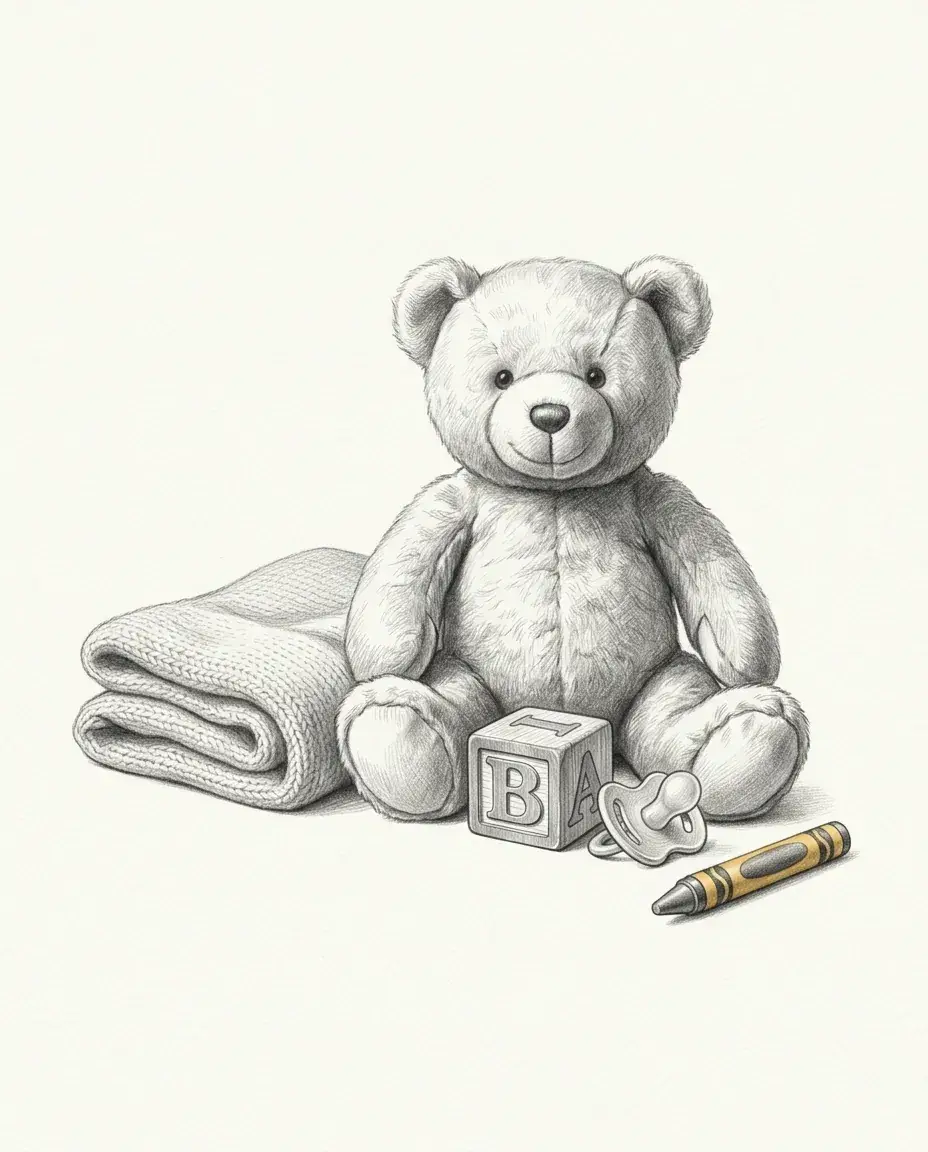
What the term covers. Putting on cartoons, colouring, or holding a plush toy after a hard day and letting the sense of being small and looked-after take over; a deliberately assembled "regression kit" of blankets, picture books, snacks and comfort objects kept for that purpose; an involuntary slip into the state under stress or after a reminder of past distress; and the online agere aesthetic of pastel art, soft-toy photographs and gentle self-care reminders through which most people first meet the word. A trusted friend or partner may take a caregiver role, offering reassurance and structure in a strictly protective, non-sexual capacity.
What the term does not cover. Age-play is consensual erotic role-play between adults, and DDlg is the caregiver/little relationship dynamic built on it; both are sexual, and the agere community defines itself against them. Adult baby / diaper lover interests and diaper fetish are adult interests too, whatever comfort element they also carry. Subspace is the BDSM headspace the word "littlespace" was modelled on, but it arises from intense play rather than from self-soothing. Nor is regressing a claim about actual age: practitioners remain adults who know exactly how old they are, and the state is temporary.
How the word is used. "Littlespace", "little space" and the clipping "agere" are community vernacular from Tumblr, TikTok and Discord, not clinical vocabulary; none of them appears in DSM-5-TR or ICD-11. The nearest clinical word is regression, which psychoanalysis uses for an involuntary defensive retreat under pressure rather than for a chosen comfort practice, so borrowing it describes the shape of the experience without importing a diagnosis.
History & origins
Clinical lineage
The underlying idea (psychological regression, a retreat to an earlier developmental stage under stress) is long established in clinical thought. Sigmund Freud introduced regression in his early writings on dreams and neurosis, and his daughter Anna Freud ranked it among the ego's defense mechanisms in The Ego and the Mechanisms of Defence (German 1936; English 1937). Later analysts, including Ernst Kris with his notion of "regression in the service of the ego," reframed regression as something that can be adaptive and restorative rather than purely pathological: a lineage that maps closely onto how littlespace practitioners describe voluntary, self-directed regression.
- 1900–1913: Freud develops regression as a concept in dream theory and the psychology of neurosis.
- 1936/1937: Anna Freud's The Ego and the Mechanisms of Defence catalogues regression as a leading defense mechanism.
- mid-20th c.: Ernst Kris and others articulate "regression in the service of the ego," allowing an adaptive, self-soothing reading.
Importantly, clinical "age regression" also refers to a separate, pseudoscientific hypnotherapy technique; the self-care practice described here is unrelated to that.
Cultural & community evolution
The specific vocabulary of "littlespace" and "agere" is recent and largely vernacular: it crystallised in online subcultures rather than in any single clinical paper, and its precise coinage is not well documented. The word littlespace originated partly in kink contexts (as an analogue to "subspace"), but from the 2010s onward a distinct non-sexual community formed around it on Tumblr and later TikTok and Discord, sharing a soft aesthetic and an explicit insistence on the practice's non-sexual nature. Community discourse split into camps: some groups (often labelled CGLRE, caregiver/little regression) retain "littlespace" terminology while affirming non-sexuality, while others (CHIRE, child-regression communities) avoid littlespace language entirely to keep maximal distance from kink. The result is a self-care-oriented identity that borrows clinical language about regression while defining itself firmly on its own, non-erotic terms.
In practice
Littlespace is expressed through soothing, childhood-associated activities and comfort objects: colouring, watching cartoons, holding a plush toy or blanket, and adopting a softer, more playful mindset. Some people enter it voluntarily as deliberate self-care; others experience it more involuntarily, sometimes triggered by stress or reminders of past distress. A trusted "caregiver" figure may provide reassurance, but in littlespace this relationship is framed as protective and non-sexual, a key contrast with the consensual adult eroticism of age-play and DD/lg dynamics.
Psychology
The appeal is most often described in terms of stress relief, anxiety reduction, and the restorative comfort of feeling small, safe, and cared for. It can function as a grounding or self-soothing mechanism and is frequently reported alongside trauma-coping or neurodivergent experiences, where it offers a predictable, low-demand emotional refuge. This fits the older clinical reading of adaptive regression (a temporary, controlled return to simpler functioning that relieves pressure) though dedicated empirical study of the modern littlespace community is still limited, and much of the evidence is qualitative and self-reported.
Prevalence & culture
Formal prevalence data are scarce, so estimates rely on community size and search interest rather than clinical surveys. Visibility has grown markedly through supportive online communities that share art, aesthetics, and self-care resources, and lay coverage increasingly separates non-sexual age regression from sexual dynamics: for example, mainstream explainers such as Glamour's A–Z of kinks and fetishes note the distinction. The result situates the practice within a broader cultural conversation about coping and mental wellbeing.
Common misconceptions
Is littlespace a kink?
Not in its non-sexual form. The most persistent misconception is that littlespace is inherently sexual or a form of kink. The non-sexual age-regression community works hard to refute this, stressing that agere is a coping and comfort state, that minors who regress are present in some of these spaces, and that it should not be conflated with the adult erotic dynamics of age-play or DD/lg. It is also not the same as the pseudoscientific hypnotic "age regression" used to "recover" memories.
Safety, consent & law
As a non-sexual self-care practice among consenting adults, littlespace is benign and raises no consent or legal concerns of its own. The relevant considerations are emotional safety and boundaries: keeping the practice clearly separate from sexual contexts, and seeking mental-health support where regression is involuntary, distressing, or tied to unresolved trauma.
Common questions
What does "agere" mean?
It is a community clipping of "age regression", pronounced as the first syllables of the phrase, and it is used both as a noun and as a tag. It gained currency partly because it carries none of the kink associations that "littlespace" picked up from its origins as an analogue of the BDSM term subspace. Some non-sexual regression communities use "agere" exclusively for that reason.
How do people enter littlespace?
Two routes are commonly described. Voluntary regression is deliberate and cued: someone sets aside time, puts on familiar cartoons, gets out comfort objects, and lets the state settle. Involuntary regression arrives unbidden, often under stress, exhaustion or after something that recalls earlier distress. The same person may experience both. Practitioners generally describe the voluntary form as restful and the involuntary form as something worth paying attention to.
Do you need a caregiver to have a littlespace?
No. Many people regress entirely on their own, and solo agere is the most common form described online. Where a caregiver figure exists it is usually a friend, sibling or partner who provides reassurance and light structure, and in non-sexual age regression that role is explicitly protective. It is a support, not a requirement, and the practice does not depend on anyone else being present.
Is littlespace unhealthy, or a sign of trauma?
Not in itself. Voluntary regression fits the long-standing clinical reading of adaptive regression, a temporary and controlled return to simpler functioning that relieves pressure. It is frequently reported alongside trauma histories, anxiety and neurodivergence, but it is more often a coping tool than a symptom. The signals worth taking to a professional are the state arriving involuntarily, being distressing, or displacing the rest of someone's life.
What is the difference between littlespace and subspace?
Subspace is an altered, often euphoric headspace that some submissive partners enter during intense BDSM play; it is a product of the play itself and belongs to an adult sexual context. Littlespace is a self-soothing comfort state, usually non-sexual, that is entered for rest rather than reached through intensity. The names are related only because "littlespace" was coined on the pattern of "subspace".
Are there minors in age-regression communities?
Yes, and that fact shapes how the communities police themselves. Because regression appeals to teenagers as much as to adults, non-sexual agere spaces enforce a hard separation from kink spaces, moderate for it strictly, and object loudly when adult content is tagged with agere vocabulary. It is the practical reason behind the community's insistence on the distinction from age-play, not merely a matter of definition.
Is littlespace the same as dissociative identity disorder or having alters?
No. Littlespace is a shift in mood and manner within one continuous sense of self; the person remains aware of who and how old they are, and typically remembers the episode afterwards. Dissociative identity disorder is a diagnosed condition involving distinct identity states and, often, amnesia between them. Some people describe experiences that sit near this line, which is a reason to speak to a clinician rather than to a forum.
- Age-Play49/100Power, Roles & ScenariosA consensual role-play between adults in which one or more partners adopt an age different from their own, often a younger persona, within a negotiated dynamic. An umbrella term for many caregiver, mentor, or peer scenarios; it never involves actual minors.49
- DDlg49/100Power, Roles & ScenariosA consensual caregiver/little relationship dynamic between adults that pairs a nurturing, authoritative caregiver with a dependent partner. That partner adopts a younger, "little" headspace. It is a specific, popular branch of age-play involving only consenting adults.49
- Female Masking17/100Identity & TransformationFemale masking is the practice of wearing a lifelike full-head silicone or latex mask to present as a woman or as an idealized doll-like figure. A matching body suit is usually worn with it. It centres on transformation, embodiment and total concealment of the wearer's own identity.17
- Otherkin36/100Identity & TransformationA non-sexual subcultural identity in which a person feels themselves to be, in part or in whole, a non-human being rather than role-playing one. That being is typically mythical, fantastical, or fictional, such as an elf, dragon, or angel.36
- Therianthropy / Therian Identity36/100Identity & TransformationA non-sexual subcultural identity in which a person feels themselves to be, in a personal and integral way, one or more non-human animals. It is distinct from clinical lycanthropy and from role-play.36
- Fursuiting37/100Identity & TransformationWearing a full or partial animal costume, a fursuit, to physically embody an anthropomorphic character, typically one's own fursona. It is predominantly a performative, playful, craft-driven and social activity within the furry fandom rather than a sexual one.37
"Littlespace" is a plain-English compound (the mental "space" of being "little" (childlike), modelled on the kink term "subspace") paired with "agere," a community clipping of *age regression*. "Regression" derives from Latin regressus, "a going back" (re-, "back" + gradi, "to step, walk").
age regression · identity regression · comfort role
Prevalence is computed from the entry's cited population estimate. Rows marked ESTare indicative editorial estimates scored against a fixed anchor rubric, not measured quantities. Method & anchors: methodology.
Uncommon · ≈ 1 in 100
- 01FetLife, kink community group sizes (community-size proxy)community-size proxy; littlespace/agere communities, though much of the practice is explicitly non-sexual
- 02An A–Z of Kinks and Fetishes, Glamourlay framing distinguishing non-sexual littlespace/age regression from sexual age-play
- 03List of paraphilias, Wikipediacontext for age-regression-related identity practices
- 04Age regression (therapy / informal), Wikipediadisambiguation of age regression, including the separate pseudoscientific hypnotherapy technique distinct from the self-soothing practice
- 05Regression (psychology), Wikipediaclinical definition and history of regression as a defense mechanism; Freud's introduction, Anna Freud's enumeration, Ernst Kris's 'regression in the service of the ego'
- 06The Ego and the Mechanisms of Defence (1936/1937), Anna Freud, WikipediaAnna Freud's cataloguing of regression among the ego's defense mechanisms; publication dates
- 07Age Regression, Fanlorenon-sexual agere/littlespace community on Tumblr; CGLRE vs CHIRE terminology split; explicit non-sexual framing and distinction from kink
- 08Sigmund Freud, Wikipediabiography of Freud, who introduced regression as a psychoanalytic concept
- 09Anna Freud, Wikipediabiography of Anna Freud, who catalogued regression among the ego's defense mechanisms
- 10Ernst Kris, Wikipediaoriginator of 'regression in the service of the ego', the adaptive reading of regression