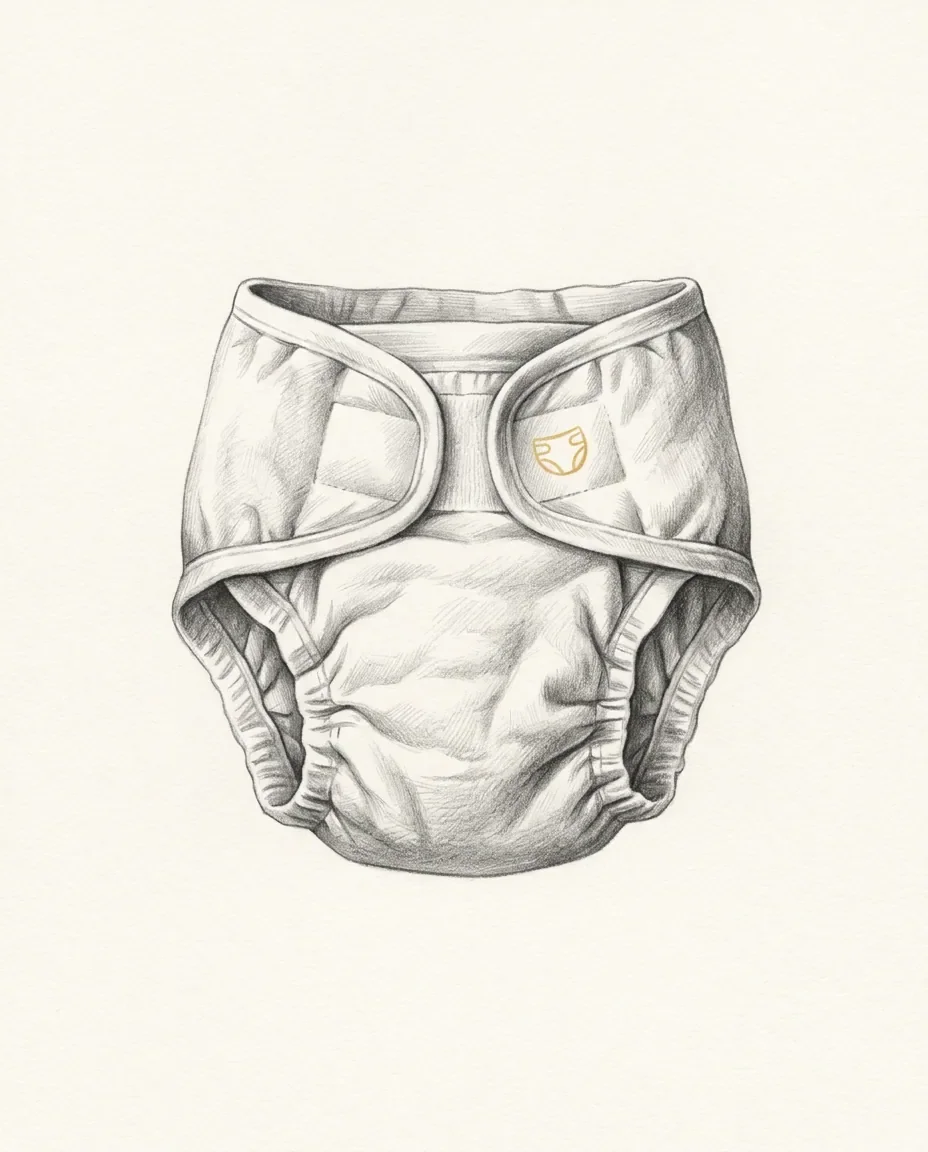
Diaper Fetish
Autonepiophilia
Added 21 Jun 2026 · Updated 22 Aug 2026
An erotic or comfort-oriented adult interest in wearing or using diapers. It overlaps with but is distinct from paraphilic infantilism; when centred on the garment and on perceiving oneself as an infant it is termed autonepiophilia. Adherents often call themselves diaper lovers (DL) within the ABDL community.
- Prevalence
- Uncommon
- Category
- Clothing & Garments
- Clinical term
- Autonepiophilia
- Domain
- Sexual interest · Paraphilia
- Confidence
- Low confidence
- Status
- Recognized in clinical literature in connection with paraphilic infantilism (autonepiophilia); benign and not a disorder unless it causes distress, impairment, or harm.
- Also known as
- diaper fetishism (paraphilic infantilism, partial), diaper fetishism, diaper lover, DL, nappy fetish, autonepiophilia, paraphilic infantilism, ABDL
- Added
- 21 Jun 2026
- Updated
- 22 Aug 2026
Featured in
Overview
A diaper fetish is an adult interest centred on diapers: valued for their material and fit, the sensation of wearing them, and associated themes of comfort, vulnerability, care, or age regression. When the interest is centred on the garment and on perceiving oneself as an infant, the clinical literature labels it autonepiophilia. People who identify with it commonly call themselves diaper lovers (DLs); the broader subculture is described as ABDL (adult baby / diaper lover), within which the diaper-focused interest sits alongside, but is separable from, the role-based regression of adult babies. This article is clinical and non-explicit, and concerns consenting adults only; the role-play involved is symbolic and adult, and must never involve actual minors.
Definition & scope
Two overlapping strands are worth keeping apart. A diaper interest can be primarily sensory and material: the feel, sound, bulk and containment of the garment itself. It can also be identity-based, part of the wider practice of paraphilic infantilism, the wish to be treated as, or to perceive oneself as, an infant. Many diaper lovers experience only the first; adult babies fold the diaper into a fuller regression that may include bottles, cots and a caregiver role. The two shade into each other, and a given person may sit anywhere along that spectrum.
Examples
What the term covers. Wearing an adult-sized diaper privately for the feel, bulk and containment of the garment; choosing between cloth and disposable, or between particular cuts and materials, much as any garment interest does; wearing one with a consenting partner as part of a caregiving scene; and using it as a route into relaxation or stress relief, which many participants describe as the main draw rather than a side effect. All of it concerns adults, in adult sizes, alone or between partners who have agreed to it.
What the term does not cover. It has nothing whatever to do with children. This is an interest of consenting adults in an adult garment; nothing here describes, depicts or condones the involvement of a minor in any way, and ABDL communities police that boundary explicitly. It is also narrower than several things it is filed beside: adult baby / diaper lover is the umbrella subculture, of which diaper-focused interest is one half; age play is the broader practice of adults enacting a younger role, most of which involves no diaper at all; littlespace names the mental state rather than the garment; DDlg names a caregiver dynamic. Separately, omorashi and watersports concern urination itself rather than what is worn, and latex or PVC interest shares only the material dimension.
How the word is used. "Diaper fetish" and "diaper lover" (DL) are community vernacular, with "nappy fetish" the British equivalent; ABDL is the standard umbrella label. Autonepiophilia is the clinical synonym, coined by John Money in 1984, and appears in reference catalogues of paraphilias but almost nowhere in everyday speech. Neither the DSM-5-TR nor the ICD-11 names it as a disorder in its own right.
History & origins
Clinical lineage
The clinical scaffolding for this interest is the concept of paraphilic infantilism. Its deeper lineage runs through the case-study cataloguing tradition begun by Krafft-Ebing's Psychopathia Sexualis (1886) and the diagnostic class of paraphilias developed across successive editions of the DSM and the WHO's ICD-11. The American sexologist John Money supplied the modern vocabulary. He first used nepiophilia (from Greek népios, "infant") for attraction to infants, then coined autonepiophilia in 1984 for the self-directed variant in which a person wishes to "become" or act as a baby rather than to care for one. Both the DSM-5-TR and the ICD-11 treat such an interest as clinically significant only when it causes marked distress, impairment or harm, so a private, consensual diaper interest sits below the diagnostic threshold for a disorder.
Cultural & subcultural evolution
The self-description "diaper lover" and the umbrella term "ABDL" crystallised with the growth of mail-order networks and internet forums in the late 20th century, which gave a previously isolated and stigmatised interest a shared vocabulary and a visible culture. An early hub, Diaper Pail Friends, was founded in San Francisco and reported roughly 3,000 members by 1995; the community's first public gatherings date to the early 1990s. Online platforms through the 1990s and 2000s consolidated "ABDL" as the standard umbrella label, and the interest has since gained meaningful media visibility through documentaries and reporting.
In practice
The interest is expressed through wearing diapers privately or with a consenting partner, the tactile and psychological experience of the garment, and, for some, scenarios of caregiving or age regression that pair a "little" with a nurturing partner. For many participants the appeal is as much about relaxation, stress relief and a sense of being cared for as it is sexual. Research finds the community splits into those oriented mainly toward role-play and those oriented mainly toward sexual arousal, with motivations varying widely across individuals.
Psychology
An exclusive focus on being treated as, or perceiving oneself as, an infant is described under paraphilic infantilism, sometimes labelled autonepiophilia; the diaper-specific interest is a partial or distinct facet of this. Proposed dynamics include comfort-seeking and stress regulation, the relief afforded by age regression, and associative learning linking the garment to early arousal. The largest study to date, Hawkinson & Zamboni's 2014 survey of 1,795 male and 139 female ABDL community members in Archives of Sexual Behavior, found limited correlation between ABDL practice and negative mood states, suggesting the interest does not in itself produce psychological harm and may serve a positive role in self-expression. Like the closely related garment interest in latex, it is not a disorder in itself and is considered clinically significant only when it causes distress, impairment or harm.
Is a diaper fetish normal?
It is uncommon but not pathological. Neither the DSM-5-TR nor the ICD-11 classifies a consensual, non-distressing diaper interest as a disorder, and survey evidence links ABDL practice to little psychological harm.
Prevalence & culture
Diaper and ABDL interests are uncommon but sustain large, well-organised online communities and have gained notable media visibility. The Hawkinson & Zamboni (2014) sample was overwhelmingly male and reported little distress, and a later Italian online-sample study (Lasala et al., 2020) similarly characterised the community as predominantly male with mixed sexual and role-play motivations. Membership platforms such as FetLife host sizeable diaper-lover and ABDL groups. Because the interest is so often private and identity-linked, most surveys draw on self-selected online communities rather than the general population, so true prevalence is hard to estimate; the List of paraphilias catalogues it under both "diaper fetishism" and "autonepiophilia".
Safety, consent & law
Diaper fetishism among consenting adults is legal, and practised privately it harms no one else. The physical risks are the ordinary ones of incontinence care and should be stated plainly: skin held against moisture becomes irritated and can break down, and prolonged wear of a wet or soiled product raises the risk of skin and urinary-tract infection, so prompt changing, washing and drying the skin, barrier creams and a correctly fitted product matter. Beyond that the considerations are honest communication with partners and keeping the interest strictly within adult, consensual contexts. The role-play is symbolic and adult; it must never involve actual minors in any way, and ABDL communities themselves draw a firm line between adult age-play and any contact with children.
Common questions
Does a diaper fetish involve children in any way?
No. It is an interest of consenting adults in an adult-sized garment, and nothing about it involves, depicts or requires a child. The clinical vocabulary keeps the two strictly apart: John Money's nepiophilia named an attraction to infants, while autonepiophilia names the entirely separate, self-directed wish to be treated as one. ABDL communities enforce that line explicitly, and any conduct involving a minor falls outside this interest and outside the law.
What is the difference between a diaper lover and an adult baby?
A diaper lover's interest is in the garment itself (how it feels, sounds and fits), and often stops there. An adult baby folds the diaper into a fuller regressed role that can include bottles, cots, childlike clothing and a caregiver partner. Most people sit somewhere between the two rather than at either end, which is why the community uses one umbrella term, ABDL, for both.
Is a diaper fetish always sexual?
No. A large share of people who have it describe the appeal as comfort, relaxation and stress relief rather than arousal, and survey work on the community finds it divides between a role-play-oriented group and an arousal-oriented one. Both are ordinary versions of the same interest, many people move between them over time, and neither is more authentic than the other.
Are there health risks to wearing diapers as an adult?
Yes, and they are the ordinary risks of incontinence care rather than anything exotic. Skin held against moisture becomes irritated and can break down, and prolonged wear of a wet or soiled product raises the risk of skin and urinary-tract infection. Changing promptly, washing and drying the skin, barrier creams and a correctly fitted product are the standard precautions. Persistent rash, sores or urinary symptoms warrant a doctor.
How do you tell a partner about a diaper fetish?
Most people who have done it well describe choosing a calm moment outside the bedroom, saying plainly what the interest is and what it is not, and being ready for the question about children, answering it directly rather than waiting to be asked. It also helps to separate disclosure from any request to participate: a partner can be entirely willing to know without being willing to join in.
Why are almost all diaper-fetish survey respondents male?
Because the samples come from online communities rather than the general population. Hawkinson & Zamboni's 2014 study recruited 1,795 men and 139 women, and Lasala and colleagues' 2020 Italian sample was 36 men out of 38. Whether that skew reflects the interest itself or simply who joins these forums and answers questionnaires is unresolved, and no general-population survey exists to settle it.
Is autonepiophilia a real diagnosis?
Not in the sense of something people are diagnosed with. It is a descriptive label coined by the sexologist John Money in 1984 for the self-directed wish to be an infant, and it appears in reference catalogues of paraphilias. Neither the DSM-5-TR nor the ICD-11 lists it as a disorder in its own right; both treat an interest of this kind as clinically relevant only where it causes marked distress, impairment or harm.
- Latex Fetish62/100Latex fetishism · Objects & MaterialsAn erotic interest in latex garments and their tight, glossy, second-skin qualities. A common material fetish involving the look, feel, sound, smell, and enveloping sensation of clinging latex on consenting adults.62
- Adult Baby / Diaper Lover42/100Autonepiophilia · Identity & TransformationAutonepiophilia, also called paraphilic infantilism, is the interest in adopting the role, mindset or self-image of an infant or very young child. Combined with a diaper-focused interest it forms the broader ABDL (adult baby / diaper lover) identity. It is regression to a childlike role, not attraction to children.42
- Age-Play49/100Power, Roles & ScenariosA consensual role-play between adults in which one or more partners adopt an age different from their own, often a younger persona, within a negotiated dynamic. An umbrella term for many caregiver, mentor, or peer scenarios; it never involves actual minors.49
- DDlg49/100Power, Roles & ScenariosA consensual caregiver/little relationship dynamic between adults that pairs a nurturing, authoritative caregiver with a dependent partner. That partner adopts a younger, "little" headspace. It is a specific, popular branch of age-play involving only consenting adults.49
- Littlespace36/100Identity & TransformationA non-sexual practice of temporarily shifting into a younger, childlike headspace for comfort, relaxation, and stress relief. It often uses childhood-associated activities and comfort objects. A self-soothing coping and identity state, explicitly distinguished from erotic age-play.36
- Garter Belt Fetish44/100Garter and suspender-belt fetishism · Clothing & GarmentsAn erotic interest in garter (suspender) belts and the straps that frame the thighs and hold up stockings, prized for their glamour. The visual framing of the upper legs is central to the appeal. A common intimate-apparel fetish tied to lingerie, not a clinical disorder.44
The clinical synonym autonepiophilia was coined by sexologist John Money (who used 'nepiophilia' from Greek népios, 'infant'), with autós ('self') + népios ('infant') + -philía ('love') marking the self-as-baby variant; the common names 'diaper lover' / 'DL' / 'ABDL' are descriptive community usage with no deeper etymology.
adult diapers · regression-adjacent · garment fetishism
Prevalence is computed from the entry's cited population estimate. Rows marked ESTare indicative editorial estimates scored against a fixed anchor rubric, not measured quantities. Method & anchors: methodology.
Uncommon · ≈ 1 in 100
- 01List of paraphilias, Wikipediadiaper fetishism / autonepiophilia and paraphilic infantilism listed and defined
- 02Paraphilia, StatPearls, NCBI Bookshelfclinical framing of garment/infantilism-adjacent paraphilic interest
- 03FetLife, kink community group sizes (community-size proxy)sizable ABDL/diaper-lover community groups (community-size proxy)
- 04Paraphilic infantilism, WikipediaJohn Money's coinage of nepiophilia/autonepiophilia (1984), the ABDL / diaper-lover terminology, Diaper Pail Friends (~3,000 members by 1995) and community history
- 05John Money, Wikipediabiography of the sexologist who coined autonepiophilia
- 06Psychopathia Sexualis, WikipediaKrafft-Ebing's 1886 case-study cataloguing tradition underlying the paraphilia class
- 07ICD-11, World Health Organizationan infantilism/garment interest is clinically significant only when it causes distress, impairment or harm
- 08Hawkinson & Zamboni (2014), Adult Baby/Diaper Lovers: An Exploratory Study of an Online Community Sample, Archives of Sexual Behavior 43:863-8771,795 male and 139 female ABDL members; community splits into role-play vs sexual-arousal subgroups; limited correlation with negative mood states
- 09Lasala et al. (2020), An Exploratory Study of Adult Baby-Diaper Lovers' Characteristics in an Italian Online Sample, Int. J. Environ. Res. Public HealthItalian online sample (36 of 38 male) characterising the community as predominantly male with mixed sexual and role-play motivations