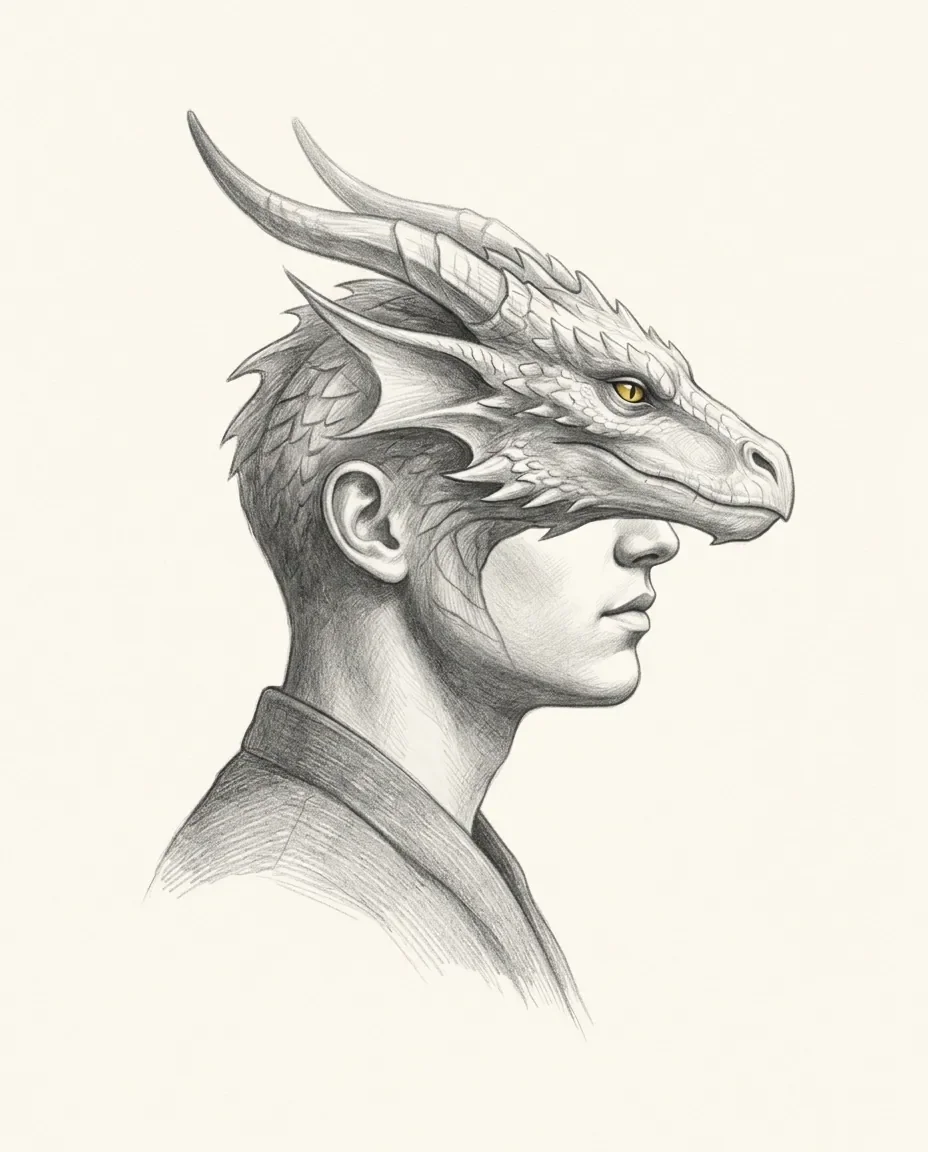
Otherkin
Added 26 Jun 2026 · Updated 22 Aug 2026
A non-sexual subcultural identity in which a person feels themselves to be, in part or in whole, a non-human being rather than role-playing one. That being is typically mythical, fantastical, or fictional, such as an elf, dragon, or angel.
- Prevalence
- Rare
- Category
- Identity & Transformation
- Domain
- Non-sexual interest
- Confidence
- Low confidence
- Status
- Not a disorder or paraphilia. A self-described subcultural identity; not classified in the DSM-5-TR or ICD-11.
- Also known as
- nonhuman identity, alterhuman, otherkind
- Added
- 26 Jun 2026
- Updated
- 22 Aug 2026
Featured in
Overview
Otherkin are people who identify as partly or wholly non-human, most often as a mythical, fantastical, or fictional being such as an elf, dragon, angel, or fae. The Oxford English Dictionary, which added the word in 2017, glosses it as "a person who identifies as non-human, typically as being wholly or partially an animal or mythical being." The identity is non-sexual and self-described: otherkin remain aware that their bodies are human, and the felt non-humanity is experienced as spiritual, psychological, or existential rather than physical. This article sets out the boundaries of the term, traces its origins in early online communities, and summarises the modest academic literature.
Definition & scope
Otherkin is an umbrella for non-human kintypes drawn largely from myth, folklore, and popular fantasy. Where a person identifies specifically as a real-world animal, the usual term is therian rather than otherkin, though the communities overlap and share much vocabulary. Since around 2014 the broader label alterhuman has been used on Tumblr and elsewhere to group otherkin, therians, vampires, and plurality communities under one heading.
The identity is not a claim of literal physical transformation, and it is distinct from three things it is often confused with:
- Role-play and fandom: enjoying playing a character is not the same as feeling one is that being.
- Clinical delusion: otherkin retain reality-testing about their human bodies, unlike the rare psychiatric delusion of clinical lycanthropy.
- Erotic interest: otherkin identity is about being, not desiring, and should not be conflated with attraction to non-human figures.
Examples
What the term covers. Kintypes come mostly from myth and fantasy: elves, dragons, fae, angels and demons are the long-standing ones, joined by "fictionkin", whose kintype is a specific character from a novel, film or game. People describe an awakening, the point at which a long-felt sense is recognised and named, and share a vocabulary of shifts (episodes in which the non-human sense becomes vivid) and of phantom wings, tails or fangs felt as sensation rather than seen. Almost all of this is expressed online, in forums, Tumblr blogs and Discord servers grouped loosely by kintype, with no membership, hierarchy or authority to speak for anyone.
What the term does not cover. Therianthropy is the parallel identity for real-world animal kintypes; the communities overlap heavily and share vocabulary without being the same thing. The furry fandom and fursuiting are creative and social pursuits organised around anthropomorphic characters, a fandom rather than an identity claim, though many people belong to both. Clinical lycanthropy is a rare psychiatric syndrome of delusional physical transformation and is a different phenomenon altogether. Attraction-based interests such as teratophilia and monster fetish point desire outward at non-human figures rather than inward at the self. Xenogender identities describe gender through non-human reference points, which is a claim about gender, not about species.
How the word is used. It is self-applied community vernacular that has since reached general dictionaries, and in community usage "kin" also works as a verb: someone will say they kin a particular being. It is never a diagnosis: it appears in no edition of the DSM or the ICD, and no clinician assigns it.
History & origins
The modern otherkin community is a documented product of pre-web and early-web online culture, with a small pre-internet lineage.
- Late 1960s to 1970s: The Elf Queen's Daughters, a group whose members described themselves as elves, are the earliest recorded antecedent. They circulated letters through the 1970s, including in the neopagan magazine Green Egg, before falling quiet.
- April 1990: The variant otherkind appeared on an elf-oriented mailing list.
- July 1990: The word otherkin was adopted on the Elfinkind Digest, a mailing list founded by a University of Kentucky student "for elves and interested observers." The term caught on as shorthand so members would not have to spell out "elf/dragon/orc/etc.-kin" each time.
- 1990s onward: The community grew almost entirely online, through Usenet, mailing lists, and later web forums and Tumblr, organising loosely by kintype without any central authority.
- c. 2014: The alterhuman umbrella term emerged to connect otherkin with adjacent non-human and plural identity communities.
Psychology
The research base is small and mostly qualitative, treating otherkin as an identity and meaning-making practice rather than a pathology. The fullest academic treatment is Danielle Kirby's Fantasy and Belief: Alternative Religions, Popular Narratives and Digital Cultures (Equinox, 2013), which situates otherkin at the meeting point of new religiosity, digital culture, and appropriated fantasy narratives. Religious-studies scholar Joseph P. Laycock (2012) reads otherkin identity work as serving existential and religious functions, and Jay Johnston (2013) has argued that non-human identity may be less a pathology than a political stance on the boundaries of the self. None of this literature frames otherkin as a mental disorder.
Is being otherkin a mental illness?
No. Otherkin identity is not a recognised disorder in the DSM-5-TR or the ICD-11, and it does not appear on the list of recognised paraphilias. Some members and observers connect the experience to neurodivergence or to spiritual frameworks, but these are self-descriptions, not diagnoses.
Prevalence & culture
The community is small, predominantly English-speaking and Western, and concentrated online. There is no reliable population estimate. The clearest quantitative signal comes from adjacent furry research: surveys of furry conventions and forums report that a sizeable minority (figures between roughly 25% and 44% across samples) identify as "less than 100% human," against around 7% of non-furries, per the Otherkin article. That indicates how broadly non-human-identity sentiment distributes rather than a count of otherkin specifically. Media coverage tends toward the sensational, while the lived community emphasises peer support and self-acceptance.
Variations & related interests
Kintypes range from classical mythical beings to creatures invented in modern fiction ("fictionkin"). The identity sits closest to therianthropy (animal kintypes), and is conceptually adjacent to embodiment themes explored in erotic target identity inversion and to fascination with the monstrous or non-human in teratophilia, though those are separate phenomena.
Safety, consent & law
Otherkin identity is legal and harms no one. Informal notions such as "species dysphoria" (distress at a felt mismatch between body and identity) are community language, not clinical diagnoses. Anyone in genuine distress is encouraged to seek affirming, non-judgemental support.
Common questions
What is a kintype?
A kintype is the specific being a person identifies as: a dragon, an elf, a particular fictional character. The word functions as a category label within the community rather than as a formal taxonomy: people may have one kintype or several, may name them precisely or loosely, and may revise them over time. There is no register of valid kintypes and no authority that recognises or rejects one.
What is the difference between otherkin and therians?
The dividing line is what the kintype is. Therians identify as real-world, earthly animals: wolves, foxes, big cats. Otherkin identify as beings from myth, folklore and fiction. The two communities emerged from adjacent corners of early online culture, use much of the same vocabulary, and overlap in membership, so the distinction is real but not policed hard, and "alterhuman" is often used to cover both.
Are otherkin the same as furries?
No. The furry fandom is a creative community built around anthropomorphic animal characters, with art, writing, costume and conventions at its centre; a fursona is a character someone made, not a claim about what they are. Otherkin describe an identity rather than a creative interest. There is real overlap in membership, and the confusion is common enough that both communities routinely explain the difference.
How do people know they are otherkin?
There is no test and no external criterion. Accounts typically describe a long-standing sense of not being entirely human that later gets a name (the community calls this an awakening), sometimes supported by vivid dreams, felt phantom limbs, or a persistent pull toward a particular being. Interpretations vary widely, from spiritual to psychological to frankly agnostic, and the identity is self-described throughout.
What is species dysphoria?
It is community language for distress at a felt mismatch between one's body and one's kintype, for instance discomfort at the absence of wings or a tail. It is not a clinical diagnosis, appears in no diagnostic manual, and should not be read as an established syndrome. Where the distress is genuine and persistent, the community's own advice is to seek affirming, non-judgemental mental-health support.
How many people identify as otherkin?
Nobody knows. There is no reliable population estimate, and the community is small, concentrated online, and predominantly English-speaking and Western. The nearest quantitative signal comes from adjacent furry research: as summarised in the Otherkin Wikipedia article, surveys of furry conventions and forums report between roughly 25% and 44% identifying as "less than 100% human", against around 7% of non-furries.
Is otherkin a religion?
Not as such, though the scholarship notes strong overlaps. Religious-studies scholar Joseph P. Laycock reads otherkin identity work as serving existential and religious functions, and Danielle Kirby's book-length study situates the community where new religiosity, digital culture and fantasy narrative meet. Individual otherkin range from explicitly spiritual to entirely secular, and there is no doctrine, text or organisation to belong to.
Is being otherkin sexual?
No. Otherkin identity is about being rather than desiring, and the community treats the conflation as a persistent nuisance. Erotic interests in non-human figures exist and are catalogued separately as teratophilia and monster fetish; the inward-facing pattern of being aroused by the fantasy of becoming something is described under erotic target identity inversion. None of those is what otherkin describes.
- Therianthropy / Therian Identity36/100Identity & TransformationA non-sexual subcultural identity in which a person feels themselves to be, in a personal and integral way, one or more non-human animals. It is distinct from clinical lycanthropy and from role-play.36
- Teratophilia35/100teratophilia · Identity & TransformationAn erotic or romantic attraction to beings perceived as monstrous, deformed, or non-human, ranging from fictional creatures to real people. Werewolves and demons sit at one end, people with unusual physical features at the other. It is mostly fantasy- and media-driven.35
- Erotic Target Identity Inversion22/100erotic target identity inversion · Identity & TransformationA theorized sexological pattern in which arousal is directed inward, at the fantasy of *becoming* the target rather than at the target itself. The person embodies the kind of being they are attracted to (a woman, an animal, an amputee). It is the inward-facing form of the erotic target location error.22
- Littlespace36/100Identity & TransformationA non-sexual practice of temporarily shifting into a younger, childlike headspace for comfort, relaxation, and stress relief. It often uses childhood-associated activities and comfort objects. A self-soothing coping and identity state, explicitly distinguished from erotic age-play.36
- Fursuiting37/100Identity & TransformationWearing a full or partial animal costume, a fursuit, to physically embody an anthropomorphic character, typically one's own fursona. It is predominantly a performative, playful, craft-driven and social activity within the furry fandom rather than a sexual one.37
- Robot / Doll Fetish35/100Agalmatophilia · Identity & TransformationAn erotic interest in robots, androids, dolls, or in being or treating a person as an artificial, programmable, or immobile being. The community is often called ASFR (alt.sex.fetish.robots), and it overlaps with agalmatophilia.35
An English coinage: "other" + "-kin" (kindred, kin). The variant *otherkind* appeared in April 1990 and *otherkin* in July 1990 on the Elfinkind Digest mailing list, devised as shorthand for "elf/dragon/orc/etc.-kin" so members need not list every non-human type.
non-human identity · alterhuman · subcultural identity · embodiment
Prevalence is computed from the entry's cited population estimate. Rows marked ESTare indicative editorial estimates scored against a fixed anchor rubric, not measured quantities. Method & anchors: methodology.
Rare · ≈ 1 in 1,000
- 01Otherkin, Wikipediadefinition and OED (2017) gloss; Elf Queen's Daughters and their Green Egg letters; coinage of otherkind (April 1990) and otherkin (July 1990) on the Elfinkind Digest; alterhuman umbrella (c. 2014); community survey work on non-human identification within the furry fandom; not a recognised disorder
- 02Danielle Kirby, Fantasy and Belief: Alternative Religions, Popular Narratives and Digital Cultures (Equinox, 2013)the principal academic study of otherkin as a digital-age alternative-spirituality identity
- 03Joseph P. Laycock (2012), 'We Are Spirits of Another Sort', Nova Religio 15(3):65-90reading of otherkin identity as serving existential and religious functions
- 04List of paraphilias, Wikipediacontext that otherkin is an identity, not a recognised paraphilia