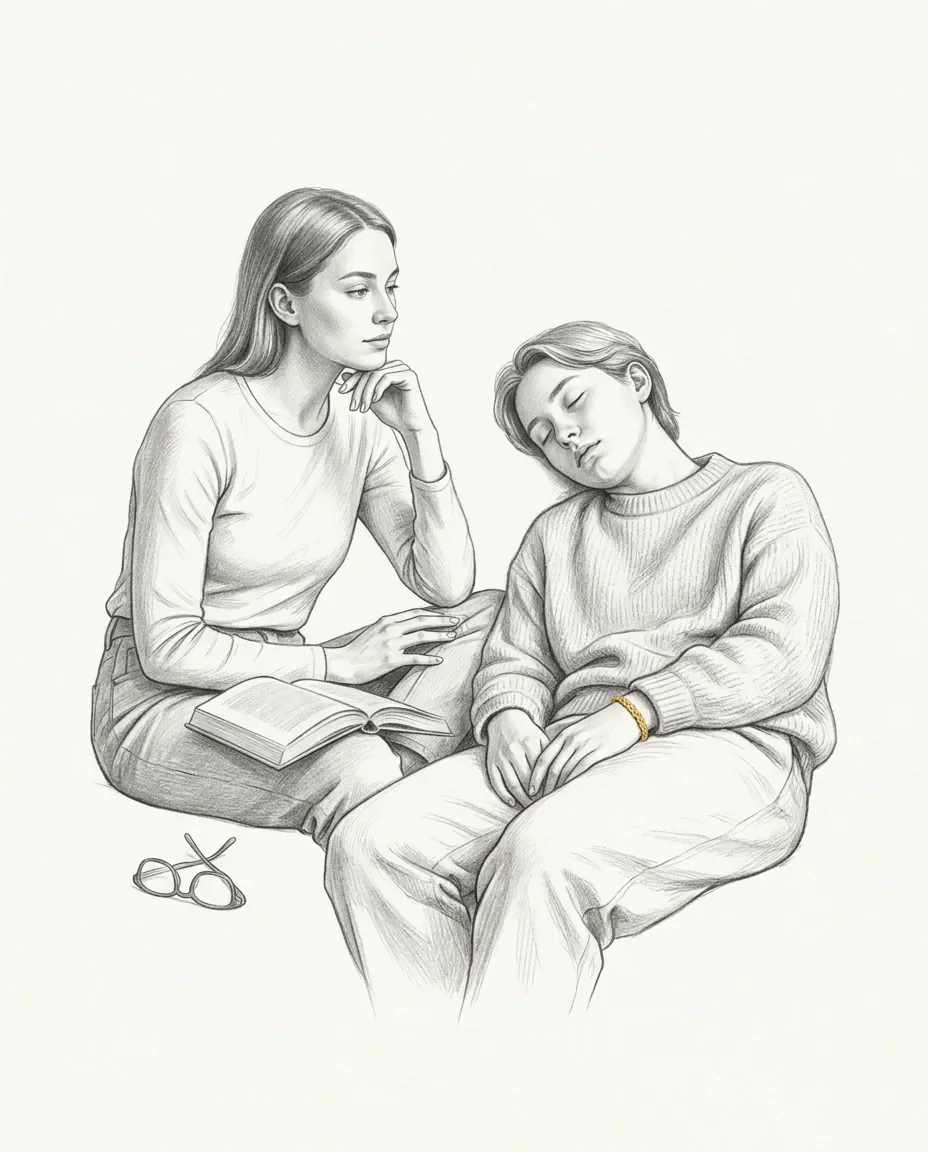
Somnophilia (Sleeping Partner)
Somnophilia
Added 21 Jun 2026 · Updated 22 Aug 2026
Sexual arousal centred on the idea of a sleeping or unconscious partner, most safely expressed as negotiated consent-play role-play between adults. Any real-life enactment requires prior, enthusiastic agreement, because a sleeping person cannot consent.
- Prevalence
- Common
- Category
- Power, Roles & Scenarios
- Clinical term
- Somnophilia
- Domain
- Sexual interest · Paraphilia
- Confidence
- Low confidence
- Status
- Listed among paraphilic interests; benign only as consensual fantasy or pre-negotiated role-play between adults, not as a disorder unless distressing or acted on non-consensually.
- Also known as
- somnophilia, sleeping beauty syndrome, sleeping partner fantasy, sleep play, Sleeping Princess fantasy, dormaphilia
- Added
- 21 Jun 2026
- Updated
- 22 Aug 2026
Overview
Somnophilia is sexual arousal organised around the idea of a sleeping or unconscious partner being touched, initiated with, or awakened. As a fantasy and a negotiated scene it sits within consent-play and power-exchange interests: the eroticism lies in themes of stillness, surprise, vulnerability, and one-sided initiation rather than in any genuine incapacity. This article traces how the clinical label was coined and refined, how the interest is typically expressed and understood, and, crucially, why it is benign only when enacted as pre-arranged role-play between awake, consenting adults. Because a truly sleeping, intoxicated, or unconscious person cannot consent, the line between a shared fantasy and a serious crime is the presence or absence of advance agreement.
Examples
What the term covers. In the great majority of cases, a fantasy: imagined, read about or watched, and never enacted. Where it is enacted, the workable form is pre-arranged role-play: one adult lies still and "asleep" while the other initiates, with the limits and the stop signal agreed beforehand while both are awake. It covers the interest in both directions: the active party, for whom the sleeping state works as an enabler for an imagined scenario, and the passive party, for whom being the one who is "asleep" and entirely still is the whole point. The 2021 study named that second version dormaphilia.
What the term does not cover. Contact with a person who is genuinely asleep, intoxicated or unconscious without their prior, explicit agreement. That is sexual assault, and it is not a variety of this interest but the crime it has to be kept clear of. Among adjacent entries, consensual non-consent is the wider family of negotiated scenes in which unwillingness is played rather than real; bondage produces immobility in a partner who stays awake throughout; hypnokink stages the surrender of agency through suggestion rather than sleep; and necrophilia is a separate paraphilic interest directed at the dead, sharing only stillness. Frotteurism and toucherism are, like the non-consensual version of this, offences defined by a victim.
How the word is used. It is clinical vocabulary, largely confined to research papers; almost nobody says it conversationally. The vernacular alternatives ("sleep play," "sleeping beauty fantasy") carry no medical standing, and the "Sleeping Beauty syndrome" label is also used, unrelatedly, for Kleine-Levin syndrome, a rare neurological sleep disorder. Somnophilia has no entry of its own in DSM-5-TR or ICD-11; it reaches them only through their residual paraphilia categories, and only where it causes distress or impairment or is acted on without consent.
History & origins
Folkloric roots
The motif at the heart of somnophilia is far older than any clinical vocabulary. The "sleeping beauty" archetype, an unconscious figure awakened by a kiss or a touch, runs through European folklore and the fairy-tale tradition, from Giambattista Basile's Sun, Moon, and Talia (1634) through the Brothers Grimm. That cultural memory is why colloquial aliases such as "Sleeping Beauty syndrome" and "Sleeping Princess fantasy" persist, even though they have no medical standing.
Clinical lineage
- 1886: In Psychopathia Sexualis, Richard von Krafft-Ebing catalogued a wide range of atypical sexual interests, establishing the descriptive, case-based tradition that later writers extended; sleep-related arousal was not yet given a separate name.
- 1986: The American sexologist John Money coined the term somnophilia in his book Lovemaps, defining it as a paraphilia "of the marauding-predatory type" in which arousal depends on intruding upon and awakening a sleeping person with erotic caresses. Money's original framing emphasised a non-consenting, often stranger, target: a definition shaped by his clinical, forensic vantage rather than by today's understanding of consensual kink.
- 2000s–2010s: Reference systems separated a paraphilia (an atypical interest) from a paraphilic disorder (one causing distress, impairment, or harm to others). Somnophilia is generally grouped among paraphilic interests rather than recognised as a stand-alone disorder, as reflected in reference compilations such as Wikipedia's List of paraphilias.
- 2021: Elizabeth Deehan and Ross Bartels published the first dedicated empirical study, Somnophilia: Examining Its Various Forms and Associated Constructs (in Sexual Abuse). They introduced the term dormaphilia for interest in being the passive party who is asleep, distinct from somnophilia proper (interest in being the active party with a sleeping person), and reported that men and women endorsed the passive interest to a similar degree, with it correlating with a need for sexual submission and the use of masochistic fantasy.
- 2023: The same authors followed with a qualitative companion, A Qualitative Exploration of Sleep-Related Sexual Interests (also in Sexual Abuse), in which most of the participants framed the appeal in consensual, role-play terms, a marked move away from Money's predatory model.
In practice
Somnophilia is most safely expressed as pre-arranged role-play in which one adult acts "asleep" while the other initiates, with both having agreed in advance on what may happen and on a clear signal to stop. The interest overlaps closely with consensual non-consent and broader surrender fantasies, and is sometimes paired with stillness, caretaking, or vulnerability themes. The Deehan and Bartels work found that, for the active party, the sleeping state can function as an "enabler" for an imagined scenario; for the passive party (dormaphilia), the draw is often feeling desired and relinquishing control entirely. For many people the interest remains primarily a fantasy that is discussed, read about, or watched rather than enacted.
Psychology
Proposed mechanisms are tentative; the evidence base is small. The appeal frequently involves the contrast between passivity and intimacy, the eroticisation of trust and surrender, and the fantasy of being desired, or desiring, without the friction of in-the-moment negotiation. For the receptive partner, the comfort of total passivity within a trusted relationship can itself be the point, and the 2021 quantitative study found this passive (dormaphilic) interest tracking closely with the need for sexual submission and masochistic fantasy. The qualitative themes identified by Deehan and Bartels (power, desirability, and the relevance of the sleep state) map onto the wider literature on power-exchange and Justin Lehmiller's 2018 fantasy survey, which placed surrender and one-sided-initiation themes among the broad and common family of power-exchange fantasies. A small minority in the qualitative study cited the absence of consent itself as part of the appeal, a finding that underscores why honest negotiation and screening matter rather than indicating that the interest is inherently dangerous.
Prevalence & culture
Dedicated prevalence data are limited, so figures should be read with caution and as proxies rather than measures of somnophilia proper. In Joyal, Cossette and Lapierre's 2015 survey of 1,516 Quebec adults, fantasies about a partner who is drunk, asleep, or unconscious fell outside the "common" tier for women and were comparatively unusual overall. A large Czech survey by Bártová and colleagues (2021), drawing on more than 10,000 respondents, similarly placed interest in a sleeping or unconscious partner toward the niche end of the spectrum. Community visibility is modest compared with mainstream power-exchange kinks, and the theme is more often encountered as a fantasy or fiction trope than as a documented regular practice.
Safety, consent & law
The defining point is consent. A genuinely sleeping, intoxicated, or unconscious person cannot consent, so any real-life version requires prior, explicit, enthusiastic agreement from a partner who is awake and able to negotiate, plus a reliable, pre-agreed way to stop the scene. Acting sexually on a non-consenting or incapacitated person is sexual assault in every jurisdiction, regardless of any prior relationship: and intoxication or sleep legally negates consent. The psychological-risk flag on this entry reflects the importance of careful negotiation, trust, and aftercare whenever surrender and passivity themes are in play, and the real harm that follows when the consent boundary is crossed. This is distinct from neighbouring fantasies such as age-play, with which somnophilia shares only the broader machinery of negotiated role-play.
Common questions
How can somnophilia be consensual if one person is asleep?
By nobody actually being asleep. The workable form is role-play: two awake adults agree in advance what will happen, one of them then acts "asleep," and either can end it with a pre-agreed signal. The stillness is performed, which is what makes the scene negotiable at all. The 2023 qualitative study found most participants describing the interest in exactly these staged, consensual terms.
Is somnophilia illegal?
The interest is not; acting on it without consent is, everywhere. A person who is genuinely asleep, intoxicated or unconscious cannot consent, and sexual contact in that state is sexual assault regardless of marriage or a long relationship. In most jurisdictions consent also cannot be granted ahead of time to cover a period of unconsciousness, so a prior agreement is not a legal shield. The unambiguously lawful version is role-play between adults who are both awake.
What is the difference between somnophilia and dormaphilia?
Which side of the scene the interest sits on. Somnophilia proper describes the active party, the one who initiates with a sleeping partner. Dormaphilia, a term Deehan and Bartels introduced in 2021, describes the passive party: the person who wants to be the one asleep and unaware. They reported that the passive interest tracked with a need for sexual submission and with masochistic fantasy, and that men and women endorsed it about equally.
Is somnophilia a paraphilia or a disorder?
It is grouped among paraphilic interests, which means atypical rather than pathological. It is not a stand-alone diagnosis in DSM-5-TR or ICD-11, and an atypical interest becomes a disorder in those systems only when it causes the person significant distress or impairment, or is acted on with someone who has not consented. Fantasy alone, and negotiated role-play alone, meet neither threshold.
Does having this fantasy mean someone is dangerous?
No, and the research does not support that inference. The 2023 interview study found most participants framing the appeal in consensual, role-play terms rather than predatory ones, a marked departure from John Money's original 1986 description. A minority did cite the absence of consent itself as part of the appeal, which is a reason to take negotiation and honesty seriously rather than a finding that people with the interest go on to offend.
How common is somnophilia?
Uncommon, on the two population surveys that touch it. Joyal, Cossette and Lapierre's 2015 survey of 1,516 Quebec adults placed fantasies about a drunk, asleep or unconscious partner outside the "common" tier, and the Czech survey by Bártová and colleagues (2021), with more than 10,000 respondents, put it toward the niche end. Neither asked about the interest under this name, so both are proxies.
Is it okay to wake a partner up with sex?
Only if it has been discussed and agreed while both people were awake, and only on the terms actually agreed. Couples who want a standing arrangement of this kind generally set out what is and is not included, revisit it rather than treat it as permanent, and treat any hesitation as a stop. Assuming permission because a relationship is long or established is precisely the assumption that causes harm here.
From the blog
- Consensual Non-Consent64/100Power, Roles & ScenariosA negotiated power-exchange scenario in which adults agree in advance to enact a scene of simulated non-consent. The fiction of resistance or being overpowered is staged while real, ongoing consent underlies the whole encounter. Categorically distinct from actual assault.64
- Age-Play49/100Power, Roles & ScenariosA consensual role-play between adults in which one or more partners adopt an age different from their own, often a younger persona, within a negotiated dynamic. An umbrella term for many caregiver, mentor, or peer scenarios; it never involves actual minors.49
- Free Use40/100Power, Roles & ScenariosFree use is a consensual power-exchange dynamic in which partners agree in advance that one may initiate intimacy with another at essentially any time. The initiator does not ask in the moment, and negotiated limits still apply. The fantasy of standing availability is enacted only under ongoing, revocable consent.40
- Cuckqueaning37/100Power, Roles & ScenariosA consensual dynamic in which a woman is aroused by knowing of, watching, or arranging her male partner's sexual involvement with another woman. It is the gender-mirror of cuckolding.37
- Findom41/100Power, Roles & ScenariosA consensual power-exchange dynamic in which a financial submissive derives arousal from sending money or gifts to a dominant who controls their spending. Such a submissive is called a "paypig" or "money slave". The surrender of resources, not any goods received, is the erotic charge.41
- Objectification Play41/100Power, Roles & ScenariosA consensual power-exchange dynamic in which one partner is treated, by agreement, as an object or a possession. That can mean serving as a piece of "furniture," being addressed in object terms, or being framed as an owner's property. Arousal comes from the eroticized, negotiated loss of personhood.41
From Latin *somnus* ("sleep") and Greek *-philia* ("love of"); coined by the sexologist John Money in his 1986 book *Lovemaps* as a label for arousal involving a sleeping partner.
role-play · consent-play · power exchange
Prevalence is computed from the entry's cited population estimate. Rows marked ESTare indicative editorial estimates scored against a fixed anchor rubric, not measured quantities. Method & anchors: methodology.
Common · ≈ 1 in 20
- 01List of paraphilias, Wikipediadefines somnophilia as arousal involving a sleeping or unconscious person
- 02Lehmiller (2018), Tell Me What You Want, survey of 4,175 Americansfantasy-survey context placing surrender and consent-play fantasies among broader power-exchange interests
- 03Somnophilia, Wikipediaterm coined by John Money in 1986; etymology from somnus + -philia; consent and legal framing; prevalence figures from Joyal 2015 and Bártová 2021
- 04John Money, WikipediaJohn Money coined somnophilia in his 1986 book Lovemaps; defined it as a 'marauding-predatory type' paraphilia
- 05Paraphilia, Wikipediadistinction between a paraphilia (atypical interest) and a paraphilic disorder (distress/impairment/harm)
- 06Psychopathia Sexualis, WikipediaKrafft-Ebing (1886) catalogued atypical sexual interests, founding the descriptive case-based tradition
- 07Deehan & Bartels (2023), A Qualitative Exploration of Sleep-Related Sexual Interests: Somnophilia and Dormaphilia, Sexual Abusededicated empirical study distinguishing somnophilia from dormaphilia; qualitative themes of power, desirability and sleep-state relevance; consent framing; Money 1986 origin
- 08Deehan & Bartels, A Qualitative Exploration of Sleep-Related Sexual Interests (SAGE)publisher landing page for the Deehan & Bartels qualitative somnophilia/dormaphilia study
- 09Deehan & Bartels (2021), Somnophilia: Examining Its Various Forms and Associated Constructs, Sexual Abuse 33(8)first dedicated empirical study; introduces 'dormaphilia' for the passive sleep-related interest; men and women endorse it equally; correlates with need for sexual submission and masochistic fantasy
- 10Joyal, Cossette & Lapierre (2015), What Exactly Is an Unusual Sexual Fantasy?, J Sex Medsurvey of 1,516 Quebec adults; fantasies involving a drunk/asleep/unconscious partner classified as uncommon/unusual
- 11Bártová et al. (2021), The Prevalence of Paraphilic Interests in the Czech Populationlarge Czech survey (>10,000) placing interest in a sleeping/unconscious partner toward the niche end of the spectrum