Aftercare
Added 22 Jun 2026 · Updated 22 Aug 2026
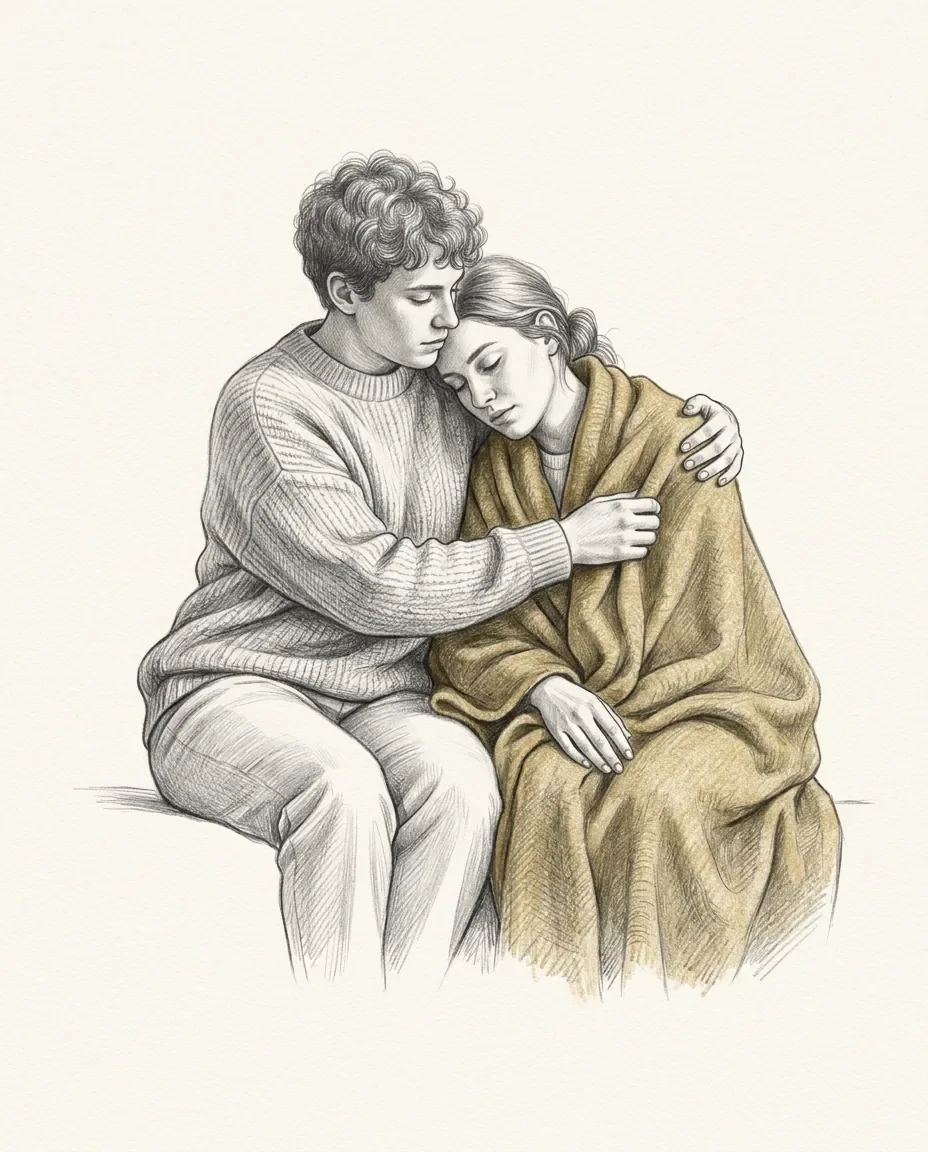
The deliberate emotional, physical and psychological care partners give one another after intense sex or a BDSM scene. It helps everyone come down from heightened arousal and return to a calm, grounded baseline. A widely shared best practice rather than a kink in itself.
- Prevalence
- Very common
- Category
- Acts & Activities
- Domain
- Non-sexual interest
- Confidence
- Medium confidence
- Status
- Not a paraphilia or disorder; a recognized care and risk-reduction practice in consensual BDSM and sex-positive contexts.
- Also known as
- after care, post-scene care, post-play care, afterplay, coming down, comedown care
- Added
- 22 Jun 2026
- Updated
- 22 Aug 2026
Featured in

Overview
Aftercare is the deliberate emotional, physical and psychological attention that partners give one another once an intense sexual encounter or BDSM scene has ended. Also called post-scene or post-play care, it is a transition ritual: it helps participants come down from heightened arousal and a steep neurochemical high, soothe any vulnerability the scene surfaced, and return to a grounded everyday baseline. Rather than a kink in itself, aftercare is widely treated as a near-universal best practice that protects safety, trust and wellbeing, and as a practical expression of ongoing consent. This article covers where the term came from, what aftercare involves, the physiology of the post-scene "drop" it cushions, and its place in consent culture.
Examples
What the term covers. Aftercare is a shape rather than a fixed list. It can be the quiet ten minutes immediately after a scene closes; a check-in message the following day, when a delayed drop is most likely to surface; a plan agreed in advance for how each person gets home and who they can talk to; or, at events and with non-regular partners, care someone arranges for themselves because nobody else will be there to give it. It runs in both directions: the partner who led the scene may need it as much as the one who received it. It is also not confined to kink, since staying close and talking after sex is the same behaviour under a plainer name.
What the term does not cover. Aftercare is not subdrop; drop is the low that aftercare is meant to cushion, and the two are constantly confused. Nor is it subspace, which happens during a scene rather than after it. It is not a ritual of belonging in the way a collar is, not a reward for good behaviour, and not an apology: treating it as an apology implies the scene was a wrong needing repair, which inverts the logic of a negotiated activity such as degradation play or impact play. Nor does it substitute for negotiation beforehand, because care given afterwards cannot retroactively supply consent that was never obtained.
How the word is used. Plain English, borrowed from medicine and social work, where "aftercare" still means follow-up support after treatment or discharge; a reader may meet that sense in a surgical or addiction-recovery context and should not conflate the two. In the kink sense it is community-coined, usually lowercase, and it appears in neither DSM-5-TR nor ICD-11, which classify conditions rather than care practices.
History & origins
From medicine to the leather scene
The word "aftercare" is plain English, borrowed from medicine and social work, where it long denoted follow-up support after treatment, surgery or release from an institution. Its migration into a sexual context is recent and community-driven.
- Late 20th century: As a discrete concept, aftercare crystallised within English-speaking BDSM and leather communities, hand in hand with the "safe, sane and consensual" ethic those communities articulated through the 1980s and 1990s and the later "risk-aware consensual kink" (RACK) refinement. Its precise coinage in the kink sense is not documented to a single author; it emerged as shared practice rather than as one person's invention.
- Per the reference literature: The Wikipedia entry on aftercare records that the term originated in the BDSM community and has since drifted toward the mainstream, frequently under the everyday label "cuddling" after sex.
The research catches up
Academic attention to post-intimacy care is newer than the practice itself:
- 2014: Muise, Giang and Impett, writing in Archives of Sexual Behavior, found that the duration of post-sex affectionate exchanges (the "afterglow") predicted greater sexual and relationship satisfaction, giving empirical weight to a ritual the kink world had already formalised.
- 2019: Maczkowiack and Schweitzer, in the Journal of Sex & Marital Therapy (45:2, 128-140), documented postcoital dysphoria (inexplicable sadness, tearfulness or irritability after otherwise satisfying consensual sex) in men, with about 41% reporting it at least once in their lifetime and 20.2% in the previous four weeks, paralleling earlier findings in women. This provides a clinical analogue for the "drop" that aftercare is designed to cushion.
In practice
Aftercare is highly individual and is ideally negotiated before a scene, not improvised after it. Common elements include:
- rehydration, snacks and a return of blood sugar;
- warmth and blankets, and a quiet, low-stimulus setting;
- gentle physical contact such as holding, hair-stroking or simply lying together;
- any necessary tending of marks left by impact play or bondage;
- verbal reassurance and affirmation, and a later debrief about how the scene felt.
It can be wordless and physical or conversational, and may unfold over minutes, hours, or across one to three days. Crucially, dominant or "top" partners may need as much support as submissives, sometimes more, because both roles can experience a post-scene crash.
Psychology
During intense play the body releases a surge of adrenaline, endorphins, oxytocin and dopamine; when the scene ends these can fall sharply, producing the low mood, tearfulness, fatigue or anxiety the community calls "subdrop" (and, for the dominant, "domdrop" or "topdrop"). Drop can arrive immediately as subspace fades, or surface a day or more later. Aftercare buffers this comedown through reassurance and bonding contact, and just as importantly it reaffirms the emotional connection and the negotiated consent that framed the activity: closing the loop opened during a scene of surrendered or exchanged control, such as a collaring dynamic. The clinical literature on postcoital dysphoria suggests the underlying physiology is not unique to kink, which is part of why intentional post-intimacy care generalises so well beyond it.
Prevalence & culture
Within kink culture aftercare is treated as standard etiquette and is heavily documented in community guides, classes and codes of conduct; the broader idea of intentional post-intimacy care has since entered mainstream sex-positive discourse. Direct prevalence figures for aftercare specifically are scarce, and the estimates that exist rest on community norms and afterglow research rather than on a dedicated population survey, so they should be read as indicative. Because BDSM-themed fantasies and activities are extremely common, large surveys such as Lehmiller's Tell Me What You Want (2018) describe submission and dominance fantasies as near-universal, the population for whom aftercare is relevant is correspondingly broad.
Safety, consent & law
Aftercare is legal, benign and a cornerstone of responsible practice. Its absence is sometimes cited as a marker that an encounter felt coercive or non-consensual, so negotiating aftercare beforehand, alongside limits and safewords, is widely encouraged as part of informed, risk-aware consent. It pairs naturally with the community concepts of subdrop and subspace, and is considered indispensable after any emotionally or physically intense scene.
Common questions
How long should aftercare last?
There is no standard duration, and treating it as a fixed block is the usual mistake. It may take ten minutes or stretch across one to three days, since a drop can surface long after the scene ends. The workable approach is to agree beforehand roughly how much each person expects, then check in again the next day rather than assuming the immediate comedown was the whole of it.
Do dominant partners need aftercare too?
Yes, sometimes more than the submissive, and it is routinely under-provided. The comedown the community calls domdrop or topdrop follows the same physiology as subdrop, and it can be sharpened by the responsibility the top carried during the scene. Because attention tends to flow toward the person who was on the receiving end, tops frequently have to ask for what they need rather than being offered it.
Does aftercare have to involve cuddling?
No. Physical closeness is the most common form, but some people find touch overwhelming immediately afterwards and prefer food, water, a shower, quiet company in the same room, or a simple mundane task. Others want conversation and reassurance rather than contact. The purpose is a return to a grounded baseline; the method is whatever actually achieves that for the people involved, which is why it is worth negotiating.
Is aftercare only a BDSM thing?
It originated in BDSM and leather communities, but the underlying need is general. Muise, Giang and Impett (2014), writing in Archives of Sexual Behavior, found that longer post-sex affectionate exchanges predicted greater sexual and relationship satisfaction in couples generally. In mainstream use the same behaviour usually goes by the plainer label of cuddling or afterglow.
Why do I feel sad or tearful after sex even when it was good?
That has a clinical name: postcoital dysphoria. Maczkowiack and Schweitzer (2019), in the Journal of Sex and Marital Therapy, documented it in men, with about 41% reporting it at least once in their lifetime and 20.2% in the previous four weeks, paralleling earlier findings in women. It is not a sign the encounter was unwanted, and it is the ordinary-life analogue of the drop that aftercare is designed to cushion.
What if a partner does not want to give or receive aftercare?
Wanting to be left alone afterwards is a legitimate preference, and "no contact for an hour, then a message" is itself an aftercare plan rather than the absence of one. What matters is that it was discussed. A partner who refuses to discuss it at all is a different matter: the absence of aftercare is sometimes cited as a marker that an encounter felt coercive, which is why it is negotiated alongside limits and safewords.
From the blog
Origins7 min read
Why some people enjoy pain, and what the body does when they do
Why do people enjoy pain? Context can flip moderate pain to pleasant, and BDSM scenes raise cortisol and endocannabinoids in the partner receiving.

Relationships8 min read
How to tell a partner about a kink, and how partners respond
How to tell a partner about a kink: 71% who shared a favourite fantasy got a positive response, and only 28% who never shared expected one.

Definitions8 min read
What BDSM stands for, and what it covers
What does BDSM stand for? Bondage and discipline, dominance and submission, sadism and masochism: what each pair means, how common it is, where the lines are.
- Subdrop58/100Sensation & PainThe emotional and physical low that some people, usually submissives, feel in the hours or days after an intense BDSM scene as heightened arousal subsides. Sadness, fatigue and irritability are typical.58
- Subspace64/100Sensation & PainAn altered, often euphoric or trance-like headspace that some submissive or bottoming partners enter during intense BDSM play. It is marked by floating sensations, time distortion, reduced pain awareness and impaired verbal responsiveness.64
- Bondage86/100Acts & ActivitiesConsensual binding or restraint of a partner with rope, cuffs, tape or other materials for erotic, aesthetic or sensory pleasure. It is the "B" of BDSM and one of the most widely fantasised-about kinks.86
- Collaring63/100Power, Roles & ScenariosThe consensual act of placing a collar on a submissive partner as a negotiated symbol of ownership, commitment, protection or submission. It takes place within a Dominant/submissive relationship and is often likened to a wedding band.63
- Impact Play71/100Sensation & PainAn umbrella term for consensual BDSM activities in which one partner strikes another's body with a hand or implement for erotic sensation or power exchange. It spans light spanking through to firmer use of paddles, floggers, crops, and canes within negotiated limits.71
- Gangbang66/100Acts & ActivitiesA consensual group-sex configuration in which one person is the shared focus of several partners (usually more than three), in succession or at once. It is a common fantasy and a negotiated practice, sharply distinct from non-consensual assault.66
Plain-English compound of "after" + "care," borrowed from medical and social-work usage (follow-up support after treatment or release); adopted by BDSM communities in the late 20th century for post-scene care. No classical-language derivation.
BDSM practice · consent & negotiation · emotional care
Prevalence is computed from the entry's cited population estimate. Rows marked ESTare indicative editorial estimates scored against a fixed anchor rubric, not measured quantities. Method & anchors: methodology.
Very common · ≈ 1 in 7
- 01Aftercare (BDSM), Wikipediadefinition, BDSM-community origin, mainstream drift toward 'cuddling', common practices, and that dominants may need equal support
- 02Muise, Giang & Impett (2014), Post Sex Affectionate Exchanges Promote Sexual and Relationship Satisfaction, Archives of Sexual Behaviorempirical evidence that post-sex affection (the afterglow) raises sexual and relationship satisfaction
- 03Is Aftercare Consent?, Psychology Todayframing of aftercare's link to consent; absence cited as a marker of non-consensual experiences
- 04Lehmiller (2018), Tell Me What You Want, survey of 4,175 Americanscontext that BDSM-related fantasies are near-universal, indicating a large population for whom aftercare is relevant
- 05Maczkowiack & Schweitzer (2019), Postcoital Dysphoria: Prevalence and Correlates Among Males, Journal of Sex & Marital Therapy 45:2, 128–140documents postcoital dysphoria (sadness/tearfulness after consensual sex) in men, ~41% lifetime and 20.2% four-week prevalence, a clinical analogue for the post-scene 'drop' that aftercare cushions
- 06Safe, sane and consensual, Wikipediathe SSC ethic of late-20th-century BDSM communities within which aftercare crystallised as shared practice