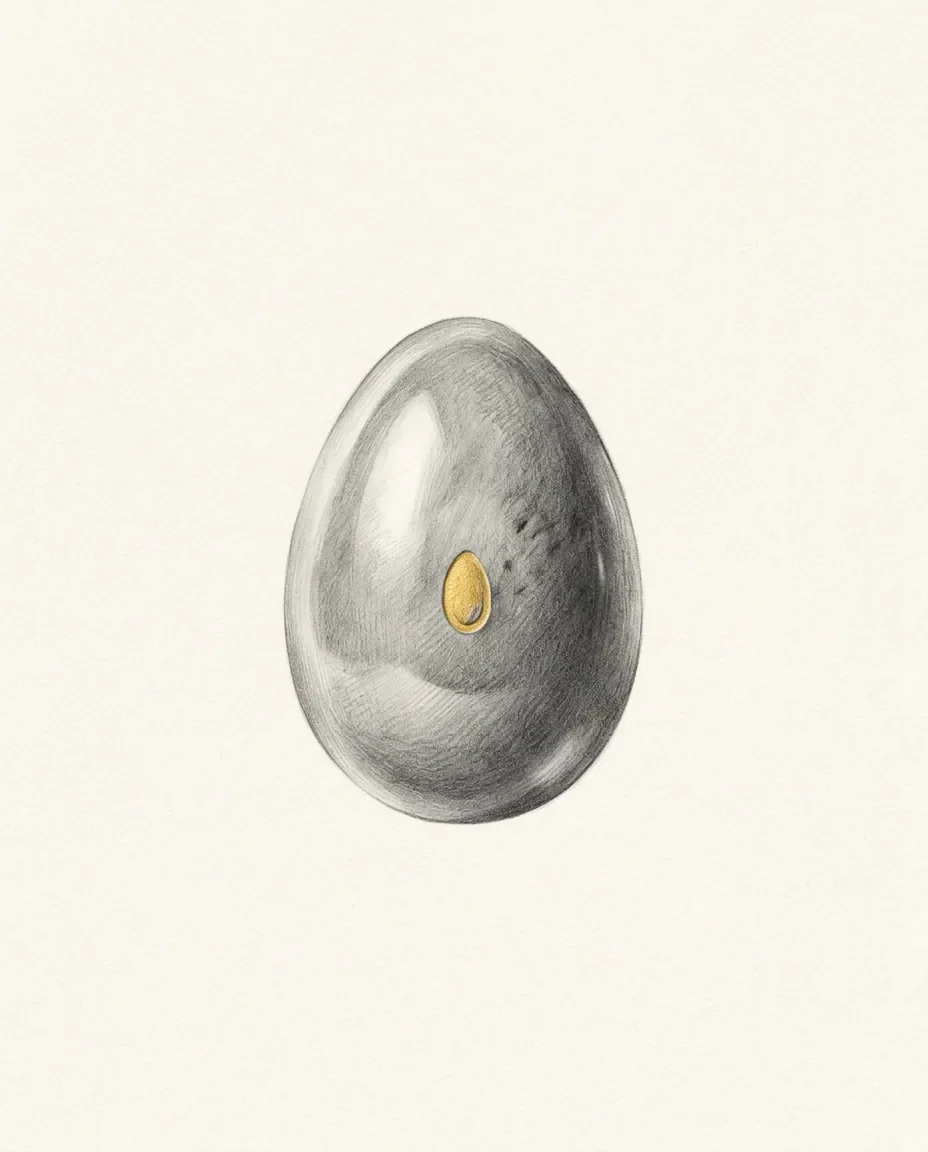
Yoni Egg
Added 21 Jun 2026 · Updated 22 Aug 2026
A yoni egg is a smooth, egg-shaped insertable - often jade or quartz - marketed for pelvic-floor exercise and sensual wellness. Interest in it blends eroticized wellness practice with the appeal of a discreet insertable object.
- Prevalence
- Rare
- Category
- Objects & Materials
- Domain
- Sexual interest
- Confidence
- Low confidence
- Status
- Not a clinical diagnosis; a wellness/insertable practice. Associated health claims lack scientific support.
- Also known as
- yoni egg, jade egg, vaginal egg, love egg (wellness), kegel egg
- Added
- 21 Jun 2026
- Updated
- 22 Aug 2026
Overview
A yoni egg (also called a jade egg) is a small, polished egg-shaped stone, traditionally carved from jade or rose quartz, designed to be worn internally and promoted within sensual-wellness circles for pelvic-floor toning, mindfulness, and erotic awareness. It sits at the intersection of an insertable-object interest and a wellness practice, and is usually discussed in terms of sensation, body-awareness, and ritual rather than a partnered act. The word yoni comes from Sanskrit, lending the modern product an aura of ancient ceremony that, as this article details, is not borne out by the historical record.
Examples
The yoni egg is one object with two framings around it (a wellness regimen and an erotic one), and most confusion about the term comes from mixing them up.
What the term covers. A smooth, polished egg carved from nephrite jade, rose quartz, obsidian or a similar stone, typically sold in a graduated set of sizes and sometimes drilled at the narrow end for a retrieval cord. The practice built around it is internal wear combined with pelvic-floor engagement, often alongside breathing or meditation routines, and it is almost always solitary. The register is wellness rather than kink: it circulates through yoga, lifestyle retail and online "yoni practice" communities rather than through dedicated kink spaces, and it reaches this catalog because the object is also used as a discreet insertable, which is where an erotic interest attaches to it.
What the term does not cover. It is not a medical device. The weighted vaginal cones and moulded silicone trainers sold for pelvic-floor rehabilitation are non-porous, manufactured to a specification and clinically studied; a carved stone with health claims attached is a different object. Nor is it object sexuality, which describes a directed romantic attraction to a particular object rather than the use of one. And the ancient ceremony the marketing invokes is not a documented tradition, as the history below sets out; the egg resembles a power object in how it is talked about, not in provenance.
How the word is used. "Yoni egg" and "jade egg" are used interchangeably, and both are marketing vocabulary rather than clinical terms; yoni is Sanskrit and carries a devotional weight that the plain English description does not. No diagnostic manual mentions the object, and no medical body endorses the practice.
History & origins
The disputed "ancient" lineage
The yoni egg is marketed as an ancient Chinese practice said to descend from imperial concubines or Taoist sexual tradition, but this provenance does not survive scrutiny. In a peer-reviewed investigation, Vaginal Jade Eggs: Ancient Chinese Practice or Modern Marketing Myth? (2019), gynecologist Jen Gunter and archaeologist Sarah Parcak searched the databases of four major collections, the Freer Gallery in Washington, the Metropolitan Museum of Art in New York, the Cleveland Museum of Art, and the Asian Art Museum in San Francisco, and found no vaginal jade egg among more than 5,000 jade objects, nor any reference to one in the surviving Taoist sexual texts. The collections did hold jade objects made for bodily orifices, a jade butt plug and a jade cicada placed in the mouths of dead kings to preserve the body, but nothing supporting a tradition of vaginal wellness eggs. They concluded the "ancient" story is a modern marketing myth. The Wikipedia entry on the jade egg likewise records the absence of historical evidence and the pseudoscientific character of the health claims attached to it.
The 2010s wellness-media surge
The contemporary practice rose to prominence in the 2010s through Western wellness and lifestyle media. The pivotal moment came in January 2017, when Gwyneth Paltrow's lifestyle brand Goop promoted a jade egg with claims that it could improve vaginal muscle tone, balance hormones, and increase "feminine energy." This drew an immediate rebuttal, a widely shared Washington Post piece relayed a gynecologist's warning against the practice, and a sharp spike in public search interest, which Google Trends records for the terms "yoni egg" and "jade egg."
The promotion also drew regulatory attention. After the watchdog group Truth in Advertising flagged the marketing claims, prosecutors from Santa Clara County and nine other California district attorneys' offices brought a consumer-protection action. In September 2018, Goop agreed to pay $145,000 in civil penalties to settle the complaint over unsubstantiated medical claims for its jade and rose-quartz eggs (and an "Inner Judge Flower Essence Blend"), and removed the disputed claims from its product pages, though the eggs themselves remained on sale. Contemporary intimate-practice guides such as Glamour's A–Z of kinks place the yoni egg among recognized wellness-adjacent insertable practices.
In practice
Use centers on gentle internal wear paired with pelvic-floor engagement, sometimes alongside breathing, meditation, or other mindfulness routines. As an interest, the appeal is often framed around connection to the body, ritual, and sensation rather than partnered activity, and it is more commonly presented as self-directed wellness than as an explicit kink.
Psychology
The draw frequently rests on themes of self-connection, embodiment, and the eroticization of a discreet personal object and the ritual surrounding it. The marketing narrative tying the practice to ancient tradition adds a layer of meaning and mystique that some users find part of the appeal: a clear illustration of how cultural framing, even an invented one, can shape and heighten an intimate practice. In this respect the stone functions much like an anthropological power object, and where the object itself becomes a focus of arousal the interest borders the territory described under fetishism.
Prevalence & culture
Despite its burst of visibility through wellness and lifestyle media, the yoni egg remains a niche practice with a modest community footprint. Because it is more often framed as wellness than as a fetish, its enthusiasts are dispersed across wellness, yoga, and intimacy spaces rather than concentrated in dedicated kink communities. No rigorous prevalence survey isolates yoni-egg use; trend data document interest as a burst around 2017 followed by a lower, sustained baseline.
Safety, consent & law
Medical caution is warranted. Porous stones such as jade and some quartz can be difficult to clean thoroughly and may harbor bacteria, and the health claims attached to the practice (improved tone, hormonal balance, and similar benefits) are not supported by scientific evidence; commentators have warned that leaving a weight in place can in principle overwork or strain the pelvic floor. Practitioners are advised to favor non-porous, body-safe materials and to follow sensible hygiene and retrieval precautions, including not leaving an egg in place for prolonged periods. It is otherwise lawful and low-risk between or by consenting adults.
Common questions
Are yoni eggs really an ancient Chinese practice?
No. Gynecologist Jen Gunter and archaeologist Sarah Parcak searched four major jade collections (the Freer, the Metropolitan Museum of Art, the Cleveland Museum of Art and the Asian Art Museum in San Francisco) and found no vaginal jade egg among more than 5,000 jade objects, nor any reference in the surviving Taoist sexual texts. They concluded the ancient provenance is a modern marketing story.
Do yoni eggs actually strengthen the pelvic floor?
There is no evidence that they do. The claims attached to them (improved muscle tone, hormonal balance, and similar benefits) are not supported by scientific evidence, and commentators have raised the opposite concern: that holding a weight in place for extended periods could overwork or strain the pelvic floor rather than condition it. Pelvic-floor training is a clinical field with devices designed and tested for the purpose.
Are yoni eggs safe to use?
They carry real, if modest, risks. Jade and some quartz are porous, so a carved egg is difficult to clean thoroughly and can harbour bacteria; a stone can also chip. The standard cautions are to prefer non-porous, body-safe materials, to clean carefully between uses, and not to leave an egg in place for prolonged periods. Anything that causes pain, unusual discharge or difficulty is a reason to see a clinician.
What happened with Goop and the jade egg?
In January 2017 Gwyneth Paltrow's lifestyle brand promoted a jade egg with claims about vaginal muscle tone, hormonal balance and "feminine energy", drawing immediate medical rebuttal. After the watchdog Truth in Advertising flagged the marketing, Santa Clara County and nine other California district attorneys brought a consumer-protection action; in September 2018 the company agreed to pay $145,000 in civil penalties and dropped the disputed claims.
Is a yoni egg a sex toy or a wellness product?
Legally and commercially it is sold as a wellness product, which is part of why its health claims attracted regulatory attention in the first place. Functionally it is an insertable, and it is used in both registers: as a mindfulness and pelvic-floor routine, and as a discreet erotic object. The two uses are not in conflict; only the medical claims are contested.
Can a yoni egg get stuck?
It cannot travel anywhere, since the vagina is a closed canal, but retrieval is the routine practical complaint: a smooth, undrilled stone is hard to grip, which is why many are sold drilled for a cord. Bearing down usually resolves it. If an egg genuinely will not come out, or if there is pain, a clinician can remove it, an unremarkable procedure and not an emergency.
- Power Object30/100Non-Sexual FetishismIn anthropology and religious studies, a power object is a crafted or found item believed to hold spiritual power or agency. It is the original sense of the word "fetish", and is used in ritual to heal, protect, bind oaths, or influence events. The term is non-sexual and concerns material religion, not erotic interest.30
- Fetishism64/100Fetishistic Disorder · Clinical ParaphiliasA DSM-5-TR paraphilic disorder defined by recurrent, intense arousal from nonliving objects or a strong focus on non-genital body parts. The body-part form is partialism, and the arousal must cause clinically significant distress or impairment. An object or body-part preference without distress is not a disorder.64
- Object Sexuality17/100Objectophilia · Objects & MaterialsObject sexuality (objectophilia, objectum sexuality, OS) is a romantic and sometimes sexual attraction directed at specific inanimate objects or structures. Those who identify with it describe committed, often reciprocal-feeling love for one particular object rather than a generic interest in things.17
- Sensation Play45/100Sensation & PainAn interest in heightened, varied skin sensations created with soft, textured, or lightly stimulating implements. Feathers, fur, silk, brushes, ice, or pinwheels are typical, often combined with anticipation and the contrast between soothing and prickling touch. It is a common, gentle form of erotic play.45
- Metal Fetish25/100Metallophilia · Objects & MaterialsAn erotic attraction to metal materials (chains, chrome, polished steel, cuffs and collars) drawn from their hardness, coolness and weight. Their sound and mirror-like shine are part of the appeal too. A material/texture fetish that frequently overlaps with BDSM gear and restraint aesthetics.25
- Robot Fetish26/100Technosexuality · Objects & MaterialsRobot fetishism, also called technosexuality or ASFR, is an erotic attraction to robots and androids, or to people behaving as artificial beings. It commonly centres on mechanical movement, control, and the blurred line between human and machine.26
From Sanskrit *yoni*, meaning "womb," "source," or "sacred origin", a term for the vulva in Hindu tradition, paired with the plain-English "egg" describing the object's shape.
wellness · insertable · ritual
Prevalence is computed from the entry's cited population estimate. Rows marked ESTare indicative editorial estimates scored against a fixed anchor rubric, not measured quantities. Method & anchors: methodology.
Rare · ≈ 1 in 1,000
- 01An A–Z of Kinks and Fetishes, GlamourMentions yoni-egg/insertable wellness play among recognized intimate practices, supporting the definition.
- 02Google Trends, relative search interest (search-interest proxy)Shows the mid-2010s rise and ongoing niche search interest in 'yoni egg' / 'jade egg', informing the search-interest subscore.
- 03Jade egg, Wikipediadocuments the disputed 'ancient' provenance, the 2010s wellness-media surge, and medical critiques of associated health claims
- 04Gunter J. & Parcak S., Vaginal Jade Eggs: Ancient Chinese Practice or Modern Marketing Myth?, Female Pelvic Medicine & Reconstructive Surgery / Urogynecology (2019)peer-reviewed study reviewing 5,000+ jade objects that found no evidence of ancient vaginal jade-egg use and no support for the associated health claims
- 05A Researcher Looked At 5,000 Jade Objects To Prove Goop's Yoni Egg Claim Wrong, BuzzFeed Newsreports the Gunter–Parcak museum-collection search finding no jade vaginal egg, debunking the 'strictly-guarded ancient secret' marketing claim
- 06Goop to pay $145,000 settlement in jade egg false advertising case, CBS News (2018)documents Goop's 2017 jade-egg promotion and the 2018 $145,000 California settlement over unsubstantiated medical claims
- 07Goop (company), Wikipediabackground on the Goop lifestyle brand and its jade-egg promotion that drove the 2017 surge in yoni-egg visibility
- 08The Mystery Behind Ancient Vaginal Jade Eggs Has Been Cracked, Forbes (Nina Shapiro, 2018)names the four museum collections searched (Freer, Met, Cleveland, Asian Art Museum SF), the 5,000+ jade objects reviewed, and the jade butt plug / mouth cicada funerary objects found but no vaginal jade egg
- 09Gwyneth Paltrow's Goop Agrees To Pay $145,000 To Settle False Advertising Lawsuit, NPR (2018)documents the Truth in Advertising complaint, the Santa Clara County plus nine other California DA action, and the $145,000 settlement over the jade/rose-quartz egg and 'Inner Judge' claims
- 10Jen Gunter, Wikipediabackground on gynecologist Jen Gunter, co-author of the peer-reviewed study debunking the jade egg's 'ancient Chinese' provenance