Robot Fetish
Technosexuality
Added 21 Jun 2026 · Updated 22 Aug 2026
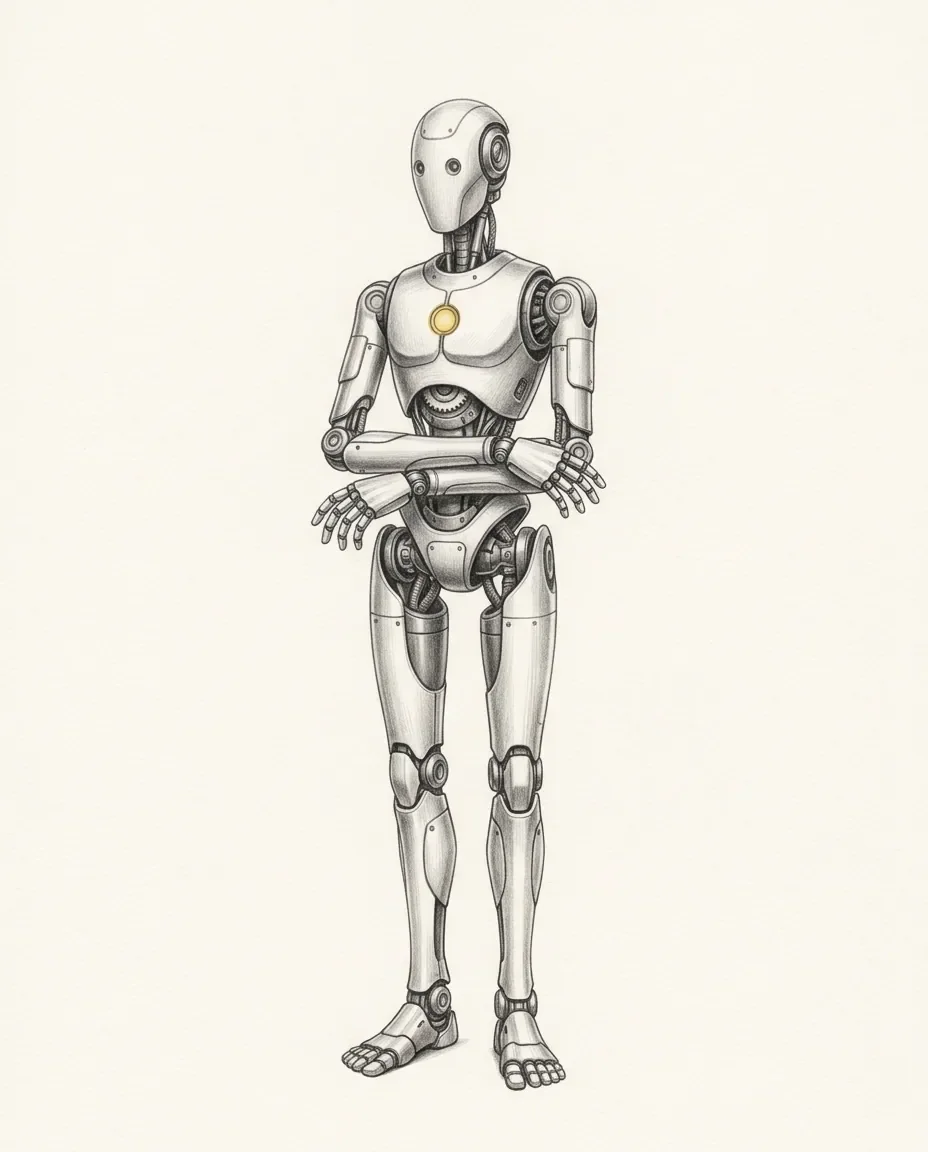
Robot fetishism, also called technosexuality or ASFR, is an erotic attraction to robots and androids, or to people behaving as artificial beings. It commonly centres on mechanical movement, control, and the blurred line between human and machine.
- Prevalence
- Rare
- Category
- Objects & Materials
- Clinical term
- Technosexuality
- Domain
- Sexual interest
- Confidence
- Low confidence
- Status
- Niche sexual interest; not classified as a paraphilia in DSM-5-TR or ICD-11.
- Also known as
- technosexuality, ASFR, robotism, android fetish, fembot fetish, robot fetishism
- Added
- 21 Jun 2026
- Updated
- 22 Aug 2026
Overview
Robot fetishism, known in its online community as ASFR and to many of its members as technosexuality, is an erotic interest in robots and androids, or in humans who behave like machines. The interest spans attraction to overtly mechanical robots, lifelike androids and gynoids, and transformation themes in which a person is imagined becoming, or being controlled like, a machine. It is a niche but unusually well-documented interest, with a self-aware subculture and a small body of academic writing, and it is not classified as a paraphilia in DSM-5-TR or ICD-11.
Examples
What the term covers. Attraction to overtly mechanical robots, to lifelike androids and gynoids, and to the characters of fiction who turn out to be manufactured; the transformation scenario in which a person becomes, or is run like, a machine; and consensual role-play between adults built on mechanical movement, flat synthetic speech, "activation" and "shutdown". What unites these is simulated animacy: the object of interest moves, answers and follows rules, and the rules are half the appeal.
What the term does not cover. Statue / doll fetish (agalmatophilia) is the older thread, directed at statues, mannequins and figures that stay still, and the stillness is frequently the point; the robot version wants motion and response. Robot / doll fetish is the umbrella that gathers both strands together with the fantasy of a person being treated as artificial, and this entry is its machine-and-android half. Dronification borrows the same aesthetic but its subject is an obedient depersonalised human rather than a machine partner, and dollification styles a partner as a doll rather than as a device. Object sexuality is committed love directed at one particular real object, where robot fetishism is directed at a class of imagined beings. A tech fetish (enthusiasm for gadgets) is not erotic at all, despite the shared vocabulary.
How the word is used. Both labels are community jargon rather than clinical terms. ASFR is simply the name of the newsgroup, still used as the scene's shorthand, and technosexuality is a self-descriptor from the same discussions, worth flagging, because "technosexual" is also used in ordinary journalism for someone merely keen on consumer technology. Neither term appears in DSM-5-TR or ICD-11, and the scholarship that does exist treats the interest as a subject for media and cultural studies rather than as a condition.
History & origins
Cultural antecedents
The erotic fascination with artificial people is far older than any of its modern labels. Mechanical automata enchanted European audiences from the Renaissance onward, and the word "robot" itself entered the world through Czech writer Karel Čapek's 1920 play R.U.R. (Rossum's Universal Robots). Čapek later credited his brother, the painter Josef Čapek, with coining the term from Czech robota, the "forced labour" once owed by serfs.
Early cinema gave the alluring artificial woman wide circulation. Fritz Lang's Metropolis (1927) introduced the Maschinenmensch, the robot given the face of the character Maria, played by Brigitte Helm and costumed by Walter Schulze-Mittendorff in lacquered plastic-wood "armour" finished to look like polished metal. As one of the first robots depicted on film, she became the prototype of the eroticised "fembot" that recurs across later science fiction: from The Stepford Wives (1975) to Westworld, Blade Runner, Ex Machina, and the Futurama episodes that openly joke about "robosexuality."
Sexological lineage
The specific erotic interest has antecedents in early sexology. As film scholar Allison de Fren documents, the desire for a beautiful but inanimate or programmable partner overlaps historically with Pygmalionism, arousal toward statues and lifelike figures, which nineteenth-century clinicians sometimes catalogued alongside other unusual interests. The fetish was thus never wholly new; what changed was the technology of the fantasy object and, crucially, the means by which enthusiasts could find one another.
Community formation
- Mid-1990s: The fetish coalesced as a distinct, self-aware community through the Usenet newsgroup alt.sex.fetish.robots, from which the enduring acronym ASFR derives. The precise founding date of the group is not well documented.
- 2001: Filmmaker Allison de Fren produced the documentary short ASFR, one of the first sustained external portraits of the subculture.
- 2003: A community-authored Technosexuality, Pygmalionist and Mind Control Fetish FAQ formalised much of the group's internal vocabulary, including the "built" versus "transformation" distinction described below.
- 2009: De Fren published the peer-reviewed essay Technofetishism and the Uncanny Desires of A.S.F.R. in Science Fiction Studies (vol. 36, pp. 404–440), the most substantial scholarly treatment of the interest. She argues that ASFR is less about machinery as such than a "strategy of denaturalization" that uses the trope of programming to think about selfhood and desire.
The term "technosexuality" as a self-descriptor emerged from these community discussions rather than from clinical literature, and its exact coinage is not formally recorded.
In practice
Expression is largely fantasy- and media-driven, and the community itself distinguishes two overlapping modes:
- "Built": desire for a ready-made android partner conceived as a wholly artificial construct, manufactured to provide companionship or intimacy. Community self-surveys suggest most enthusiasts favour this mode.
- "Transformation": fascination with the process by which a human is willingly or unwillingly turned into a machine, foregrounding the moment of change itself.
- Appreciation of fictional androids, robots, gynoids, and fembots in film, television, games, and fiction.
- Consensual role-play involving robotic movement, monotone speech, "activation," "malfunction," or "programmed" responses.
Some enthusiasts emphasise the aesthetic of artificiality; others the control, predictability, or built-to-please framing.
Psychology
Proposed accounts highlight cultural exposure to science fiction, the appeal of an idealised and fully controllable partner, and overlap with transformation and agency-themed fantasies. De Fren's reading reframes the interest as play with the boundary between person and object rather than mere attraction to hardware. It also shares conceptual territory with object sexuality and the statue and doll cluster, though robot fetishism is distinguished by its emphasis on simulated animacy: a partner that moves, speaks, and responds. Formal empirical research is sparse, and most understanding comes from community self-description rather than clinical study; it is not recognised as a distinct paraphilia in DSM-5-TR or ICD-11.
Prevalence & culture
Robot fetishism is uncommon, but it enjoys disproportionate cultural visibility thanks to decades of androids in film and television, and it appears to be gaining attention alongside the spread of lifelike AI and humanoid consumer devices. Because no large general-population survey isolates the interest, prevalence figures are necessarily rough; broad fetish-prevalence work such as Scorolli et al. (2007) places attraction to objects and artificial forms well down the relative-frequency tables. Community-size proxies (durable forums, FembotWiki, and long-lived discussion groups descended from the original newsgroup) confirm a small but persistent niche. It is best described as a rare yet well-documented sexual interest.
Safety, consent & law
The interest is generally harmless, involving fantasy, fiction, role-play, and inanimate objects. Consent considerations apply only to the human partners involved in any shared role-play, and there are no inherent legal concerns among consenting adults.
Common questions
What does ASFR stand for?
It stands for alt.sex.fetish.robots, the mid-1990s Usenet newsgroup where the interest first gathered as a self-aware community. The group is long gone but the acronym stuck, and it is still how enthusiasts name the scene to one another. Many also call themselves technosexuals. Neither word came from a clinician; both were coined by the people they describe.
What is the difference between a robot fetish and a doll or statue fetish?
Movement and rules. A statue or doll fetish (agalmatophilia in the older clinical literature) is directed at a figure that stays still, and the stillness is often what appeals. A robot fetish is directed at something that acts: mechanical motion, speech, programmed obedience, being switched on and off. This catalogue also carries robot / doll fetish as the umbrella for people who hold both.
Is a robot fetish a paraphilia or a disorder?
No. Neither DSM-5-TR nor ICD-11 lists it, and nothing about the interest meets the threshold those manuals set, which is distress, impairment, or a non-consenting person. It involves fiction, artwork, objects and role-play between adults. A clinician would take an interest only if someone found their own attraction genuinely distressing, and then the distress would be the subject, not the robots.
Do people with a robot fetish want an actual sex robot?
For most, the interest predates and outruns the hardware. The community formed around fiction, film and artwork in the 1990s, long before any humanoid machine could plausibly play the part, and community writing still centres on stories, images and role-play rather than devices. Some enthusiasts follow humanoid-robot and AI developments closely, but that is an interest in the fantasy getting nearer, not a requirement of it.
What is a "fembot"?
A feminine-presenting robot or android in fiction, and the interest's most durable image. Its prototype is the Maschinenmensch of Fritz Lang's Metropolis (1927), among the first robots ever put on film, and the figure has been recycled through science-fiction cinema ever since. "Fembot fetish" is sometimes used loosely for the whole interest, though the interest is not limited to feminine machines.
How common is a robot fetish?
Rare, and never measured directly. No general-population survey isolates it, and the broad fetish-frequency work of Scorolli and colleagues (2007) places attraction to objects and artificial forms well down its relative-frequency table. What can be observed is community persistence: forums, wikis and archives descended from the original newsgroup have run for decades, indicating a small but unusually durable niche.
Is technosexuality the same as loving gadgets?
No, and the collision causes real confusion. Within the ASFR community technosexuality names an erotic interest in robots and androids. In everyday speech and journalism, "technosexual" usually means someone enthusiastic about consumer technology, what this catalogue files as a tech fetish, which is not sexual at all. Only context tells you which sense is meant.
From the blog
Origins5 min read
Can you develop a fetish later in life? What the evidence allows
Can you develop a fetish later in life? What onset studies, conditioning experiments and acquired-preference cases say about when interests form.
Origins7 min read
Why do people have kinks? Where the evidence runs out
Why do people have kinks? What conditioning, excitation transfer and the trauma story each explain, and the point where the evidence stops.
- Statue / Doll Fetish19/100Agalmatophilia · Objects & MaterialsAgalmatophilia is a sexual or romantic attraction to statues, mannequins, dolls, or other lifelike representations of the human form. A linked theme, Pygmalionism, centres on fantasies of such a figure coming to life, or of a living body turning to stone or freezing into immobility.19
- Object Sexuality17/100Objectophilia · Objects & MaterialsObject sexuality (objectophilia, objectum sexuality, OS) is a romantic and sometimes sexual attraction directed at specific inanimate objects or structures. Those who identify with it describe committed, often reciprocal-feeling love for one particular object rather than a generic interest in things.17
- Car & Machine Fetish20/100Mechanophilia · Objects & MaterialsMechanophilia (mechaphilia) is a rare sexual or romantic attraction to machines, most often motor vehicles such as cars, motorcycles, or aircraft. A machine's form, sound, vibration or attributed personality is eroticized. It is distinct from ordinary car enthusiasm.20
- Denim Fetish27/100Denim Fetishism · Objects & MaterialsAn erotic or aesthetic interest centred on denim garments, most often jeans, but also jackets, skirts and overalls. They are valued for their coarse texture, body-shaping fit, scent, and rugged, casual associations. It is a common-variation material and clothing fetish, not a clinical disorder.27
- Metal Fetish25/100Metallophilia · Objects & MaterialsAn erotic attraction to metal materials (chains, chrome, polished steel, cuffs and collars) drawn from their hardness, coolness and weight. Their sound and mirror-like shine are part of the appeal too. A material/texture fetish that frequently overlaps with BDSM gear and restraint aesthetics.25
- Vacuum Bed / Encasement Fetish27/100Objects & MaterialsAn interest in being sealed inside an airtight latex envelope from which the air is pumped out, shrink-wrapping and immobilising the body. It sits within total-enclosure fetishism and is a higher-risk form of bondage and sensory deprivation.27
"Technosexuality" combines Greek tekhnē, "craft/art/skill," with "sexuality"; it arose as a community self-descriptor, not a clinical coinage. ASFR is an acronym of the 1990s Usenet newsgroup alt.sex.fetish.robots. The word "robot" comes from Czech robota, "forced labour," introduced in Karel Čapek's 1920 play R.U.R. and credited by him to his brother Josef Čapek.
machines & vehicles · artificial beings · transformation-adjacent
Prevalence is computed from the entry's cited population estimate. Rows marked ESTare indicative editorial estimates scored against a fixed anchor rubric, not measured quantities. Method & anchors: methodology.
Rare · ≈ 1 in 1,000
- 01List of paraphilias, Wikipediadefinition/existence of technosexuality/ASFR as a recognized niche interest
- 02FetLife, kink community group sizes (community-size proxy)community-size proxy confirming robot/ASFR fetish is a small niche group
- 03Sexual fetishism, Wikipedia (carries the Scorolli 2007 relative-frequency table)framing of object/artificial-being fetishism as an uncommon focus
- 04Robot fetishism, Wikipediadefinition, ASFR/technosexuality terminology, the alt.sex.fetish.robots newsgroup origin, and the built vs transformation fantasy distinction
- 05R.U.R., WikipediaKarel Čapek's 1920 play R.U.R. introducing the word robot from Czech robota, forced labour
- 06Karel Čapek, WikipediaČapek crediting his brother Josef Čapek with coining the word robot for R.U.R.
- 07Maschinenmensch, WikipediaFritz Lang's Metropolis (1927) robot given Maria's face, played by Brigitte Helm and costumed by Walter Schulze-Mittendorff; one of the first robots depicted on film and prototype of the eroticised fembot
- 08Allison de Fren, Technofetishism and the Uncanny Desires of A.S.F.R. (Science Fiction Studies, 2009)scholarly history of ASFR, its sexological antecedents (Pygmalionism), and the denaturalization reading of the interest
- 09Scorolli et al. (2007), Relative prevalence of different fetishes, Int. J. Impotence Research 19(4):432-437relative-frequency framing showing attraction to objects/artificial forms is uncommon among fetishes
- 10DSM-5, Wikipediarobot fetishism is not classified as a paraphilia in the DSM-5/DSM-5-TR
- 11ICD-11, World Health Organizationrobot fetishism is not classified as a paraphilic disorder in ICD-11