Sensation Play
Added 21 Jun 2026 · Updated 22 Aug 2026
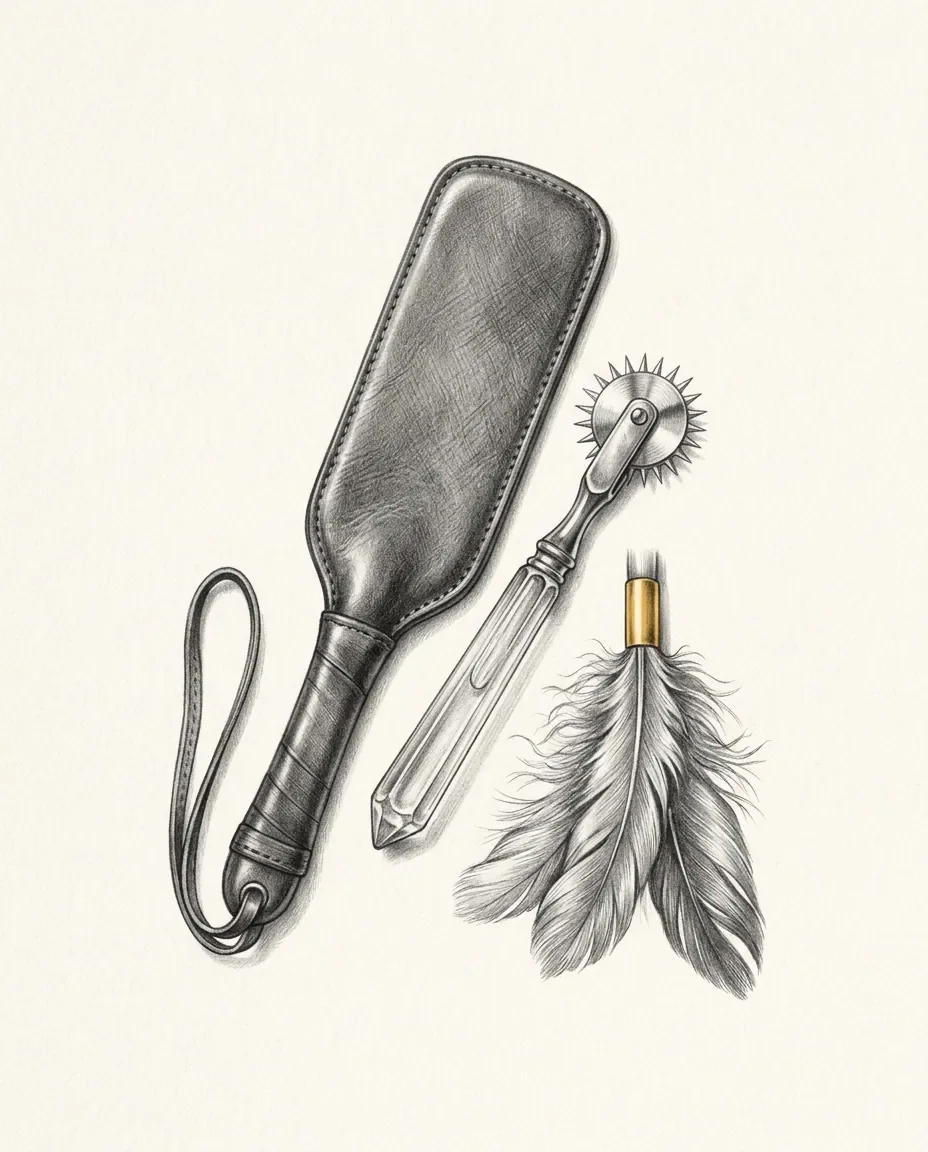
An interest in heightened, varied skin sensations created with soft, textured, or lightly stimulating implements. Feathers, fur, silk, brushes, ice, or pinwheels are typical, often combined with anticipation and the contrast between soothing and prickling touch. It is a common, gentle form of erotic play.
- Prevalence
- Common
- Category
- Sensation & Pain
- Domain
- Sexual interest
- Confidence
- Low confidence
- Status
- Common benign interest; not a disorder. Among the lowest-risk forms of erotic sensation play.
- Also known as
- Texture / Sensation Play, texture play, soft sensation, feather play, Wartenberg wheel
- Added
- 21 Jun 2026
- Updated
- 22 Aug 2026
Featured in
Overview
Sensation play (also called texture play) is the deliberate exploration of how different surfaces and stimuli feel against the skin. It spans soft, soothing tools such as feathers, fur, and silk through to prickly or tingling implements like soft brushes, Wartenberg pinwheels, and ice, and it leans heavily on alternating sensations and on the contrast between expectation and actual touch. It is one of the gentlest and most approachable activities in the broader sensation-and-pain family, and this article traces where the practice and its signature tools come from, how it is typically expressed, and why it appeals.
Examples
What the term covers. A feather or fur mitt drawn slowly across the back; a length of silk trailed over the arms; the fine points of a pinwheel rolled along the ribs; ice and warmed objects used in alternation, which is temperature play; dripped candle wax, which is wax play; fingernails, which is scratching; the held pressure of a clothespin or clamp, which is pinching and clamping; light tickling; the flat of a blade with no cutting intent, as in knife play; and the buzz of low-level electro play. What makes any of these sensation play is that the point lies in what the skin registers, and in how unpredictable the next thing will be.
What the term does not cover. Sensation is not the same as pain. Impact play and spanking deliver force in blows and are measured in intensity; masochism names a taste for pain itself rather than any technique. Sensation play can be intense, but it is defined by variety and contrast rather than by how much it hurts, and much of it does not hurt at all. Nor is it sensory deprivation, which removes input rather than adding it, though the two are constantly combined, since a blindfold is what makes a feather unpredictable. Sensory overload play goes further the other way, flooding the senses deliberately. A silk or fur fetish attaches desire to the material itself, where sensation play is largely indifferent to which fabric is used, and texture fixation is a non-sexual comfort behaviour sharing the vocabulary and none of the context.
How the word is used. Community vernacular, and an umbrella rather than a diagnosis. It is defined mostly by contrast, standing against "impact play" and "pain play" in kink education and toy retail. Its coinage is undocumented, and it appears in neither DSM-5-TR nor ICD-11.
History & origins
Naming
"Sensation play" is modern community vocabulary rather than a clinical diagnosis; its precise coinage is not well documented, and it grew up alongside the contemporary BDSM and kink lexicon of the late twentieth century as an umbrella for tactile, non-impact play. It has never appeared as a disorder in the DSM-5-TR or ICD-11, and it is best understood as a descriptive label for an ordinary range of touch-based intimacy.
The signature tools
Several of its hallmark implements have older and quite specific histories, none more so than the pinwheel:
- 1930s: The neurologist Robert Wartenberg (1887–1956) championed the spiked rolling wheel for mapping skin sensitivity. Wartenberg did not invent the device; by his own account it was already in widespread use in Europe when he practiced in Germany. A Jewish physician, he emigrated to the United States in 1935 and joined the University of California Hospital in San Francisco.
- 1937: Wartenberg introduced the instrument to American clinicians in A Pinwheel for Neurological Examination, published in the Journal of the American Medical Association on 16 October 1937, calling it "an indispensable part of the outfit for everyday neurologic practice." Designed to test dermatomes and nerve response by rolling its radiating pins across the skin, it was only much later adopted as a recreational tactile toy, and is now rarely used in clinics for hygiene reasons.
The older sexological backdrop
The deeper context is the long-recognized human responsiveness to touch and texture. Erotic interest in particular materials and surface sensations was already catalogued in foundational sexology: Richard von Krafft-Ebing's Psychopathia Sexualis (1886) and Havelock Ellis's Studies in the Psychology of Sex both described heightened arousal from fabrics such as silk and fur. Sensation play gathers these older threads (fine textures, contrast, and anticipation) into a single, intentionally gentle practice rather than a fixation on one object.
In practice
Sensation play is typically expressed by tracing or trailing a series of contrasting stimuli across the skin: a feather or fur mitt, a length of silk, a soft brush, the cool prick of a pinwheel, or chilled and warmed objects. It is frequently paired with a blindfold or light restraint, a small dose of sensory deprivation, so the receiving partner cannot predict the next sensation, which sharpens attention and anticipation. Practitioners use it as a tender warm-up, a standalone activity, or an early building block within more intense scenes, and it adapts easily to nearly any comfort level. It overlaps closely with the rougher, instinct-driven style of primal play, and it forms the bottom of an intensity ladder that runs up through temperature play and wax play, through the held pressure of pinching and clamping, to impact play and electro play: a progression practitioners often climb deliberately within a single scene.
Psychology
The appeal centers on focused attention, trust, the surrender of control over what one feels, and the way novel or unpredictable touch can intensify arousal. It draws on broad human responsiveness to skin contact and on the amplifying effect of mild sensory restriction and anticipation: limiting one channel (sight) tends to heighten another (touch). Tactile sensitivity varies considerably between individuals, so the same feather or pinwheel can feel soothing to one person and electric to another. The evidence base for sensation play specifically is thin, because it is rarely studied as a discrete behaviour; its mechanisms are usually inferred from the broader, better-documented psychology of touch, mindfulness, and consensual power exchange.
Prevalence & culture
Light sensation play is one of the more mainstream forms of erotic play and is routinely recommended in popular guides and "A–Z of kinks" articles as a low-stakes entry point. It is rarely measured on its own, so prevalence rests on its overlap with broadly endorsed interests in touch, blindfolding, and mild restraint. In Lehmiller's 2018 survey of 4,175 Americans, only 4% of women and 7% of men reported never having had a BDSM-themed fantasy, and Joyal, Cossette & Lapierre (2015) found submission and domination themes to be statistically common for both sexes: figures consistent with the very wide reach of the gentle, sensation-focused play this entry describes. FetLife groups dedicated to sensation and texture play offer a further community-size proxy.
Safety, consent & law
This is among the lowest-risk activities in the domain. Basic care includes keeping sharp or pinwheel-type tools from breaking the skin unless that is explicitly intended, watching for skin sensitivity or allergies (latex, certain fabrics), sanitizing shared implements between people, and respecting negotiated limits and consent. With these in place it is a benign and accessible interest for consenting adults, with no specific legal concerns.
Common questions
What do you need to start sensation play?
Almost nothing, which is part of why it is recommended as a first step. A feather, a silk scarf, a soft make-up brush, an ice cube and a blindfold cover most of the range, and all are already in most homes. Specialist items such as a Wartenberg pinwheel or a fur mitt add variety without being necessary. What matters more than equipment is a negotiated limit and an agreed way to stop.
Why is a blindfold used in sensation play?
Because unpredictability does most of the work. When the receiving partner cannot see what is coming, each touch arrives without warning, attention narrows to the skin, and mild stimuli register far more strongly than they otherwise would. This is the principle behind sensory deprivation applied on a small scale: closing one channel amplifies another. It also hands control of the experience entirely to the other person, which for many people is the appeal.
Is a Wartenberg wheel painful?
That depends almost entirely on pressure. The device was designed to test nerve response by rolling radiating pins across the skin, not to injure it, and used lightly it produces a tingling or prickling sensation rather than pain. Pressed harder it turns genuinely sharp, and harder still it can break the skin, which is outside what the tool is for. Because it is awkward to sterilise, a wheel is usually kept to one person.
Is sensation play a good way to start with BDSM?
It is the usual recommendation, and for good reasons: it needs no equipment, leaves no marks, carries very little physical risk, and can be stopped at any moment without unwinding anything first. It also gives both people practice at the parts that matter most elsewhere, negotiating in advance, reading a partner's reactions, and using a safeword, with very little at stake if the scene goes nowhere.
Can sensation play be non-sexual?
Frequently, yes. Many people describe extended sensation play as calming or meditative rather than arousing, and use it for closeness, for winding down, or simply as a way of being attended to with nothing further expected. Nothing in the practice requires nudity, genital contact or a sexual outcome. Where it does form part of sex, it is often the slow opening rather than the point of the encounter.
How do you clean sensation play toys?
By material, and it matters more with some items than others. Metal and hard plastic, such as a pinwheel or a smooth wand, can be washed and disinfected between people. Feathers, fur, leather and fabric are porous and cannot be reliably sanitised, so they are usually treated as personal rather than shared items. Skin sensitivity is the other routine check, since latex and some fabrics and dyes provoke reactions in people who did not expect one.
- Silk Fetish34/100Objects & MaterialsAn erotic attraction to silk, centred on its smooth, soft, cool tactile feel and luminous drape. It is a soft-textile material interest within the broad family of fabric fetishisms rather than a separately defined clinical paraphilia.34
- Fur Fetish32/100Doraphilia · Objects & MaterialsAn erotic interest in fur, animal skins, or hides, real or faux, valued for their softness, warmth, scent, and sensory feel against the body. Clinically termed doraphilia, it is generally a benign material fetish rather than a disorder.32
- Primal Play33/100Identity & TransformationA consensual style of intimacy in which partners drop social restraint and act from an instinctual, animalistic headspace. It most often takes the form of predator-and-prey dynamics. In its feral register it overlaps with therian identity and inner-animal embodiment rather than scripted scenes.33
- Mummification45/100Sensation & PainMummification is a form of consensual bondage in which a person's body is wrapped or encased in materials such as plastic film, tape, or bandages. The wrapping often runs head to foot, restricting movement and heightening sensory experience. It is a recognised BDSM practice, not a clinical paraphilia.45
- Pinching and Clamping45/100Sensation & PainA consensual sensation-play interest in steady, focused pressure applied to the skin or sensitive areas, by the fingers or by implements. Clamps and clothespins are typical. The appeal lies in the slow build of controlled pressure and the vivid rush of sensation when it is released.45
- Tickling Fetish45/100Knismolagnia · Sensation & PainAn erotic or playful interest centered on tickling, ticklishness, and the laughter, squirming, and gentle restraint it produces. It ranges from lighthearted affection to a focused fetish within consensual play.45
A plain-English descriptive compound ("sensation" (from Latin sensus, "feeling, perception") plus "play") coined within the late-20th-century BDSM community as an umbrella for touch-focused, non-impact erotic play; it has no clinical -philia or -lagnia derivation.
light sensation · skin sensation · anticipation
Prevalence is computed from the entry's cited population estimate. Rows marked ESTare indicative editorial estimates scored against a fixed anchor rubric, not measured quantities. Method & anchors: methodology.
Common · ≈ 1 in 20
- 01An A–Z of Kinks and Fetishes, Glamourlay framing of sensation/texture play as a common, accessible kink
- 02Lehmiller (2018), Tell Me What You Want, survey of 4,175 AmericansBDSM-umbrella fantasies near-universal, placing mild sensation play among common interests
- 03FetLife, kink community group sizes (community-size proxy)community-size proxy for sensation-play interest groups
- 04Wartenberg wheel, Wikipediathe pinwheel as a neurological sensitivity-testing instrument popularized (not invented) by Robert Wartenberg; 1930 descriptions and his 1937 JAMA introduction to US clinicians; later adoption as a sensation-play toy
- 05Joyal, Cossette & Lapierre (2015), What Exactly Is an Unusual Sexual Fantasy?, PubMedsubmission and domination themes reported as statistically common for both men and women, supporting the wide reach of gentle sensation/restraint play
- 06Psychopathia Sexualis, WikipediaKrafft-Ebing's 1886 cataloguing of erotic responsiveness to fabrics and surface sensations as early sexological backdrop
- 07Studies in the Psychology of Sex, WikipediaHavelock Ellis's documentation of heightened arousal from particular materials and textures
- 08Diagnostic and Statistical Manual of Mental Disorders (DSM-5-TR), American Psychiatric Associationsensation play is not classified as a disorder in the DSM-5-TR
- 09ICD-11, World Health Organizationsensation play is not classified as a disorder in the ICD-11