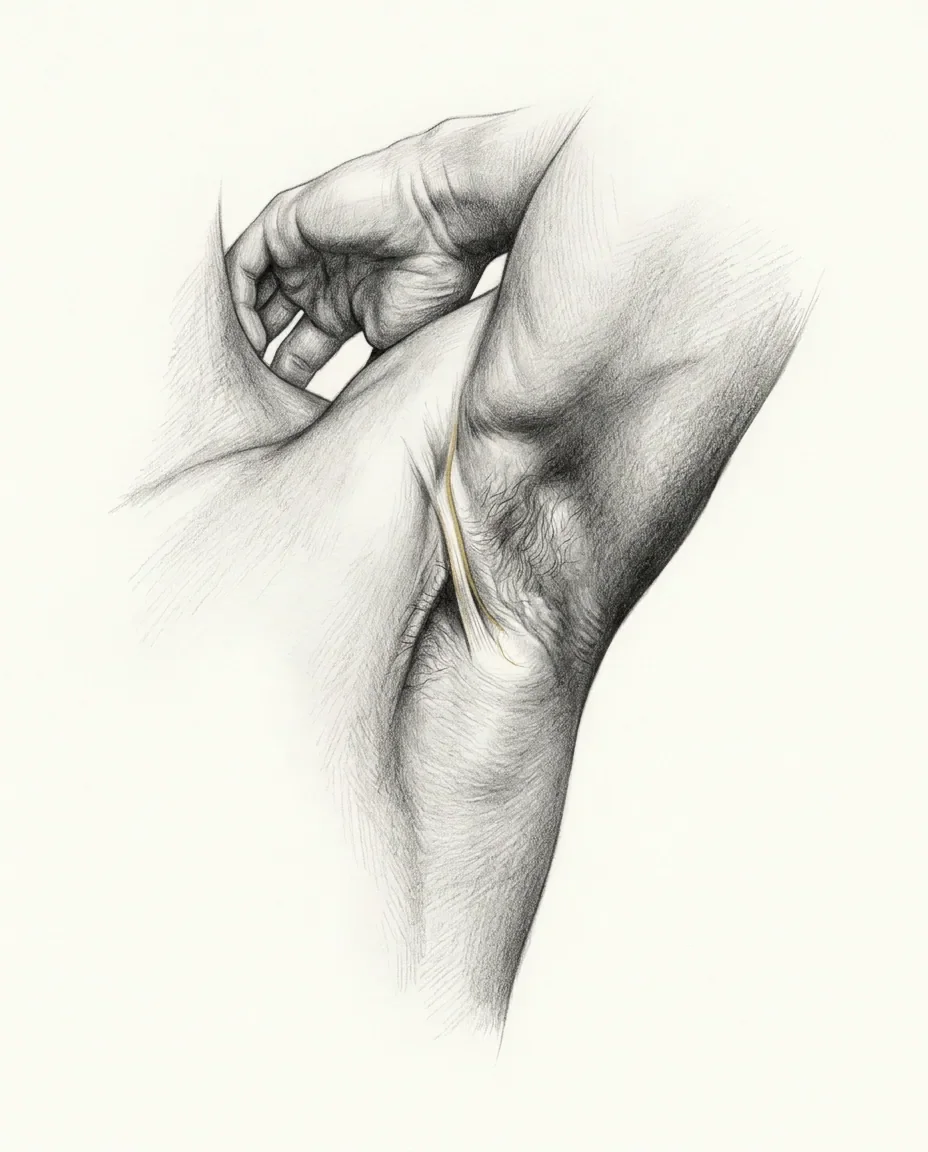
Armpit Fetish
Maschalagnia
Added 21 Jun 2026 · Updated 22 Aug 2026
Maschalagnia (armpit fetishism) is a partialism in which the armpit is a primary focus of sexual attraction. Interest may center on the underarm's appearance, hair, natural scent, or touch; the related term axillism denotes underarm sexual contact specifically.
- Prevalence
- Uncommon
- Category
- Body Parts & Partialism
- Clinical term
- Maschalagnia
- Domain
- Sexual interest · Paraphilia
- Confidence
- Low confidence
- Status
- Partialism; a benign paraphilic variation, not a disorder unless it causes distress or impairment.
- Also known as
- Armpit Partialism (Maschalagnia), axillism, maschalagnia, underarm fetish, armpit partialism
- Added
- 21 Jun 2026
- Updated
- 22 Aug 2026
Overview
Armpit fetishism, known clinically as maschalagnia, is a form of partialism: sexual interest concentrated on a specific body part rather than the whole person. Here the focus is the axilla (armpit), and the appeal can involve its appearance, the natural scent of the area, the presence or absence of hair, or tactile and kissing contact. The Armpit fetishism article treats maschalagnia and axillism as alternate names for the interest, while axillism (also spelled axilism) more specifically denotes underarm sexual contact. As a partialism it is grouped among the paraphilic variations, yet it is benign and only clinically relevant where it causes distress or impairment.
Examples
What the term covers. Attraction focused on the axilla and the shallow hollow it forms: the shape and skin of the underarm, the presence, absence or texture of hair there, the region's natural scent, and touch, kissing or nuzzling directed at it. For many people the interest is one preference among several and appears simply as a place they like to linger; for a smaller number it is the reliable focus of arousal. Axillism names the sexual act performed at the underarm specifically, rather than the attraction behind it.
What the term does not cover. Olfactophilia is an interest in body odour wherever it occurs, and sweat fetish attaches to perspiration rather than to a body part. Either can be part of armpit interest without being the same thing. Where the draw is hair as such, the relevant interest is body hair; hair fetish concerns scalp hair. Mysophilia is arousal at dirtiness and unwashed items, which is a different appeal from the ordinary scent of clean skin. And the umbrella term for the whole class is partialism, of which this is one of the less common examples.
How the word is used. Maschalagnia is a reference-book word, formed on the same -lagnia pattern as other partialism labels and essentially never spoken; axillism is likewise confined to glossaries and older sexological writing. Everyday usage is simply "armpit fetish". Neither term is a diagnosis: the DSM-5-TR and the ICD-11 have no category for interest in a particular body part, reaching it only through the general fetishistic-disorder criteria, and only when there is distress or impairment.
History & origins
Clinical lineage
Clinical attention to body-part-focused attraction dates to the foundational sexology of the late nineteenth century. Richard von Krafft-Ebing's Psychopathia Sexualis (1886) described fixations on isolated body regions, and Havelock Ellis, in Studies in the Psychology of Sex (the relevant volume on the sexual impulse and olfaction dates to 1905), devoted extended discussion to smell in attraction, observing how individual body scents could become powerfully erotic. Sigmund Freud likewise framed part-focused fixations within his theory of fetishism. The Wikipedia article on armpit fetishism cites all three of these figures.
Terminology
The term maschalagnia combines the Ancient Greek maschale (μασχάλη, "armpit") with -lagnia (from lagneia, λαγνεία, "lust"), following the same naming convention as other -lagnia partialisms; its precise coinage is not well documented and it has never been a standalone diagnostic category. Axillism, from Latin axilla ("armpit"), names the corresponding sexual practice: a form of intercrural-style contact. In The Joy of Sex (1974), Alex Comfort discussed underarm intercourse and championed the erotic value of natural underarm scent, calling routine armpit shaving "simply ignorant vandalism."
Modern classification
Modern diagnostic systems fold such interests into the broader notion of partialism. As summarised on Partialism, the DSM-5-TR treats a focus on a non-genital body part as a possible form of fetishistic disorder only where it causes significant psychosocial distress or impairment: otherwise regarding it as a normal-range variation, a threshold also stated in StatPearls.
In practice
Expression is usually integrated into ordinary intimacy: a partner may enjoy nuzzling, smelling, kissing, or touching the underarm, and some find the region especially erotic during foreplay; axillism describes underarm contact specifically. For a subset the interest has a strong olfactory component, overlapping with attraction to natural body odour and with sweat interest, and, where underarm hair is the draw, with body hair interest. Preferences regarding underarm hair and grooming vary widely between individuals and cultures.
Psychology
Partialisms are often explained through associative learning and the close cortical mapping between adjacent body regions, alongside the role of scent in attraction and pair bonding. The armpit is a dense site of apocrine glands, which plausibly underlies the olfactory dimension some people report. The popular framing of this as "pheromone" attraction should be treated cautiously: as the Armpit fetishism article itself notes, no study has conclusively identified a human pheromone, and the vomeronasal organ is non-functional in humans: so claims of a hardwired chemosignalling mechanism remain unproven, and the evidence base for any specific cause is thin.
Prevalence & culture
Maschalagnia is uncommon as a named primary interest and is sparsely represented in the research literature. In Scorolli et al. (2007), the large analysis of online fetish-community membership, body-part fetishes were dominated by feet (about 47%), with armpit interest sitting well down among the minor body-part foci; the same relative-frequency table is reproduced on Sexual fetishism. Armpit-focused content nonetheless has a visible niche online. Cultural attitudes toward underarm hair and odour differ markedly across regions and eras, which shapes how openly the interest is expressed.
Safety, consent & law
The interest is benign and involves only consenting adults and ordinary, non-injurious contact. As with any intimacy, mutual consent and attention to hygiene preferences are the only relevant considerations.
Common questions
Is an armpit fetish normal?
It is uncommon as a primary interest but entirely benign. Interest concentrated on a non-genital body part is called partialism, and modern classification treats it as a normal-range variation rather than a condition; it would only be considered a fetishistic disorder if it caused the person significant distress or impairment in their life. Nothing about the armpit makes it a stranger focus than the neck, the hands or the feet.
What is axillism?
Axillism, sometimes spelled axilism, is the name for sexual contact performed at the underarm, an intercrural-style act using the hollow of the armpit. It is a term for the practice rather than for the attraction, so someone can have the interest without it and can do it without having the interest. Alex Comfort discussed the act in The Joy of Sex (1974), which is where most later references pick it up.
What is the difference between an armpit fetish and a sweat or body-odour fetish?
The difference is what the interest is anchored to. An armpit fetish is anchored to a place: the appearance and feel of the underarm are part of the appeal even when scent is not involved. Sweat fetish attaches to perspiration wherever it appears, and olfactophilia to body scent generally. They overlap often, since the armpit is a dense site of scent glands, but plenty of people report one without the others.
Do people with an armpit fetish prefer hairy or shaved underarms?
Both, and the split is not predictable. Some are drawn specifically to underarm hair, which puts the interest close to body hair attraction; others prefer smooth skin and the way the hollow reads without it. Grooming norms differ sharply between countries and have changed a great deal within living memory, so what a given person finds appealing is shaped as much by what they grew up seeing as by anything else.
Does someone with this interest want their partner to stop using deodorant?
Some do. Where the appeal is olfactory, antiperspirant is removing the thing that is being sought, and Alex Comfort made exactly that argument in 1974 when he called routine armpit shaving "simply ignorant vandalism". Many others have no scent component at all and no view on the matter. It is a preference to be raised and negotiated like any other, not something a partner should be expected to accommodate unasked.
Is kissing or licking a partner's armpit safe?
It is ordinary skin contact and carries no special risk. The practical points are small ones: antiperspirants, deodorants and fragrances are not intended to be tasted and can irritate, so many people rinse first; freshly shaved skin is easily chafed; and infections that pass by skin-to-skin or oral contact behave here exactly as they would anywhere else. Beyond that, mutual consent and a shared understanding about grooming are the whole of it.
- Sweat Fetish46/100Olfactophilia (sweat subtype) · Body Functions & FluidsA sexual interest in sweat and natural body odor, valued for its scent, musk, and sense of physical authenticity. It is a benign olfactophilic interest among consenting adults rather than a recognized disorder.46
- Leg Fetish53/100Crurophilia · Body Parts & PartialismCrurophilia is a partialism in which the legs are the primary focus of sexual attraction. Interest may center on a leg's shape, length, line, or musculature, or on the way legs are framed by clothing such as stockings, skirts, or heels.53
- Breast Fetish68/100Mazophilia · Body Parts & PartialismMazophilia is a pronounced sexual interest centred on the breasts: their shape, size, feel and the intimacy of contact. It ranges from an extremely common aesthetic preference to a more dedicated partialism in which the breasts become the dominant focus of arousal.68
- Body Hair Fetish34/100Hirsutophilia · Body Parts & PartialismAn erotic focus on natural body hair (chest, abdomen, arms, legs, or underarms) where its presence, density, or texture is a primary source of attraction. A benign partialism in consenting adults, sometimes labelled hirsutophilia.34
- Belly Fetish32/100Abdominal Partialism · Body Parts & PartialismAbdominal partialism is a strong erotic focus on the belly and stomach area. Preferences vary widely, from toned or soft midriffs to the navel itself, and may include gentle touch of the region. It is a benign variation in consenting adults.32
- Navel Fetish32/100Alvinophilia · Body Parts & PartialismA focused erotic interest in the navel and surrounding abdomen: its shape, depth, or adornment. Clinically a partialism (alvinophilia / omphalophilia); an uncommon, benign body-part interest with a small but visible online following.32
Coined from Ancient Greek 'maschale' (μασχάλη, armpit) + '-lagnia' (from 'lagneia', λαγνεία, lust), literally 'armpit-lust', following the standard -lagnia naming pattern for partialisms.
upper body · torso
Prevalence is computed from the entry's cited population estimate. Rows marked ESTare indicative editorial estimates scored against a fixed anchor rubric, not measured quantities. Method & anchors: methodology.
Uncommon · ≈ 1 in 100
- 01List of paraphilias, Wikipediadefinition/existence of maschalagnia (armpit partialism)
- 02Scorolli et al. (2007), Relative prevalence of different fetishes, Int. J. Impotence Research 19(4):432-437body-part fetish relative-frequency framing; armpits a small minor share well below feet (47%)
- 03Sexual fetishism, Wikipedia (carries the Scorolli 2007 relative-frequency table)carries the Scorolli 2007 body-part table placing armpit/underarm among less common body-part foci
- 04Havelock Ellis, Studies in the Psychology of Sex (1897-1928)early sexological treatment of olfaction and body scent in attraction, relevant to the olfactory component of armpit partialism
- 05Armpit fetishism, Wikipediamaschalagnia/axillism as alternate names; citations to Comfort, Ellis and Freud; and the caveat that no human pheromone has been conclusively identified and the vomeronasal organ is non-functional in humans
- 06Partialism, Wikipediadefinition of partialism as focus on a non-genital body part and its DSM-5 classification as fetishistic disorder only with significant distress/impairment
- 07Psychopathia Sexualis (Krafft-Ebing, 1886), Wikipediathe 1886 foundational sexology describing fixations on isolated body regions
- 08Three Essays on the Theory of Sexuality (Freud, 1905), WikipediaFreud's framing of part-focused fixations within a theory of fetishism
- 09The Joy of Sex (Alex Comfort, 1974), WikipediaComfort's discussion of underarm intercourse and defence of natural underarm scent ('ignorant vandalism' on shaving)
- 10DSM-5-TR, Paraphilic Disorders (American Psychiatric Association, 2022)fetishistic disorder applies to a non-genital body-part focus only with clinically significant distress or impairment
- 11Paraphilia, StatPearls, NCBI Bookshelfa paraphilia becomes a pathology only when it causes significant distress and impairment of functioning