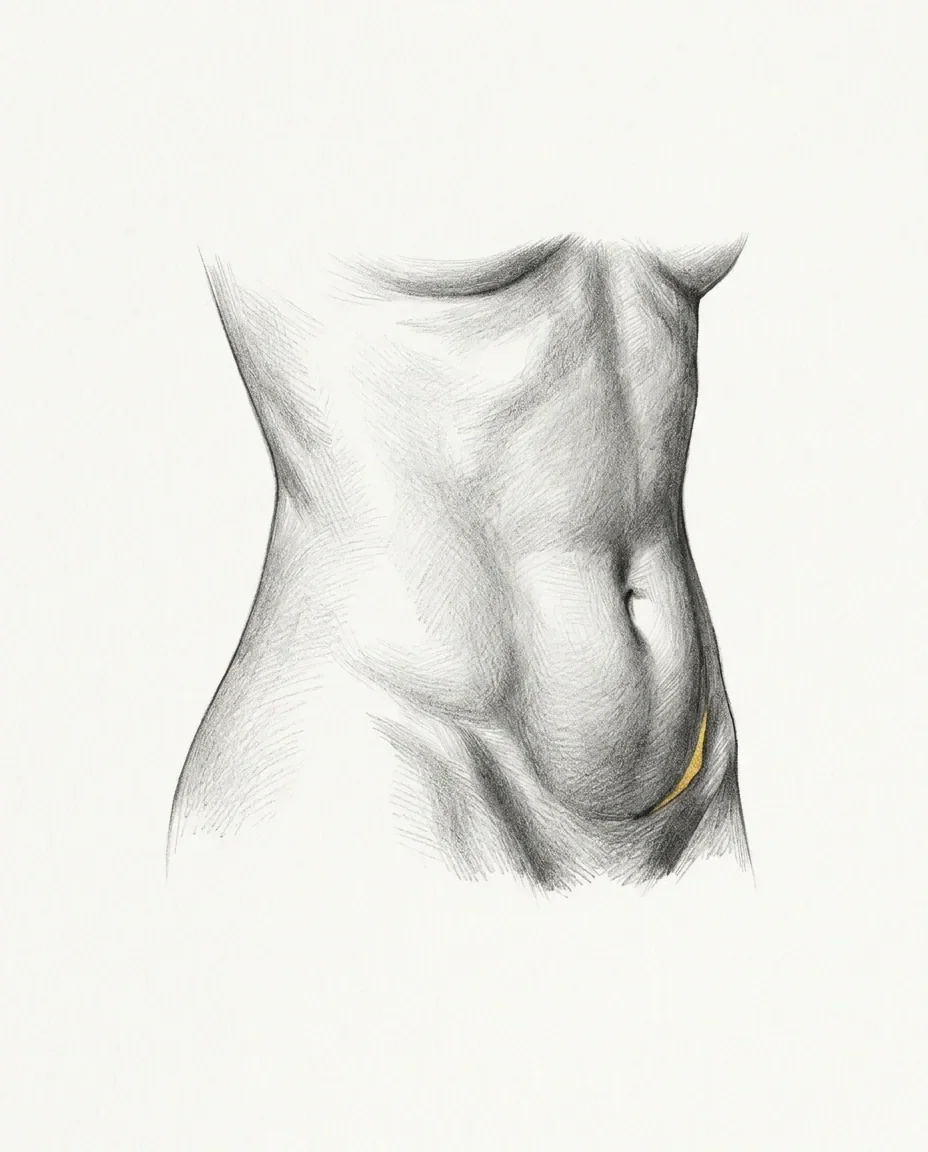
Belly Fetish
Abdominal Partialism
Added 21 Jun 2026 · Updated 22 Aug 2026
Abdominal partialism is a strong erotic focus on the belly and stomach area. Preferences vary widely, from toned or soft midriffs to the navel itself, and may include gentle touch of the region. It is a benign variation in consenting adults.
- Prevalence
- Uncommon
- Category
- Body Parts & Partialism
- Clinical term
- Abdominal Partialism
- Domain
- Sexual interest
- Confidence
- Low confidence
- Status
- Common variation, not a disorder; benign partialism.
- Also known as
- abdomen & stomach partialism, stomach fetish, abdominal partialism, tummy fetish, navel fetish
- Added
- 21 Jun 2026
- Updated
- 22 Aug 2026
Overview
Abdominal partialism, commonly called a belly fetish or stomach fetish (clinically alvinolagnia), is a pronounced erotic interest in the stomach and belly region, including the midriff and the navel. Preferences within it are diverse, ranging from toned abdomens to softer or fuller bellies, reflecting differing aesthetic tastes. The navel-focused form is sometimes distinguished as alvinophilia, and the two overlap heavily in practice. For most people the interest functions as a strong preference rather than an exclusive condition for arousal. This article covers the lineage of the terms, how the interest is expressed, its likely psychology, and what is known about its prevalence.
Definition & scope
A belly fetish is a partialism: an erotic emphasis on a specific non-genital body region. Its scope is broader than a navel-specific focus, taking in the whole midriff, the line of the stomach, and the contour of the abdomen. The two labels commonly used mark that distinction:
- Alvinolagnia (belly/stomach fetish): attraction to the midriff and stomach as a whole.
- Alvinophilia (navel fetish): attraction focused on the navel itself, treated in this directory as the closely related navel fetish.
Within the interest, preferences split along body-type lines, some toward firm, toned abdomens and others toward soft or fuller bellies, so it is less a single ideal than a family of aesthetic tastes.
Examples
What the term covers. Attention that settles on the midriff rather than passing over it: the line of the stomach, the softness or definition of the abdomen, the shape and depth of the navel, the way the region moves when someone breathes or stretches. In practice it shows up as appreciation of an exposed midriff (crop tops, low waistbands, swimwear, sari or dance costume) and as touch, usually mild: a hand rested on the belly, stroking, or light pressure. Preferences inside the interest diverge sharply, some toward firm, toned abdomens and others toward soft or fuller ones, so two people describing a belly fetish may be describing nearly opposite ideals.
What the term does not cover. The navel fetish is the narrower focus, keyed to the navel alone rather than the whole region. Feederism and weight gain turn on the process of a body becoming larger, not on the belly as it is, and body inflation is a fantasy of swelling rather than an attraction to anatomy. Pregnancy fetish is keyed to gestation, stretch mark fetish to skin texture, and stomach noise fetish is auditory: the digestive sounds rather than the body part. Muscle worship concerns developed musculature and strength in general. Neighbouring torso partialisms such as back, thigh and butt interest differ only in the region they settle on.
How the word is used. "Belly fetish," "tummy fetish" and "stomach fetish" are everyday vernacular. Alvinolagnia and alvinophilia circulate in popular -philia glossaries and in sex-education writing but appear in no diagnostic manual; the recognised clinical frame is partialism, which the DSM-5 folded into fetishistic disorder and which is diagnosed only where distress or impairment is present.
History & origins
The belly and navel as erotic objects
The abdomen, and the navel in particular, have drawn aesthetic and erotic attention for millennia. The exposed female navel appears as an image of desire in ancient literature, from the Song of Songs in the Hebrew Bible to Sanskrit descriptions of goddesses by writers such as Kālidāsa, and the midriff is foregrounded in dance traditions such as belly dancing, where performers historically adorned the navel with jewels or sequins. No single coinage marks the origin of the interest as a named focus; it is better understood as a long-standing strand of bodily attraction later given clinical vocabulary.
Clinical lineage
In sexological terms the interest falls under partialism, an erotic emphasis on a particular non-genital body part. The framework descends from the classic catalogues of Krafft-Ebing's Psychopathia Sexualis (1886) and Havelock Ellis's Studies in the Psychology of Sex (1897–1928), and was later refined through the DSM and ICD lineages. The DSM-IV classed partialism as a distinct paraphilia (not otherwise specified); the DSM-5 merged it into fetishistic disorder, and, like the current DSM-5-TR, treats it as a disorder only where it causes the person significant distress or impairment. Absent that, it is regarded as a normal-range variation, not a pathology.
The terms alvinophilia and alvinolagnia
The navel-specific label alvinophilia and the stomach-specific alvinolagnia appear in popular and community catalogues and in sex-positive educational sources such as the Center for Positive Sexuality, which defines belly fetish (alvinolagnia) as attraction to the stomach and alvinophilia as attraction to the navel. These terms are not established in the DSM or ICD, and their precise origins are not well documented in clinical sources.
Cultural cycles
Midriff visibility has shifted with fashion, and the belly fetish Wikipedia article traces several inflection points: the bikini's introduction in 1946, the navel-piercing trend and low-rise styles of the 1990s, each of which made the belly a more openly displayed and admired body region in Western culture. Midriff-baring costume in television (from Cher in the 1970s to countless music and dance performances) reinforced the region's visibility.
In practice
The interest is commonly expressed through visual appreciation of the midriff, attention to the navel, and enjoyment of light touch or contact with the area, which is a sensitive erogenous zone. Reported activities stay mild and mutual: gentle pressing, rubbing, or stroking of the belly, and appreciation of exposed-midriff clothing. Because the midriff is partially exposed in everyday clothing, swimwear, and fashion, it is a frequently noticed region, giving the interest many ordinary points of contact between adults.
Psychology
The interest fits the general pattern of partialisms, in which a particular body area becomes erotically salient through individual preference and associative learning rather than any single cause. The abdomen's links to body image, fashion, and signals of fitness or softness may shape the specific form a person's preference takes: toward a firm, a soft, or a navel-centred ideal. Descriptive sources note that skin-to-skin belly contact is associated with the release of oxytocin, the bonding hormone, which may reinforce the region's affective and erotic charge. As with most partialisms, the dedicated evidence base is thin, so these mechanisms remain general and partly inferential.
Prevalence & culture
As a clearly named focus the interest is uncommon and lightly studied. It sits within the broad, minor category of non-foot body-part partialisms mapped by Scorolli et al. (2007), whose survey of online fetish communities found feet dominating body-part fetishes (~47%) with every other single body part, the belly among them, making up a small minority. Midriff aesthetics nonetheless enjoy broad cultural visibility through fashion, dance, and media, while dedicated online communities exist but stay relatively small. Related appearance-led partialisms are catalogued nearby; see the closely related navel fetish as well as lip attraction and neck attraction.
Safety, consent & law
This is a benign interest with no inherent safety or legal concerns beyond ordinary consent between adults. It is regarded as a normal-range variation rather than a paraphilic disorder, and it becomes a clinical matter only in the rare case that it causes the person distress or impairment.
Common questions
What is the difference between a belly fetish and a navel fetish?
Scope. A belly fetish takes in the whole midriff (the stomach, the abdominal contour, the waist), while a navel fetish narrows to the navel itself: its shape, depth and adornment. The popular labels track the same split, alvinolagnia for the stomach and alvinophilia for the navel. In practice the two overlap so heavily that many people would answer to either name.
Is a belly fetish about toned stomachs or soft ones?
Both, and the split is real rather than incidental. Some people are drawn to firm, defined abdomens and read them as signals of fitness; others are drawn specifically to softness and fullness. Because the interest is defined by a body region rather than a body type, it holds two more or less opposite aesthetics under one name, which is a frequent source of confusion when people compare notes.
Is alvinolagnia a real medical term?
Not in any diagnostic sense. Alvinolagnia and alvinophilia circulate widely in popular fetish glossaries and in sex-positive educational writing such as the Center for Positive Sexuality's entry on the subject, but neither appears in the DSM-5-TR or the ICD-11, and their origins are not documented in clinical sources. The term clinicians actually use is partialism.
Why is the stomach an erogenous zone?
It is thinly covered, sensitive, and rarely touched casually, so contact there registers as deliberate. Descriptive sources also link skin-to-skin contact on the belly to the release of oxytocin, the hormone associated with bonding, which may reinforce the region's affective charge. Beyond that the evidence is thin: like most partialisms, the belly's erotic salience is better documented as a pattern than explained as a mechanism.
Is a belly fetish a disorder?
No. The DSM-IV once listed partialism as a paraphilia in its own right; the DSM-5 folded it into fetishistic disorder, and the DSM-5-TR keeps the same threshold: a diagnosis requires that the interest cause the person marked distress or functional impairment. An erotic preference for the midriff, however pronounced, sits in the normal range of variation and asks nothing beyond ordinary consent between adults.
How common is a belly fetish?
Uncommon as a named focus, and no survey isolates it. The available frame is Scorolli and colleagues' 2007 analysis of online fetish communities, in which feet accounted for about 47% of body-part fetishes and every other single body part (the belly among them) made up a small minority. Midriff aesthetics are highly visible in fashion and dance, but the dedicated communities stay small.
- Lip Fetish43/100Labia Oris Partialism · Body Parts & PartialismLip and mouth partialism is a pronounced erotic focus on the lips and mouth, typically centering on lip fullness, shape, color, and movement. Associated cues such as lipstick, glossy lips, or kissing are often part of it. A benign, mainstream-adjacent variation.43
- Neck Fetish29/100Trachelophilia · Body Parts & PartialismA partialism (trachelophilia) in which the neck, nape and throat are a focus of erotic interest, both in appearance and in sensation. Light touch, breath and kissing are typical. A benign body-part interest unless it causes distress.29
- Navel Fetish32/100Alvinophilia · Body Parts & PartialismA focused erotic interest in the navel and surrounding abdomen: its shape, depth, or adornment. Clinically a partialism (alvinophilia / omphalophilia); an uncommon, benign body-part interest with a small but visible online following.32
- Body Hair Fetish34/100Hirsutophilia · Body Parts & PartialismAn erotic focus on natural body hair (chest, abdomen, arms, legs, or underarms) where its presence, density, or texture is a primary source of attraction. A benign partialism in consenting adults, sometimes labelled hirsutophilia.34
- Armpit Fetish35/100Maschalagnia · Body Parts & PartialismMaschalagnia (armpit fetishism) is a partialism in which the armpit is a primary focus of sexual attraction. Interest may center on the underarm's appearance, hair, natural scent, or touch; the related term axillism denotes underarm sexual contact specifically.35
- Skin Fetish29/100Integumentophilia · Body Parts & PartialismA focused erotic interest in human skin itself, its texture, smoothness, warmth, scent and sheen, rather than the body as a whole. The act of touching and being touched is part of it. It is generally a benign aesthetic and tactile preference.29
"Belly" derives from Old English belg / bælig, "bag" or "pouch"; "navel" from Old English nafela. The clinical descriptor "abdominal partialism" pairs Latin abdomen with "partialism," the sexological term for erotic focus on a single body part; the stomach-specific form is sometimes called alvinolagnia (Latin alvus, "belly," plus Greek -lagnia, "lust"), and the navel-specific form alvinophilia.
torso · abdomen
Prevalence is computed from the entry's cited population estimate. Rows marked ESTare indicative editorial estimates scored against a fixed anchor rubric, not measured quantities. Method & anchors: methodology.
Uncommon · ≈ 1 in 100
- 01Scorolli et al. (2007), Relative prevalence of different fetishes, Int. J. Impotence Research 19(4):432-437relative prevalence of body-part partialisms; non-foot body parts each make up a small minority of body fetishes
- 02Sexual fetishism, Wikipedia (carries the Scorolli 2007 relative-frequency table)carries the Scorolli 2007 body-part fetish frequency table this niche partialism sits within
- 03List of paraphilias, Wikipediadefinition/existence of abdominal partialism as a recognized partialism
- 04DSM-5-TR, Paraphilic Disorders (American Psychiatric Association, 2022)partialism is a paraphilic focus diagnosed only when it causes distress or impairment
- 05Navel fetishism (alvinophilia), Wikipedianavel fetishism as a partialism; cultural/literary lineage (Song of Songs, Sanskrit literature, belly dancing); relation to alvinolagnia
- 06Belly fetish (alvinolagnia), Wikipediadefinition of belly/stomach fetish (alvinolagnia) and its co-occurrence with navel fetishism; cultural cycles (bikini 1946, 1990s navel piercing and low-rise fashion, Cher, belly dancing, Sanskrit references to Kālidāsa); oxytocin release on belly skin contact; typical mild expression
- 07Partialism, WikipediaDSM-IV classed partialism as a separate paraphilia NOS; DSM-5 merged it into fetishistic disorder, diagnosed only with distress or impairment
- 08Psychopathia Sexualis, WikipediaKrafft-Ebing's 1886 work as an early systematic catalogue of erotic body-part fixations underpinning the partialism concept
- 09Studies in the Psychology of Sex, WikipediaHavelock Ellis's early sexological discussion of body-part erotic fixation
- 10#TuesdayTerms: Belly Fetish, Center for Positive Sexualitydefines alvinolagnia (stomach) and alvinophilia (navel) as partialisms; sex-positive, non-clinical framing