Clown Fetish
Coulrophilia
Added 21 Jun 2026 · Updated 22 Aug 2026
Coulrophilia is an erotic or imaginative attraction to clowns or the clown persona, including the makeup, costume, and theatrical character. It is an uncommon interest, not a recognized clinical diagnosis.
- Prevalence
- Rare
- Category
- Identity & Transformation
- Clinical term
- Coulrophilia
- Domain
- Sexual interest
- Confidence
- Low confidence
- Status
- Uncommon costume/persona interest; not a recognized DSM-5-TR or ICD-11 diagnosis. Benign and clinically irrelevant absent distress or impairment.
- Also known as
- coulrophilia, clown kink, clown attraction, jester fetish
- Added
- 21 Jun 2026
- Updated
- 22 Aug 2026
Featured in
Overview
Clown fetish, clinically labelled coulrophilia, is an erotic or aesthetic attraction centered on clowns, jesters, and the broader clown persona: the painted face, the costume, the exaggerated expressions, and the theatrical, larger-than-life character. The appeal is usually directed at the costumed persona and its sense of play, performance, and disguise rather than at any individual person. It is an uncommon interest and is not a recognized clinical diagnosis in either the DSM-5-TR or the ICD-11. This article traces the term's recent coinage, the long cultural history of the clown figure, and the speculative psychology behind why a painted, performing character can register as alluring rather than only frightening.
Definition & scope
Coulrophilia is directed at the clown as persona rather than at a particular individual: the makeup, wig, costume, and heightened performing character. That focus places it firmly among persona and disguise interests, close kin to cosplay and masking, and set apart from a general attraction to a person who happens to perform as a clown. It is the exact inverse, in name and often in feeling, of coulrophobia, the far more familiar fear of clowns. Neither is a formal diagnosis; both describe how a single, deliberately ambiguous cultural figure lands very differently on different people.
Examples
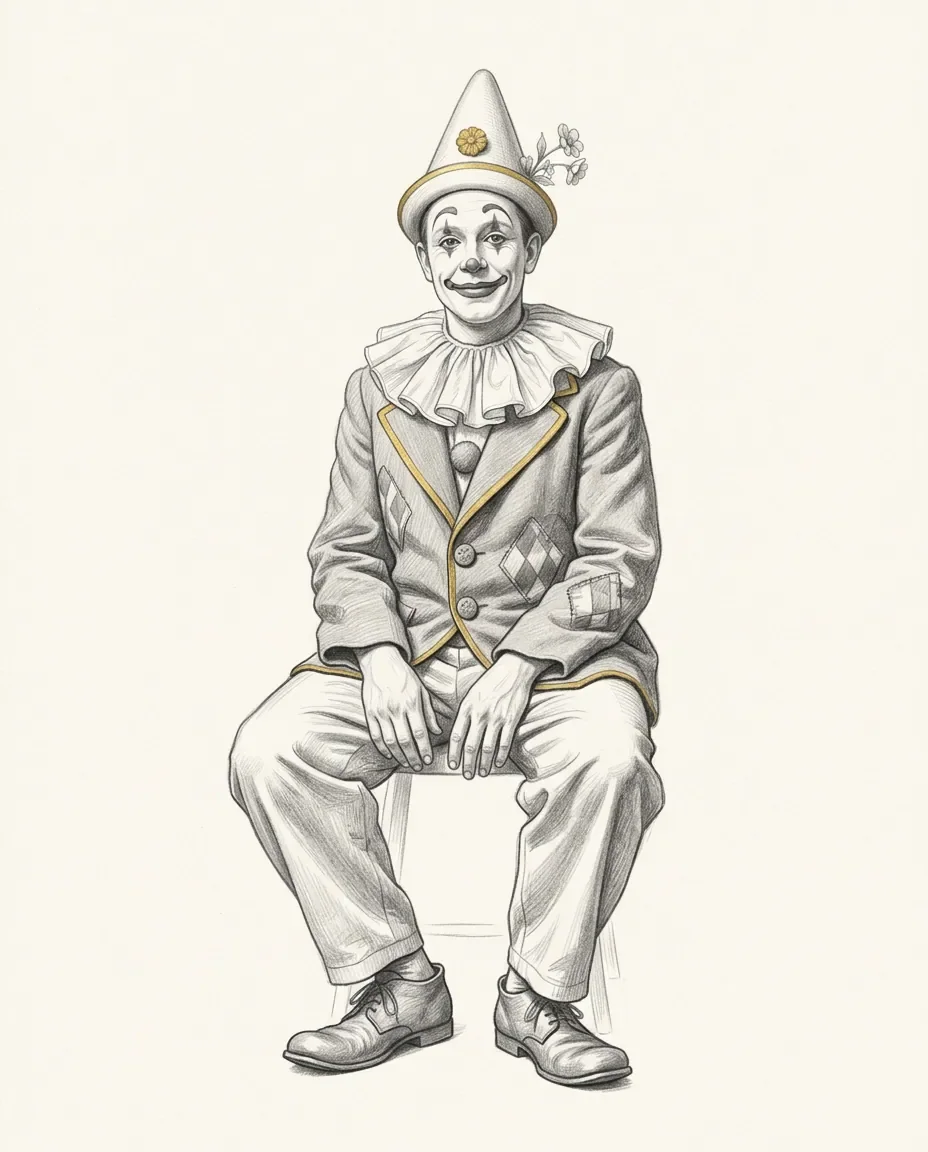
What the term covers. The whole apparatus of the clown rather than any single part of it: the greasepaint and its fixed painted expression, the wig, the ruff, the oversized costume and shoes, the red nose. The lineages differ and few people are drawn to all of them: the courtly jester and the melancholy Pierrot at one end, the bright circus and birthday-party clown in the middle, the horror clown of modern film at the other. The interest also runs in two directions: admiring a costumed performer, and putting the makeup on oneself, which is by some distance the more commonly described form.
What the term does not cover. Cosplay fetish is the general costume-and-persona interest, of which the clown is one narrow character. A mask fetish concerns the rigid object, where a clown's face is usually paint applied to a real one, and kigurumi masking is a separate masking tradition built on anime characters. Fear play deliberately stages fright within a scene, which horror-clown imagery lends itself to but coulrophilia does not require. Teratophilia concerns beings read as monstrous, and a clown is a person under the paint. Nor does the word cover attraction to someone who happens to work as a clown: the persona is the object, not the performer.
How the word is used. As a folk-sexological label found in online glossaries and lists, applied by people to themselves. It is not a clinical term (no edition of the DSM and no version of the ICD-11 has ever catalogued a clown-specific interest), and in ordinary conversation "clown kink" is the plainer and far more common phrase.
History & origins
The figure of the clown
Unlike the term that names attraction to it, the clown itself is ancient. The lineage runs through medieval and Renaissance court jesters, the commedia dell'arte of sixteenth-century Italy with stock masked figures such as Harlequin and Pierrot, the English pantomime tradition (the Regency-era performer Joseph Grimaldi gave his name to the archetypal "Joey" clown), and finally the modern circus and television clown. Across all of these, as the Wikipedia entry on the clown records, the figure carried a stable cultural ambivalence: licensed to mock, to transgress, and to unsettle, the clown was simultaneously comic and faintly uncanny, a face you cannot quite read behind a fixed painted smile.
Coinage of the term
Coulrophilia is a recent, non-clinical coinage. It was built by analogy to its far more familiar opposite, coulrophobia ("fear of clowns"); Wiktionary glosses it plainly as formed "after coulrophobia with -philia." The coulro- element is itself disputed. It is popularly traced to an Ancient Greek root for "stilt-walker" (and thence "clown"), but lexicographers are openly skeptical: Etymonline notes that coulrophobia became current only "by 2001" (with web claims of a 1980s–1990s origin), calls it "a popular term, not from psychology, possibly facetious," and observes that it "looks suspiciously like the sort of thing idle pseudo-intellectuals invent on the internet," possibly a reworking of the Modern Greek borrowing kloun ("clown"). The attraction-form, coulrophilia, is later still, an early-twenty-first-century internet term that surfaced in online glossaries and discussion rather than in any sexological text.
Absence from the clinical canon
No clown-specific interest appears anywhere in the foundational sexological literature. Neither Richard von Krafft-Ebing's Psychopathia Sexualis (1886), nor Havelock Ellis's Studies in the Psychology of Sex, nor Sigmund Freud's Three Essays on the Theory of Sexuality (1905) names it, and no edition of the DSM (DSM-I through DSM-5-TR) or the ICD has ever catalogued a clown paraphilia. Coulrophilia is therefore best understood as a descriptive folk-sexological label rather than a diagnosis: it sits, like many entries here, in the broad space of cosplay and persona interests that fall well outside the clinical concept of a paraphilic disorder.
In practice
Where it is expressed at all, coulrophilia is typically realized through costume, theatrical makeup, and consensual role-play between adults, or simply as an aesthetic appreciation enjoyed through art, performance, and media. The emphasis tends to fall on transformation and persona (becoming, or admiring, a heightened masked character) which is why it overlaps so heavily with cosplay and with broader masking and transformation interests. The clown is, in effect, a ready-made alternate identity: full-coverage makeup, a wig, and a costume that license behaviour and presentation outside one's everyday self.
Psychology
Proposed (and largely speculative) accounts tie the appeal to the same uncanny tension that drives clown fear. The clown is simultaneously familiar and concealed, playful and unreadable; the literature on coulrophobia attributes that unease partly to the way heavy makeup flattens and fixes facial expression, defeating ordinary face-reading. Some people evidently experience that same ambiguity as fascinating rather than threatening: an inversion of the more common aversion. Related, better-studied themes plausibly feed the interest: arousal tied to disguise and anonymity, the social and theatrical license of an adopted persona, and simple novelty toward an exaggerated, performative character. Empirical study specific to coulrophilia is essentially absent, so these remain hypotheses; in any case, absent distress or impairment the interest is clinically irrelevant.
Prevalence & culture
How common is coulrophilia?
Rare, and unmeasured. No prevalence survey measures coulrophilia, and it does not appear in the large general-population fantasy studies such as Joyal and Carpentier (2017), so any percentage would be invented; it is best described simply as rare. Its cultural footprint, however, is outsized relative to the interest itself. Clowns occupy a large space in popular imagination: from beloved circus, television, and birthday-party figures to the modern horror archetype crystallized by Stephen King's It (1986) and its film adaptations, and by the broader "evil clown" trope catalogued on Wikipedia. That ambient visibility, more than any organized scene, is what keeps the theme in circulation; small online communities discuss it, usually framed within costume, cosplay, and persona-play fandoms rather than as a standalone subculture.
Safety, consent & law
The interest is benign. It concerns costumes, makeup, and persona enjoyed by consenting adults, and carries no inherent consent or legal concern beyond the ordinary communication and negotiation any partners owe one another.
Common questions
Why would anyone find clowns attractive?
The most-offered explanation is that the clown's unreadability cuts both ways. Heavy makeup fixes the face into a single expression and defeats ordinary face-reading, which is what the literature on clown fear identifies as the source of unease; the same ambiguity registers to some people as intriguing rather than threatening. Add the licence an adopted persona grants, the theatricality, and simple novelty. None of this has been studied directly.
Is coulrophilia a recognised medical condition?
No. It appears in no edition of the DSM and nowhere in ICD-11, and it is absent from the foundational sexological literature: Krafft-Ebing, Ellis and Freud all catalogue unusual interests at length without naming anything clown-specific. It is a descriptive label for a costume-and-persona taste, and absent distress or impairment it is of no clinical interest whatsoever.
Is coulrophilia the opposite of coulrophobia?
In form, yes: the word was built by swapping -phobia for -philia. In substance it is more interesting than a straight inversion, because both responses come from the same ambiguity in the figure, a fixed smile over a face you cannot read. Fear of clowns is by far the more familiar reaction and much the better documented; attraction is the rarer route out of the same encounter.
Is a clown fetish about scary clowns or funny ones?
Both exist, and the divide matters to the people involved. Some of the interest attaches to the bright circus and party clown and its atmosphere of licensed silliness; some attaches to the horror clown that Stephen King's It crystallised, where the appeal sits closer to fear play and the pleasure of a controlled fright. The costume is shared; the mood is not.
What is the difference between a clown fetish and a cosplay kink?
Scope. Cosplay fetish covers costume and persona play in general, whatever the character; coulrophilia names one specific character type and its makeup. In practice most clown-themed play happens inside costume and cosplay communities rather than in any standalone clown scene, which is why the two are so often mentioned in the same breath.
Is "coulrophilia" even a real word?
It is a word people use, but its pedigree is shaky. Lexicographers are openly sceptical of the coulro- element: Etymonline dates coulrophobia only to around 2001, calls it "a popular term, not from psychology, possibly facetious," and suspects it was invented online rather than derived from Greek. Coulrophilia is a later back-formation from that already-dubious word.
- Transformation Fetish33/100Metamorphophilia · Identity & TransformationA transformation fetish is an erotic or imaginative fascination with the process of a body changing form into something else. That might be an animal, an object, or another kind of being. The appeal centers on the metamorphosis itself rather than the end state.33
- Mask Fetish37/100Mask Fetishism · Clothing & GarmentsAn erotic interest in masks, hoods, and other face coverings, often tied to themes of anonymity, transformation, and concealed or altered identity. It is an uncommon clothing-and-material fetish rather than a clinical disorder.37
- Alien Fetish25/100Exophilia · Identity & TransformationAn erotic or romantic attraction to fictional extraterrestrial or otherworldly beings, expressed through media, art, and storytelling. No real entity is involved. A fantasy-driven interest closely tied to science-fiction fandom; not a recognized clinical paraphilia.25
- Dronification25/100Identity & TransformationDronification, also called drone play, is a roleplay interest in which a person is imagined or treated as an obedient, depersonalised "drone". It is an identity-transformation fantasy: a machine-like unit stripped of individuality. It draws on objectification, hypnosis and science-fiction themes of lost autonomy.25
- Vore25/100Vorarephilia · Identity & TransformationA fantasy interest in the idea of one being swallowing or being swallowed whole by another, almost always depicted in fiction, art, and animation. It is a symbolic, non-literal engulfment theme rather than any real act.25
- Shrinking Fetish26/100Microphilia · Identity & TransformationMicrophilia is an erotic or romantic fascination with miniature beings, or with the fantasy of being shrunk to a tiny size. The counterpart to macrophilia, it centres on extreme size difference and is realised almost entirely through fiction, art, and role-play.26
A modern internet-era coinage formed by analogy to coulrophobia ('fear of clowns'), swapping -phobia for -philia ('love'). The coulro- element is popularly glossed as a Greek root for 'stilt-walker' (hence 'clown'), but lexicographers (Etymonline, Wiktionary) consider that derivation dubious and possibly a pseudo-classical invention; the term does not appear in classical sexology.
persona play · costume & masking · media-driven
Prevalence is computed from the entry's cited population estimate. Rows marked ESTare indicative editorial estimates scored against a fixed anchor rubric, not measured quantities. Method & anchors: methodology.
Rare · ≈ 1 in 1,000
- 01List of paraphilias, Wikipediaexistence of clown-directed attraction (coulrophilia) as a named niche interest, not a recognized disorder
- 02Coulrophobia, Wikipediaetymology of the coulro- root and the cultural uncanny associated with clowns (counterpart of coulrophilia)
- 03coulrophilia, Wiktionarydefinition and etymology: coined 'after coulrophobia with -philia'
- 04Coulrophobia, Etymonlinedating (current by 2001) and lexicographers' skepticism about the disputed Greek 'stilt-walker' root
- 05Clown, Wikipediahistory of the clown figure: court jesters, commedia dell'arte (Harlequin, Pierrot), Joseph Grimaldi, and the modern circus clown
- 06Evil clown, Wikipediathe horror-clown archetype (Stephen King's It and adaptations) sustaining the clown's outsized cultural visibility
- 07Psychopathia Sexualis, WikipediaKrafft-Ebing's 1886 sexological catalogue contains no clown-specific interest
- 08Three Essays on the Theory of Sexuality, WikipediaFreud's 1905 foundational work names no clown paraphilia
- 09Joyal & Carpentier (2017), The Prevalence of Paraphilic Interests and Behaviors in the General Population, J. Sex Research 54(2):161-171large general-population fantasy survey that does not measure clown attraction, underscoring that no prevalence figure exists
- 10DSM-5-TR, Paraphilic Disorders (American Psychiatric Association, 2022)no clown-specific diagnosis exists in the DSM lineage
- 11ICD-11 for Mortality and Morbidity Statistics, World Health Organizationthe ICD-11 catalogues no clown-specific paraphilia or diagnosis