Fear Play
Added 21 Jun 2026 · Updated 22 Aug 2026
A consensual BDSM practice that deliberately evokes controlled fear, startle, or adrenaline within a negotiated scene to heighten arousal. It draws on the body's fight-or-flight response. A niche, psychologically intense form of edge play.
- Prevalence
- Uncommon
- Category
- Sensation & Pain
- Domain
- Sexual interest
- Confidence
- Low confidence
- Status
- Consensual psychological edge play; not a disorder when consensual. Distinct from clinical fear or anxiety conditions.
- Also known as
- adrenaline play, predator-prey sensation, startle play, fear kink, consensual non-consent fear
- Added
- 21 Jun 2026
- Updated
- 22 Aug 2026
Featured in

Overview
Fear play (also called adrenaline play or startle play) is the deliberate, consensual evocation of fear, surprise, or adrenaline within an erotic scene. Rather than centring on physical pain, it targets the psychological and physiological rush of the fight-or-flight response, produced through scenarios such as predator-prey chase dynamics, sudden startles, theatrically threatening props, or simulated peril. Because the receiving partner experiences genuine alarm while remaining objectively safe, the practice is widely classified within kink communities as a form of edge play. This article covers its documented lineage, how it is typically expressed, the psychology of fear-arousal overlap, and the consent and safety framing that distinguishes it from abuse.
Definition & scope
Fear play sits in the psychological, not the physical, register of sensation. Where impact or pain play works on the body, fear play works on the nervous system's alarm response: the startle reflex, the surge of adrenaline, the heightened alertness of feeling hunted. It overlaps heavily with primal play and consensual non-consent, but the two are distinct in emphasis. Primal play foregrounds instinctive, animalistic energy; fear play foregrounds the specific emotion of fear and the physiological arousal that rides with it. It is a niche within a niche, and it is not a clinical category. Crucially, the fear is real in the moment but the danger is not: the whole practice depends on the receiver being genuinely startled while never actually at risk.
Examples
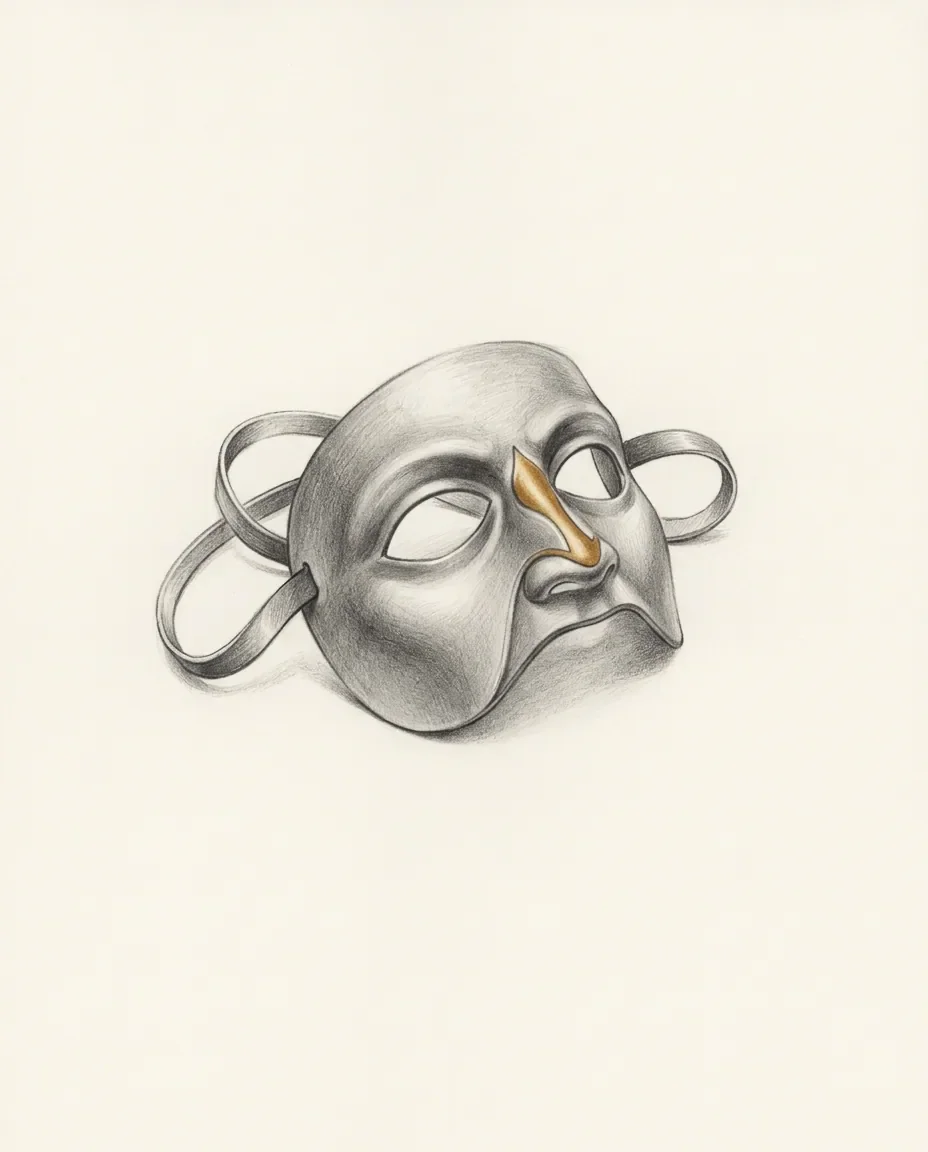
What the term covers. The scenarios vary but the mechanism is constant: something is engineered to trigger alarm in a partner who has agreed in advance to be alarmed. A staged chase through a house or a wood, where being caught is the agreed outcome. A sudden noise, a partner appearing from somewhere unexpected, or a countdown that ends in a startle. A theatrically menacing prop (a mask, a blunt blade, an unlit lighter), handled slowly, so that the anticipation rather than the object does the work. Or a frame of engineered helplessness, such as a staged interrogation or a captor-and-captive scene. Some of the most effective versions involve almost nothing at all: an unspecified threat, a long pause, and a partner who has been told only that something is coming.
What it does not cover. It is not primal play, which foregrounds instinctive, animal energy rather than the emotion of fear, though the two are often combined. It is not pain play or impact play, which work on the body rather than on the alarm response. Practices whose danger is physical rather than staged, breath play among them, belong to edgeplay for a different reason: there the risk is real and cannot be negotiated away, whereas here the fear is real and the danger is not. And it is categorically not biastophilia, the clinical paraphilia defined by a partner's genuine non-consent; everything in fear play rests on prior agreement between adults.
How the term is used. "Fear play," "adrenaline play" and "startle play" are community vernacular, used interchangeably on kink forums and in scene negotiation. None appears in DSM-5-TR or ICD-11.
History & origins
Fear play has no single documented coinage. It is a vernacular community label rather than a clinical term, and it crystallised out of the broader BDSM and power-exchange subcultures that organised through the late twentieth century rather than from psychiatric taxonomy. Its conceptual underpinnings, however, draw on two separable threads: an older clinical observation that danger and eros are entangled, and a twentieth-century experimental psychology of how arousal is labelled.
Clinical & scientific lineage
- 1886: Richard von Krafft-Ebing's Psychopathia Sexualis and, later, Havelock Ellis catalogued cases in which fear, danger, and erotic excitement were intertwined: early observations that prefigured the modern understanding of threat and arousal, though neither author described "fear play" as such.
- 1962: Stanley Schachter and Jerome Singer proposed the two-factor theory of emotion, arguing that physiological arousal is ambiguous and must be cognitively labelled, so the same bodily activation can be experienced as different emotions depending on context.
- 1971: Dolf Zillmann formalised excitation-transfer theory, showing that residual arousal from one stimulus can carry over and intensify the emotional response to a later, unrelated stimulus before the original arousal fully dissipates.
- 1974: Donald Dutton and Arthur Aron's Capilano suspension bridge study found that men who crossed a frightening high bridge were more likely to interpret their arousal as attraction to a female interviewer than men who crossed a stable bridge, the canonical demonstration that fear-induced arousal can be misattributed to sexual interest.
These findings supply the mechanistic vocabulary (excitation transfer, misattribution of arousal) that practitioners and writers now use to explain why fear can amplify erotic excitement.
Cultural & subcultural evolution
Fear-focused scenes acquired their own informal label only as adjacent vocabularies matured. As terms like "primal play" and "consensual non-consent" entered community lexicons through the 1990s and 2000s (propagated by munches, conventions, and later online platforms such as FetLife) fear play emerged as a recognisable cluster overlapping with predator-prey role-play and restraint. Lay reference works such as Glamour's A–Z of kinks now treat adrenaline and fear as a real but niche interest. Throughout, the practice has remained absent from the DSM-5-TR and ICD-11 as anything pathological, consistent with the modern distinction between consensual interests and paraphilic disorders.
In practice
Despite feeling spontaneous, fear play is heavily scripted and pre-negotiated. It rests on a foundation of trust so the receiving partner can experience real adrenaline while remaining objectively safe. Common expressions include staged chase or predator-prey dynamics, sudden startles, theatrically menacing (but harmless) props, and simulated peril woven into role-play and dominance-and-submission frames. Intensity is calibrated to what participants find thrilling rather than genuinely traumatising, and clear safewords or non-verbal safe signals remain available throughout.
Psychology
The appeal is usually explained through excitation transfer and arousal misattribution: the autonomic signatures of fear and sexual arousal overlap substantially (racing heart, quickened breath, heightened alertness) so circulating adrenaline can be relabelled as, and can amplify, erotic excitement. The contrast between feeling endangered and being fundamentally cared for can deepen intimacy and produce a cathartic release once the scene ends. Tolerance for this kind of stimulation varies widely and is shaped by individual history and temperament; the same scenario that is exhilarating for one person can be destabilising for another. The direct evidence base specific to consensual fear play is thin, most support is extrapolated from general arousal-labelling research rather than studies of practitioners.
Prevalence & culture
Fear play has little mainstream visibility, a small dedicated community presence, and almost no dedicated quantitative research, so prevalence can only be estimated from its overlap with broader surveyed interests. Population fantasy surveys such as Lehmiller's Tell Me What You Want (2018) document that BDSM and power-exchange fantasies are near-universal, but fear-specific adrenaline play sits well within the narrower, less common edge of that cluster. Community-size proxies on platforms like FetLife show fear and predator-prey groups as small dedicated-interest spaces rather than mass categories.
Safety, consent & law
Fear play is psychologically intense and is treated as edge play for good reason: it can trigger panic, flashbacks, or trauma responses, and surging adrenaline can impair judgment for both the giver and the receiver. Responsible practice depends on thorough negotiation, knowledge of a partner's triggers and history, reliable safe signals that survive a panicked state, and attentive aftercare. It is benign only among consenting adults; inducing genuine fear in a non-consenting person is abusive and may constitute assault, harassment, or coercion in most jurisdictions.
Common questions
Is fear play dangerous?
Yes, more so than most kink, and the danger is psychological rather than physical. A scene can tip from thrilling into panic without warning, can surface flashbacks or dissociation in someone with a trauma history they may not have disclosed, and floods both partners with adrenaline that degrades judgment and memory while it lasts. No technique removes this. It is the reason the practice is treated as edge play rather than as an intense variation on role-play.
How do you use a safeword if you're panicking?
Often you can't, and that is the design problem at the centre of the practice. Partners therefore agree a signal that survives a panicked state (an object held and dropped, three sharp taps, a hand squeeze), and the person running the scene takes on the duty of reading breathing, muscle tone and eye contact rather than waiting to be told. Any real doubt is resolved by stopping, not by continuing.
What is the difference between fear play and consensual non-consent?
They aim at different feelings. Consensual non-consent stages the absence of agreement: the charge comes from the receiver appearing not to consent while having in fact negotiated every part of it. Fear play targets the alarm response itself, and can be built with no pretence of refusal at all. Many scenes use both, but a startle inside a fully co-operative scene is still fear play.
Is this the same as liking horror films or haunted houses?
The underlying mechanism is close: both rely on the body's alarm response being pleasurable when the danger is known to be staged. The non-sexual form of that pleasure has its own name here, frisson. What fear play adds is a partner controlling the intensity, an erotic frame, and a startle happening in the room rather than on a screen, which is also why it is harder to stop once it has gone too far.
What does aftercare look like after a fear-play scene?
Deliberately mundane. Because the scene ran on adrenaline, the crash afterwards can be steep, so aftercare usually means warmth, food, water, ordinary speech in an ordinary voice, and explicit confirmation that the scenario is over and the person is safe. Reactions can also arrive a day or two later as subdrop, which is why partners commonly agree to check in again afterwards rather than assuming the scene ended when it ended.
Is fear play legal?
Between consenting adults in private, yes. The complications are situational: a staged chase or an abduction scene that spills into a public place can become a genuine criminal matter (public alarm, breach of the peace, or a weapons offence if a prop turns out to be a real blade) regardless of what the participants agreed between themselves. Frightening someone who has not consented is assault, harassment or coercion in most jurisdictions.
From the blog

- Primal Play33/100Identity & TransformationA consensual style of intimacy in which partners drop social restraint and act from an instinctual, animalistic headspace. It most often takes the form of predator-and-prey dynamics. In its feral register it overlaps with therian identity and inner-animal embodiment rather than scripted scenes.33
- Roleplay81/100Power, Roles & ScenariosAdopting characters, personas, or imagined scenarios to enact sexual fantasy with a partner. One of the most common and versatile sexual interests, role-play frames or heightens arousal through story, character, and pretend.81
- Dominance and Submission92/100Power, Roles & ScenariosA consensual erotic dynamic in which one partner takes a dominant role and the other a submissive role, exchanging power within agreed limits. It is one of the most widespread elements of BDSM and of human sexual fantasy.92
- Figging33/100Sensation & PainA sensation practice in which a piece of peeled, carved ginger root is inserted into the anus (or vagina) to produce a building, spreading burning sensation. It descends from a Victorian horse-trade trick called feaguing or gingering and is now a niche, medium-core BDSM activity.33
- Self-Bondage32/100Sensation & PainThe practice of restraining oneself, alone, for erotic pleasure, typically using a device or timed mechanism to eventually release the restraints. It shares bondage's sensations of helplessness and restriction but removes the safety net of a present partner.32
- Wartenberg Wheel Play34/100Sensation & PainSensation play using a Wartenberg wheel, a spiked, freely rotating pinwheel rolled across the skin to produce a prickling, tingling stimulus. The wheel was originally a neurological diagnostic instrument. It sits within broader sensation and impact-adjacent play rather than causing injury when used as intended.34
A plain-English descriptive term: "fear" (Old English fǣr, "sudden danger") paired with "play," the standard kink-community word for negotiated erotic activity. The variant "adrenaline play" references the hormone adrenaline (epinephrine), coined from the Latin ad- "toward" and ren "kidney," for the gland atop the kidney.
psychological sensation · adrenaline · fight-or-flight arousal
Prevalence is computed from the entry's cited population estimate. Rows marked ESTare indicative editorial estimates scored against a fixed anchor rubric, not measured quantities. Method & anchors: methodology.
Uncommon · ≈ 1 in 100
- 01Lehmiller (2018), Tell Me What You Want, survey of 4,175 Americanspsychological-sensation/adrenaline play sits within the BDSM-adjacent fantasy cluster (active interest well below the ~45-50% BDSM umbrella)
- 02An A–Z of Kinks and Fetishes, Glamourlay framing of fear/adrenaline as a recognized but niche kink rather than a clinical paraphilia
- 03FetLife, kink community group sizes (community-size proxy)community-size proxy showing fear/predator-prey play as a small dedicated-interest group
- 04Krafft-Ebing, Psychopathia Sexualis (1886)early clinical observation of the entanglement of fear, danger, and erotic excitement that prefigured modern fear-arousal understanding
- 05Misattribution of arousal, Wikipedia (Schachter & Singer 1962 two-factor theory; Dutton & Aron 1974 Capilano suspension bridge study)the two-factor theory of emotion (1962) and the Dutton & Aron suspension bridge study (1974) showing fear-induced arousal misattributed to attraction
- 06Excitation-transfer theory, Wikipedia (Dolf Zillmann, 1971)Zillmann's 1971 excitation-transfer theory: residual arousal from one stimulus carries over to intensify a later emotional response