Dronification
Added 26 Jun 2026 · Updated 22 Aug 2026
Dronification, also called drone play, is a roleplay interest in which a person is imagined or treated as an obedient, depersonalised "drone". It is an identity-transformation fantasy: a machine-like unit stripped of individuality. It draws on objectification, hypnosis and science-fiction themes of lost autonomy.
- Prevalence
- Rare
- Category
- Identity & Transformation
- Domain
- Sexual interest
- Confidence
- Low confidence
- Status
- Not a recognised paraphilia; a contemporary roleplay and identity-play interest within BDSM objectification, benign when consensual and well-supported.
- Also known as
- drone play, drone fetish, latex drone, robotization
- Added
- 26 Jun 2026
- Updated
- 22 Aug 2026
Featured in
Overview
Dronification, also called drone play, is a roleplay and identity-transformation interest in which a person is imagined or treated as an obedient, depersonalised "drone": a uniform, machine-like unit stripped of individual will and reprogrammed to serve. It blends erotic objectification, hypnosis play and science-fiction imagery of cybernetic assimilation. This article covers the concept, its roots, how it is practised, and the consent and safety questions it raises.
Definition & scope
The defining move in dronification is the swap of a person's identity for a function. A "drone" is meant to think of itself not as an individual but as an interchangeable unit, often given a serial number or designation rather than a name, and to act with simple, obedient, mechanical responses. It overlaps with several established interests but is not identical to any:
- It shares the machine aesthetic of robot fetishism and robot/doll play, but the focus is the obedient hive-unit headspace rather than the look of a robot alone.
- It uses hypnosis and "brainwashing" roleplay as a primary tool for inducing the drone state.
- It is a form of erotic transformation and of deep power exchange, with depersonalisation rather than pet or littlespace identities at its centre.
Drone "headspace"
Practitioners describe a mental state in which personal identity is set aside in favour of order, simplicity and obedience, sometimes framed as ego-loss or "non-self" thinking. Reaching and leaving that state deliberately is the heart of the practice.
Examples
What the term covers. The practice scales from a single element to a whole identity. At the light end it is aesthetic and linguistic: a hood, a flat delivery, a designation used instead of a name for an evening, with no trance involved at all. At the heavier end it is a long, scripted induction into the headspace described above, sustained across a scene or a weekend. It is also practised alone: a person can put themselves into the drone framing with audio and gear and no partner present. Some circles use a group or "hive" framing, which is where the science-fiction source material shows most plainly. A great deal of the theme circulates as fiction and artwork rather than as anything enacted at all.
What the term does not cover. Robot fetishism is directed at machines and androids as objects of attraction; dronification points the machine imagery at a human being instead, and robot / doll fetish is the broader umbrella over both. Dollification remakes a partner as something posed and decorative, where a drone is made functional and obedient. Objectification play turns a person into furniture or property, which is inert; a drone works. Pet play substitutes one identity for another rather than emptying it, and bimbofication rewrites a personality instead of removing it. Hypnokink is a technique this practice leans on heavily but does not own. Clinical depersonalisation (the dissociative symptom) is a different thing again: involuntary, unwanted, and not left at will.
How the word is used. Purely community jargon, and recent: "dronification" for the process, "drone" for the role, "drone play" or "drone fetish" loosely for the scene. It appears in community guides and glossaries only, never in DSM-5-TR, ICD-11 or the sexological literature, and it has no clinical synonym because no clinician ever named it.
History & origins
Dronification has no clinical lineage: it is a 21st-century, internet-native kink assembled from older erotic and cultural threads rather than named in any diagnostic manual. Its aesthetic and vocabulary are borrowed directly from science fiction's hive-mind and cybernetic-assimilation stories. Community guides most often point to the Borg of Star Trek as the template, with their assimilation, shared consciousness and technological uniformity, per community coverage; the Cybermen of Doctor Who and android or robot-servant fiction sit alongside it as reference points.
As a self-aware fetish the scene coalesced online in the late 1990s and 2000s, when latex fetish, hypnosis roleplay and BDSM objectification circles began treating machine-like depersonalisation as a distinct practice rather than a stray theme. It matured on imageboards, art platforms and dedicated collectives, and today has its own vocabulary of designations, "hive" units and "programming." The lineage is cultural and subcultural, not medical: there is no coinage in the sexological canon and no case literature specific to it.
In practice
Drone play is staged through aesthetics, language and induction, and it is non-explicit at its core. Common elements, drawn from community guides, include:
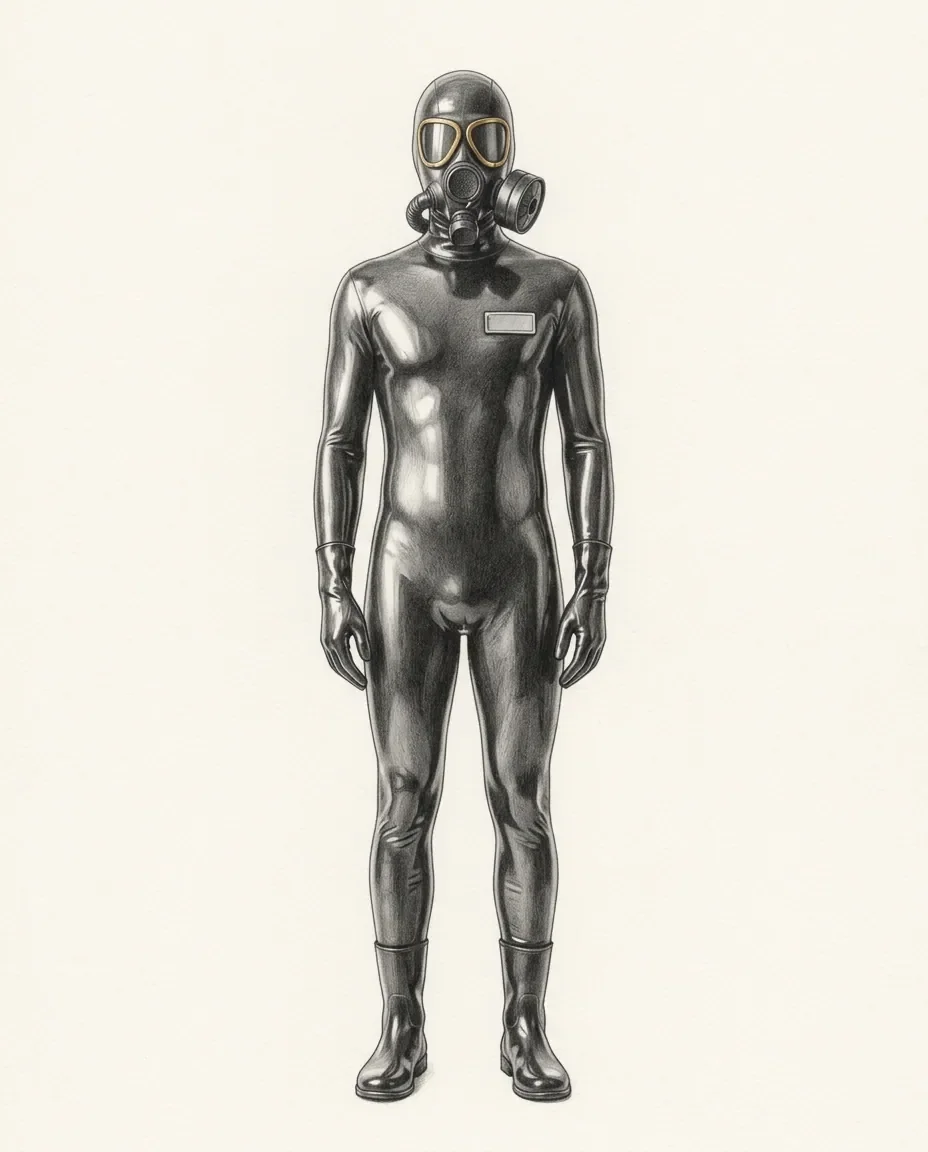
- Gear: full-body latex or rubber suits, hoods, gas masks and headphones that hide the face and reinforce uniformity and sensory control.
- Identity markers: serial numbers, designations or barcodes in place of a name, and flat, robotic speech patterns.
- Hypnotic induction: scripted commands, trance audio and "reprogramming" roleplay used to move a willing participant into the drone state.
- Behaviour: simplified, literal, obedient responses and mechanical posture, performed within an agreed scene.
Psychology
The appeal mirrors other depersonalisation interests. For the submissive, the draw is often described as relief through self-erasure: handing over decision-making and identity can feel freeing, focusing and intensely submissive. For the dominant, the interest is control of identity itself, not merely behaviour. The science-fiction framing (hive minds, android obedience, cybernetic assimilation) gives the fantasy a ready vocabulary and aesthetic. Like most modern internet-native kinks, dronification has little formal research behind it; documentation is community-generated rather than clinical, and its mechanisms are best understood as a blend of objectification, role absorption and the focusing effect of trance.
Prevalence & culture
There are no prevalence statistics for dronification: it is a recent, internet-native subculture rather than a surveyed interest. Its visibility comes from online communities on FetLife, Reddit and Tumblr, dedicated drone-themed sites and collectives, and appearances at fetish events such as Wasteland in Amsterdam and Folsom Europe in Berlin, per community coverage. It sits within the wider, well-documented family of sexual fetishism and BDSM objectification, but as a named scene it is small and concentrated in latex, hypnosis and sci-fi-fan circles.
Safety, consent & law
Because the practice deliberately strips identity and uses trance and "reprogramming," consent and psychological care are central. Community guidance stresses explicit negotiation, safewords or non-verbal signals (important when speech is restricted or roleplayed as robotic), and structured aftercare to return fully to one's own sense of self after extended depersonalisation. The hypnosis element is roleplay and suggestion among consenting adults, not genuine loss of will, and responsible practitioners treat lasting distress or difficulty "coming back" as a signal to stop. Gear that covers the face also carries ordinary vision, hearing and ventilation cautions. Practised this way, between informed adults, it is benign and legal.
Common questions
Is drone headspace the same as dissociation?
No, and the distinction is the safety-relevant one. Drone headspace is entered deliberately, inside an agreed scene, and left deliberately; clinical depersonalisation is involuntary, unwanted, and does not switch off on request. The two can look superficially similar from outside, which is why community guidance treats difficulty returning to one's ordinary sense of self as a signal to stop rather than as part of the experience.
Is dronification the same as a robot fetish?
No. A robot fetish is attraction to machines and androids: the machine is the partner. Dronification applies machine imagery to a person, and the object of interest is a human being made obedient and uniform. The aesthetics are shared, so the two turn up in the same spaces, but one is about what you want and the other about what you become.
Does dronification involve real mind control?
No. The hypnosis element is suggestion and role-play between consenting adults, and it cannot override anyone's will. What trance can do is narrow attention and make a chosen framing easier to hold, which is exactly what the practice wants from it. Participants stay able to stop, and responsible practice keeps a safeword or a non-verbal signal available precisely because speech is being played as robotic.
What is a "hive" in drone play?
A framing in which several drones are treated as units of one collective rather than as individuals, usually sharing a designation series in place of names. It comes straight from the science-fiction source material of assimilation and shared consciousness, and it appears in group scenes and in online collectives organised that way. Plenty of drone play is one-to-one and involves no hive at all.
Do you need latex gear to be a drone?
No. Full-body latex, hoods, visors and gas masks are the scene's signature look because they hide the face and enforce uniformity, but the practice is defined by the headspace rather than the wardrobe. A good deal of it happens with an ordinary uniform, a pair of headphones, or nothing but language: a designation, a flat voice, and a set of agreed responses.
Is dronification safe?
It is benign when done carefully, and its risks are psychological rather than physical. Because the practice deliberately sets identity aside, it needs explicit negotiation beforehand and real aftercare afterwards, especially after long sessions. Gear covering the face brings the ordinary cautions about vision, hearing and ventilation. Lasting distress, or difficulty coming back to yourself, means stopping rather than pushing further.
Is dronification a paraphilia or a disorder?
No. It is named in neither DSM-5-TR nor ICD-11, and there is no case literature on it: it is a twenty-first-century, internet-native kink assembled from older threads and documented by its own community rather than by clinicians. Between informed adults it is legal and carries no inherent harm, the same footing as most consensual role-play in this catalogue.
From the blog
- Robot Fetish26/100Technosexuality · Objects & MaterialsRobot fetishism, also called technosexuality or ASFR, is an erotic attraction to robots and androids, or to people behaving as artificial beings. It commonly centres on mechanical movement, control, and the blurred line between human and machine.26
- Robot / Doll Fetish35/100Agalmatophilia · Identity & TransformationAn erotic interest in robots, androids, dolls, or in being or treating a person as an artificial, programmable, or immobile being. The community is often called ASFR (alt.sex.fetish.robots), and it overlaps with agalmatophilia.35
- Transformation Fetish33/100Metamorphophilia · Identity & TransformationA transformation fetish is an erotic or imaginative fascination with the process of a body changing form into something else. That might be an animal, an object, or another kind of being. The appeal centers on the metamorphosis itself rather than the end state.33
- Hypnokink44/100Power, Roles & ScenariosA consensual psychological power-exchange interest, usually called erotic hypnosis, in which arousal centers on trance and suggestion. The fantasy is of one partner influencing another's mind. It plays with surrender of will between adults using relaxation and suggestion techniques.44
- Objectification Play41/100Power, Roles & ScenariosA consensual power-exchange dynamic in which one partner is treated, by agreement, as an object or a possession. That can mean serving as a piece of "furniture," being addressed in object terms, or being framed as an owner's property. Arousal comes from the eroticized, negotiated loss of personhood.41
- Total Power Exchange46/100Power, Roles & ScenariosA consensual BDSM relationship structure in which one partner cedes broad authority over their life to another on an ongoing basis. It extends dominance and submission beyond scenes into everyday living.46
A modern English coinage from "drone" (an unmanned or worker unit that follows commands) plus the suffix "-ification" ("making into"), meaning "the process of being made into a drone." It originates in 21st-century online fetish communities and has no clinical lineage.
depersonalisation · hypnosis & mind-control play · machine/robot transformation
Prevalence is computed from the entry's cited population estimate. Rows marked ESTare indicative editorial estimates scored against a fixed anchor rubric, not measured quantities. Method & anchors: methodology.
Rare · ≈ 1 in 1,000
- 01Getting Into Drone Fetish: Uniformity, Control, and Mindless Submission, Playful Magazinedefinition of drone play, depersonalisation and drone headspace, latex/gas-mask/hypnosis elements, serial-number identity markers, community venues (FetLife, Reddit, Tumblr, Wasteland, Folsom Europe), and consent/aftercare guidance
- 02Dronification 101: A Beginner's Guide To Becoming A Drone, Smitizenscience-fiction origins (the Borg of Star Trek as template), latex/gas-mask/visor gear, hypnosis as the transformation mechanism, serial-number designations, HexCorp and other online communities, and the emphasis on communication and consent
- 03Sexual fetishism, Wikipediaplacement of dronification within the broad family of fetishism and BDSM objectification; no study has ever measured how many people practise it, and it carries no separate clinical recognition