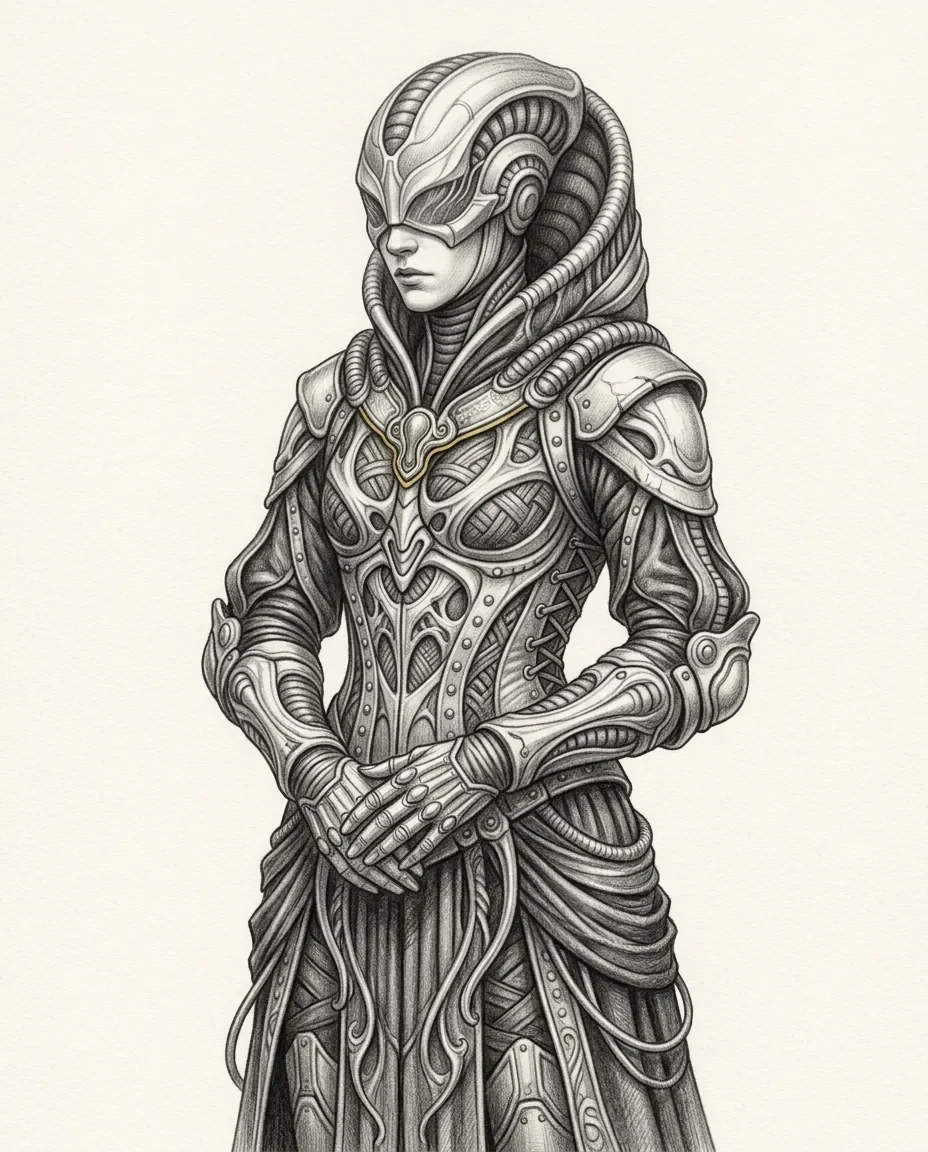
Alien Fetish
Exophilia
Added 21 Jun 2026 · Updated 22 Aug 2026
An erotic or romantic attraction to fictional extraterrestrial or otherworldly beings, expressed through media, art, and storytelling. No real entity is involved. A fantasy-driven interest closely tied to science-fiction fandom; not a recognized clinical paraphilia.
- Prevalence
- Rare
- Category
- Identity & Transformation
- Clinical term
- Exophilia
- Domain
- Sexual interest
- Confidence
- Low confidence
- Status
- Not a recognized paraphilia; a fantasy- and media-driven attraction to fictional beings, benign among consenting adults.
- Also known as
- exophilia, extraterrestrial attraction, ET attraction, xenophilia (fictional beings), alien attraction
- Added
- 21 Jun 2026
- Updated
- 22 Aug 2026
Featured in
Overview
Alien fetish, sometimes called exophilia, is an erotic or romantic attraction to imagined aliens and extraterrestrial beings, ranging from near-human "space-folk" to wholly non-human forms. Because no real object of attraction exists, the interest is entirely fantasy- and media-based, drawing on science fiction, comics, games, and original fan creations. It is a niche facet of speculative-fiction fandom rather than a response to any encounter with a real entity, and it is not a clinically recognized diagnosis. This article traces where the term comes from, how the interest is expressed, the psychology proposed for it, and its modest but growing cultural footprint.
Definition & scope
Exophilia sits inside a wider family of interests in non-human and fantastical figures, and it helps to draw the boundaries. The object is specifically extraterrestrial: a being imagined as originating beyond Earth, whether a sleek humanoid visitor, an insectoid or reptilian form, or something with no human analogue at all. That distinguishes it from the closely related monster attraction (folkloric or horror creatures) and from teratophilia, the broader attraction to forms read as monstrous or far from the human norm; exophilia is best understood as the science-fiction dialect of that older, wider pattern. The interest is directed at a concept rendered in media, never at a real entity, which is why it is treated throughout as a benign fantasy rather than a clinical condition.
Examples
What the term covers. The forms are as wide as the fiction that supplies them: near-human "space-folk" marked out by a skin tone or a ridge of bone, the sleek grey humanoid of abduction lore, reptilian, insectoid and cephalopod-like designs, and beings with no human analogue at all: a shape, a light, a swarm. The register is equally wide, running from tender interspecies romance to predator-and-prey scenarios in which the alienness is the whole point. In every case the object is a concept rendered in media: a character in a book, a drawing, a game, or a persona a consenting adult adopts with makeup and costume.
What the term does not cover. The wider family it belongs to is teratophilia, attraction to forms read as monstrous, and its folkloric and horror wing is monster attraction; exophilia is the science-fiction dialect specifically, defined by an origin beyond Earth rather than by strangeness alone. Tentacle erotica is a depiction genre that often uses alien bodies but is defined by the appendage. Monster girl characters are a stylistic tradition of their own. Fictosexuality is attraction to fictional characters because they are fictional, which is a different claim about the object. Otherkin identity concerns who a person feels they are rather than whom they desire, and female masking shares the prosthetics but not the object.
How the word is used. Exophilia is a literary coinage, not a clinical one, circulating in online glossaries, fan communities and catalogues like this one rather than in medical writing; it is absent from DSM-5-TR and from ICD-11. The commercial label is "alien romance" or "sci-fi romance" (the shelf where most of the fiction is actually sold), and the wider community more often describes itself in terms of monster-loving than by any -philia at all.
History & origins
Coinage of the term
Unlike most entries in the sexological canon, exophilia did not originate in a clinic. The term was coined by the pseudonymous writer Supervert in the 2001 book Extraterrestrial Sex Fetish, a literary-philosophical novel whose protagonist is obsessed with the sexuality of aliens; Wikipedia glosses the word as "a fetishism whose object is the sexuality of extraterrestrials." Because it arose from a work of fiction rather than clinical observation, exophilia is not listed as a paraphilia by the American Psychiatric Association in the DSM-5-TR and does not appear in the historical diagnostic literature. The word is built from Greek exo- ("outside, external") and -philia ("love, affinity"): literally "love of the outside," of that which lies beyond.
Antecedents in sexology
The broader pattern of erotic interest in non-human and fantastical figures long predates the modern term. Catalogues of unusual desire such as Richard von Krafft-Ebing's Psychopathia Sexualis (1886) and Havelock Ellis's Studies in the Psychology of Sex recorded attraction directed at imagined, symbolic, or fantastical objects. The specifically extraterrestrial form had no name in that literature: it could not, since the modern alien is itself a twentieth-century invention. Exophilia therefore has an unusually shallow clinical pedigree, inheriting the general framing of non-human attraction while its actual subject matter is a product of popular culture.
Cultural & subcultural evolution
The distinctly extraterrestrial flavor is a product of twentieth-century popular culture. Pulp science fiction supplied the early archetypes (the seductive "green-skinned space woman," the enigmatic humanoid visitor) and post-war film and television cemented them. The widely publicized 1961 Betty and Barney Hill abduction account, in which the New Hampshire couple described being taken aboard a craft and physically examined by humanoid beings, was chronicled in John G. Fuller's 1966 best-seller The Interrupted Journey and folded intimate and invasive themes into UFO lore. Television franchises such as Star Trek introduced sympathetic interspecies romance into the mainstream, and by the 1970s and 1980s human-alien erotica circulated through fan fiction and zines at conventions. Two later developments gave the interest a commercial footing: the rise of self-published "alien romance" (also "sci-fi romance") as a distinct publishing niche in the 2010s, and the growth of an online "monster-loving" community over the same decade, overlapping with monster attraction and cosplay-driven fandom. Social platforms have since amplified it through fan edits and convention culture.
In practice
The interest is overwhelmingly imaginative and media-mediated. It is most often expressed through reading and writing fiction, consuming and producing fan art, collecting figures or media, and imaginative role-play: either solo or with a partner who adopts an alien persona (often via makeup, prosthetics, or costume, and sometimes overlapping with masking and identity play). Its appeal typically centers on novelty, the allure of the exotic "other," idealized or exaggerated traits, and the safe distance that pure fantasy affords for exploring unconventional scenarios.
Psychology
What draws people to fictional aliens?
There is little dedicated empirical study of exophilia specifically, so psychological accounts are largely extrapolated from the broader literature on fantasy and non-human attraction. It overlaps conceptually with monster and creature interests, furry-adjacent fandom, and the general appeal of imaginative escapism. Proposed motivators include curiosity and openness to experience, aesthetic taste, and the creative freedom to author one's own scenarios free of real-world social constraints. For most people it is one strand of a wider enjoyment of speculative fiction rather than a fixed or exclusive orientation, and the evidence base for any stronger claim is thin.
Prevalence & culture
How common is alien fetish?
No population survey isolates exophilia, so prevalence can only be inferred and is low. Large general-population studies of unusual fantasy (such as Joyal, Cossette & Lapierre (2015)) show that the great majority of fantasies are far more conventional, placing a media-driven, non-human interest firmly in the rare tail. Indirect signals of community size include active online fiction and art communities, sizeable "alien romance" and "monster romance" catalogues on self-publishing platforms, and subreddits and fan groups devoted to the theme. Cultural visibility is modest but rising, carried by speculative media and self-published romance, while formal clinical study remains minimal: lay overviews such as Glamour's A-Z of kinks treat it as a niche, benign fantasy.
Safety, consent & law
Exophilia is benign and not a recognized paraphilia. It concerns fictional beings only and involves no real person or animal, so when expressed through art, writing, role-play, and fantasy among consenting adults it raises no consent or legal concerns. As with any fantasy interest, the only ordinary considerations are communication and mutual consent within real-world adult relationships.
Common questions
What is the difference between an alien fetish and a monster fetish?
Origin, not appearance. Exophilia is directed at beings imagined as coming from beyond Earth, which is a science-fiction premise; monster attraction draws on folklore and horror: vampires, werewolves, demons. Both sit inside the wider teratophilia family, the attraction to forms read as far from human. In practice the communities overlap heavily, and many people do not separate them at all.
Does having an alien fetish mean someone believes aliens are real?
No, and the two have almost nothing to do with each other. The interest is directed at characters in fiction, art and games, and it requires no belief that anything corresponding to them exists. Abduction narratives such as the widely publicised Betty and Barney Hill account fed imagery into the culture, but it is the imagery that circulates, not the claim.
Is exophilia a paraphilia or a mental disorder?
No. It is not listed in DSM-5-TR and has no place in the historical diagnostic literature, which is unsurprising given that the word was coined in a novel rather than a clinic. Nothing about it involves a real person or animal, so the harm criteria those manuals use cannot apply. It is a fantasy interest, and a benign one.
What is "alien romance" fiction?
A self-publishing genre, also sold as sci-fi romance, in which the love interest is extraterrestrial. It grew into a substantial commercial category during the 2010s and is the largest single place the interest actually surfaces: a shelf with its own covers, tropes and regular readership rather than a subculture. Much of that readership would not describe itself as having a fetish at all.
Is it normal to be attracted to a fictional non-human character?
It is common enough to sustain its own genres and conventions. Attraction directed at imagined and symbolic figures was being recorded in the earliest sexological catalogues, and modern surveys of fantasy find that people's imaginations routinely visit places their behaviour never goes. What matters clinically is whether an interest causes distress or crowds out real relationships, not how far its object sits from human.
Is an alien fetish the same as being into tentacles?
They intersect without being the same. Tentacle erotica is a genre defined by a particular kind of body, and its creatures are frequently alien, so a good deal of material serves both interests. Exophilia is defined by where a being is imagined to come from; plenty of its objects are humanoid, and plenty of tentacled creatures in fiction are perfectly earthly.
- Monster Fetish38/100Teratophilia · Identity & TransformationAn erotic or romantic attraction to monstrous, mythical, alien, or otherwise non-human creatures as portrayed in fiction, art, games, and film. Sometimes called teratophilia, it centers on imagined fantasy beings rather than any real person or animal.38
- Female Masking17/100Identity & TransformationFemale masking is the practice of wearing a lifelike full-head silicone or latex mask to present as a woman or as an idealized doll-like figure. A matching body suit is usually worn with it. It centres on transformation, embodiment and total concealment of the wearer's own identity.17
- Cosplay Fetish43/100Identity & TransformationAn erotic interest in dressing as, or being with a partner dressed as, a specific fictional character, where costume and persona are both central to arousal. It blends costume, role-play, and fandom identity, and is a niche erotic facet of an otherwise non-sexual hobby.43
- Clown Fetish25/100Coulrophilia · Identity & TransformationCoulrophilia is an erotic or imaginative attraction to clowns or the clown persona, including the makeup, costume, and theatrical character. It is an uncommon interest, not a recognized clinical diagnosis.25
- Dronification25/100Identity & TransformationDronification, also called drone play, is a roleplay interest in which a person is imagined or treated as an obedient, depersonalised "drone". It is an identity-transformation fantasy: a machine-like unit stripped of individuality. It draws on objectification, hypnosis and science-fiction themes of lost autonomy.25
- Vore25/100Vorarephilia · Identity & TransformationA fantasy interest in the idea of one being swallowing or being swallowed whole by another, almost always depicted in fiction, art, and animation. It is a symbolic, non-literal engulfment theme rather than any real act.25
From Greek exo- ('outside, external') + -philia ('love, affinity'), literally 'love of the outside': coined by the writer Supervert in the 2001 book Extraterrestrial Sex Fetish, a literary rather than clinical term for attraction to extraterrestrial beings.
non-human attraction · fantasy · media-driven
Prevalence is computed from the entry's cited population estimate. Rows marked ESTare indicative editorial estimates scored against a fixed anchor rubric, not measured quantities. Method & anchors: methodology.
Rare · ≈ 1 in 1,000
- 01List of paraphilias, Wikipediadefinition/existence of attraction to non-human/extraterrestrial beings as a recognized fantasy interest
- 02An A–Z of Kinks and Fetishes, Glamourlay framing of alien/monster attraction as a niche media-driven fantasy kink
- 03Joyal, Cossette & Lapierre (2015), What Exactly Is an Unusual Sexual Fantasy?, J. Sexual Medicine 12(2):328-340framing context: most sexual fantasies are conventional, placing a media-driven non-human interest in the rare tail
- 04Exophilia, Wikipediaterm coined by the writer Supervert in the 2001 book Extraterrestrial Sex Fetish; defined as a fetishism whose object is the sexuality of extraterrestrials; not a DSM-recognized paraphilia
- 05Psychopathia Sexualis, WikipediaKrafft-Ebing's 1886 catalogue of unusual desire as an antecedent for attraction directed at imagined/symbolic objects
- 06Barney and Betty Hill incident, Wikipediathe widely publicized 1961 abduction account and John G. Fuller's 1966 book The Interrupted Journey, folding intimate/invasive themes into twentieth-century UFO lore
- 07DSM-5-TR, Paraphilic Disorders (American Psychiatric Association, 2022)exophilia is not listed as a recognized paraphilia in the DSM