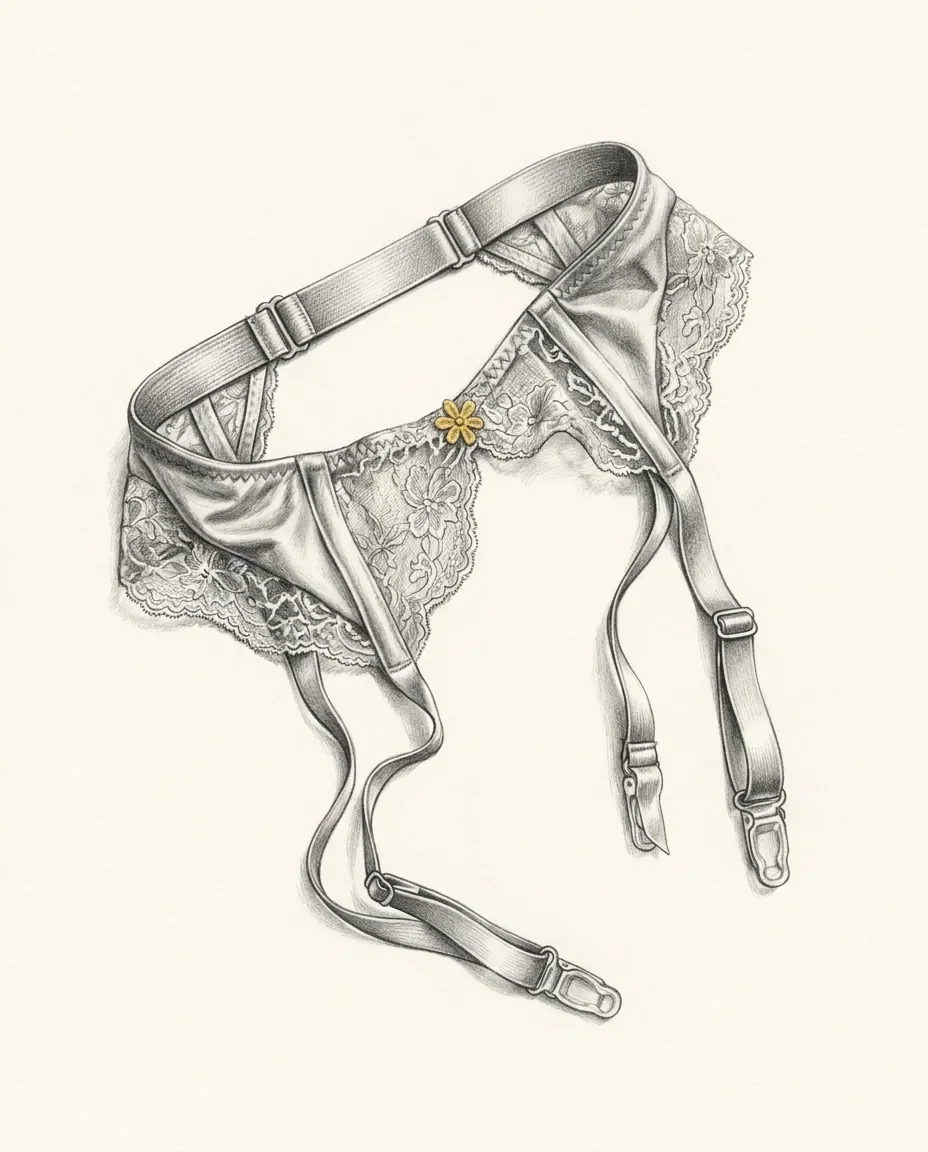
Garter Belt Fetish
Garter and suspender-belt fetishism
Added 21 Jun 2026 · Updated 22 Aug 2026
An erotic interest in garter (suspender) belts and the straps that frame the thighs and hold up stockings, prized for their glamour. The visual framing of the upper legs is central to the appeal. A common intimate-apparel fetish tied to lingerie, not a clinical disorder.
- Prevalence
- Uncommon
- Category
- Clothing & Garments
- Clinical term
- Garter and suspender-belt fetishism
- Domain
- Sexual interest
- Confidence
- Low confidence
- Status
- Common intimate-apparel fetish; a normal variation, not a disorder unless it causes distress or impairment.
- Also known as
- Garter & Suspender-Belt Fetishism, suspender kink, stocking-strap attraction, suspender-belt fetish, garter fetish
- Added
- 21 Jun 2026
- Updated
- 22 Aug 2026
Featured in

Overview
Garter and suspender-belt fetishism is an intimate-apparel interest in which the garter belt, its straps, and the stockings they hold become a strong source of arousal or focus. The appeal commonly rests on the visual framing of the thighs and hips, the contrast of straps against bare skin, and the garment's long-standing coding as deliberately glamorous lingerie. This article traces the garment's journey from a purely functional band to a charged erotic signal, and frames the interest as a well-populated subset of lingerie attraction rather than an obscure niche.
Examples
What the term covers. Enjoyment of a partner wearing a suspender belt with stockings, and of the line the straps draw down the thigh; the small ritual of fastening and unfastening the clips; a preference for particular constructions: narrow satin, wide retro cuts, lace panels, six straps rather than four; wearing one oneself, whatever one's gender; and the charged status of the wedding garter as an object in its own right. For most people it works as an added charge on otherwise conventional attraction rather than as a requirement.
What the term does not cover. A stocking fetish attaches to the hosiery the belt holds up, and pantyhose and nylon interest to one-piece legwear, the very garment whose arrival made the suspender belt optional. Lingerie fetish is the family this sits inside; a corset shapes the torso rather than suspending anything; thigh and leg interest is in the body the straps frame rather than in the straps; lace and satin interest follows the material into any garment at all; and wedding-dress interest is in the ceremony's clothing at large.
How the word is used. The naming is regional rather than technical: "garter belt" is American and "suspender belt" British for the same garment, and because "suspenders" means trouser braces in American English the two reliably confuse each other. "Garter" alone usually means the single elasticated band worn at the thigh (the wedding garter), not the waistband with straps. None of these is a clinical term; garment interest is catalogued under fetishism generally, and no diagnostic manual names this particular object.
History & origins
The garter is far older than the lingerie it later came to evoke, and its erotic meaning was acquired only after it lost its everyday job.
From function to ceremony
For centuries both men and women wore simple garters, narrow bands tied or buckled above or below the knee, to keep their stockings from sliding down. Before the invention of practical elastic, garters relied on buckles or spiral springs to grip the leg. The band also carried social and ceremonial weight: England's Order of the Garter, founded by Edward III in 1348, made the humble band a heraldic emblem of the highest chivalry, while the wedding-garter custom kept it close to ideas of intimacy and good fortune.
The suspender belt and its eroticisation
- Late 19th–early 20th c.: as elasticated fastenings matured, the dedicated suspender belt (the American garter belt) emerged, hanging clips from a waistband to suspend the stockings.
- 1940s–1960s: the suspender belt became common foundation wear, a popular alternative to the girdle, especially among teens and young women.
- Early 1960s: the introduction of pantyhose/tights offered a one-piece alternative; by the later twentieth century tights were far more widely worn than separate stockings. That very displacement is what recoded the suspender belt as deliberately seductive rather than merely practical: once it was no longer needed, choosing to wear one became an erotic statement.
Clinical lineage
Attraction to specific garments has been documented since the foundations of sexology. Richard von Krafft-Ebing's Psychopathia Sexualis (1886) recorded fetishistic attachment to articles of clothing, and the French psychologist Alfred Binet gave the phenomenon its name in his 1887 essay Du fétichisme dans l'amour, arguing that such interests arise through associative experience. Garter and suspender interest sits as one ordinary variant within this clothing-fetishism lineage and is not itself a named disorder.
In practice
Expression is typically mild and benign: a preference for a partner wearing a suspender belt with stockings, enjoyment of the look, texture, and ritual of fastening the straps, or collecting particular styles in lace, satin, or sheer. For most people it functions as a heightened preference layered onto otherwise conventional attraction, and it overlaps heavily with broader lingerie and stocking interest. The clinical literature treats garment fetishism of this kind as non-pathological unless it causes the person distress or impairment.
Psychology
The interest fits standard models of fetish formation. Associative learning ties the garment to past arousal, so that the suspender belt itself becomes an erotic cue. Layered on top is the dense cultural symbolism garters carry (glamour, retro pin-up imagery, burlesque, and overt seduction) which makes the object a ready-made signal even for those who never "conditioned" it directly. Because the straps draw the eye toward the upper legs, the interest frequently shades into thigh and leg partialism. As with clothing fetishes generally, the evidence base for any single mechanism is thin, and most accounts combine learning and symbolic-cue explanations rather than choosing between them.
Prevalence & culture
How common is a garter belt fetish?
No study measures this specific garment, so an exact rate is unknown, but it sits within the largest and most-reported cluster of clothing fetishes (legwear and lower-body garments), which suggests it is one of the more common intimate-apparel interests rather than a rare one. Reliable hard figures for this specific garment do not exist, but it can be located within broader data. Scorolli and colleagues' 2007 analysis of online fetish communities found that, among clothing-related groups, legwear and lower-body garments (stockings, skirts and the like) formed the single largest cluster at roughly 33%, just ahead of footwear at about 32%: placing stocking-and-strap interests among the more common clothing fetishes. Garter belts form a recognisable strand within that cluster, riding on the high overall popularity of lingerie. The interest enjoys substantial search demand, sizeable online communities, and strong mainstream visibility through fashion editorials, bridal traditions, burlesque revival, and period film and television, where the suspender belt remains visual shorthand for retro glamour.
Safety, consent & law
There are no inherent safety, consent, or legal concerns: the interest involves ordinary intimate apparel worn by consenting adults. Standard norms of mutual consent and privacy apply, and the garment poses none of the physical risks associated with restrictive or breath-affecting kink.
Common questions
What is the difference between a garter belt and a suspender belt?
Nothing but the country. "Garter belt" is the American name and "suspender belt" the British one for the same garment: a waistband with straps and clips that hold stockings up from above. The confusion is compounded by "suspenders" meaning trouser braces in American English, and by British writing calling the individual straps suspenders, so instructions written on either side of the Atlantic can read oddly to the other.
What is the difference between a garter and a garter belt?
A garter is the single band worn round the thigh, historically tied or buckled to stop a stocking sliding down, and surviving today mostly as the wedding garter. A garter belt is the later waist-worn garment that suspends stockings from above on straps and clips. Both get called garters casually, which is why searching for one turns up a great deal of the other.
Is a garter belt fetish a paraphilia or a disorder?
No. Interest in intimate apparel is among the most commonly reported variations there is, and no diagnostic manual treats it as a disorder in itself. Fetishistic disorder is diagnosed only where an interest causes the person marked distress or impairment, or involves someone who has not consented, conditions a preference for what a willing partner chooses to wear does not meet.
What is the difference between a garter belt fetish and a stocking fetish?
They usually travel together but attach to different objects. A stocking fetish is about the hosiery: its sheerness, texture, seams, and the way it changes the leg. A garter belt interest is about the suspending apparatus: the waistband, the straps crossing the thigh, the clips. Someone who prefers hold-ups or pantyhose has the first without the second.
Do men wear garter belts?
Some do. Garment interests are not bounded by who a garment was marketed to, and suspender belts turn up in lingerie interest and cross-dressing alike, with specialist makers producing cuts sized and shaped for men. No survey measures how many, so any figure would be invented; it is uncommon enough to attract comment and common enough that retailers cater to it.
Are garter belts still practical, or purely decorative?
Both. They do the job they were designed for, since separate stockings genuinely need suspending and clips hold better over a long day than the silicone bands of hold-ups. What changed is that they became optional. Once tights took over everyday legwear from the early 1960s, wearing a suspender belt turned into a deliberate choice, and that is what recoded it as glamorous rather than merely functional.
- Lingerie Fetish70/100Clothing & GarmentsAn erotic interest in lingerie and intimate apparel in which the garments themselves, their fabrics, and their styling become a focus of arousal. Bras, briefs, stockings, corsets and slips are typical. One of the most common and mainstream garment-related interests.70
- Stocking Fetish57/100Clothing & GarmentsA sexual interest in stockings and hosiery, centered on sheer or textured legwear, seams, garters and the look and feel of nylon and silk. It is among the most common garment and material fetishes.57
- Thigh Fetish43/100Body Parts & PartialismA focused erotic interest in the hips and thighs, in which these areas of the lower body are a primary source of attraction. It is a common, benign variation of ordinary attraction rather than a clinical concern.43
- Diaper Fetish44/100Autonepiophilia · Clothing & GarmentsAn erotic or comfort-oriented adult interest in wearing or using diapers. It overlaps with but is distinct from paraphilic infantilism; when centred on the garment and on perceiving oneself as an infant it is termed autonepiophilia. Adherents often call themselves diaper lovers (DL) within the ABDL community.44
- Maid Fetish44/100Clothing & GarmentsAn erotic interest in maid costumes worn by consenting adults, classically the black-and-white "French maid" look. That look means a fitted dress, frilled white apron, lace trim, and headpiece. A costume- and service-role clothing preference, not a clinical disorder.44
- Gym Wear Fetish43/100Clothing & GarmentsAn erotic interest in athletic and activewear, valued for its tight fit, smooth stretch fabric and fitness associations. Leggings, yoga pants, compression gear, lycra and spandex tops, and gym kit are typical. A common garment/material fetish, not a clinical disorder.43
"Garter" derives from Old French *gartier* / *garet* (the bend of the knee), the band originally tied at the knee to hold up a stocking; "suspender" is from Latin *suspendere*, "to hang up," describing the straps that suspend the stocking. The clinical sense follows Alfred Binet's coinage of *fétichisme* (1887) for arousal attached to a specific object.
intimate apparel · lingerie accessories · garment fetishism
Prevalence is computed from the entry's cited population estimate. Rows marked ESTare indicative editorial estimates scored against a fixed anchor rubric, not measured quantities. Method & anchors: methodology.
Uncommon · ≈ 1 in 100
- 01Scorolli et al. (2007), Relative prevalence of different fetishes, Int. J. Impotence Research 19(4):432-437prevalence anchor (legwear/stockings ~33% of clothing fetishes; garter belts a small sub-portion)
- 02Sexual fetishism, Wikipedia (carries the Scorolli 2007 relative-frequency table)carries the Scorolli relative-frequency table for clothing/garment fetishes
- 03List of paraphilias, Wikipediaexistence/definition of garment fetishism toward lingerie accessories
- 04Garter, Wikipediahistory of the garter and suspender belt: tied/buckled bands to hold stockings, 1940s-60s suspender belt as girdle alternative, early-1960s displacement by pantyhose/tights
- 05Order of the Garter, WikipediaOrder of the Garter founded by Edward III in 1348, making the band a ceremonial/heraldic emblem
- 06Psychopathia Sexualis, WikipediaKrafft-Ebing's Psychopathia Sexualis (1886) documented fetishistic attachment to articles of clothing