Petrification Fetish
Added 26 Jul 2026 · Updated 22 Aug 2026
An erotic or imaginative fascination with the fantasy of a living body turning to stone, played out mainly in art, fiction and role-play. Real statues are not the object of interest. It is distinct from agalmatophilia, the attraction to statues as objects.
- Prevalence
- Rare
- Category
- Identity & Transformation
- Domain
- Sexual interest
- Confidence
- Low confidence
- Status
- Not a recognized clinical diagnosis and not separately listed among paraphilias; clinical literature acknowledges the fantasy only as one pole of agalmatophilia's definition (being transformed into the preferred object), not as a distinct category.
- Also known as
- petrifaction fetish, stone transformation fetish, turned-to-stone fantasy, statue transformation fetish
- Added
- 26 Jul 2026
- Updated
- 22 Aug 2026
Featured in
Overview
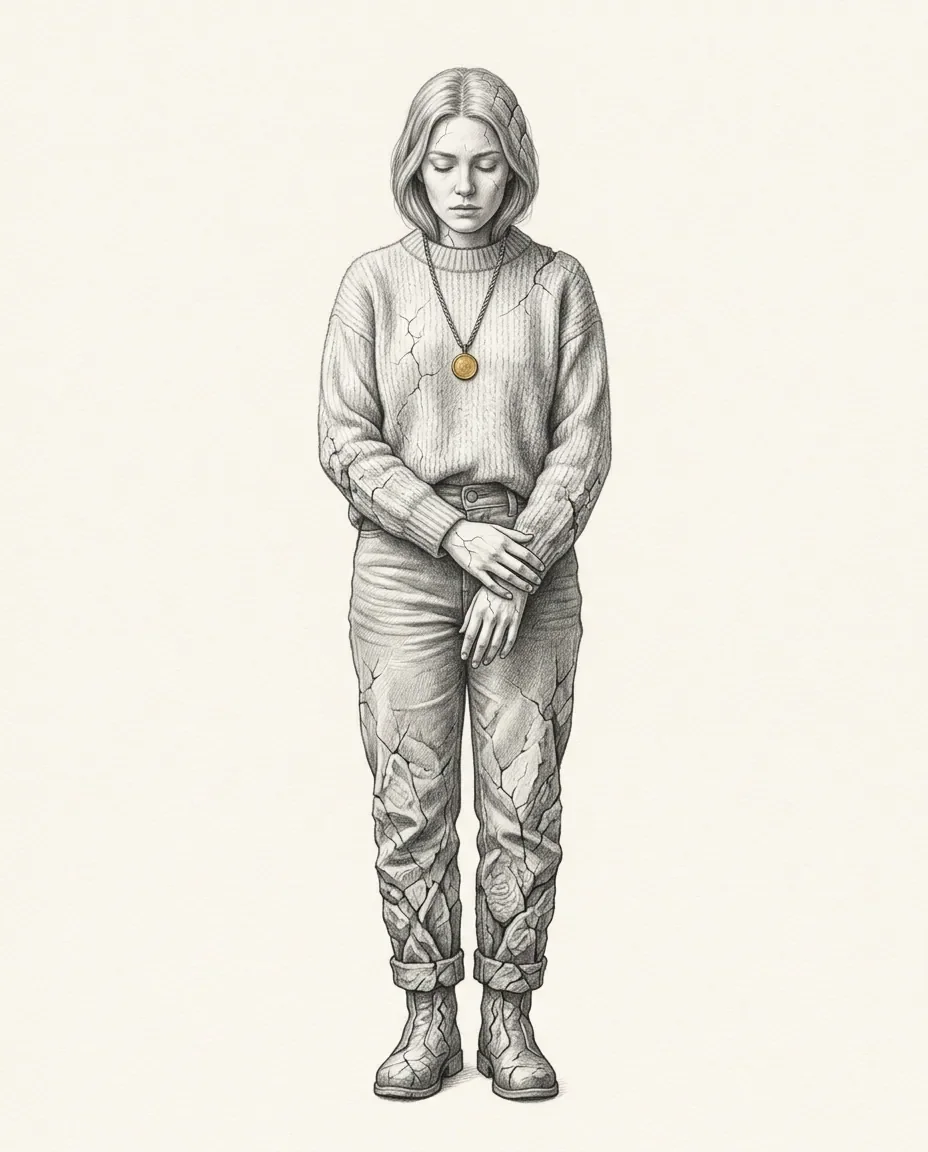
A petrification fetish is a fascination with the fantasy of a living person being turned to stone: skin hardening into marble or granite, motion slowing to stillness, a body ending frozen mid-gesture. The appeal sits in the becoming, not in an existing statue. That distinguishes it sharply from agalmatophilia, the clinical term for attraction to statues, mannequins and dolls as objects in their own right, even though the two interests share imagery and are often discussed together. Because turning a real person to stone is impossible and would be lethal if it were not, the interest lives almost entirely in illustration, captioned artwork, fan fiction and collaborative writing rather than in any enactable practice.
Definition & scope
The fantasy usually keeps three beats: a trigger (a curse, a gaze, a potion, a machine), a transformation sequence rendered in some detail, and an end state of frozen, statuesque immobility, sometimes reversed later in the story. Because the draw is the process, petrification is generally classed by fan communities as one variety of transformation fetish, grouped in fan archives alongside the other transformation tags rather than treated as a genre of its own; what marks it out within that family is only that the endpoint is an object rather than another living creature. It also overlaps dollification, where a partner is styled and posed as a lifelike doll, and it shares its interest in enforced stillness with immobility-based practices such as mummification. A separate thread links it to teratophilia and monster fetish: the classic petrifying agent, the gorgon, is itself a monster, so the trope's stock imagery is monstrous even where the appeal is not.
Examples
What the term covers. Almost everything under this label is a depicted transformation rather than anything done: an illustrated sequence in which a figure greys, stiffens and stops panel by panel; a captioned single image implying a before and an after; serialised fiction and collaborative writing in which a curse, a gaze, a potion or a machine begins the change and, often, reverses it at the end. The trigger and the material (marble, granite, plain grey stone) are treated as variables by the communities that produce this work, while the transformation sequence itself is the fixed point.
What the term does not cover. Agalmatophilia, attraction to statues and mannequins as objects, is an interest in the finished thing rather than in the change, and it is the term most often mistaken for this one. Dollification overlaps in imagery but styles and poses a living partner as a doll rather than narrating a change of material. Mummification and bondage immobilise a body that stays flesh throughout. Teratophilia and monster fetish name attraction to the gorgon rather than to what her gaze does. Within the wider transformation fetish family, petrification is simply the branch whose endpoint is an object.
How the word is used. It is fandom vocabulary, not clinical language: "petrification" and the older "petrifaction" both circulate as archive tags. Neither appears in DSM-5-TR or ICD-11, and neither is separately listed among catalogued paraphilias; the clinical literature reaches the fantasy only inside agalmatophilia's own definition, which covers pleasure taken in being transformed into, or transforming another into, the preferred object.
History & origins
The myth that supplied the imagery
The idea of a gaze or curse that turns flesh to stone is old and specific. The earliest surviving accounts of the Gorgons, three sisters whose look killed by petrification, appear in Greek poetry of roughly 700 to 650 BCE, in Hesiod and in Homer, where "the Gorgon" is already a dread monster. Medusa, the one mortal sister, was beheaded by Perseus, who avoided her gaze by watching its reflection in a polished shield; her severed head kept its petrifying power and was later fixed to Athena's aegis. The Corfu temple pediment (early sixth century BCE) shows how quickly the image became a standard architectural motif, and gorgon faces (gorgoneia) spread across shields, coins and vases by the hundreds. Roman poetry gave the story its most influential retelling: Ovid's Metamorphoses (1st century CE) reframed Medusa as a beautiful woman transformed into a monster as punishment, adding a layer of tragedy to what had been a straightforward monster tale. This dual inheritance, dread and pathos both attached to a stone-making gaze, is the raw cultural material every later petrification story draws on, including the folkloric petrified-people legends collected from Cornwall to the Philippines that a broader survey of petrifaction in mythology and fiction traces across dozens of cultures.
From myth to modern fandom trope
Unlike agalmatophilia, which entered clinical vocabulary through nineteenth-century sexology, petrification never acquired a Greek-rooted clinical name or a diagnostic entry; it is not found on Wikipedia's List of paraphilias as a distinct term. Instead the motif migrated intact through popular fiction, tabletop gaming's petrification-as-status-effect mechanics (a staple since early Dungeons & Dragons rulebooks), fantasy and children's literature, and eventually video games, anime and manga, where series such as Dr. Stone built entire premises around mass petrification. As transformation-themed art communities organized on hobbyist archives and later on sites such as DeviantArt from the early 2000s onward, petrification became one of the standard tags within the wider transformation-fiction fandom, alongside animal and size-change transformation, produced almost entirely as illustrated sequences, captioned images and short stories rather than photography or live performance.
A recognized pole within agalmatophilia's own definition
The closest the clinical literature comes to naming this fantasy directly is inside the definition of agalmatophilia itself: the overview of agalmatophilia notes that gratification can come not only from attraction to an existing statue but from "sexual pleasure gained from thoughts of being transformed or transforming another into the preferred object," which is precisely the petrification fantasy, described there as one face of a broader object-attraction paraphilia rather than as a separate diagnosis.
In practice
Expression is almost entirely representational: illustrated transformation sequences (a figure shown progressively greying and stiffening panel by panel), captioned single images implying a before-and-after, serialized fiction, and text-based collaborative role-play in which a scene narrates a character's transformation and, often, eventual restoration. Where it appears in negotiated partner play at all, it borrows techniques from stillness- and immobility-based practices, holding a fixed pose for an extended period, rather than any literal transformation.
Psychology
Proposed explanations echo those given for the wider transformation fetish: the appeal of surrendered control, the eroticized loss of agency and motion, fascination with an idealized and permanently "perfect" body, and the specific charge of being rendered powerless by a gaze or curse rather than by a person. The gorgon myth adds a note of danger-mixed-with-beauty that recurs in later fiction. As with most niche fantasy interests, no dedicated clinical study exists, so these accounts remain descriptive rather than empirically tested.
Prevalence & culture
No prevalence survey isolates petrification fetish, and no general-population figure exists for object-attraction interests of any kind. The nearest available measure is a relative one drawn from inside the communities themselves: surveying 381 online fetish discussion groups, Scorolli and colleagues (2007) found that objects unrelated to the body accounted for only about 5% of the preferences expressed, against 33% for body parts. That ranks interests among people already gathered in fetish communities; it says nothing about how common any of them are outside them. Visibility instead runs through dedicated transformation-fiction archives, DeviantArt and Fur Affinity tag communities, and mainstream media exposure to the Medusa myth and petrification-as-plot-device in games and anime, which keeps cultural awareness of the image far ahead of any measurable interest in it as a sexual fantasy.
Safety, consent & law
The fantasy is inherently fictional and safe: no real petrification is possible, so it carries none of the physical risk of enactable kinks. It is not classified as a disorder under the DSM-5-TR or ICD-11, which reserve paraphilic-disorder status for patterns causing distress, impairment, or harm to a non-consenting party, none of which arise from an interest expressed through art and fiction.
Common questions
What is the difference between a petrification fetish and agalmatophilia?
Agalmatophilia, catalogued here as statue and doll fetish, is attraction to statues, mannequins and dolls as objects that already exist. A petrification fetish is about the change itself: flesh hardening, movement stopping, a body ending as an object. The two share imagery and are usually discussed together, and the standard definition of agalmatophilia does stretch to cover the thought of being transformed into the preferred object, which is the closest the clinical literature comes to naming this fantasy at all.
Why does Medusa appear in so much petrification fantasy?
Because she supplied the imagery. The Gorgons appear in Greek poetry of roughly 700 to 650 BCE as sisters whose look turned people to stone, and Ovid's Metamorphoses later recast Medusa as a beautiful woman punished with monstrousness. That double inheritance (dread and pathos attached to a single petrifying gaze) is the stock material almost every later petrification story borrows, from tabletop rulebooks to anime.
Can a petrification fetish be acted out in real life?
Not literally, and that shapes the whole interest. Nobody can be turned to stone, so it lives in illustration, fiction and collaborative writing rather than in any practice. Where it enters partner play at all it borrows from stillness- and immobility-based kinks (holding a fixed pose for a long stretch, or the enforced stillness of mummification), which approximates the image rather than the transformation the fantasy is actually about.
Is a petrification fetish a paraphilia or a disorder?
Neither, on the current classifications. It is not separately listed among catalogued paraphilias and appears in neither DSM-5-TR nor ICD-11, both of which reserve paraphilic-disorder status for patterns causing distress, impairment or harm to a non-consenting person. An interest expressed entirely through drawings and short stories meets none of those conditions, and it carries none of the physical risk of an enactable kink.
Where does petrification content actually appear?
In transformation-fiction archives and art communities rather than in photography or video, for the obvious reason that the subject cannot be filmed. Hobbyist archives carried it first, and from the early 2000s it became one of the standard tags on general art sites alongside animal and size-change transformation. Mainstream exposure arrives secondhand, through the Medusa myth and through petrification used as a plot device or a status effect in games and anime.
How common is a petrification fetish?
Rare, though no survey has measured it directly. The closest anchor is Scorolli and colleagues' 2007 analysis of 381 online fetish discussion groups, in which objects unrelated to the body accounted for about 5% of stated preferences against 33% for body parts, a ranking within fetish communities, not a general-population rate. Awareness of the image runs far ahead of any measurable interest in it as a fantasy.
- Statue / Doll Fetish19/100Agalmatophilia · Objects & MaterialsAgalmatophilia is a sexual or romantic attraction to statues, mannequins, dolls, or other lifelike representations of the human form. A linked theme, Pygmalionism, centres on fantasies of such a figure coming to life, or of a living body turning to stone or freezing into immobility.19
- Transformation Fetish33/100Metamorphophilia · Identity & TransformationA transformation fetish is an erotic or imaginative fascination with the process of a body changing form into something else. That might be an animal, an object, or another kind of being. The appeal centers on the metamorphosis itself rather than the end state.33
- Dollification23/100Identity & TransformationA role-play and transformation kink in which one partner, the "doll", is styled, posed and treated as a lifelike human doll by a partner, the "maker". Costume, makeup, restrictive material or a doll-like persona create it. The charge comes from performing as a doll, not from attraction to an actual inanimate object.23
- Teratophilia35/100teratophilia · Identity & TransformationAn erotic or romantic attraction to beings perceived as monstrous, deformed, or non-human, ranging from fictional creatures to real people. Werewolves and demons sit at one end, people with unusual physical features at the other. It is mostly fantasy- and media-driven.35
- Monster Fetish38/100Teratophilia · Identity & TransformationAn erotic or romantic attraction to monstrous, mythical, alien, or otherwise non-human creatures as portrayed in fiction, art, games, and film. Sometimes called teratophilia, it centers on imagined fantasy beings rather than any real person or animal.38
- Female Masking17/100Identity & TransformationFemale masking is the practice of wearing a lifelike full-head silicone or latex mask to present as a woman or as an idealized doll-like figure. A matching body suit is usually worn with it. It centres on transformation, embodiment and total concealment of the wearer's own identity.17
From Latin petra ("rock, stone") via the verb "petrify," itself from French pétrifier; the community label "petrification fetish" is a modern coinage inside transformation-fiction fandom with no Greek-rooted clinical name of its own.
transformation · fantasy · immobility · mythology
Prevalence is computed from the entry's cited population estimate. Rows marked ESTare indicative editorial estimates scored against a fixed anchor rubric, not measured quantities. Method & anchors: methodology.
Rare · ≈ 1 in 1,000
- 01Petrifaction in mythology and fiction, Wikipediathe petrification trope's broad cultural presence across folklore and modern fiction, games and anime, used to frame it as a widespread narrative motif rather than a clinical topic
- 02Gorgon, Wikipediaearliest Gorgon sources (Hesiod/Homer, c. 700-650 BCE), the petrifying gaze, and the Corfu temple pediment (early 6th century BCE) as an early architectural depiction
- 03Medusa, Wikipediathe Perseus/Medusa myth and Ovid's Metamorphoses (1st century CE) retelling of Medusa's transformation and beheading
- 04Agalmatophilia, Wikipediathe clinical definition of agalmatophilia explicitly including 'being transformed... into the preferred object' as one gratification pole, used to distinguish petrification fantasy from statue attraction
- 05List of paraphilias, Wikipediaconfirms petrification is not separately listed as a recognized paraphilia
- 06Scorolli et al. (2007), Relative prevalence of different fetishes, Int. J. Impotence Research 19(4):432-437relative frequency of fetish targets across 381 online fetish discussion groups: objects unrelated to the body ~5% of stated preferences against ~33% for body parts, a within-community ranking, explicitly not a general-population prevalence estimate
- 07DSM-5-TR, American Psychiatric Associationnot a stand-alone diagnosis; paraphilic-disorder status requires distress, impairment or non-consensual harm
- 08ICD-11, World Health Organizationnot classified as a disorder absent distress or impairment