Robot / Doll Fetish
Agalmatophilia
Added 21 Jun 2026 · Updated 22 Aug 2026
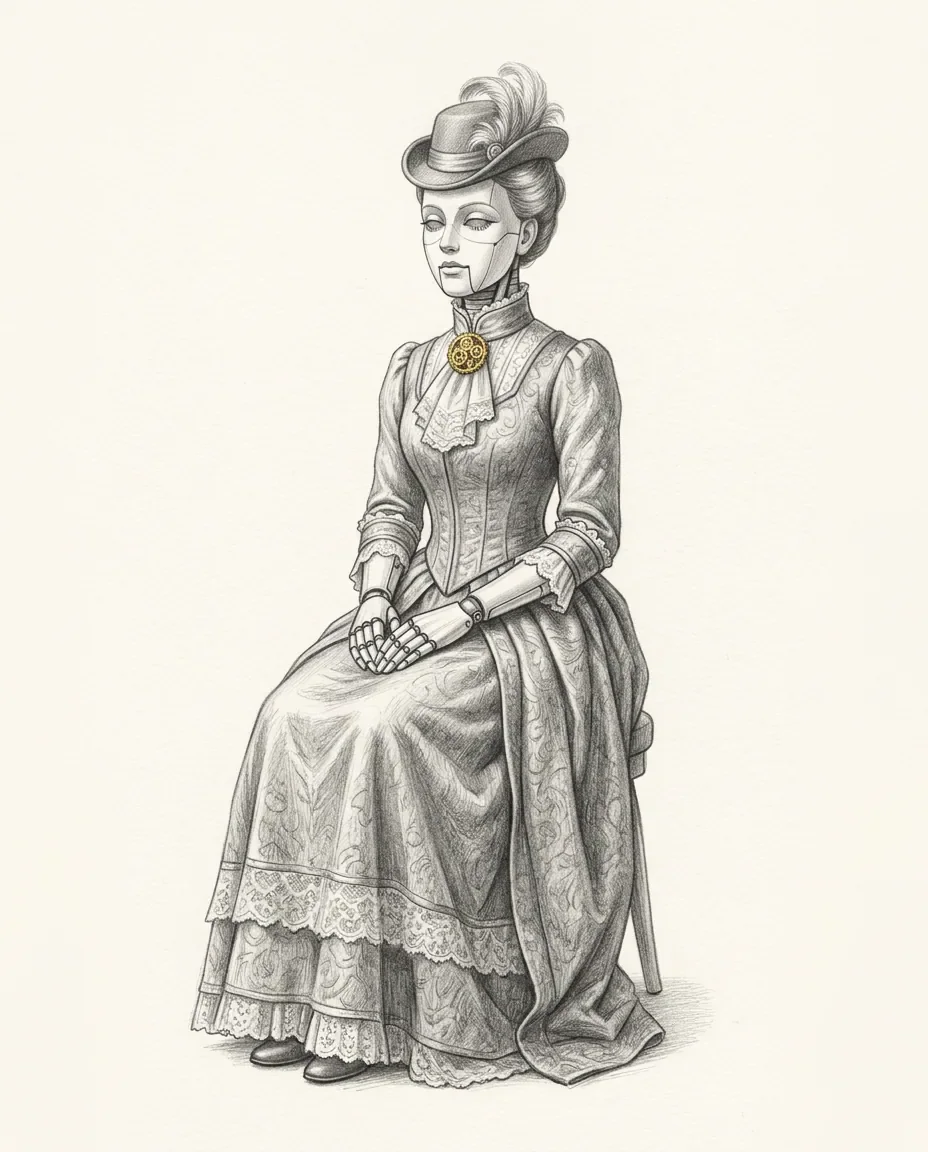
An erotic interest in robots, androids, dolls, or in being or treating a person as an artificial, programmable, or immobile being. The community is often called ASFR (alt.sex.fetish.robots), and it overlaps with agalmatophilia.
- Prevalence
- Rare
- Category
- Identity & Transformation
- Clinical term
- Agalmatophilia
- Domain
- Sexual interest · Paraphilia
- Confidence
- Low confidence
- Status
- Object/transformation paraphilia catalogued in clinical literature; not a stand-alone DSM-5-TR/ICD-11 diagnosis absent distress or impairment.
- Also known as
- robot / doll identity play, agalmatophilia, ASFR, robot fetish, doll fetish, android fetish, technosexual, statuephilia, objectification play, alt.sex.fetish.robots
- Added
- 21 Jun 2026
- Updated
- 22 Aug 2026
Featured in
Overview
Robot/doll fetish is an erotic interest centered on artificial human-like beings (robots, androids, dolls, and mannequins) and on the idea of a person taking on, or being treated as, such a being. The long-running online label ASFR derives from an early Usenet newsgroup, and the theme overlaps with the clinical category agalmatophilia (attraction to statues, dolls, and mannequins) and with broader objectification play. It is catalogued among object and transformation paraphilias and is harmless between consenting adults. This article traces its mythic and clinical roots, its community origins online, and what is and is not known about it.
Definition & scope
The interest gathers several related attractions under one heading: to robots and androids as such, to dolls and mannequins as lifelike-but-inanimate figures, and to the fantasy of a person being, becoming, or being treated as an artificial being. It is distinct from doll and statue fetish proper (which centers on the figure) in that the robot-and-doll variant often foregrounds programmability and artificial agency: stillness, mechanical motion, scripted obedience, activation and deactivation. It is not the same as ordinary appreciation of companion dolls, nor does the fantasy require any real robot to exist.
Examples
What the term covers. Fiction and artwork featuring androids, gynoids, fembots and lifelike dolls, which is where most of the interest lives; appreciation of companion dolls and mannequins as objects; and role-play in which one consenting adult adopts an artificial persona: stillness, deliberately mechanical movement, a flat synthetic voice, scripted obedience, or an "activation" and "shutdown" that bracket the scene. The programmable element is what marks this variant out: not simply a figure, but a figure with rules.
What the term does not cover. Two neighbouring entries split the same ground more narrowly: robot fetish covers the machine-and-android strand and its ASFR community, while statue / doll fetish covers agalmatophilia, the older clinical thread about statues, mannequins and figures. Dollification is the specific role-play of styling and posing a partner as a doll, and dronification swaps the doll for an obedient drone persona. Petrification fetish is about a body turning to stone, and transformation fetish about the process of changing form generally. Objectification play is the wider consensual dynamic of being treated as an object, artificial or otherwise, and object sexuality is attraction to actual objects such as bridges or instruments rather than to human-shaped ones.
How the word is used. The vocabulary is mostly community-made. ASFR is simply the name of the Usenet group that first gathered the interest, and participants still describe themselves as ASFRians or technosexuals and sort themselves into "built" and "transformation" camps. The clinical register offers only agalmatophilia, which covers the statue-and-doll half. Neither manual (DSM-5-TR or ICD-11) carries any of these as a diagnosis.
History & origins
The interest has two distinct lineages that have only partly converged: an old clinical thread about statues and figures, and a young, internet-native thread about robots.
Clinical & mythic lineage
- 8 CE: The cultural template is the myth of Pygmalion, the sculptor who falls in love with his own ivory statue, which then comes to life, retold in Ovid's Metamorphoses and giving rise to the later coinage "Pygmalionism," the love of an object of one's own creation.
- 1877: Early sexology recorded statue-eroticism as case material; the agalmatophilia literature cites an 1877 report of a gardener who fell in love with a statue of the Venus de Milo. The behaviour was described in nineteenth-century French pathology as amour des êtres inanimés ("love of inanimate beings").
- 1886: The pioneering sexologist Richard von Krafft-Ebing discussed attraction to inanimate human-like forms in his landmark Psychopathia Sexualis (first edition 1886).
- c. 1930: The clinical term agalmatophilia, from Greek ágalma ("statue, votive image") plus -philía ("love"), settled into use as a comparatively modern medicalization of this long-attested statue-eroticism. Standard references note that it overlaps but is not identical with Pygmalionism, which emphasizes the fantasy of the figure coming to life.
Cultural & subcultural evolution
- 1990s: The modern robot-and-doll variant is largely community-defined. The abbreviation ASFR comes directly from the Usenet newsgroup alt.sex.fetish.robots, which coalesced as the interest's first organized online home and gave it a lasting shorthand; participants also call themselves technosexual or ASFRians.
- Late 1990s onward: As internet access widened, the community migrated from Usenet to web forums and image archives, supporting a durable tradition of ASFR fiction and manipulated art.
- 2001: Filmmaker Allison de Fren documented the subculture in a short film titled ASFR, later expanding her academic study of "technofetishism"; this remains one of the few sustained scholarly treatments. Documentation has stayed chiefly case-based, qualitative, and self-reported rather than the product of large clinical studies. As lifelike companion dolls and humanoid robotics have advanced, cultural visibility has grown.
In practice
Expression is overwhelmingly fantasy-, art-, and role-play-based:
- Appreciation of fiction and artwork featuring androids, fembots, and lifelike dolls.
- Interest in lifelike companion dolls and mannequins as objects.
- Role-play in which one partner adopts a robotic, doll-like, or "programmable" persona, sometimes including stillness, mechanical movement, or scripted obedience.
A recurring community split, observed in informal ASFR surveys, distinguishes those drawn to a built artificial being (a manufactured android partner) from those drawn to transformation (a human becoming, or being turned into, an artificial being). One widely cited community survey found roughly two-thirds favouring "built" and the rest favouring transformation or a combination. In the transformation camp it is often the process of becoming artificial that is eroticized, linking the interest to transformation fetish.
Psychology
Proposed accounts emphasize the safety of an idealized, non-judgmental, fully controllable partner; the eroticization of surrendering or assuming agency (a theme it shares with dominance & submission); the uncanny contrast between lifelike form and inanimacy; and early imprinting on robot, doll, and android imagery in fiction and media. It is listed among object and transformation paraphilias, sits close to statue/doll fetish, and is not a stand-alone DSM-5-TR or ICD-11 diagnosis unless it causes the person clinically significant distress or impairment. The evidence base is thin, and these mechanisms remain proposed rather than established.
Is it a disorder?
No. On its own the interest is a benign paraphilia. Modern classification (DSM-5-TR, ICD-11) treats an unusual sexual interest as a disorder only when it causes the person marked distress or impairment, or involves a non-consenting party, neither of which applies to fantasy and consensual role-play between adults.
Prevalence & culture
The interest is rare but maintains long-established, well-documented online communities and has notable cultural resonance through science fiction's androids and lifelike dolls. No dedicated prevalence survey isolates it: large fetish-frequency studies such as Scorolli et al. (2007) place attraction to inanimate human-like objects among the smaller share of object-directed fetishes. Community-size proxies such as FetLife groups and ASFR forums indicate small but durable groups. It appears in encyclopedic paraphilia catalogs and draws limited formal research attention.
Safety, consent & law
Between consenting adults the interest is harmless, involving objects, fiction, or mutually agreed role-play. The relevant consideration is simply clear negotiation when one partner plays an "object," so that safewords, breaks, limits, and ongoing consent remain explicit even when a partner is performing stillness or scripted obedience. It concerns adults only.
Common questions
What does ASFR stand for?
It is the name of the Usenet newsgroup alt.sex.fetish.robots, which became the interest's first organised home online in the 1990s and left the abbreviation behind as a permanent label. Participants use it as both a noun and an adjective, call themselves ASFRians, and often prefer technosexual in conversation. The letters have long outlived the newsgroup itself, and few people using them today have ever read it.
What is the difference between a robot fetish and a doll fetish?
The dividing line is agency. A robot fetish centres on the machine: mechanical movement, programming, control, the blurred boundary between person and device. A statue or doll fetish centres on the figure and its stillness: an inanimate body in perfect, unresponsive form. This entry covers the space where the two meet, where a figure is both doll-like and programmable, which is where much of the community's fiction actually sits.
Do you need to own a sex doll or a robot for this?
No, and most people involved do not. The interest is overwhelmingly expressed through fiction, artwork and role-play between partners, and it long predates any hardware capable of supporting it. No real android exists that resembles the ones the fantasy describes, which has never limited the interest in the slightest; the imagined version was always the point.
How do you role-play as a doll or android safely?
The persona is the complication: someone performing stillness, silence or scripted obedience has given up the usual signals that something is wrong. Agree beforehand what the scene includes and how it ends, and set a non-verbal signal (a dropped object, a hand gesture) that works when speech is out of character. Watch for the ordinary physical costs of holding a position: circulation, joints, temperature. Afterwards, deliberately step out of the persona and check in as yourselves.
Are sex dolls and sex robots legal?
Adult companion dolls are legal to own in most countries, though a few restrict their import or sale, and rules differ enough that it is worth checking locally. One line is absolute: dolls modelled on children are a criminal matter, and importing or possessing one is an offence in a number of jurisdictions including the United Kingdom and Australia. That has nothing to do with the interest described here, which concerns adults only.
Does this mean someone cannot connect with real people?
That is the standard assumption and there is no evidence for it. The research on this interest is thin, case-based and qualitative, and it does not support any claim about the social lives of the people who report it. In practice the interest usually sits alongside ordinary relationships as one thread among several, and the role-play form requires a willing partner by definition.
- Statue / Doll Fetish19/100Agalmatophilia · Objects & MaterialsAgalmatophilia is a sexual or romantic attraction to statues, mannequins, dolls, or other lifelike representations of the human form. A linked theme, Pygmalionism, centres on fantasies of such a figure coming to life, or of a living body turning to stone or freezing into immobility.19
- Transformation Fetish33/100Metamorphophilia · Identity & TransformationA transformation fetish is an erotic or imaginative fascination with the process of a body changing form into something else. That might be an animal, an object, or another kind of being. The appeal centers on the metamorphosis itself rather than the end state.33
- Dominance and Submission92/100Power, Roles & ScenariosA consensual erotic dynamic in which one partner takes a dominant role and the other a submissive role, exchanging power within agreed limits. It is one of the most widespread elements of BDSM and of human sexual fantasy.92
- Spectrosexuality35/100spectrophilia · Identity & TransformationA fantasy-based sexual or romantic attraction to ghosts, spirits, or deities, sometimes including the belief in intimate encounters with the supernatural. The clinical label is spectrophilia; an older sense of the term also covers arousal from one's mirror image.35
- Teratophilia35/100teratophilia · Identity & TransformationAn erotic or romantic attraction to beings perceived as monstrous, deformed, or non-human, ranging from fictional creatures to real people. Werewolves and demons sit at one end, people with unusual physical features at the other. It is mostly fantasy- and media-driven.35
- Littlespace36/100Identity & TransformationA non-sexual practice of temporarily shifting into a younger, childlike headspace for comfort, relaxation, and stress relief. It often uses childhood-associated activities and comfort objects. A self-soothing coping and identity state, explicitly distinguished from erotic age-play.36
The clinical name agalmatophilia is from Greek agalma, "statue" or "votive image," plus -philia, "love of"; the community label ASFR is an acronym of the 1990s Usenet newsgroup alt.sex.fetish.robots.
objectification · artificial-being play · transformation
Prevalence is computed from the entry's cited population estimate. Rows marked ESTare indicative editorial estimates scored against a fixed anchor rubric, not measured quantities. Method & anchors: methodology.
Rare · ≈ 1 in 1,000
- 01List of paraphilias, Wikipediadefinition/existence of agalmatophilia and ASFR-style artificial-being attraction
- 02FetLife, kink community group sizes (community-size proxy)community-size proxy; small but established robot/doll/ASFR interest groups
- 03Scorolli et al. (2007), Relative prevalence of different fetishes, Int. J. Impotence Research 19(4):432-437framing within object-directed fetishes, a small share of all fetish interest
- 04Agalmatophilia, WikipediaGreek etymology (agalma + philia), the 1877 Venus de Milo case, the Pygmalionism overlap, and the static-vs-coming-to-life distinction
- 05Robot fetishism, WikipediaASFR/alt.sex.fetish.robots origin, technosexual/ASFRian self-labels, the built-vs-transformation split, Allison de Fren's 2001 ASFR film, and the agalmatophilia relationship
- 06Pygmalion (mythology), Wikipediathe Pygmalion myth retold in Ovid's Metamorphoses (8 CE) as the cultural template and source of 'Pygmalionism'
- 07Richard von Krafft-Ebing, Wikipediathe sexologist whose case-based study of paraphilias documented attraction to inanimate human-like forms
- 08Psychopathia Sexualis, WikipediaKrafft-Ebing's landmark 1886 work cataloguing paraphilic case material