Spread-Eagle Bondage
Added 10 Jul 2026 · Updated 22 Aug 2026
A consensual bondage position in which a person's wrists and ankles are secured to four separate anchor points, holding the limbs wide apart. The body is immobilised in an open, exposed posture. It is one of the most recognisable ties in BDSM.
- Prevalence
- Very common
- Category
- Sensation & Pain
- Domain
- Sexual interest
- Confidence
- Medium confidence
- Status
- Consensual BDSM bondage position; a benign variation in consenting adults, not a disorder absent distress or non-consent.
- Also known as
- spreadeagle, spread eagle, four-point bondage, four-point restraint
- Added
- 10 Jul 2026
- Updated
- 22 Aug 2026
Featured in
Overview
Spread-eagle bondage, also called four-point bondage, is a consensual restraint position in which a person's wrists and ankles are fastened to four separate anchor points so the arms and legs are held wide apart in an open "X" shape. The name borrows the heraldic image of an eagle displayed, wings and legs outstretched. It is one of the most recognisable positions in bondage, valued for the combination of total immobility, exposure, and helplessness it produces. This article covers where the term comes from, how the position is set up, its appeal, prevalence, and the safety considerations that separate it from unrestrained play.
Definition & scope
The defining feature is the four-point anchoring: each limb is tied off independently and pulled toward a corner, so the body is spread and cannot draw the limbs together. According to Wikipedia's overview of bondage positions, spread-eagle can be arranged horizontally (face-up or prone) or vertically, and occasionally inverted. A face-up spread-eagle gives access to the front of the body but not the back, so it is not paired with rear-facing play.
Common anchoring setups include:
- Bed corners: wrist and ankle cuffs or rope run to the four corners of a bed frame, the most domestic arrangement.
- Saint Andrew's cross (X-cross): a standing X-shaped frame found in many BDSM dungeons, restraining the wrists, ankles, and sometimes the waist in a vertical spread-eagle.
- Spreader bars: rigid bars clipped between the ankles (and sometimes the wrists) that hold the limbs a fixed distance apart, used on their own or to reinforce a tie.
Spread-eagle is distinct from ties that bind the limbs together, such as hogtie bondage or a box tie: where those gather the body inward, the spread-eagle stretches it open.
Examples
What the term covers. The bed form, with cuffs or rope run from each wrist and ankle to the four corners of a frame, which is where most people meet the position first. The vertical form on a Saint Andrew's cross, standard furniture in most play spaces, holding the arms at roughly 45 degrees so the wrists are raised without the body hanging from them. The prone variant, face-down, which opens the back rather than the front. And loose approximations: an ankle spreader bar used on its own holds the legs apart without securing the arms at all, producing much of the effect without the four-point tie.
What the term does not cover. Strappado draws the arms behind the back and lifts them, the opposite geometry. Suspension bondage puts the body's weight on the rope rather than on a surface. Mummification and the vacuum bed immobilise by encasing rather than by spreading. Shibari is patterned rope work valued partly for how it looks, where a spread-eagle is valued only for what it does. Stress-position play and predicament bondage make the person hold or choose something effortful; a spread-eagle asks nothing of them. It is also a position rather than an interest: vincilagnia names arousal at being bound, and spread-eagle is one shape that arousal can take.
How the word is used. Ordinary English long before it was kink vocabulary. "Spread-eagled" describes anyone lying with limbs flung wide and appears constantly in reporting and fiction with no erotic sense at all. Within kink it names a position, not a technique or a scene, and "four-point" is the neutral synonym used in rope instruction and equipment listings. Neither term is clinical: DSM-5-TR and ICD-11 name no bondage positions whatsoever, and the entire position vocabulary of this field is community-made.
History & origins
The heraldic term
"Spread eagle" began as a heraldic phrase. It describes an eagle displayed: shown from the front with both wings, both legs, and the tail-feathers spread open, a device used on coats of arms since the medieval period and still seen on the emblems of Germany, Poland and the United States. English dictionaries date the compound to the mid-16th century, with the Oxford English Dictionary's earliest evidence from 1550 and Etymonline recording the heraldic sense from the 1560s. The figurative use for a person whose arms and legs are stretched wide apart, and from there the bondage position, is a later extension of that same image.
The Saint Andrew's cross
The standing form of the position is tied to a specific piece of furniture. The X-shaped frame is named for Saint Andrew, the apostle traditionally said to have been martyred on a diagonal cross (the saltire). The BDSM community adopted the shape and the name because a person fastened to it is held in a vertical spread-eagle. As documented in Wikipedia's article on the X-cross, the frame became standard dungeon equipment as the leather and fetish scenes of the later 20th century built up a shared vocabulary of purpose-made furniture, and commercially produced crosses appeared as the equipment market grew. The 45-degree spread of the arms keeps the wrists raised without the overhead strain of a suspended position.
In practice
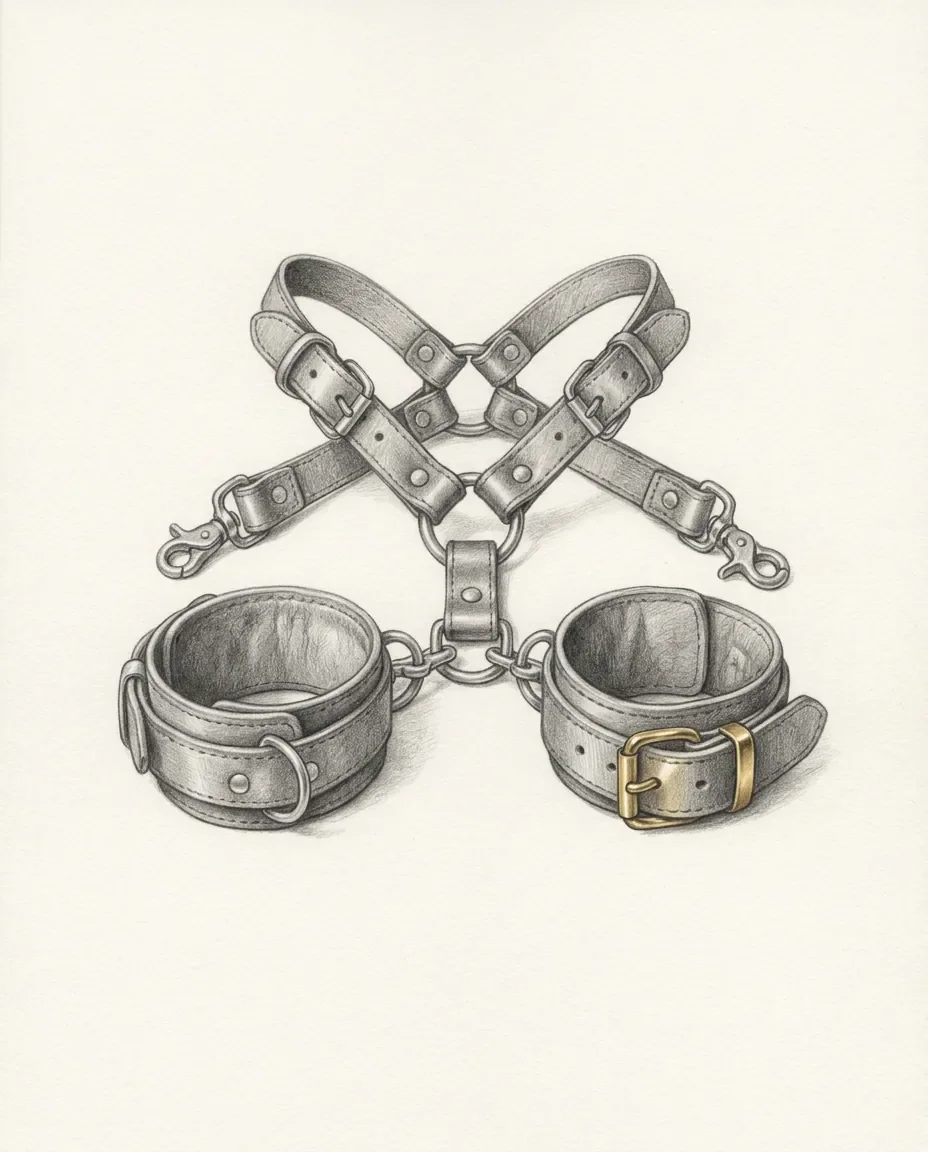
The position is usually built with bondage cuffs and tethers or with rope, restraining one limb at a time. The person tying, often called a rigger or rope top, adjusts the tension so the limbs are held firmly without over-stretching the shoulders or hips. Because the body is fully open and cannot curl or shield itself, spread-eagle is frequently combined with sensation play, teasing, or sensory deprivation such as a blindfold. It is non-explicit as a position in itself and is widely depicted in fetish photography and art.
Psychology
The appeal centres on exposure and surrender. Being unable to close the body or protect oneself heightens vulnerability and the erotic charge of helplessness, while for the partner tying, the draw is control and unhurried access. Like consensual BDSM generally, interest in restraint is treated as a benign variation rather than a disorder: the DSM-5-TR and ICD-11 do not classify consensual bondage as pathological absent distress, impairment, or non-consent.
Is spread-eagle bondage common?
Bondage and restraint fantasies are among the most widely reported of all sexual interests. In Lehmiller's (2018) survey of 4,175 Americans, power and rough-sex themes including bondage formed one of the seven core fantasy categories, and spread-eagle is one of the first positions most newcomers to bondage encounter because it needs only cuffs and a bed. Consistent with this, Joyal and Carpentier (2017) found masochism-related interests among the more commonly reported themes in a general-population sample of 1,040 adults. Actual practice is narrower than fantasy, but the position's simplicity keeps it near the entry point of the hobby.
Safety, consent & law
The main physical concerns are circulatory and musculoskeletal rather than respiratory. Restraints worn too tightly at the wrists or ankles can compress nerves or restrict blood flow, and holding the shoulders and hips stretched for long periods can strain joints, so limbs should be checked for colour, temperature, and numbness and released if problems appear. As with all bondage, a restrained person should never be left alone, safety shears or quick-release cuffs should be within reach, and negotiation with a clear safeword or safe signal comes first. Between consenting adults the activity is lawful in most places, but non-consensual restraint is a serious crime everywhere, and in some jurisdictions consent may not be a defence where injury results, as in the English R v Brown ruling.
Variations & related interests
Spread-eagle sits alongside other restraint practices such as hogtie bondage, full shibari rope work, and the advanced end of the craft in suspension bondage. It pairs naturally with dominance and submission dynamics and, like all intense play, is often followed by aftercare.
Common questions
Can you do spread-eagle bondage on an ordinary bed?
Yes, and it is the most common way it is done. Four cuffs and four tethers run to the corners of a bed frame produce the position without any dedicated furniture, which is why it is usually the first tie people try. The limits are practical: a frame with no corner posts gives nothing to anchor to, a soft mattress lets the body sink and slacken the tension, and a bed cannot hold the standing version at all.
What is a spreader bar for?
A spreader bar is a rigid bar clipped between the ankles, or sometimes the wrists, holding the limbs a fixed distance apart. It does with one piece of hardware what four separate tethers do with tension, so it is used either alone or to reinforce a full tie. Because the distance is fixed rather than adjustable under load, the wearer cannot close the legs at all, and anyone standing in one needs supporting, since balance and walking become awkward.
What is the difference between spread-eagle bondage and a Saint Andrew's cross?
One is a position, the other is furniture. Spread-eagle describes the shape the body is held in (four limbs anchored apart), however that is achieved. A Saint Andrew's cross, or X-cross, is the standing X-shaped frame found in most play spaces, and anyone fastened to it is in a vertical spread-eagle. So every cross tie is a spread-eagle, while plenty of spread-eagles use a bed, a floor frame, or a set of fixed anchor points instead.
Is spread-eagle bondage dangerous?
Compared with other restraint it sits at the gentler end: the body is supported by a bed or a frame, nothing compresses the neck or chest, and no weight hangs from the rope. The real risks are quieter: a cuff tight enough to pinch a nerve at the wrist, shoulders or hips held stretched too long, and a restrained person left where nobody can reach them. Anything that dulls sensation, alcohol included, removes the warning system the position depends on.
How long can someone stay tied in a spread-eagle?
There is no fixed limit, and in practice the shoulders decide. Lying face-up with the arms only moderately spread stays comfortable far longer than standing on a cross with the arms raised, where the shoulders and the weight-bearing legs tire quickly. Check in often, watch for hands going cold, pale or numb, and treat a joint ache as a reason to release and reposition rather than as something to push through.
Is enjoying being tied up a disorder?
No. Neither DSM-5-TR nor ICD-11 treats consensual bondage as pathological. An interest becomes a clinical matter only where it causes the person genuine distress or impairment, or involves someone who has not consented. Restraint themes are also among the most widely reported of all sexual fantasies, so the interest is statistically ordinary as well as clinically unremarkable.
Is spread-eagle bondage legal?
Between consenting adults in private it is lawful in most places, and restraining someone who has not agreed to it is a serious crime everywhere. The complication is injury: in some jurisdictions consent is not a defence once actual bodily harm results, the position taken by the English courts in R v Brown. Bondage that leaves no injury rarely raises the question, which is a further practical argument for restraints loose enough not to mark.
- Bondage86/100Acts & ActivitiesConsensual binding or restraint of a partner with rope, cuffs, tape or other materials for erotic, aesthetic or sensory pleasure. It is the "B" of BDSM and one of the most widely fantasised-about kinks.86
- Hogtie Bondage51/100Sensation & PainA consensual bondage position in which a person's wrists and ankles are bound together behind the back, drawing the limbs toward each other. The body is held prone and immobile. The term is borrowed from the livestock practice of tying an animal's legs together.51
- Rigger / Rope Top50/100Power, Roles & ScenariosThe role of the person who applies rope to restrain, position, or suspend a partner in bondage. A rigger or rope top is the active, tying half of a rope scene, paired with the rope bottom who is tied.50
- Suspension Bondage49/100Sensation & PainA form of consensual bondage in which a restrained person is partly or fully lifted off the ground from one or more overhead suspension points. Rope, webbing, cuffs, or chain carry the load. It is a technically demanding, higher-risk practice within the wider rope-bondage and BDSM world.49
- Sensory Deprivation53/100Sensation & PainA consensual interest in deliberately restricting one or more senses, most often sight and hearing, to heighten the remaining sensations. The aim is to intensify focus, trust, and surrender. Blindfolds, hoods, and earplugs are common tools; it borrows its name from mid-20th-century perceptual-isolation research.53
- Dominance85/100Power, Roles & ScenariosTaking the leading, controlling role in a consensual power-exchange dynamic. One of the two halves of dominance and submission (D/s) within BDSM, in which a person directs the scene, sets the rules, and guides a willing partner who has agreed to yield control.85
From the heraldic "spread eagle," an eagle displayed with wings and legs outstretched (attested in English from the mid-16th century: OED's earliest evidence dates to 1550, the heraldic sense to the 1560s). The phrase was later applied figuratively to a person whose limbs are stretched wide apart, and from there to the bondage position. "Bondage" derives from Anglo-Latin *bondagium*, the state of being bound.
rope bondage · restraint · bondage positions · BDSM
Prevalence is computed from the entry's cited population estimate. Rows marked ESTare indicative editorial estimates scored against a fixed anchor rubric, not measured quantities. Method & anchors: methodology.
Very common · ≈ 1 in 7
- 01Bondage positions and methods, Wikipediaspread-eagle definition; four-point anchoring; horizontal/vertical/inverted variants; Saint Andrew's cross (X-cross) and spreader bars; front-access limitation
- 02X-cross (BDSM), WikipediaSaint Andrew's cross / X-cross as standard dungeon furniture holding a vertical spread-eagle; name from the saltire on which Saint Andrew was martyred; 45-degree arm spread
- 03spread eagle, n., Oxford English Dictionaryearliest OED evidence for 'spread eagle' dated to 1550; heraldic origin of the term
- 04spread-eagle, Etymonlineheraldic sense of 'spread eagle' from the 1560s; an eagle displayed with body, legs and wings outstretched
- 05Lehmiller (2018), Tell Me What You Want, survey of 4,175 Americanspower/rough-sex and bondage themes as one of the seven core fantasy categories
- 06Joyal & Carpentier (2017), The Prevalence of Paraphilic Interests and Behaviors in the General Population, PubMedgeneral-population survey of 1,040 adults; masochism-related interests among the more commonly reported themes
- 07R v Brown / Operation Spanner, Wikipedialegal framing that consent may not be a defence for bodily harm in some jurisdictions
- 08DSM-5-TR, American Psychiatric Associationconsensual restraint interest is not pathologised absent distress, impairment, or non-consent
- 09ICD-11, World Health Organizationconsensual BDSM/restraint interest is not classified as a disorder absent distress or harm