Sensory Deprivation
Added 21 Jun 2026 · Updated 22 Aug 2026
A consensual interest in deliberately restricting one or more senses, most often sight and hearing, to heighten the remaining sensations. The aim is to intensify focus, trust, and surrender. Blindfolds, hoods, and earplugs are common tools; it borrows its name from mid-20th-century perceptual-isolation research.
- Prevalence
- Common
- Category
- Sensation & Pain
- Domain
- Sexual interest
- Confidence
- Medium confidence
- Status
- Not a recognized disorder; a common, generally benign sensation-play practice.
- Also known as
- sensory play, blindfolding, hooding, sensory restriction
- Added
- 21 Jun 2026
- Updated
- 22 Aug 2026
Featured in
Overview
Sensory deprivation is the consensual, deliberate reduction or removal of sensory input, most often sight and hearing, to change how the body registers touch and anticipation. Also called sensory restriction, or by its commonest tool, blindfolding, it works by narrowing the channels the brain has to attend to: with vision or sound muted, the remaining sensations feel sharper and the receiver grows more attuned to each touch, sound and shift in the scene, producing a heightened, immersive, sometimes meditative state. Unusually for kink vocabulary, it borrows its name straight from Cold War-era experimental psychology. This article traces that scientific origin, how the practice is expressed today, and where its appeal and its risks lie.
Definition & scope
At its plainest it is a blindfold worn for a few minutes during intimacy. At its fullest it is extended, staged restriction of several senses at once (a padded hood, earplugs or white noise, restraint of the hands) directed by one partner for a receiver who has agreed to it. Its defining feature is subtraction: it takes input away rather than adding it, which sets it apart from its mirror image, deliberate over-stimulation. It belongs to the broad family of sensation play and BDSM rather than to any single clinical category. It is not the same as the isolation used in interrogation or solitary confinement, where sensory removal is imposed and harmful; the erotic practice is bounded, brief and revocable.
Examples
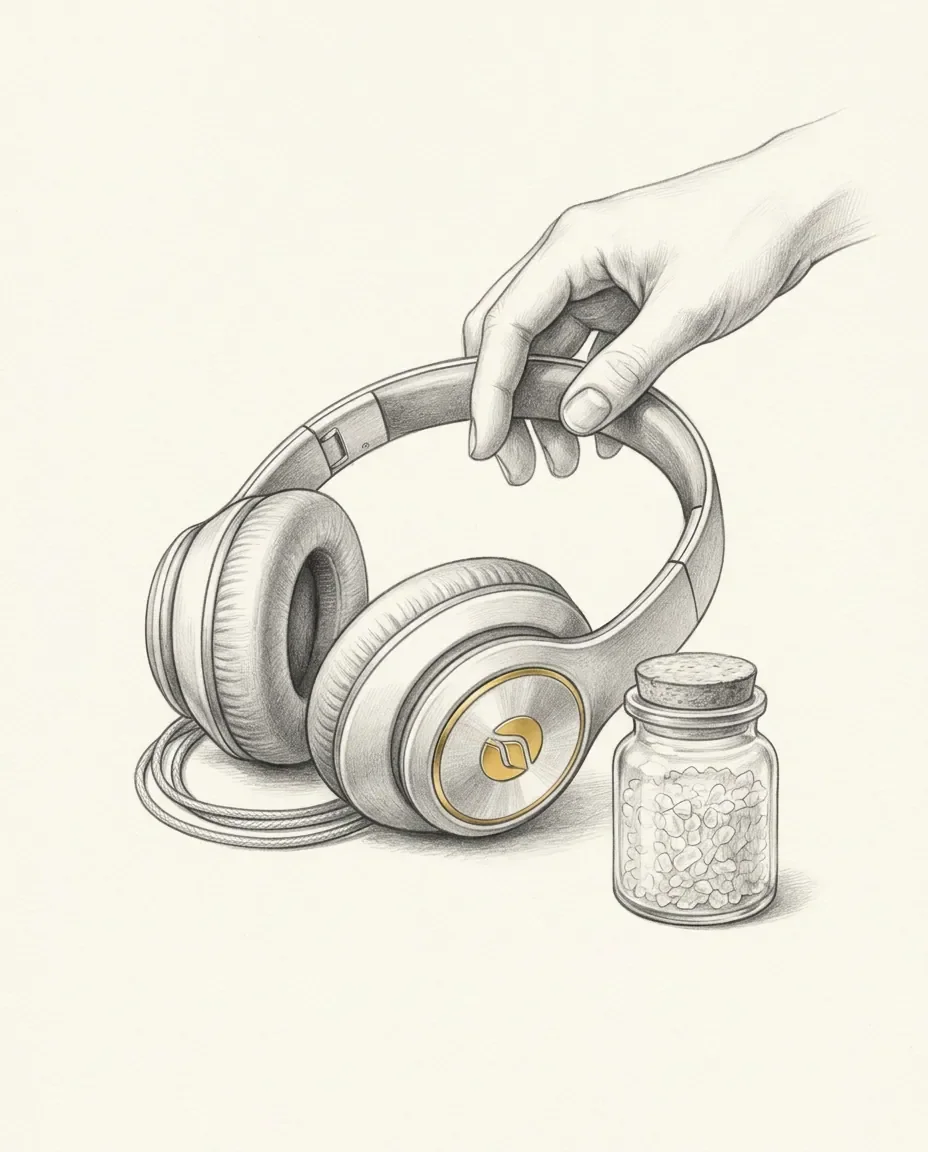
What the term covers. A blindfold or a padded sleep mask, which is where most of the practice begins and ends; earplugs, noise-cancelling headphones or white noise to remove sound; a soft hood; and being led, spoken to or touched while unable to see. It is often layered with light bondage, so that the receiver cannot simply lift the blindfold, and with sensation play or temperature play, so that a feather, a brush or a piece of ice arrives without warning. Scenes run from a couple of minutes to a staged hour, and the receiver's disorientation is the object rather than a side effect.
What the term does not cover. Its mirror image is sensory overload play, which floods the senses instead of muting them. Mummification and the vacuum bed encase the body, and claustrophilia concerns enclosure in a small space; in all three the restriction of movement is the point and any loss of input is incidental. Gag play removes speech rather than a sense, a mask fetish is about the object and the anonymity it confers, and hypnokink works by suggestion rather than by subtraction. Most importantly, anything that restricts air (a sealed hood, a gas mask, breath play) is a different and far more dangerous practice; sensory deprivation removes sight and sound and must leave the airway untouched.
How the word is used. The phrase is borrowed intact from experimental psychology, which is unusual for kink vocabulary, and it still carries that other life: a search for "sensory deprivation tank" leads to commercial flotation rather than to anything erotic. Inside the community the everyday words are "blindfolding" and "sensory play". Neither the practice nor the term appears in DSM-5-TR or ICD-11 as any kind of disorder.
History & origins
The scientific origin of the term
Unlike most kink vocabulary, "sensory deprivation" was not coined within the community. It was lifted, already formed, from mid-twentieth-century psychology.
- Early 1950s: At McGill University, the psychologist Donald O. Hebb ran a program that isolated paid volunteers from patterned sight, sound and touch, using translucent goggles, sound-damped cubicles and cardboard cuffs over the hands. The work was funded by a Canadian Defence Research Board grant amid Cold War anxiety about interrogation and "brainwashing." Volunteers were paid about twenty dollars a day, and most could not last long before restlessness and distorted perception set in.
- 1954: Hebb's students W. H. Bexton, Woodburn Heron and T. H. Scott published Effects of decreased variation in the sensory environment in the Canadian Journal of Psychology, documenting restlessness, impaired thinking and vivid hallucinations in isolated subjects. This is the study that fixed "sensory deprivation" as a scientific concept.
- 1954: Independently, the neuroscientist John C. Lilly built the first isolation (flotation) tank at the U.S. National Institute of Mental Health, suspending subjects in warm, dark, silent water to strip away stimulation. His later Epsom-salt designs seeded the recreational "floating" movement and Restricted Environmental Stimulation Therapy (REST), a rebranding that stressed the calm rather than the deprivation.
From laboratory to bedroom
The blindfold as an instrument of trust and heightened feeling is far older than any of this, appearing across ritual, theatre and folk practice long before a modern kink vocabulary existed. Contemporary adult use fuses that old erotic appeal of restricted sight with the borrowed clinical term. In present-day sexology and lay guides the practice is treated as part of the sensation play and BDSM repertoire, not as a stand-alone disorder, and it appears in neither the DSM-5-TR nor the ICD-11.
In practice
It is usually built from simple, inexpensive tools: blindfolds, hoods, earplugs, headphones playing white noise, and sometimes padded restraint. A scene can be as short as a blindfold slipped on for a moment or as involved as a longer session in which one partner narrates, touches and guides while the other has sight and sound withdrawn. It is often paired with sensation play so that muting one channel amplifies another: a feather, ice, a soft brush or gentle warmth felt with the eyes closed. Its natural counterpart is deliberate overload, explored in sensory overload play, and it is sometimes combined with electrostimulation for contrast between anticipation and sensation.
Psychology
Why do people enjoy it?
The appeal is usually described in terms of trust, surrender and presence. Removing sight or sound deepens reliance on a partner, quiets distraction and forces attention onto the body and the moment, which many find both relaxing and intense. The mechanism is part perceptual (suppressing one channel sharpens the others) and part relational (the vulnerability of not being able to see heightens intimacy and the dynamics of consensual control). Some receivers report the "floaty," altered state noted in formal restriction research. The evidence specific to erotic use is thin, and most of the psychological framing is extrapolated from the broader REST and perception literature rather than from studies of kink itself.
Prevalence & culture
How common is it?
Sensory play is one of the more accessible and widely practised kinks, helped by the everyday familiarity of the blindfold. Large fantasy surveys place its umbrella of BDSM and sensory-control interests among the very common: Justin Lehmiller's 2018 survey of 4,175 Americans found only 4% of women and 7% of men had never had a BDSM-themed fantasy, and Joyal, Cossette & Lapierre (2015) reported submission and domination themes, closely tied to trust-based restriction, to be statistically common in both sexes. Popular "A–Z of kinks" guides such as Glamour's routinely list blindfolding among the beginner-friendly practices, and it sustains large communities in kink spaces. Because it shares a name and a literature with formal sensory-restriction research, it carries more scientific context than most niche interests.
Safety, consent & law
The practice is regarded as benign between consenting adults, but it carries real cautions. Any hood or face covering must leave breathing completely unobstructed: nothing non-porous, nothing sealed at the neck, and nothing that cannot be removed in a single movement. A covering that restricts air is no longer sensory play but breath play, which carries a risk of death rather than of discomfort. Because speech or sight may be limited, partners agree a reliable non-verbal signal in advance (a dropped object, a hummed tone, a squeeze pattern), and the receiver is never left alone. Removing the senses can trigger anxiety, panic or disorientation in some people, and prolonged or intense restriction can produce the perceptual disturbances the original laboratory studies documented, so sessions are kept moderate in length and closely monitored. The same techniques, imposed rather than chosen, have been condemned as abuse: hooding and enforced isolation used in interrogation were ruled inhuman and degrading treatment by the European Court of Human Rights. Consent and reversibility are what separate the play from the harm. With those in place there are no specific legal concerns for consensual adult practice.
Common questions
Is a sensory deprivation tank the same as sensory deprivation play?
No, though they share a name and a lineage. A flotation tank is a commercial wellness product descended from John C. Lilly's 1954 isolation tank, used alone and marketed for relaxation. Sensory deprivation as a kink is a partnered practice built from blindfolds, hoods and earplugs, where the point is trust and heightened touch rather than solitude. Most people typing the phrase into a search box want the tank; in practice the two rarely overlap.
Is sensory deprivation safe?
A blindfold between consenting adults is among the lowest-risk things in kink. The risks arrive with escalation. Full hoods can obstruct breathing, trap heat and muffle a partner's voice; removing sight can trigger panic or dissociation in someone who did not expect it; and a receiver who is also restrained cannot end the scene alone. The practical rules are that nothing goes over the head that cannot come off in one movement, and the receiver is never left unattended.
Are hoods riskier than blindfolds?
Considerably. A blindfold covers the eyes and leaves the nose and mouth clear. A hood covers the whole head, so it can restrict airflow, build heat, and muffle speech at exactly the moment speech matters most. Anything non-porous (plastic, tape, latex sealed at the neck) moves the activity out of sensory play and into breath play, which carries a risk of death rather than of discomfort.
Can sensory deprivation cause hallucinations?
Prolonged deprivation can. The 1954 McGill study by Bexton, Heron and Scott documented restlessness, impaired thinking and vivid hallucinations in volunteers isolated for long stretches at a time. Erotic scenes are far shorter and rarely approach those conditions. What receivers more commonly describe is a floaty, time-distorted state, closer to the altered headspace of subspace than to anything the laboratory produced.
Why does blocking one sense make the others feel sharper?
Partly perception and partly attention. With vision suppressed there is less competing input, so touch and sound receive more processing and far more of the receiver's conscious attention. Anticipation does the rest: not knowing where the next contact will land turns an ordinary touch into an event. The effect is well described experientially and thinly researched in erotic settings specifically, with most of the evidence extrapolated from general perception studies.
How do you communicate if you cannot see or hear your partner?
By agreeing a signal before anything goes on. Because a blindfolded or hooded receiver may not see a gesture or hear a question, partners usually settle on something physical: an object held in the hand that can be dropped, a squeeze pattern, or a hummed tone if the mouth is occupied. Checking in at intervals is the other half of it, and that is the responsibility of whoever can still see.
Is sensory deprivation a disorder?
No. It appears in neither DSM-5-TR nor ICD-11, and consensual sensation play of this kind is treated in sexology as an ordinary variation. The clinical literature that shares the phrase concerns involuntary isolation rather than erotic practice. Imposed instead of chosen, the same techniques are something else entirely: hooding and enforced isolation used in interrogation have been ruled inhuman and degrading treatment.
- Sensory Overload Play29/100Sensation & PainA consensual sensation-play practice of deliberately flooding the senses with intense, layered, or competing input. Overlapping touch, temperature, sound, and light produce an overwhelming, disorienting state. It is the mirror image of sensory deprivation.29
- Electro Play39/100Sensation & PainA consensual sensation interest in which mild electrical current is used to produce tingling, buzzing, or muscle-twitching sensations on the body. It is practiced within BDSM and sensation-play communities using purpose-built or repurposed devices.39
- Claustrophilia (Confined Spaces)22/100Claustrophilia · Settings & SituationsClaustrophilia is sexual arousal or contentment from being confined in small, enclosed spaces: effectively the inverse of claustrophobia. It is an uncommon paraphilic interest that overlaps with bondage, restriction and sensory-control play.22
- Breath Play52/100Asphyxiophilia · Sensation & PainA sexual interest in restricting breathing or blood/oxygen flow to heighten arousal, ranging from light, negotiated partnered breath control. At its far end it includes solitary erotic asphyxiation. Clinically recognised as a specifier of sexual masochism and carrying a serious risk of accidental death.52
- Spread-Eagle Bondage54/100Sensation & PainA consensual bondage position in which a person's wrists and ankles are secured to four separate anchor points, holding the limbs wide apart. The body is immobilised in an open, exposed posture. It is one of the most recognisable ties in BDSM.54
- Biting Kink51/100Odaxelagnia · Sensation & PainOdaxelagnia is a consensual interest in arousal from biting or being bitten, ranging from gentle nibbling to firmer bites that may leave a temporary mark. It blends strong sensation, intimacy, and a mild element of marking, and sits at the gentle end of sensation play.51
From Latin sensus ("sense, feeling") and de-/privare ("to take away, deprive"); the phrase "sensory deprivation" was adopted from mid-20th-century experimental psychology, crystallizing with Donald Hebb's early-1950s perceptual-isolation program at McGill University and the landmark Bexton, Heron & Scott (1954) study, then borrowed by the BDSM community as a descriptive term.
sensory modulation · perceptual restriction · disorientation
Prevalence is computed from the entry's cited population estimate. Rows marked ESTare indicative editorial estimates scored against a fixed anchor rubric, not measured quantities. Method & anchors: methodology.
Common · ≈ 1 in 20
- 01Lehmiller (2018), Tell Me What You Want, survey of 4,175 AmericansBDSM/sensory-control fantasies near-universal, supporting a modest active-interest estimate
- 02An A–Z of Kinks and Fetishes, Glamourlay framing of blindfolding/sensory deprivation as a common kink
- 03FetLife, kink community group sizes (community-size proxy)community-size proxy for sensory-deprivation groups
- 04Sensory deprivation, Wikipediaorigin of the term in mid-20th-century perceptual-restriction research, including Hebb's McGill University studies and REST
- 05Bexton, Heron & Scott (1954), Effects of decreased variation in the sensory environment, PubMedlandmark 1954 McGill study documenting cognitive decline and hallucinations under sensory deprivation, establishing the concept
- 06Donald O. Hebb, WikipediaHebb as the McGill psychologist who led the early-1950s sensory-deprivation research program
- 07Isolation, Canada's Historythe Canadian Defence Research Board funded Hebb's McGill isolation experiments, paying student volunteers about twenty dollars a day, in a Cold War context of interrogation research
- 08John C. Lilly, WikipediaLilly's 1954 invention of the isolation/flotation tank at NIMH and the later recreational floating/REST movement
- 09Isolation tank, Wikipediahistory of the flotation/isolation tank and Restricted Environmental Stimulation Therapy (REST)
- 10Joyal, Cossette & Lapierre (2015), What Exactly Is an Unusual Sexual Fantasy?, PubMedsubmission and domination themes (closely tied to trust-based restriction) reported as statistically common for both sexes
- 11Diagnostic and Statistical Manual of Mental Disorders (DSM-5-TR), American Psychiatric Associationsensory deprivation is not classified as a disorder in the DSM-5-TR
- 12ICD-11, World Health Organizationsensory deprivation is not classified as a disorder in the ICD-11