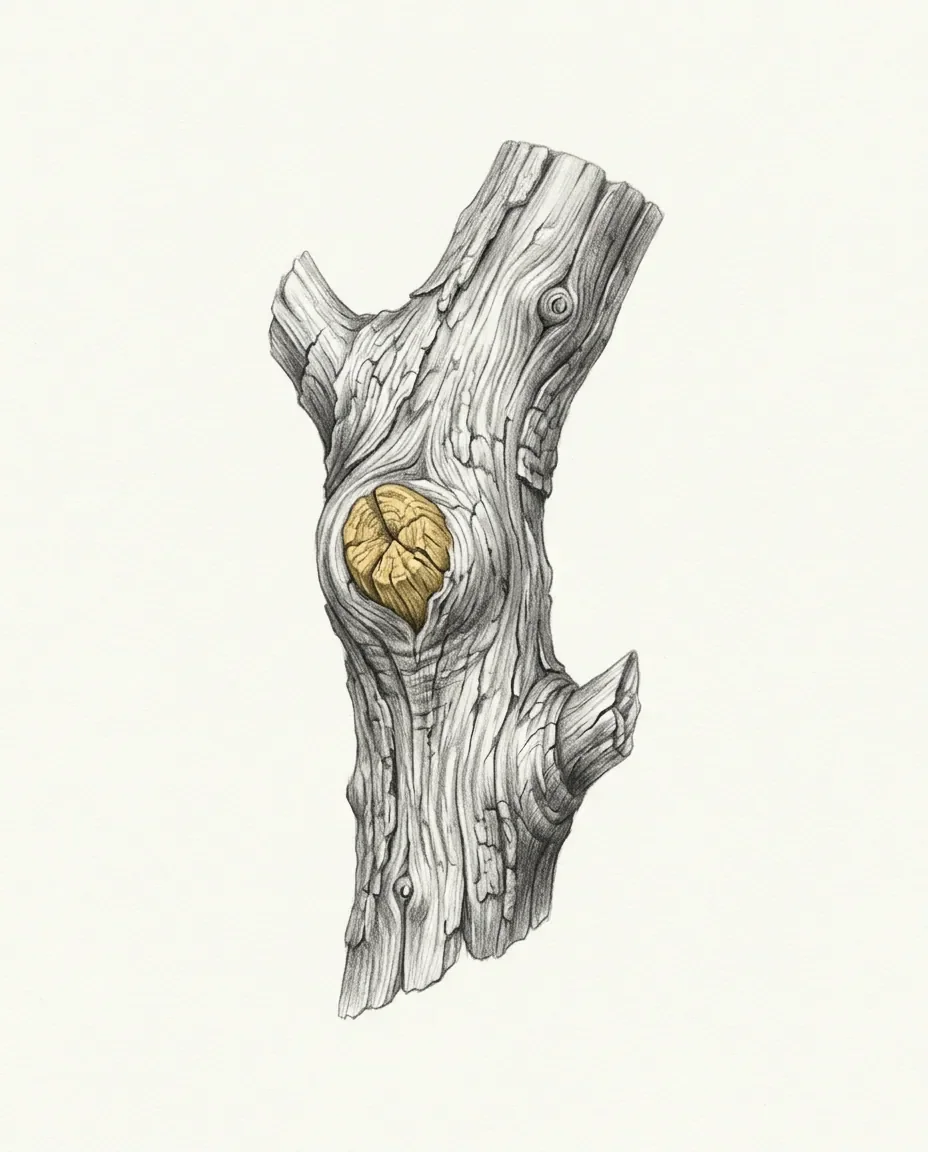
Wood Fetish
Xylophilia
Added 22 Jun 2026 · Updated 22 Aug 2026
A very rare erotic interest in wood or wooden objects valued as a material, for their grain, scent, warmth and worked surfaces. The glossary-level label "xylophilia" is obscure and ambiguous, and the interest is distinct from dendrophilia, the attraction to living trees.
- Prevalence
- Very rare
- Category
- Objects & Materials
- Clinical term
- Xylophilia
- Domain
- Sexual interest
- Confidence
- Low confidence
- Status
- Glossary-level material fetish with no dedicated clinical literature; not a defined paraphilic disorder in the DSM-5-TR or ICD-11, and benign unless it causes distress or impairment. The clinical name 'xylophilia' is obscure and ambiguous with unrelated forest-love and biological senses.
- Also known as
- xylophilia, wood fetishism, timber fetish, wooden-object fetish
- Added
- 22 Jun 2026
- Updated
- 22 Aug 2026
Overview
Wood fetish, sometimes given the pseudo-clinical name xylophilia, is a very rare material fetish in which wood or wooden objects become an erotic focus for their own sake: the grain, the weight, the scent, the warmth, the worked and polished surface. It belongs to the family of object and material fetishes alongside leather, silk, rubber and metal, where the appeal sits in the substance rather than in a person. The record here is thin, and this article is honest about that, documenting the interest at the depth the sources actually permit, which is glossary depth.
Definition & scope
The label xylophilia should be used with caution, for two reasons.
- It is obscure. It appears in popular kink glossaries, not in psychiatric literature, and has no case history behind it.
- It is a homonym. In ordinary use a xylophile is a lover of forests, woods and woodworking, an aesthetic taste with no erotic content at all. In biology the cognate adjective xylophilous describes organisms that live on or in wood, such as certain fungi and beetles (Wiktionary). Neither sense is the fetish.
Examples
What the term covers. Wood valued as a material rather than as a tool: the feel of open grain under the hand, the sheen of a planed and polished face, the smell of freshly cut timber, the weight of a block and the way it holds warmth. In the few accounts that exist the interest is private and aesthetic, a response to the substance itself, which is what places it alongside the leather, silk and metal fetishes rather than alongside anything that requires a partner.
What the term does not cover. Dendrophilia is attraction to living trees, sometimes as veneration and sometimes with the tree read as a phallic form; it is the better attested of the two terms, and the difference between a growing tree and worked timber carries most of the distance between them. Object sexuality is romantic or sexual attachment to a particular object as a partner, which is a relationship rather than a material preference. Using a wooden paddle or cane is impact play or spanking: there the implement's function carries the charge and the material is largely incidental. And the two non-erotic senses of the word noted above (the forest-lover and the biological xylophilous) are not this at all.
How the word is used. "Wood fetish" is plain English; "xylophilia" is a glossary label with a clinical shape and no clinical standing, defined simply as sexual attraction to wood in lists such as TherapyRoute's. It appears in no diagnostic manual and in no case report. This catalog names the entry in English first for exactly that reason.
History & origins
Feet, hair and leather were singled out in the founding sexological catalogues. Wood was not, so what follows is the history of a label rather than of a documented clinical phenomenon.
Clinical lineage
- 1886: Richard von Krafft-Ebing's Psychopathia Sexualis establishes the modern vocabulary for cataloguing sexual interests and popularises the Greek-derived -philia convention that later produces "xylophilia". Krafft-Ebing discusses object- and material-directed fetishism in general terms, but wood is not a target anywhere in his case material.
- Twentieth century onward: no coiner, no first case, no clinical pedigree. Xylophilia in its fetish sense is absent from the DSM-5-TR and the ICD-11 as a named disorder.
- Present day: the term survives in online lists and crowd-sourced dictionaries, for instance TherapyRoute's list of paraphilias, which defines it simply as sexual attraction to wood.
Distinction from dendrophilia
Wood fetishism is not dendrophilia, which is the better-attested of the two terms. Dendrophilia is attraction to living trees, sometimes as veneration and sometimes with the tree read as a phallic form; reference accounts trace it through Raymond Corsini's Dictionary of Psychology (1999), Brenda Love's Encyclopedia of Unusual Sex Practices (1992) and Thomas Gregor's ethnography Anxious Pleasures (1987). Xylophilia centres instead on wood as an inert, worked material. Trees are alive; timber is not, and that difference carries most of the distance between the two interests. Both sit inside the wider field of object sexuality and material fetishism.
In practice
Reported expression is private and aesthetic: the texture of grain under the hand, the polish of a finished surface, the smell of freshly cut timber, the weight and temperature of a wooden object. There is no scene, no organised community and no commercial culture built around it, and the interest is known chiefly as a catalogue entry rather than through observed behaviour. Its internal logic parallels the better-documented leather, silk and metal fetishes, where arousal attaches to a substance's surface, temperature and feel rather than to what the object is for.
Psychology
What causes it?
No causal account has been established for this interest specifically, and honesty requires saying so. The general framework offered for material fetishes is the closest available: associative conditioning between a material and arousal, the sensory salience of a substance with a strong tactile and olfactory signature, and the symbolic weight natural materials carry. Where object-directed attraction has been studied at all, it is under the heading of object sexuality, and the fieldwork is small. Amy Marsh's 2010 survey of objectum sexuals drew twenty-one respondents from a community of about forty and led her to treat object sexuality as an orientation rather than a paraphilia. Nothing in that literature is wood-specific. Any psychological story told about xylophilia is extrapolation.
Prevalence & culture
How common is it?
Vanishingly rare, and not separately measured. The nearest usable figure comes from Scorolli and colleagues (2007), whose internet study of at least 5,000 fetishists found that preferences for objects unrelated to the body accounted for about 5% of the total, the smallest of their six categories, and wood would be one target among many inside that slice. Joyal, Cossette and Lapierre (2015) likewise place object- and material-directed fantasies among the statistically unusual interests in a general population sample. A wood-specific variant falls well below even those baselines. Cultural visibility is close to nil: the interest appears in lists of fetishes and almost nowhere else.
Safety, consent & law
The interest involves an inert, ordinary material and consenting adults. It raises no consent question and no legal question. The practical cautions are the everyday ones of handling wood (splinters, sharp edges, surface finishes and chemical treatments) and are features of the material, not of the interest. It is a benign and very uncommon material preference, of clinical relevance only in the standard case where an interest causes genuine distress or impairment.
Common questions
What is the difference between a wood fetish and dendrophilia?
Dendrophilia is attraction to living trees and plants; a wood fetish attaches to timber as a worked, inert material: grain, polish, scent, weight. Trees are alive and wood is not, and that difference carries most of the distance between the two. Dendrophilia also has much the better paper trail, appearing in Corsini's Dictionary of Psychology (1999), Brenda Love's 1992 encyclopedia and Gregor's ethnography Anxious Pleasures (1987); xylophilia has none of that.
Does xylophilia mean a wood fetish?
Only in one of its senses, which is why the label is unhelpful. In ordinary use a xylophile is a lover of forests, woods and woodworking, with no erotic content whatever, and in biology xylophilous describes organisms that live on or in wood, such as certain fungi and beetles. The fetish sense appears only in popular kink glossaries, and nothing in the word itself distinguishes the three.
Is a wood fetish a paraphilia or a disorder?
No. It is not a named disorder in the DSM-5-TR or the ICD-11, and material fetishes of this kind are benign between consenting adults. The standard clinical threshold applies and is rarely met: an interest matters clinically only when it causes the person genuine distress or impairment, or involves someone who has not consented. An inert material does neither on its own.
Is liking a wooden paddle or cane a wood fetish?
Usually not. In impact play and spanking an implement is chosen for what it does (the sting of a thin cane, the thud of a broad paddle) and could as easily be leather or acrylic without changing the scene. A wood fetish is the reverse: the material itself is the draw and the object's purpose is secondary. The test is whether the wood would still matter if it did nothing.
Is a material fetish the same as object sexuality?
No. Object sexuality is attachment to a specific object as a partner, with a relationship attached to it; Amy Marsh's 2010 survey of twenty-one respondents led her to treat it as an orientation rather than a paraphilia. A material fetish is a response to a substance in general (any wood, any leather) rather than to one particular thing.
Are there safety concerns with a wood fetish?
Only the ones that come with the material. Splinters and sharp edges are the obvious hazards, and most manufactured timber carries surface finishes, stains or chemical treatments that were never intended for prolonged skin contact. If a wooden object is used on the body, a smooth, sealed, well-finished surface is the practical requirement. None of that is specific to the interest; it is simply what handling wood involves.
- Dendrophilia (Trees & Plants)11/100Dendrophilia · Clinical ParaphiliasDendrophilia is a very rare interest in which trees and plants become the focus of sexual, romantic or reverential feeling. It is usually grouped with object-sexuality (objectophilia), has no dedicated clinical literature, and is not a disorder unless it causes distress or impairment.11
- Object Sexuality17/100Objectophilia · Objects & MaterialsObject sexuality (objectophilia, objectum sexuality, OS) is a romantic and sometimes sexual attraction directed at specific inanimate objects or structures. Those who identify with it describe committed, often reciprocal-feeling love for one particular object rather than a generic interest in things.17
- Leather Fetish65/100Leather fetishism · Objects & MaterialsAn erotic attraction to leather as a material: its look, smell, creak, shine, and feel when worn. It overlaps strongly with BDSM gear and is bound up with a recognised, organised leather subculture with its own bars, codes, and titles.65
- Silk Fetish34/100Objects & MaterialsAn erotic attraction to silk, centred on its smooth, soft, cool tactile feel and luminous drape. It is a soft-textile material interest within the broad family of fabric fetishisms rather than a separately defined clinical paraphilia.34
- Metal Fetish25/100Metallophilia · Objects & MaterialsAn erotic attraction to metal materials (chains, chrome, polished steel, cuffs and collars) drawn from their hardness, coolness and weight. Their sound and mirror-like shine are part of the appeal too. A material/texture fetish that frequently overlaps with BDSM gear and restraint aesthetics.25
- Hierophilia (Sacred Objects)10/100Hierophilia · Objects & MaterialsHierophilia is a rare paraphilic interest in which sexual arousal attaches to sacred, religious, or ritual objects and imagery. Vestments, icons, rosaries and ritual implements are typical. The charge comes from the symbolic and taboo weight of the holy, not from the items as ordinary things.10
From Ancient Greek xylon (ξύλον, “wood”) + -philia (“love, attraction”), literally “love of wood”, following the -philia naming convention popularised by Krafft-Ebing's Psychopathia Sexualis (1886). The same roots give the homonyms “xylophile” (a lover of forests and woodworking) and the biological adjective “xylophilous” (of organisms living on or in wood), neither of which carries the fetish sense. No coiner or first use is documented for the erotic meaning.
material fetish · natural materials · objectophilia
Prevalence is computed from the entry's cited population estimate. Rows marked ESTare indicative editorial estimates scored against a fixed anchor rubric, not measured quantities. Method & anchors: methodology.
Very rare · fewer than 1 in 10,000
- 01List of paraphilias, Wikipediaplaces wood/material-directed interests within the broad catalogue of object-focused paraphilias and the -philia naming convention
- 02Uncommon Sexual Interests: A Guide to and Comprehensive List of Paraphilias, TherapyRouteglossary-level definition of xylophilia as 'sexual attraction to wood', and dendrophilia as 'sexual attraction to trees', establishing the distinction
- 03xylophilous, Wiktionarythe biological homonym: 'xylophilous' means living on or in wood (e.g. some fungi and beetles), distinct from the fetish sense
- 04Xylophilous, Merriam-Websterdictionary confirmation of the non-erotic biological sense of the xylo- + -philous root pair
- 05Joyal, Cossette & Lapierre (2015), What Exactly Is an Unusual Sexual Fantasy?, J. Sexual Medicine 12(2):328-340general-population context placing object/material-directed fantasies among statistically rare and atypical interests, far below which a wood-specific variant falls
- 06Scorolli C, Ghirlanda S, Enquist M, et al. (2007), Relative prevalence of different fetishes, Int J Impot Res 19:432-437internet study of at least 5,000 fetishists: preferences for objects unrelated to the body were the smallest category at about 5%, the bracket into which a wood fetish would fall
- 07Marsh, A. (2010), Love among the objectum sexuals, Electronic Journal of Human Sexuality 13the only survey work on object-directed attraction (21 respondents from OS Internationale), and its conclusion treating object sexuality as an orientation rather than a paraphilia
- 08Psychopathia Sexualis, WikipediaKrafft-Ebing (1886) popularised the -philia naming convention behind 'xylophilia' and catalogued object/material fetishism in general terms, though wood was never a specific target
- 09Dendrophilia (paraphilia), Wikipediathe better-attested attraction to living trees, citing Corsini's Dictionary of Psychology (1999), Brenda Love's Encyclopedia of Unusual Sex Practices (1992) and Gregor's Anxious Pleasures (1987), distinguishing it from wood-as-material xylophilia
- 10Paraphilia, Wikipediaxylophilia is not a named disorder in the DSM-5-TR or ICD-11; object-directed material interests are benign unless they cause distress or impairment