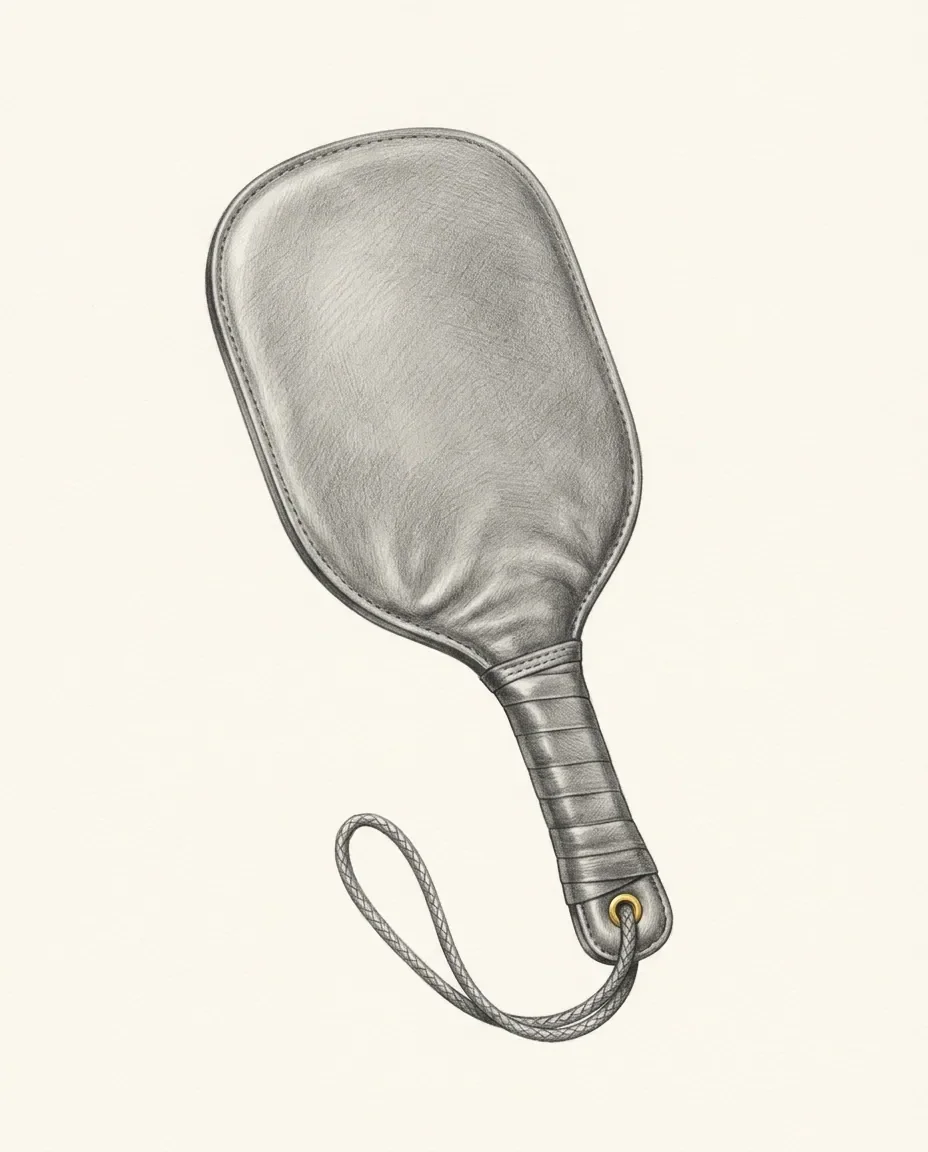
Impact Play
Added 21 Jun 2026 · Updated 7 Sep 2026
An umbrella term for consensual BDSM activities in which one partner strikes another's body with a hand or implement for erotic sensation or power exchange. It spans light spanking through to firmer use of paddles, floggers, crops, and canes within negotiated limits.
- Prevalence
- Ultra-common
- Category
- Sensation & Pain
- Domain
- Sexual interest
- Confidence
- Medium confidence
- Status
- Consensual BDSM impact play, a benign variation in consenting adults; a disorder only with distress or a non-consenting person.
- Also known as
- erotic spanking, striking play, percussion play
- Added
- 21 Jun 2026
- Updated
- 7 Sep 2026
Featured in
Overview
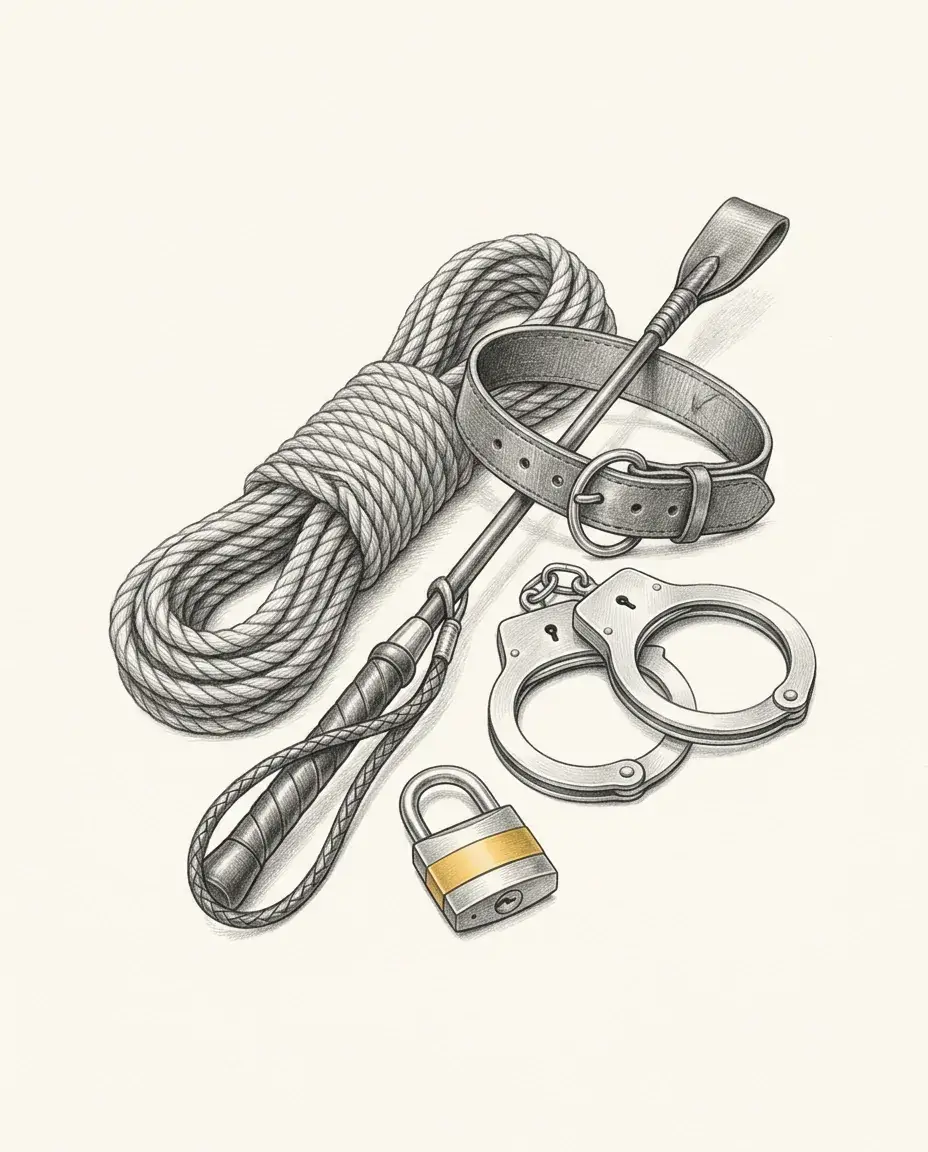
Impact play is an umbrella term for consensual BDSM practices in which one partner strikes another's body, by hand or with an implement, to produce erotic sensation, sensation contrast, and a power-exchange dynamic. It overlaps closely with broader pain play and sensation play, and ranges from light, playful spanking to firmer use of paddles, floggers, crops, and canes, all within negotiated limits. It is one of the most accessible and widely practised forms of kink, and for many people the first they try.
Examples
What the term covers. The open hand, as in spanking; leather or wooden paddles; multi-tail floggers; riding crops; rattan canes and switches; and the belt or hairbrush of a domestic discipline dynamic. The range of occasion is as wide as the range of implements: a few playful swats folded into otherwise ordinary sex sits under the same heading as an hour-long negotiated scene with agreed implements, target zones, a safeword and planned aftercare. The delivery, a strike, makes something impact play; intensity, formality and the dynamic around it vary.
What it does not cover. Intense sensation produced by other means belongs elsewhere: wax play, needle play, figging and electro play are not impact, and the lighter textures of sensation play sit at the opposite end of the same interest. Pain play, clinically algolagnia, is the wider umbrella of which impact is one route. Masochism and sadism name diagnostic categories rather than activities, and describe a person's pattern of arousal, not what happens in a scene.
How the word is used. It is community jargon of the 1990s onward; no clinical text coined it, and it appears in no diagnostic manual: DSM-5-TR and ICD-11 name only sexual masochism and sadism disorder, and only where distress, impairment or a non-consenting person is involved. In conversation people rarely use the umbrella at all; they name the implement, as in "a caning scene" or "we were flogging". "Impact play" earns its keep in classes, checklists and negotiation, where one word for everything that lands as a blow is what is needed.
History & origins
Pre-clinical and cultural roots
The erotic charge of striking the body is documented far back in cultural history, predating any clinical vocabulary. Depictions of erotic flagellation survive from antiquity, the Etruscan Tomb of the Whipping (roughly 5th century BC) is a widely cited example, and references appear in the Roman satirists Juvenal and Petronius. In the early-modern period flagellation for arousal recurs in libertine literature; John Cleland's Fanny Hill (1748) contains well-known scenes, and London's so-called "flogging schools" appear in print in the late seventeenth century. By the Victorian era, spanking and flagellation imagery circulated widely in erotic engravings and novellas, sometimes nicknamed le vice anglais ("the English vice").
Clinical lineage
The medical framing arrived in the late nineteenth century. Richard von Krafft-Ebing catalogued flagellation and the desire to give or receive blows within his accounts of sadism and masochism in Psychopathia Sexualis (1886): the work that coined both terms, masochism after the novelist Leopold von Sacher-Masoch and sadism after the Marquis de Sade. Havelock Ellis treated the same territory under "algolagnia" in his Studies in the Psychology of Sex, and Sigmund Freud examined beating fantasies in his 1919 paper A Child Is Being Beaten. These early authors pathologised what they observed. Over the twentieth century clinicians withdrew the diagnosis from the consensual end of the spectrum, and today the DSM-5-TR (2022) and the ICD-11 classify sexual masochism and sadism as disorders only when they cause distress, impairment, or harm to a non-consenting person.
Cultural & subcultural evolution
- Late 19th–early 20th c.: flagellation imagery is a staple of the underground erotic press, and the clinical terms enter the cultural vocabulary.
- Post-1945: modern BDSM technique is codified within the organised leather subcultures that grew up in urban centres such as San Francisco, where flogging, paddling, and spanking became structured club practices shaped by motorcycle and military aesthetics.
- 1990s onward: "impact play" itself emerges as a modern umbrella label within these communities, grouping spanking, flogging, paddling, and caning under one heading. The phrase is a community coinage with no documented originator.
- 2010s: mainstream visibility surges with the Fifty Shades of Grey phenomenon and a large online how-to and educational culture.
In practice, how the interest is typically expressed
A negotiated scene fixes the implements, intensity, target areas, and signals in advance. Strikes go to well-padded regions such as the buttocks and the upper back below the shoulder blades; according to Wikipedia's summary of practitioner guidance, practitioners avoid bony areas, joints, the spine, the kidneys, the tailbone, the neck, and the head. They warm up gradually, escalating from light contact to firmer strokes, and sort implements by the sensation they produce: broad, heavy tools (the open hand, leather paddles, multi-tail floggers) give a deep, dull "thuddy" sensation, while narrow, fast tools (canes, crops, single-tail whips) give a sharp "stingy" one. A recognised hazard of flexible implements is "wrapping," in which the tip lands off-target. This overview is non-explicit and carries no instruction.
Psychology
The appeal combines several proposed mechanisms: endorphin- and stress-response-driven pain processing, a heightened present-moment focus sometimes described as a flow or "subspace" state, trust and surrender, and the symbolic charge of discipline or control. For many participants the central experience is the headspace and the relational dynamic, with pain as the route to them; interview research with practitioners of masochism and submission emphasises meaning, role, and connection as much as sensation (Brown et al., 2020). The evidence base on causation remains thin and descriptive, and no single developmental account is established. Clinicians treat the interest in consenting adults as a benign variation.
Prevalence & culture
Impact-style interests are among the most commonly reported in kink research. In the Quebec general-population survey by Joyal & Carpentier (2017), 23.8% of respondents reported having engaged in sexual masochistic behaviour and 7.1% in sadistic behaviour at least once: rates too high for masochism to count as statistically unusual. In Justin Lehmiller's survey of 4,175 Americans reported in Tell Me What You Want (2018), BDSM fantasies were near-universal, with about 65% having fantasised about receiving pain and about 60% about inflicting it. Earlier work by Joyal, Cossette & Lapierre (2015) likewise found masochistic fantasy far too common to be called atypical. Impact play is visible in mainstream media and lifestyle writing and has an extensive instructional and community presence (FetLife, dedicated subreddits, in-person munches and workshops), which makes it one of the better-documented areas of consensual kink.
Safety, consent & law
Between consenting adults, impact play is legal in most contexts, and practitioners approach it as risk-aware practice. Safe technique avoids bones, joints, the spine, the kidneys, and the head; intensity is negotiated and escalated gradually; and safewords plus aftercare are standard, with attention to bruising, broken skin, and circulation. Consent must be informed and revocable. Striking a non-consenting person is assault, and in some jurisdictions, following lines of authority such as the United Kingdom's R v Brown, consent may not be a legal defence to the infliction of serious bodily harm even between willing adults.
Common questions
Is impact play the same thing as BDSM?
No. It is one activity within it. BDSM covers bondage, discipline, dominance and submission, and sadomasochism; impact play is the striking subset, and it can be practised with no power dynamic at all, for sensation alone. It is often someone's first experience of kink, which is why the two get conflated. Much of BDSM involves no striking.
Does impact play have to hurt?
No. Intensity is a dial, and a great deal of impact play is practised at levels that read as warmth, pressure or rhythm. When Brown and colleagues (2020) interviewed practitioners about the appeal, what came back was headspace, trust and the relational dynamic at least as much as sensation. People who want the harder end arrive there over time and by agreement.
How do you try impact play for the first time?
The standard advice is to start with the hand, agree a safeword and what is off-limits before anything begins, stay on the buttocks, build up gradually from light contact, and check in out loud. Stopping early costs nothing; a scene that went further than someone wanted cannot be undone. Plan aftercare as part of it.
Why are some parts of the body off-limits?
Because they have no muscle padding over something that matters. The kidneys sit high in the lower back with little protection; the spine, tailbone, joints, neck and head can be injured by force that a well-padded area absorbs harmlessly. The buttocks and the upper back below the shoulder blades are the standard targets for that reason, and flexible implements need extra care because the tip can wrap around onto an unintended area.
Is bruising normal after impact play?
Marks are common at moderate intensities and fade like any other bruise; people vary a great deal in how easily they mark, and it is a poor proxy for how hard a scene was. What warrants attention is broken skin, swelling that keeps growing, numbness, or marks over the kidneys or spine. Anyone on blood thinners or with a clotting condition should treat bruising as a reason to keep intensity low.
Does enjoying impact play mean something is wrong with me?
No. No developmental or trauma-based account of the interest is established, and the descriptive evidence is thin enough that nobody can claim one. It is also far too widely reported in general-population surveys for a pathology explanation to be plausible as a general rule. In consenting adults it is treated as a benign variation, and clinicians only take an interest where there is distress, impairment or a non-consenting person.
What is subspace, and why do people talk about aftercare so much?
Subspace is the altered, sometimes euphoric or floaty headspace that a receiving partner can enter during an intense scene. It can be followed by subdrop, a low mood in the hours or days afterwards as the physiological response settles. Aftercare (warmth, food, reassurance, quiet company) is the standard practice for landing from that, and it applies to the person giving the strikes as well.
From the blog
Origins7 min read
Why some people enjoy pain, and what the body does when they do
Why do people enjoy pain? Context can flip moderate pain to pleasant, and BDSM scenes raise cortisol and endocannabinoids in the partner receiving.

Definitions8 min read
What BDSM stands for, and what it covers
What does BDSM stand for? Bondage and discipline, dominance and submission, sadism and masochism: what each pair means, how common it is, where the lines are.
How common7 min read
The most common kinks, ranked by what the surveys found
The most common kinks, ranked by evidence: dominance and submission, bondage, foot fetish, roleplay and voyeurism lead 474 entries, read tier by tier.
- Spanking78/100Sensation & PainAn interest in giving or receiving consensual, rhythmic blows to fleshy areas of the body, by hand or with implements such as paddles. People do it for erotic sensation, discipline themes, or power exchange between consenting adults.78
- Flogging60/100Sensation & PainConsensual impact play in which one partner strikes another's body with a multi-tailed flogger, whip, or single-tail. The rhythmic sensation ranges from a broad "thuddy" impact to a sharp, stinging line. It is a common, negotiated element of BDSM sensation play.60
- Caning48/100Sensation & PainConsensual impact play using a thin, flexible rod such as a rattan cane or switch to deliver sharp, stinging strokes. It is a focused subset of BDSM impact play known for an intense, lingering sensation and carries higher injury risk than padded implements.48
- Pain Play58/100Algolagnia · Sensation & PainPain play (algolagnia) is a clinical umbrella term for sexual arousal connected to physical pain, whether that pain is received or inflicted. The received form is labelled active/masochistic, the inflicted form passive/sadistic. It frames pain itself, not any specific implement, as the source of erotic interest.58
- Sensation Play45/100Sensation & PainAn interest in heightened, varied skin sensations created with soft, textured, or lightly stimulating implements. Feathers, fur, silk, brushes, ice, or pinwheels are typical, often combined with anticipation and the contrast between soothing and prickling touch. It is a common, gentle form of erotic play.45
- Choking Kink78/100Sensation & PainA consensual interest in choking or being choked at the neck during sex: usually as a gesture of dominance, surrender, or intensity. Clinically termed sexual choking or strangulation, it is now common among young adults and carries serious, sometimes hidden, physical risk.78
A plain descriptive English compound of "impact" (via Latin *impactus*, "struck against," from *impingere*, "to strike against") and "play." It is a modern community umbrella term grouping spanking, flogging, paddling, and caning, with no separate clinical coinage.
impact · striking · umbrella-category
Prevalence is computed from the entry's cited population estimate. Rows marked ESTare indicative editorial estimates scored against a fixed anchor rubric, not measured quantities. Method & anchors: methodology.
Ultra-common · ≈ 1 in 5 or more
- 01Erotic spanking, Wikipediadefinition of consensual striking for erotic sensation and its place within BDSM impact play
- 02Impact play, Wikipediadefinition, implement categories (thuddy vs stingy), target body areas and avoided zones, the wrapping hazard, and historical antecedents (Tomb of the Whipping, Fanny Hill, flogging schools)
- 03Joyal & Carpentier (2017), The Prevalence of Paraphilic Interests and Behaviors in the General Population, J. Sex Research 54(2):161-171general-population behaviour rates of 23.8% masochism and 7.1% sadism, supporting impact play as a common kink
- 04Joyal, Cossette & Lapierre (2015), What Exactly Is an Unusual Sexual Fantasy?, J. Sexual Medicine 12(2):328-340masochistic fantasy is too common in the general population to be considered atypical
- 05Lehmiller (2018), Tell Me What You Want, survey of 4,175 AmericansBDSM fantasies near-universal; ~65% fantasised about receiving pain and ~60% about inflicting it
- 06Krafft-Ebing, Psychopathia Sexualis (1886), Wikipediaearly clinical cataloguing of flagellation and the coinage of sadism and masochism, the historical lineage of consensual impact play
- 07Richard von Krafft-Ebing, Wikipediabiographical and clinical context for the late-19th-century medical framing of flagellation, sadism and masochism
- 08Havelock Ellis, WikipediaEllis's treatment of algolagnia in Studies in the Psychology of Sex
- 09Freud, 'A Child is Being Beaten' (1919), Standard Edition vol. 17:175, PEP-WebFreud's 1919 paper on beating fantasies, part of the clinical lineage of impact-style interests
- 10Sigmund Freud, Wikipediabiographical context for Freud's analysis of beating fantasies
- 11Fanny Hill, Wikipediaearly-modern literary depiction of flagellation for arousal (1748)
- 12Fifty Shades of Grey, Wikipedia2010s mainstream cultural visibility of consensual BDSM and impact play
- 13Brown et al. (2020), What Is So Appealing About Being Spanked, Flogged, Dominated, or Restrained?, J. Sex Researchpractitioner accounts emphasising meaning, role, connection and headspace over pain in isolation
- 14DSM-5-TR, Paraphilic Disorders (American Psychiatric Association, 2022)sexual masochism/sadism classed as disorders only with distress, impairment or harm to others
- 15ICD-11, Paraphilic disorders (World Health Organization)depathologisation of consensual sadism/masochism in modern nosology