Silk Fetish
Added 21 Jun 2026 · Updated 22 Aug 2026
An erotic attraction to silk, centred on its smooth, soft, cool tactile feel and luminous drape. It is a soft-textile material interest within the broad family of fabric fetishisms rather than a separately defined clinical paraphilia.
- Prevalence
- Uncommon
- Category
- Objects & Materials
- Domain
- Sexual interest
- Confidence
- Low confidence
- Status
- Soft-material sensory interest; not a recognized paraphilia. Benign common-spectrum preference.
- Also known as
- silk fetishism, silkiness fetish, silk material fetish
- Added
- 21 Jun 2026
- Updated
- 22 Aug 2026
Featured in
Overview
Silk fetishism is a sensory-led erotic interest in which the fabric itself (its slip, coolness, and luminous drape) becomes a focus of arousal. The appeal is largely tactile: the way silk glides over skin, its faint sheen catching the light, and its long-standing cultural aura of luxury and refinement. It belongs to the broad family of soft-textile material fetishisms rather than constituting a separate clinical condition, and this article traces how that family was first described, how silk earned its particular sensual prestige, and what is known about the interest's psychology and prevalence.
Examples
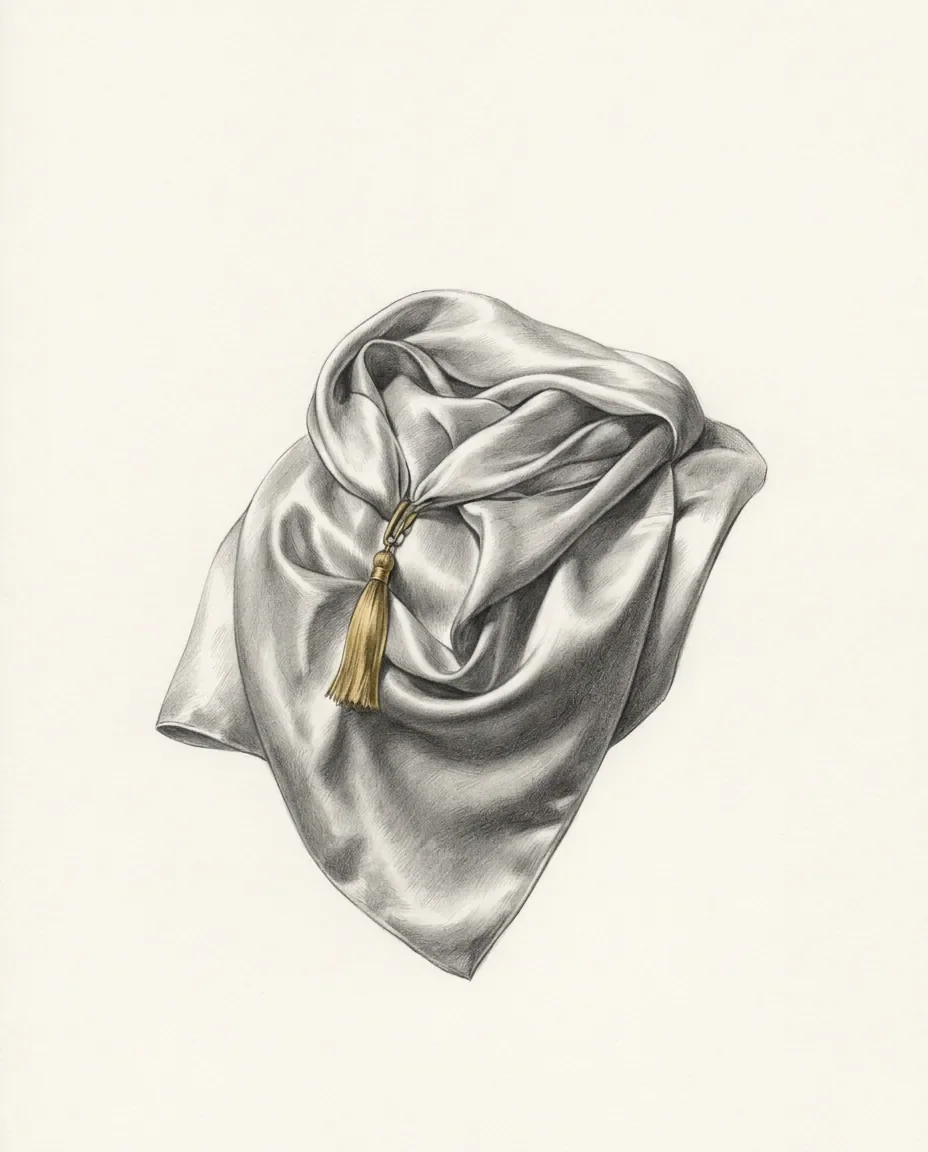
What the interest covers. In practice it is a texture before it is a garment. The cues people describe are the cool slip of a silk scarf drawn across skin, the weight and swing of a charmeuse robe, the quiet sound the cloth makes as it moves, the feel of a silk-lined sleeve going on, and bedding that slides rather than grips. Some people are drawn to silk worn by a partner, some to wearing it themselves, and many to both; for a good share of them the material matters more than the item, so a scarf, a slip, a lining and a pillowcase all register as the same cue.
What it does not cover. It is not a satin interest: satin names a weave rather than a fibre, and most satin sold today is polyester, which a silk-specific enthusiast can usually tell apart by hand. It is not the tight, occlusive appeal of latex, spandex or nylon, where the sensation is compression and encasement rather than cool slip, nor the openwork visual interest of lace, nor the warm fuzz of wool and fur. Where the garment rather than the cloth is the point, lingerie fetish is the closer term; where the pleasure of the texture is not sexual at all, it is texture fixation.
How the word is used. "Silk fetish" is everyday vernacular and appears in no diagnostic manual under its own name. DSM-5-TR's fetishistic disorder and its ICD-11 counterpart are defined by the distress, impairment or harm an interest causes, never by the material involved, so no fabric is a diagnosis in itself.
History & origins
The fabric and its prestige
Silk's erotic coding is inseparable from its history as a rare luxury. Woven from the protein filament a silkworm spins for its cocoon, sericulture is traditionally dated in China to around 2700 BCE, with the earliest surviving woven silk fragment dated to about 3630 BCE from a Yangshao-culture site, where it wrapped a child's body. For roughly three millennia the technique was a guarded imperial secret; silk became one of China's principal exports under the Han dynasty and travelled west along the trans-Asian caravan routes later named the Silk Road, reaching Rome as a costly exotic. The monopoly finally broke in 552 CE, when, by Procopius's account, two Nestorian monks smuggled silkworm eggs to the emperor Justinian hidden in hollow canes, seeding a Byzantine silk industry. Sericulture had already spread to Korea, Japan and India before that. This long association with rarity, refinement and the body of the wearer is the cultural substrate on which the modern sensory interest sits.
Clinical lineage
Material and textile attractions entered sexology among the earliest documented fetishisms. Richard von Krafft-Ebing's Psychopathia Sexualis (1886) catalogued arousal attached to specific fabrics and garments, while the French psychologist Alfred Binet adapted fétichisme into an erotic sense in his 1887 essay Le fétichisme dans l'amour, arguing that such interests form through early associative learning, an emotionally charged early encounter with the object becoming a durable arousal cue. The chronology is roughly:
- 1886: Krafft-Ebing documents fabric and garment fetishism in Psychopathia Sexualis.
- 1887: Binet frames fetishism as a learned association, naming fine textiles among typical objects.
- Early 1900s: Havelock Ellis, in his Studies in the Psychology of Sex, treats fabric attractions as ordinary variations of sensory taste rather than disease.
- DSM-5-TR (2022) / ICD-11: neither manual lists any single fabric as a disorder; fetishism is clinically relevant only where it causes distress, impairment, or harm.
Silk has no separately documented coinage of its own; it has simply always been a prized exemplar within the smooth-fabric category, alongside satin and nylon, owing to its rarity and sensory distinctiveness.
Where silk sits among fabrics
Clinical case series have long sorted fabric fetishes by material. A frequently cited 1983 review of 48 fetishism cases found clothing involved in about 58%, rubber in roughly 23%, footwear and body parts around 15% each, leather about 10%, and "soft materials or fabrics" in about 6%, placing silky textiles as a real but minority focus relative to the rubber/leather scenes. Silk's appeal is distinguished from those by being soft and cool rather than tight and occlusive.
In practice
The interest is typically expressed through silk garments, scarves, robes, sheets, gloves, or linings, worn by oneself or a partner, and through gentle contact of the fabric against the skin. For many enthusiasts it blends into a wider appreciation of any smooth, fine cloth, with the texture itself, rather than a particular garment, being the salient cue. It frequently coexists with related smooth-material interests such as spandex.
Psychology
Soft-material interests are usually explained through sensory conditioning: pleasurable early associations with fine fabric become eroticised, and the smoothness functions as a learned arousal cue, consistent with Binet's associative model. The comforting, soothing quality of silk and its connotations of intimacy and luxury reinforce the response. The evidence base specific to silk is thin and largely anecdotal; most theorising generalises from the broader literature on fabric and clothing fetishism rather than from dedicated study.
Prevalence & culture
How common is a silk fetish?
Survey work on fetishism places textile and material interests well below the dominant body-part and footwear categories. Scorolli and colleagues' 2007 analysis of online fetish communities found legwear and footwear at the top of the clothing rankings, with whole-body and other fabric interests trailing. Broad fetishistic interest, meanwhile, is common in the general population: Joyal and Carpentier (2017) surveyed 1,040 adults in Quebec and found interest in fetishism reported by well over the 15.9% "statistically unusual" threshold, so a preference for a single smooth fabric like silk is a small slice of a widespread taste. Silk-specific communities are small relative to the latex or leather scenes, though silk's strong cultural coding as sensual and luxurious gives it steady mainstream visibility in fashion, advertising and lingerie.
Safety, consent & law
The interest is consensual and lawful, and there is nothing hazardous about the material itself beyond the ordinary care any fine garment requires. One caution is worth stating plainly, because silk invites it: scarves and other silk lengths make poor restraints. The cloth is slippery and tightens under load, knots pull down hard and are difficult to release quickly, and it resists cutting, which is why standard bondage guidance is to use material designed for the purpose and to keep safety shears within reach. Nothing should be tied around a partner's neck.
Common questions
Is it normal to be turned on by silk?
Yes, in the sense that fabric and material interests are ordinary and widely reported. Joyal and Carpentier's 2017 survey of 1,040 adults in Quebec found interest in fetishism well above the threshold the authors used to mark an interest as statistically unusual, so a preference for one smooth cloth sits inside a broad and unremarkable taste rather than outside it.
Is a silk fetish a disorder?
No. DSM-5-TR's fetishistic disorder and its ICD-11 counterpart are defined by consequences rather than by objects: an interest qualifies only where it causes marked distress or impairment, or involves a person who has not consented. Neither manual lists any fabric. A preference for silk that a person enjoys, and can set aside, is not a clinical matter under either system.
Why does silk feel the way it does?
The fibre is a long, fine, almost perfectly smooth protein filament, so a woven silk surface has very little to catch on skin; that is the slip. It also carries heat away from the body readily, which is why silk reads as cool on first contact and then warms to the wearer. The faint sheen comes from the filament's roughly triangular cross-section, which reflects light unevenly.
Can you tell real silk from polyester satin by touch?
Many enthusiasts say yes, and the difference is physical rather than imagined. Silk takes up a little moisture and warms with the body; polyester does not, so it keeps a cooler, more persistent slip and builds static. Silk also drapes with more weight for its thickness and makes a drier, quieter sound. This is why a satin interest is a close relative rather than the same thing.
Is a silk fetish safe?
The material poses no risk in ordinary use. The one real hazard is improvised restraint: silk scarves are slippery, tighten under load, knot down hard and resist cutting, which makes them a poor choice for bondage and a dangerous one anywhere near the neck. Purpose-made rope or cuffs, plus a pair of safety shears kept within reach, are the standard answer.
Can an interest in silk be non-sexual?
Often, yes. Enjoying the feel of a fabric for comfort, calm or plain sensory pleasure is common, and is catalogued separately here as texture fixation. The interest counts as a fetish in the descriptive sense only when the material itself is a reliable part of sexual arousal, rather than something a person simply likes to touch, and plenty of people have the first without the second.
- Satin Fetish31/100Objects & MaterialsAn erotic attraction to satin centred on its smooth, slippery feel and characteristic sheen, a benign soft-textile material interest. It is not a clinically defined paraphilia, and it overlaps closely with silk and other shiny-fabric preferences.31
- Nylon Fetish43/100Nylon Fetishism · Objects & MaterialsAn erotic attraction to nylon as a material: the sheer, smooth, faintly glossy synthetic fabric used in hosiery, stockings, tights, and other slick garments. It is a textile-material preference rather than a clinically defined paraphilia.43
- Spandex Fetish36/100Objects & MaterialsAn erotic attraction to spandex and similar stretch fabrics (Lycra, elastane), focused on their tight, second-skin fit and smooth, glossy surface. It is a benign synthetic-material interest rather than a clinically defined paraphilia.36
- Lace Fetish33/100Objects & MaterialsA focused erotic interest in lace and lace-trimmed garments: their openwork pattern, sheerness, and delicate texture. The association with lingerie and intimate apparel is part of the appeal. A benign variant of material and clothing fetishism rather than a disorder.33
- Wetsuit Fetish33/100Objects & MaterialsAn erotic interest in wetsuits and other neoprene garments, prized for their second-skin fit, glossy surface and the enclosure a full suit gives. A material fetish beside rubber, latex and spandex, with a diving-gear strand of its own.33
- Fur Fetish32/100Doraphilia · Objects & MaterialsAn erotic interest in fur, animal skins, or hides, real or faux, valued for their softness, warmth, scent, and sensory feel against the body. Clinically termed doraphilia, it is generally a benign material fetish rather than a disorder.32
From the material *silk* (Old English *seolc*, ultimately from the Latin *sericum* and Greek *sērikón*, "of the Seres," the people of silk-producing East Asia); the modifier *fetish* derives via French *fétiche* from Portuguese *feitiço*, "charm, sorcery."
soft textiles · smooth materials · tactile
Prevalence is computed from the entry's cited population estimate. Rows marked ESTare indicative editorial estimates scored against a fixed anchor rubric, not measured quantities. Method & anchors: methodology.
Uncommon · ≈ 1 in 100
- 01Scorolli et al. (2007), Relative prevalence of different fetishes, Int. J. Impotence Research 19(4):432-437object/material fetish category; legwear and footwear dominate clothing fetishes, with other fabric interests trailing well below
- 02Joyal & Carpentier (2017), The Prevalence of Paraphilic Interests and Behaviors in the General Population, J. Sex Research 54(2):161-171fetishism is common in the general population, exceeding the statistically-unusual threshold; a single smooth fabric like silk is a small niche slice
- 03Chalkley & Powell (1983), The clinical description of forty-eight cases of sexual fetishism, British Journal of Psychiatry 142:292-295prevalence anchor: in this 48-case clinical series, soft materials and fabrics - the class silk belongs to - are among the least common fetish objects (~6% of cases, against ~58% clothing and ~23% rubber), the clinical share this population estimate is scaled down from
- 04Sexual fetishism, Wikipedia (carries the Scorolli 2007 table and the 1983 48-case review fabric breakdown)definition of material/textile fetishism and its place in the fetishism literature
- 05Richard von Krafft-Ebing, Psychopathia Sexualis (1886)earliest clinical documentation of fabric/garment fetishism in the sexological literature
- 06The Origins of the Theory of Sexual Fetishism: Charcot & Magnan (1882) and Alfred Binet (1887), SpringerBinet's 1887 Le fétichisme dans l'amour framing fetishism as a learned association formed in childhood; basis of the sensory-conditioning account
- 07Silk, Definition & History, Encyclopaedia Britannicasericulture dated to ~2700 BCE in China; silk as a rare luxury fibre, anchoring its cultural prestige
- 08History of silk, Wikipediaguarded imperial secret, Han-dynasty export, Silk Road spread to Rome, Byzantium and beyond, cultural substrate of silk's sensual coding