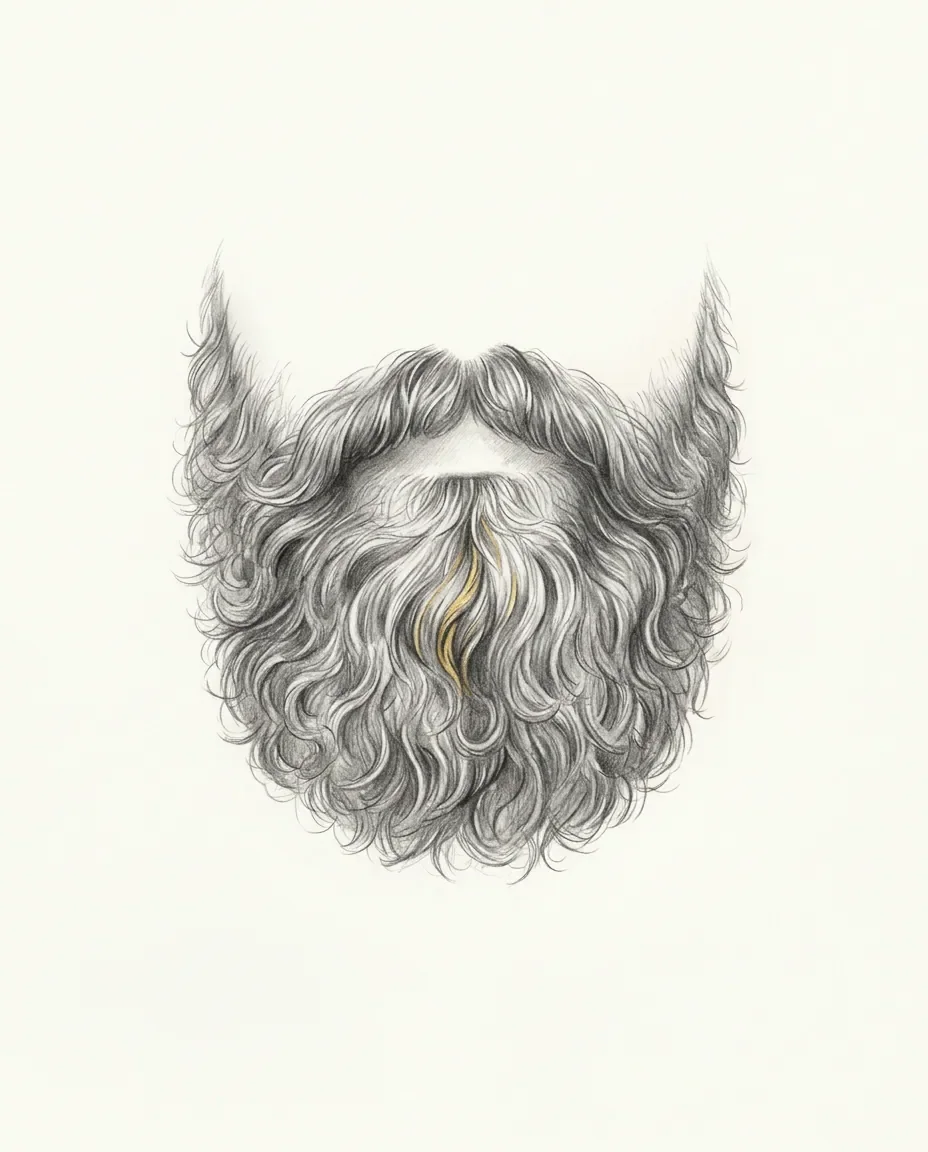
Beard Fetish
Pogonophilia
Added 21 Jun 2026 · Updated 22 Aug 2026
An erotic focus on facial hair such as beards, stubble, moustaches, or sideburns, where this feature is a primary driver of attraction. Sometimes labelled pogonophilia, it is a benign facial-hair partialism in consenting adults.
- Prevalence
- Uncommon
- Category
- Body Parts & Partialism
- Clinical term
- Pogonophilia
- Domain
- Sexual interest · Paraphilia
- Confidence
- Low confidence
- Status
- Listed among partialisms in encyclopedic catalogs; benign variation, not a disorder unless it causes distress or impairment.
- Also known as
- pogonophilia, facial hair fetish, stubble fetish, facial hair partialism
- Added
- 21 Jun 2026
- Updated
- 22 Aug 2026
Overview
Facial-hair partialism, sometimes labelled pogonophilia, is an erotic interest centred on beards, stubble, moustaches, or sideburns. As a partialism it directs attention to a specific feature rather than the whole person, and for those who hold it the presence, texture, length, colour, or grooming of facial hair strongly shapes attraction. For most it functions as a pronounced aesthetic preference rather than an exclusive requirement for arousal. This article traces the term and the fascination it names, how the interest is expressed, its likely psychology, and what little prevalence data exists.
Examples
What the term covers. An attraction keyed specifically to facial hair: a full beard, a few days' stubble, a moustache alone, or sideburns. People who hold it usually have narrow preferences within that range (density and coverage, coarse or soft texture, length, colour, whether it is closely shaped or left to grow), and the feature may work as a strong preference that decides who they notice, or as a reliable and central component of arousal. Facial hair is unusual among the objects of partialism in that it can be grown, shaped or removed at will, so the interest attaches to something its object actively maintains.
What the term does not cover. It is narrower than hair fetishism, which centres on scalp hair, and separate from an interest in body hair on the chest, arms or underarms or in pubic hair; someone may hold any one of these and none of the rest. It is not a general attraction to masculine appearance or to maturity: build is muscle worship, and attraction to much older partners is gerontophilia. Dress-led interests such as the suit and tie work on presentation rather than on the body itself. And enjoying beard culture (grooming products, barbering, beard-forward fashion) is not in itself erotic.
How the word is used. "Beard fetish" is ordinary speech, and is generally used loosely to mean a pronounced taste rather than a fetish in any technical sense: "she has a serious beard thing" is the register in which the interest is actually discussed. Pogonophilia is a catalogue coinage: assembled from genuine Greek roots and current in popular lists of paraphilias, but not a diagnostic term. Neither it nor facial-hair attraction is named in the DSM or the ICD; the nearest formal concept is partialism.
History & origins
The fascination before the term
The beard is far older as an object of meaning than any clinical label for finding it attractive. Across the ancient world facial hair carried prestige and authority: in ancient Egypt and Mesopotamia beards were stylised, oiled, and curled with tongs, while many religious traditions (Sikhism, Orthodox Judaism, and much of Islamic practice) treat the beard as a marker of faith and dignity. As a secondary sexual characteristic it has long signalled maturity and masculinity, which is part of why grooming fashions have swung repeatedly between clean-shaven and bearded ideals.
Clinical lineage
Classic sexology treated hair as one of the recognised foci of erotic fixation. Krafft-Ebing's Psychopathia Sexualis (1886) and Havelock Ellis's Studies in the Psychology of Sex (1897–1928) both discussed hair fetishism, though they concentrated on scalp hair rather than naming facial hair specifically. Modern reference works fold beards into the broader category of hair fetishism (trichophilia), which explicitly spans scalp, facial, chest, axillary, and pubic hair. In diagnostic terms a body-part focus of this kind sits under partialism, which the DSM-5 absorbed into fetishistic disorder, and which is considered a disorder only where it causes distress or impairment.
The term pogonophilia
The word combines the Ancient Greek pōgōn ("beard") with -philia ("love, attraction"); the same root yields pogonophobia (dislike of beards) and pogonotrophy (beard-growing). The companion noun pogonophile is recorded in general dictionaries from roughly 1960–65, but as an erotic label "pogonophilia" is best regarded as a popular catalogue coinage: its precise origin as a clinical term is not well documented, and it does not appear in the DSM or ICD.
Cultural cycles
Beard fashion has moved in long waves. Facial hair surged in the Renaissance, collapsed under the early-20th-century safety-razor marketing that made clean-shaven the default through the 1960s, returned with 1960s–70s counterculture, and revived strongly in the 2010s as full beards became fashionable among younger men and fuelled a grooming-products boom. Each swing changes how visible, and how desirable, the feature is at large.
In practice
The interest is typically expressed through partner preference, appreciation of the look and feel of facial hair, and engagement with grooming aesthetics and beard-focused fashion. Enthusiasts often attend closely to texture, fullness, length, and style, and the attraction may range from a mild leaning to a reliable, central component of arousal. As an ordinary attraction between adults it requires no special practices.
Psychology
Because facial hair is a secondary sexual characteristic associated with maturity and dominance, it features prominently in many people's ideals of masculine attractiveness: a plausible base on which a stronger focus can build. As with other partialisms, individual learning history and associative conditioning likely shape how salient the feature becomes for a given person, while broad cultural trends move its desirability over time. The evidence base specific to facial-hair attraction is thin, so these mechanisms remain general and partly inferential.
Prevalence & culture
No survey isolates beard attraction directly, so figures come from the parent category. The Scorolli et al. (2007) analysis of online fetish communities found that about 7% of the sampled population were aroused by hair, a minor share within which facial hair is only a fraction, well below the ~47% who focused on feet. Contemporary "beard culture" nonetheless gives the broad interest real mainstream visibility through grooming brands, fashion, and media, even as dedicated erotic communities focused specifically on facial hair stay modest in size. Related body-hair preferences are catalogued alongside it; see body-hair fetishism and other appearance-led partialisms such as thigh attraction.
Safety, consent & law
This interest concerns adults and ordinary attraction and carries no inherent safety, consent, or legal concerns. Although listed among partialisms in encyclopedic catalogues, it is not a disorder and causes no harm when it is simply a preference; clinical attention would apply only in the rare case that the focus causes a person distress or impairment.
Common questions
Is a beard fetish a paraphilia or a disorder?
It is catalogued among partialisms, which describes where the attention falls rather than diagnosing anything. DSM-5 folded partialism into fetishistic disorder, and that label applies only where the focus causes the person genuine distress or impairment, or involves someone who has not consented. An attraction to facial hair between consenting adults meets neither condition, so it is a benign variation rather than a disorder.
What is the difference between a beard fetish and a hair fetish?
The region of the body. Hair fetishism, sometimes called trichophilia, is usually about scalp hair: its length, texture and colour, and sometimes acts such as brushing or cutting. A beard interest is facial, and responds to things scalp hair does not offer: stubble against skin, the shaping of a jawline, the daily decision to keep it or take it off. Reference works file both under one broad heading that also spans chest, underarm and pubic hair, but few people hold all of them at once.
Is liking beards a fetish or just a preference?
For most people it is a preference: one attractive feature among many, noticeable but not required. It is usually called a fetish or a partialism only when the feature is a primary driver of attraction: when its presence or absence changes whether someone is interested at all. There is no sharp line between the two, and nothing practical turns on which side of it a given person falls.
How common is it to be attracted to beards?
No survey isolates facial-hair attraction, so the only figure available comes from the parent category. In Scorolli and colleagues' 2007 analysis of online fetish communities, hair accounted for roughly 7% of fetishes: a minor share, within which facial hair is a fraction, and far below the ~47% who focused on feet. Ordinary preference for beards is much more widespread than that, but no comparable study has measured it.
Are beards widely found attractive, or is this a niche taste?
Both, at different intensities. Facial hair is a secondary sexual characteristic long read as a marker of maturity and status, and beard fashion has swung between clean-shaven and bearded ideals for centuries, most recently in the 2010s revival. Broad appeal is therefore mainstream and moves with fashion, while a fetish-level focus (where the beard itself drives the attraction) remains a much smaller phenomenon.
Is a beard fetish only about men?
Not necessarily. The attraction attaches to a feature, and facial hair is not exclusive to men: it occurs among transgender and non-binary people, and in some cisgender women. In practice almost every description of the interest is framed around men, because that is where beards are most culturally visible and where beard fashion and grooming culture operate.
- Body Hair Fetish34/100Hirsutophilia · Body Parts & PartialismAn erotic focus on natural body hair (chest, abdomen, arms, legs, or underarms) where its presence, density, or texture is a primary source of attraction. A benign partialism in consenting adults, sometimes labelled hirsutophilia.34
- Thigh Fetish43/100Body Parts & PartialismA focused erotic interest in the hips and thighs, in which these areas of the lower body are a primary source of attraction. It is a common, benign variation of ordinary attraction rather than a clinical concern.43
- Armpit Fetish35/100Maschalagnia · Body Parts & PartialismMaschalagnia (armpit fetishism) is a partialism in which the armpit is a primary focus of sexual attraction. Interest may center on the underarm's appearance, hair, natural scent, or touch; the related term axillism denotes underarm sexual contact specifically.35
- Lip Fetish43/100Labia Oris Partialism · Body Parts & PartialismLip and mouth partialism is a pronounced erotic focus on the lips and mouth, typically centering on lip fullness, shape, color, and movement. Associated cues such as lipstick, glossy lips, or kissing are often part of it. A benign, mainstream-adjacent variation.43
- Redhead Fetish43/100Redophilia · Body Parts & PartialismA focused attraction to red (ginger) hair, treated as a hair-colour partialism within hair fetishism. Liking red hair is common; the labelled "fetish" is uncommon and informal.43
- Muscle Worship45/100Sthenolagnia · Body Parts & PartialismAn erotic interest in muscular physique and displays of physical strength, encompassing admiration of developed musculature. For some, arousal is tied to demonstrations of power and the hands-on appreciation of a partner's muscles.45
Pogonophilia is from Ancient Greek pōgōn (πώγων), "beard," plus -philia (φιλία), "love" or "attraction", literally "love of beards." The same root appears in pogonophobia (dislike of beards) and pogonotrophy (the cultivation of a beard). The noun pogonophile is recorded in general dictionaries from c.1960-65; its use as an erotic label is a later popular-catalogue coinage rather than an established clinical term.
head and face · body hair
Prevalence is computed from the entry's cited population estimate. Rows marked ESTare indicative editorial estimates scored against a fixed anchor rubric, not measured quantities. Method & anchors: methodology.
Uncommon · ≈ 1 in 100
- 01Scorolli et al. (2007), Relative prevalence of different fetishes, Int. J. Impotence Research 19(4):432-437hair-related fetishes are ~7% of all fetishes; facial/beard hair is a small sub-portion of body-hair partialism
- 02Sexual fetishism, Wikipedia (carries the Scorolli 2007 relative-frequency table)carries the Scorolli relative-frequency table situating hair/body-hair fetishes as a minor category
- 03List of paraphilias, Wikipediadefines pogonophilia (arousal from beards/facial hair) as a recognized partialism
- 04Havelock Ellis, Studies in the Psychology of Sex (1897-1928)early sexological discussion of hair as a recognized focus of erotic fixation
- 05Hair fetishism (trichophilia), Wikipediahair fetishism explicitly spans scalp, facial, chest, axillary and pubic hair; carries the Scorolli 7% hair figure
- 06Psychopathia Sexualis, WikipediaKrafft-Ebing's 1886 work as an early systematic catalogue of erotic fixations including hair fetishism
- 07Partialism, Wikipediapartialism merged into DSM-5 fetishistic disorder; diagnosed only where it causes distress or impairment
- 08Beard, Wikipediabeard as a cross-cultural marker of maturity/masculinity and the historical fashion cycles, including the 2010s beard revival
- 09pogonophile, Dictionary.cometymology of pogonophile from Greek pōgōn 'beard'; dictionary record dated c.1960-65