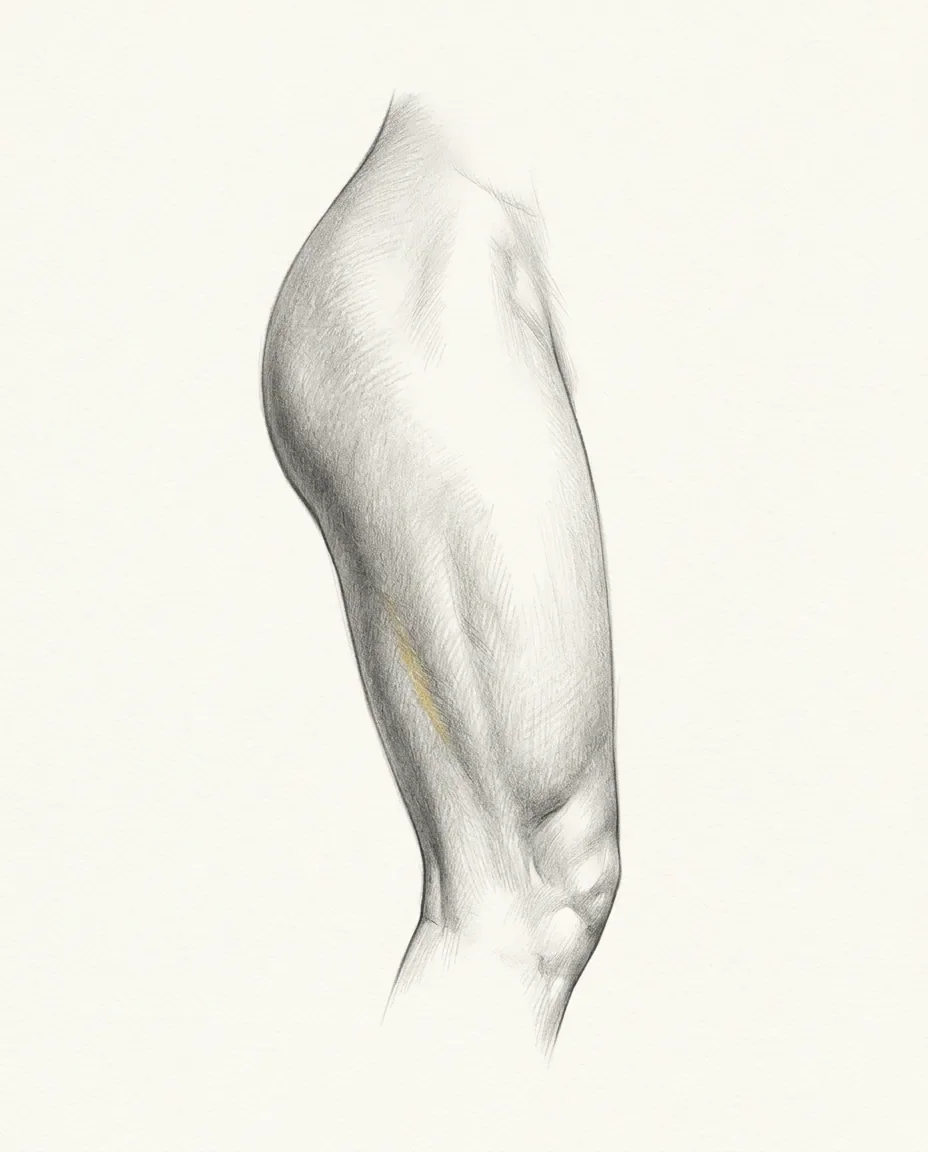
Thigh Fetish
Added 21 Jun 2026 · Updated 22 Aug 2026
A focused erotic interest in the hips and thighs, in which these areas of the lower body are a primary source of attraction. It is a common, benign variation of ordinary attraction rather than a clinical concern.
- Prevalence
- Common
- Category
- Body Parts & Partialism
- Domain
- Sexual interest
- Confidence
- Low confidence
- Status
- Common variation of normal attraction; not a disorder. A focused partialism but not a recognized clinical paraphilia.
- Also known as
- hip & thigh partialism, hip fetish, thigh gap interest, leg partialism, hip and thigh fetish
- Added
- 21 Jun 2026
- Updated
- 22 Aug 2026
Featured in
Overview
A thigh fetish, or hip-and-thigh partialism, is a form of partialism in which erotic attention is directed at a specific body region rather than the whole person. Here the focus settles on the hips, the curve and softness of the thighs, and the contours where the legs meet the torso. This article traces how such focused attractions were first described, how they were classified and reclassified in clinical nosology, and how thigh interest sits today within the broad, ordinary spectrum of human attraction. For most people it is simply a strong preference within otherwise typical attraction; for a smaller number a particular body region functions as the central, most reliable trigger of arousal.
Examples
What the term covers. Attention that settles on the sweep from waist to knee: the fullness or slenderness of the upper leg, the line where thigh meets hip, and the way that region is framed by fitted skirts, shorts, swimwear or hosiery. In practice it shows up as a consistent pull in partner preference, in what a person notices first, and in an aesthetic taste that runs through fashion photography, dance and figurative art. For most people it is a strong preference inside otherwise ordinary attraction; for a smaller number the region is the most reliable trigger of arousal, which is the point at which the word fetish starts to be used.
What the term does not cover. A leg fetish takes in the whole limb, calves and ankles included, and a knee fetish or foot fetish narrows onto a different part of it. An interest in stockings or pantyhose is a garment interest that happens to sit on the thigh; the two often travel together but are separable, and someone drawn to the fabric may not care about the leg beneath it. A butt fetish neighbours it above, morphophilia concerns overall body size and shape rather than one region, and face-sitting or a thighjob are acts rather than attractions; the second uses the thighs as the instrument, which an interest in them may motivate but does not define.
How the word is used. "Thigh fetish" is plain descriptive English with no clinical pedigree; the technical frame is partialism, an erotic focus on a body part rather than a whole person. "Thigh gap" is a 2010s body-image coinage circulated online, not a clinical or sexological term, and it describes an appearance rather than an interest. Neither DSM-5-TR nor ICD-11 names a thigh-specific interest at all.
History & origins
Clinical lineage
The idea that erotic attention can concentrate on a single body part grew out of late-nineteenth-century sexology.
- 1886: Richard von Krafft-Ebing's Psychopathia Sexualis catalogued focused, fragmentary attractions among his many case studies, treating an erotic fixation on a part of the body as a notable variant.
- 1887: the French psychologist Alfred Binet gave the phenomenon its name, applying fétichisme to sexuality in Du fétichisme dans l'amour; both Krafft-Ebing and Havelock Ellis later argued that such attractions arose largely from associative, learned experience.
- The hips and thighs, however, were rarely singled out as a named clinical category. They sat within broader discussions of bodily beauty and the "erotic ideal," and there is no well-documented coiner of a specific thigh-fetish term, the colloquial name is a plain descriptive compound.
The word partialism itself is a twentieth-century clinical refinement of fetishism:
- DSM-III (1980) explicitly excluded arousal to body parts from the fetishism diagnosis.
- DSM-III-R (1987) reversed course and introduced partialism as a separate diagnosis for an erotic focus on body parts, a status it kept through DSM-IV as a "paraphilia not otherwise specified."
- DSM-5 (2013) merged partialism back into fetishistic disorder, a change argued for by Martin Kafka on the grounds of substantial overlap, and made clear it is a disorder only when it causes distress or impairment. A simple preference for hips and thighs therefore falls outside any diagnosis.
Cultural & evolutionary reframing
Through the twentieth century, scientific interest in the lower body shifted from psychopathology toward attraction research framed around the waist-to-hip ratio (WHR).
- 1993: the evolutionary psychologist Devendra Singh proposed that WHR functions as a cross-cultural signal of health and fertility, reporting that a ratio near 0.7 was widely rated most attractive in Western samples.
- Later cross-cultural work found preferred ratios ranging roughly from 0.6 to 0.8 across populations, and noted that hip and thigh fat stores are rich in fatty acids relevant to reproduction: recasting the appeal of the curve of the hips and thighs as part of mainstream, evolved aesthetic preference rather than a pathology.
In practice
The interest is expressed through visual appreciation, partner choice, and a preference for clothing that frames the lower body: fitted skirts, shorts, swimwear, or hosiery. It overlaps heavily with mainstream aesthetic ideals about body shape and proportion celebrated in fashion, dance, and figurative art, and frequently shades into adjacent interests such as the leg fetish and the stocking fetish, where the thigh is the canvas for the garment.
Psychology
Focus on the hips and thighs is usually understood as one end of the normal spectrum of erotic preference rather than a distinct condition. Two complementary accounts are commonly offered:
- Evolutionary: hip and thigh morphology carries signals associated with fertility and health (the WHR literature), making the region a plausible default focus of attraction.
- Learning / associative: in the tradition Binet and Ellis began, individual history, early experiences, and conditioning shape which features become most salient for a given person.
Neither account is settled, and the evidence base specific to thigh interest (as opposed to feet or to general body-shape preference) remains thin, since the interest so rarely presents clinically.
Prevalence & culture
How common is a thigh fetish?
A defined interest in hips and thighs is moderately common but rarely named explicitly, because it blends into ordinary standards of attractiveness. Hard figures are scarce: in Scorolli and colleagues' 2007 analysis of online fetish communities, feet dominated body-part interests at roughly 47%, with legs and thighs forming a much smaller, less formalised share. Broader fantasy and paraphilia surveys such as Joyal & Carpentier (2017) treat partialism collectively rather than itemising the thigh, so a precise prevalence cannot be stated with confidence. Dedicated communities are less organised than those for feet or breasts, and the thigh's cultural visibility comes mostly through fashion and figurative art rather than a named subculture.
Safety, consent & law
This interest involves consenting adults and ordinary attraction, so it raises no special safety, consent, or legal issues beyond those of any relationship. It is not classified as a disorder under the current DSM-5-TR unless an associated fetishistic focus causes clinically significant distress or impairment.
Common questions
Is a thigh fetish normal?
Yes, and unusually so for something with the word fetish attached. An erotic focus on the hips and thighs sits at the ordinary end of attraction, close enough to mainstream standards of beauty that most people who have it never bother naming it. Under DSM-5-TR it would count as a disorder only if the focus caused genuine distress or impairment, which a preference does not.
What is the difference between a thigh fetish and a leg fetish?
Scope. A leg fetish takes in the whole limb, calves and ankles and the line of the leg as a unit, while a thigh interest concentrates on the upper leg and the hip it joins. In practice the two overlap heavily and many people would answer to either label; the distinction matters mainly when someone is trying to describe precisely what draws their attention.
Why are thighs considered attractive?
Two accounts are usually offered, neither of them settled. Evolutionary work on the waist-to-hip ratio, beginning with Devendra Singh's 1993 research reporting a ratio near 0.7 rated most attractive in Western samples and later cross-cultural studies finding preferences from roughly 0.6 to 0.8, treats hip and thigh shape as a health and fertility signal. Associative-learning accounts in the tradition of Binet and Ellis hold instead that individual history determines which features become salient.
Is a thigh gap the same thing as a thigh fetish?
No. Thigh gap is a body-image term that circulated online in the 2010s, describing a particular appearance of the upper legs when standing. It is a beauty-standard label rather than a description of anyone's attraction, and it names no clinical or sexological concept. People with a thigh interest are divided on it, since many are drawn to fullness rather than to a gap, and preferences vary as widely here as anywhere else.
Is a thigh fetish the same as partialism?
Partialism is the general category, an erotic focus directed at a body part rather than at a whole person, and a thigh interest is one instance of it. The term has had an unstable clinical history: DSM-III excluded body parts from fetishism in 1980, DSM-III-R made partialism a separate diagnosis in 1987, and DSM-5 folded it back into fetishistic disorder in 2013.
Do thigh-high stockings count as a thigh fetish?
Not by themselves. An interest in stockings or pantyhose is a garment interest: the draw is the fabric, the sheen and the way it changes the leg. A thigh interest is anatomical and survives the garment coming off. The two very often occur together, since hosiery frames exactly the region in question, but plenty of people have one without the other.
- Leg Fetish53/100Crurophilia · Body Parts & PartialismCrurophilia is a partialism in which the legs are the primary focus of sexual attraction. Interest may center on a leg's shape, length, line, or musculature, or on the way legs are framed by clothing such as stockings, skirts, or heels.53
- Stocking Fetish57/100Clothing & GarmentsA sexual interest in stockings and hosiery, centered on sheer or textured legwear, seams, garters and the look and feel of nylon and silk. It is among the most common garment and material fetishes.57
- Thighjob42/100Intercrural Sex · Acts & ActivitiesA non-penetrative act in which the penis is moved between a partner's closed thighs. Known clinically as intercrural sex, it is documented in ancient Greece, in southern African courtship traditions, and in modern HIV-prevention research as a lower-risk practice.42
- Lip Fetish43/100Labia Oris Partialism · Body Parts & PartialismLip and mouth partialism is a pronounced erotic focus on the lips and mouth, typically centering on lip fullness, shape, color, and movement. Associated cues such as lipstick, glossy lips, or kissing are often part of it. A benign, mainstream-adjacent variation.43
- Redhead Fetish43/100Redophilia · Body Parts & PartialismA focused attraction to red (ginger) hair, treated as a hair-colour partialism within hair fetishism. Liking red hair is common; the labelled "fetish" is uncommon and informal.43
- Muscle Worship45/100Sthenolagnia · Body Parts & PartialismAn erotic interest in muscular physique and displays of physical strength, encompassing admiration of developed musculature. For some, arousal is tied to demonstrations of power and the hands-on appreciation of a partner's muscles.45
The plain-English name "thigh fetish" pairs the everyday anatomical word with fetish, from French fétiche (via Portuguese feitiço, "charm, sorcery"), a sexual sense coined by Alfred Binet in 1887. It belongs to partialism, from Latin pars ("part"), an erotic focus on a single body region; there is no distinct classical -philia term specifically for the thigh.
lower body · torso
Prevalence is computed from the entry's cited population estimate. Rows marked ESTare indicative editorial estimates scored against a fixed anchor rubric, not measured quantities. Method & anchors: methodology.
Common · ≈ 1 in 20
- 01Scorolli et al. (2007), Relative prevalence of different fetishes, Int. J. Impotence Research 19(4):432-437relative-frequency context for body-part partialisms (feet dominate at 47%; legs/thighs a smaller share)
- 02Sexual fetishism, Wikipedia (carries the Scorolli 2007 relative-frequency table)carries the Scorolli body-part fetish table situating thigh/leg partialism
- 03List of paraphilias, Wikipediadefinition/existence of leg/thigh partialism as a recognized body-part focus
- 04Partialism, Wikipediahistory of partialism as a concept and its marginal place in DSM/sexological nosology; DSM-IV NOS status and DSM-5 merger into fetishistic disorder
- 05Psychopathia Sexualis, WikipediaKrafft-Ebing's 1886 cataloguing of focused/fragmentary erotic attractions
- 06Waist–hip ratio, WikipediaDevendra Singh's 1993 WHR research; ~0.7 ratio rated most attractive in Western samples; hip/thigh fat as fertility signal
- 07Joyal & Carpentier (2017), The Prevalence of Paraphilic Interests and Behaviors in the General Population, J. Sex Research 54(2):161-171general-population paraphilia survey that treats partialism collectively rather than itemising the thigh
- 08DSM-5-TR, Paraphilic Disorders (American Psychiatric Association, 2022)fetishistic disorder is diagnosed only when distress/impairment is present; a preference for hips/thighs is not a disorder