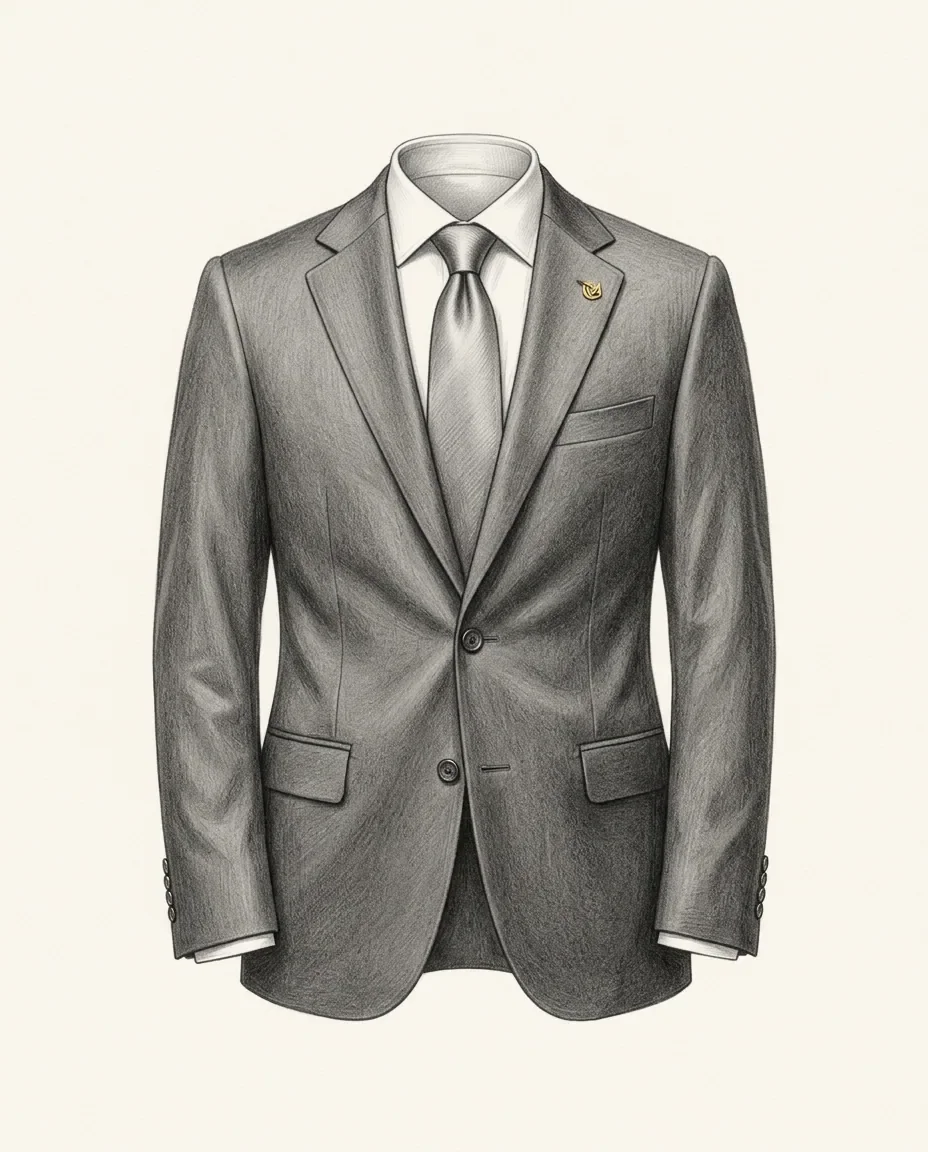
Suit and Tie Fetish
Added 22 Jun 2026 · Updated 22 Aug 2026
An erotic interest centred on tailored suits, dress shirts and neckties, prized for their formality and perceived masculinity. Power symbolism and crisp tactile detail add to the appeal. It is a niche clothing fetish, not a clinical disorder.
- Prevalence
- Uncommon
- Category
- Clothing & Garments
- Domain
- Sexual interest
- Confidence
- Low confidence
- Status
- A niche clothing fetish and a normal variation of erotic taste, not a disorder unless it causes distress or impairment. Not a recognised standalone paraphilia in the DSM-5-TR or ICD-11.
- Also known as
- suit fetish, suited fetish, formalwear fetish, business-wear fetish, necktie fetish, tie fetish, sartorial fetish
- Added
- 22 Jun 2026
- Updated
- 22 Aug 2026
Overview
Suit and tie fetishism is a clothing-focused erotic interest in which the tailored business suit, dress shirt and necktie become a notable source of arousal: worn by a partner, by oneself, or both. The appeal commonly rests on the formal, masculine image of the suit, the authority it signals, and the precise details of cut, cloth, knotted tie and accessories. As a garment fetish (sometimes called a sartorial or formalwear fetish) it sits within the broad family of clothing fetishisms, alongside uniform and lingerie interests, rather than forming a distinct clinical category. This article sets out the garment's cultural origins, the clinical lineage of clothing fetishism into which it falls, how the interest is expressed, and its place among the rarer, more discreet object fetishes.
Definition & scope
The fetish attaches to a specific class of garment: the two- or three-piece lounge suit, the collared dress shirt, and above all the necktie, along with adjacent accessories such as cufflinks, waistcoats and polished dress shoes. It is distinct from a general appreciation for a well-dressed partner; the defining feature is that the formal garments themselves carry erotic charge. The interest is a normal variation of taste, not a mental disorder. A clinical label (fetishistic disorder) applies only when reliance on such objects causes marked distress or functional impairment, per the DSM-5-TR and the ICD-11, and no version of those manuals names the suit as a discrete diagnosis.
Examples
What the term covers. A partner arriving sharply suited and tied and that being the event rather than a pleasant detail; close attention to cut, cloth and the architecture of a knot, from the cutaway collar to the double Windsor; the adjacent hardware of cufflinks, waistcoat, braces and polished dress shoes; and the reverse direction, arousal from dressing formally oneself, which enthusiasts often describe as building as the layers go on and the tie is knotted. It also covers the settings the garment brings with it: suited club nights, and office or boss-and-assistant scenarios in which the suit does the work of signalling who is in charge.
What the term does not cover. A uniform fetish turns on institutional insignia and rank (military, police, medical, service dress), whereas the suit signals civil and corporate authority with no organisation standing behind it. A tie fetish is the narrower sibling, keyed to the necktie alone and often to its constriction rather than the ensemble. Leather and rubber fetishes are keyed to a material rather than to tailoring. Cross-dressing and homeovestism concern the gendered meaning of clothing rather than its formality. And simply finding a well-dressed person attractive is ordinary taste: the distinction is whether the garments themselves carry the charge.
How the word is used. Community vernacular. "Suited" is the usual shorthand in personals and event listings, alongside sartorial fetish and formalwear fetish. None of it is clinical: neither DSM-5-TR nor ICD-11 names the suit, and clothing fetishism as a whole becomes a diagnosis only where it causes marked distress or impairment.
History & origins
Clinical lineage of clothing fetishism
The study of garment-directed arousal is more than a century old. Richard von Krafft-Ebing catalogued arousal tied to specific articles of dress in Psychopathia Sexualis (1886), and the French psychologist Alfred Binet first applied the word "fetishism" to erotic life in his 1887 essay Le fétichisme dans l'amour ("Fetishism in love"), published across two issues of the Revue Philosophique.
- 1886: Krafft-Ebing documents fixation on articles of dress within his catalogue of sexual variation.
- 1887: Binet names sexual fetishism, giving the phenomenon its enduring clinical label.
- 1905: Freud takes up fetishism in his Three Essays on the Theory of Sexuality, folding it into his account of the sexual instinct.
- 20th century onward: clothing fetishism is recognised as a subset of object fetishism, with garments fixed upon ranging from footwear and underwear to uniforms; the modern DSM and ICD treat such interests as disorders only when they cause distress or impairment.
None of these early authors singled out the business suit specifically. Suit and tie fetishism is best read as a modern, community-named branch of clothing fetishism, attaching erotic meaning to a garment whose cultural charge is comparatively recent.
Cultural origins of the suit
The sober dark suit is itself a product of a documented shift in menswear. The psychologist J. C. Flügel, in The Psychology of Clothes (1930), coined the term the "Great Masculine Renunciation" to describe how, from the late eighteenth century, elite Western men abandoned bright colour, ornament, heels and decorative fabrics for restrained, utilitarian tailoring: men, in his phrase, ceasing to claim to be beautiful and aiming "henceforth at being only useful." Accelerated by Enlightenment ideals and the French Revolution, this renunciation established the suit's dominance through the nineteenth and twentieth centuries and loaded it with connotations of seriousness, conformity and authority. The fetish draws directly on that symbolic inheritance.
In practice
Expression is typically mild and benign: a strong preference for a partner who is sharply suited and tied, enjoyment of quality cloth and a freshly knotted tie, or arousal from dressing in formal wear oneself. Some describe arousal that builds as garments are layered on and the tie is knotted, and many enthusiasts are particular about cut and fabric: a Vice account of London suit-fetish nights describes guests in immaculately pressed two-pieces with cutaway collars and double-Windsor-knotted ties. It frequently appears in power-themed role-play around office, boss-and-subordinate or authority scenarios, overlapping with uniform interest and with dominance-and-submission dynamics, up to standing arrangements such as total power exchange.
Psychology
The interest aligns with established models of fetish formation, including associative learning that links the suit to formative experiences and the dense symbolism the garment carries. Commentators on dress note that the suit and necktie read as markers of masculinity, competence and social power. For many enthusiasts the arousal is bound up with those connotations of dominance, status and masculinity rather than the cloth alone, which is why the fetish so often shades into role-play. As with most specific object fetishes, the direct evidence base is thin: most accounts are qualitative or community-based rather than experimental.
Prevalence & culture
How common is a suit fetish?
Suit fetishism is seldom studied directly and ranks among the more obscure clothing interests. The best available frame comes from the large internet-community survey by Scorolli et al. (2007), which tallied fetish-themed discussion groups. Among clothing-focused groups it found:
| Garment category | Share of clothing-fetish groups |
|---|---|
| Worn on legs and buttocks (stockings, skirts) | ~33% |
| Footwear | ~32% |
| Underwear | ~12% |
| Whole-body garments (jackets, suits) | ~9% |
The whole-body-garment class, the one that best captures the suit, was the smallest, consistent with the interest's niche standing. It nonetheless has a distinct following, especially within gay male subcultures, supported by club nights such as the London party documented by Vice and by specialist studios producing suited-themed material. Because formal wear can be worn openly in everyday life, the interest is unusually discreet compared with leather or rubber.
Safety, consent & law
There are no inherent safety, consent or legal concerns: the interest involves ordinary clothing and consenting adults. Standard norms of consent and communication apply, particularly when it is woven into power-exchange or authority role-play.
Common questions
What is the difference between a suit fetish and a uniform fetish?
Whether there is a badge behind the authority. A uniform fetish turns on insignia and rank: a police, military, medical or service uniform states a role an organisation has assigned. A suit states status the wearer claims for himself: money, competence, seriousness. The two overlap wherever a dress code is quasi-official, and many people are drawn to both, but the symbolic source is different.
Is a tie fetish the same as a suit fetish?
Not quite; one is a subset of the other. A tie fetish is keyed to the necktie itself: the knot, the silk, the collar it sits against, and for some the sense of constriction at the throat. A suit and tie fetish takes in the whole ensemble, usually with the tie as its focal point. Someone can care about ties and be indifferent to tailoring; the reverse is much less common.
How common is a suit and tie fetish?
It is one of the rarer clothing interests, and no survey targets it directly. Scorolli and colleagues' 2007 analysis of online fetish communities is the closest measure: among clothing-focused groups, whole-body garments including jackets and suits accounted for about 9%, well behind legwear at roughly 33% and footwear at roughly 32%. That was the smallest clothing category they counted.
Is a suit fetish mostly a gay male thing?
The visible community skews that way, but the interest is not confined to it. Suit-fetish club nights and specialist studios are concentrated in gay male scenes, which is where the practice has actually been documented; Vice's account of London suit nights is the usual reference point. No survey has measured the interest across orientations, so how it is distributed outside those visible spaces is simply unknown.
Why do suits read as powerful?
Because of a deliberate historical retreat from display. The psychologist J. C. Flügel called it the "Great Masculine Renunciation": from the late eighteenth century, elite Western men abandoned bright colour, ornament and heels for restrained tailoring, in his phrase ceasing to claim beauty and aiming henceforth only at being useful. Two centuries of that convention loaded the plain dark suit with seriousness, conformity and authority, and that inheritance is what the fetish draws on.
Can you have a suit fetish about wearing one yourself?
Yes, and it is a common form. Enthusiasts frequently describe arousal from being the suited one (the ritual of dressing, the weight and structure of good cloth, the moment the tie is knotted) rather than from what a partner wears. Because a suit can be worn openly anywhere without comment, the interest is unusually discreet compared with leather or rubber.
Is a suit and tie fetish a disorder?
No. Fetishistic disorder requires that reliance on an object cause marked distress or functional impairment, and neither DSM-5-TR nor ICD-11 names the suit as anything at all. The interest involves ordinary clothing, consenting adults and no inherent physical or legal risk, which makes it one of the more straightforwardly benign entries in this catalog.
- Uniform Fetish60/100Uniform Fetishism · Clothing & GarmentsAn erotic interest in uniforms and the authority, role, or status they signal: military, police, medical, school, or service dress. A common clothing-and-role fetish rather than a clinical disorder.60
- Leather Fetish65/100Leather fetishism · Objects & MaterialsAn erotic attraction to leather as a material: its look, smell, creak, shine, and feel when worn. It overlaps strongly with BDSM gear and is bound up with a recognised, organised leather subculture with its own bars, codes, and titles.65
- Glasses Fetish47/100Clothing & GarmentsA sexual or romantic attraction to people wearing eyeglasses, or to the spectacles themselves, often tied to perceptions of intelligence. Perceptions of sophistication or vulnerability are often part of it too.47
- Skin Fetish29/100Integumentophilia · Body Parts & PartialismA focused erotic interest in human skin itself, its texture, smoothness, warmth, scent and sheen, rather than the body as a whole. The act of touching and being touched is part of it. It is generally a benign aesthetic and tactile preference.29
- Total Power Exchange46/100Power, Roles & ScenariosA consensual BDSM relationship structure in which one partner cedes broad authority over their life to another on an ongoing basis. It extends dominance and submission beyond scenes into everyday living.46
- Ballet Boot Fetish32/100Clothing & GarmentsAn erotic interest in ballet boots, the fetish footwear that holds the foot fully en pointe on a seven-inch heel. The appeal lies in the leg line, the object itself and the limit it places on walking. A niche within shoe and boot fetishism.32
A plain-English descriptive name combining "suit" (from Old French 'sieute', a set of like garments, ultimately from Latin 'sequi', to follow) and "tie" (from Old English 'tigan', to bind). "Fetish" derives from Portuguese 'feitiço', a charm or sorcery, from Latin 'facticius', artificial.
formal wear · business attire · garment fetishism · necktie
Prevalence is computed from the entry's cited population estimate. Rows marked ESTare indicative editorial estimates scored against a fixed anchor rubric, not measured quantities. Method & anchors: methodology.
Uncommon · ≈ 1 in 100
- 01Sexual fetishism, Wikipedia (carries the Scorolli 2007 relative-frequency table)Alfred Binet's 1887 coinage of 'fetishism' for erotic life, and the framing of garment/clothing fetishes as a recognised subset of object fetishism within which suit interest sits
- 02Clothing fetish, Wikipediadefinition of clothing fetishism as fixation on a particular article, fashion or uniform, including a man's suit
- 03Scorolli et al. (2007), Relative prevalence of different fetishes, Int. J. Impotence Research 19(4):432-437relative-frequency framing: suits are a niche garment far below footwear (32%) and legwear (33%)
- 04Vice, Fancy Fuckin': Inside the Well-Dressed World of Suit Fetish Nightsdocuments an active suit-fetish community, club nights, enthusiast particularity about cut and cloth, and power/authority appeal
- 05Richard von Krafft-Ebing, Psychopathia Sexualis (1886)earliest clinical systematisation of clothing/object fetishism within which suit interest is a modern branch
- 06J. C. Flügel, The Psychology of Clothes (1930), the "Great Masculine Renunciation"origin of the modern restrained business suit and its symbolism of seriousness, authority and conformity
- 07Fetishistic disorder, WikipediaDSM-5-TR framing that garment/object fetishism is a disorder only when it causes marked distress or impairment; Freud's 1905 Three Essays discussion of fetishism
- 08ICD-11 for Mortality and Morbidity Statistics, World Health OrganizationICD-11 classification of paraphilic disorders, under which suit fetishism is not a discrete diagnosis and clothing fetishism is non-disordered absent distress or harm