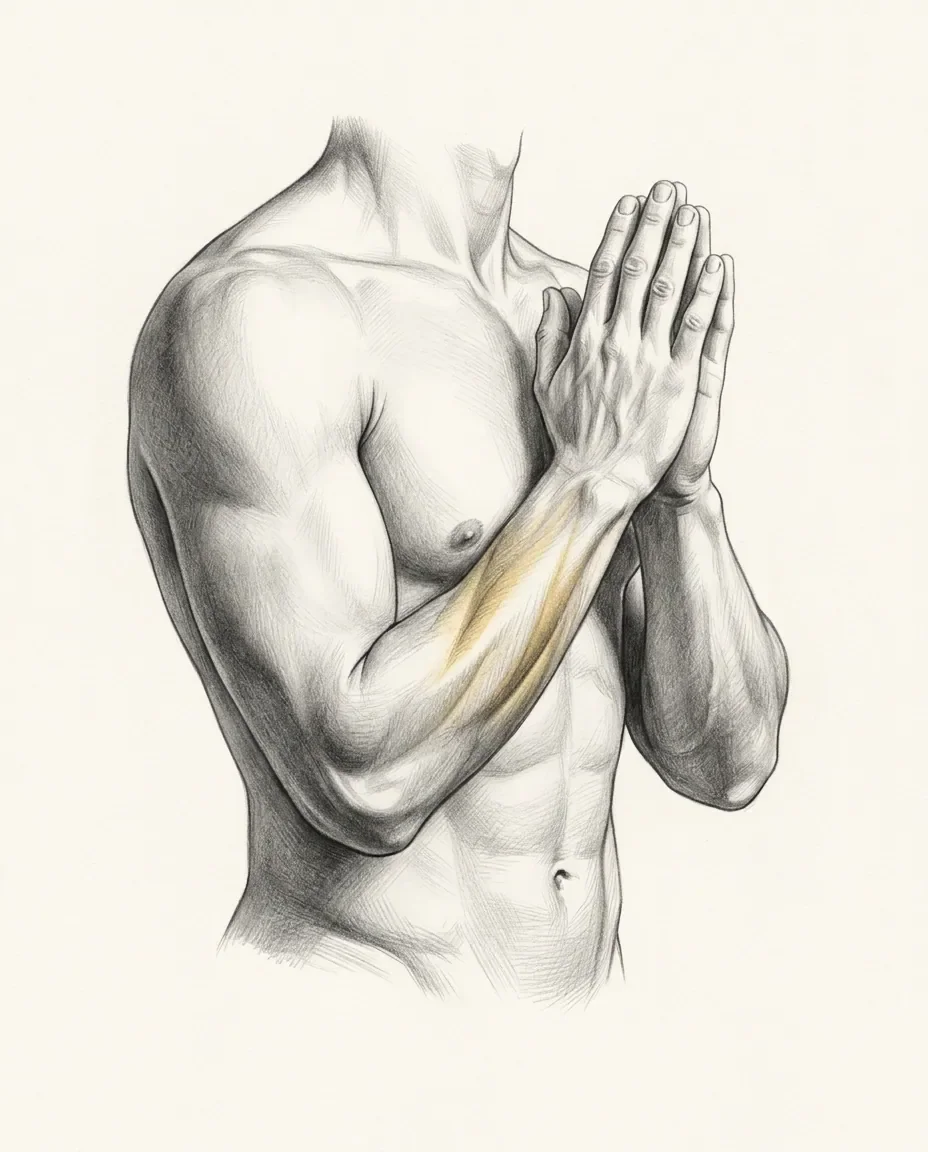
Muscle Worship
Sthenolagnia
Added 21 Jun 2026 · Updated 22 Aug 2026
An erotic interest in muscular physique and displays of physical strength, encompassing admiration of developed musculature. For some, arousal is tied to demonstrations of power and the hands-on appreciation of a partner's muscles.
- Prevalence
- Common
- Category
- Body Parts & Partialism
- Clinical term
- Sthenolagnia
- Domain
- Sexual interest · Paraphilia
- Confidence
- Low confidence
- Status
- A partialism / strong preference; treated as a paraphilia only if it causes distress, impairment, or harm. Generally a benign interest.
- Also known as
- muscle fetish, muscle partialism, sthenolagnia, cratolagnia, muscle adoration, bodybuilder fetish
- Added
- 21 Jun 2026
- Updated
- 22 Aug 2026
Overview
Muscle worship is an erotic attraction to muscular bodies and to physical strength, in which a "worshipper" admires, praises, and often touches the developed musculature of a more muscular partner. The clinical-sounding labels sthenolagnia (arousal from the display of muscles or strength) and cratolagnia (arousal from feats or demonstrations of power) are sometimes attached to it. The focus may rest on a particular muscle group or on overall development, and the interest is widely practised as a benign preference between consenting adults, better understood as a partialism than as a distinct disorder. This article covers the classical and physical-culture roots of the muscular ideal, the clinical vocabulary attached to it, how muscle worship is practised, and what is (and is not) known about its prevalence.
Definition & scope
Muscle worship names an attraction to visible muscularity and to the capability it signals, not simply to a large body. The interest can be aesthetic (admiring physique as sculpture), tactile (appreciating a partner's muscles by touch in a consensual session), or dynamic (aroused by flexing, posing, or feats of strength). It sits within partialism, the focus on a non-genital bodily feature, and shades into ordinary fitness fandom at one end and organised session culture at the other. It is not the same as size-difference or strength-domination interests, though it can overlap with them.
Examples
What the term covers. Admiring a bodybuilder's development much as one would a sculpture; a negotiated session in which a worshipper feels, praises and massages a partner's arms, back, chest or thighs; flexing and posing performed for an appreciative audience of one; feats of strength such as lifting or carrying a smaller partner; and the paid session arrangements that competitive bodybuilders of either sex offer as a source of income. The interest attaches to visible development and to the capability it advertises, so it can be satisfied by a photograph, a pose, or a hand on a contracted muscle.
What the term does not cover. Macrophilia and the giantess fetish concern impossible scale rather than achievable muscularity, and the size difference kink turns on the contrast between two partners rather than the physique of one. Worship play is the broader devotional dynamic of revering part of a partner's body; muscle worship is one target within it, not a synonym for it. Feederism and the weight gain fetish also centre on a changing body, but point at the opposite morphology. Ordinary admiration of athletes is not the fetish either: the term marks the cases where musculature is the organising erotic object, in the way a back fetish organises attraction around a single region.
How the word is used. "Muscle worship" is community vernacular, current in fitness circles, among gay men, and around female bodybuilding. Sthenolagnia and cratolagnia are Greek-pattern coinages that survive in popular paraphilia glossaries rather than in peer-reviewed research, and neither is a diagnosis: DSM-5-TR and ICD-11 contain no such category, treating an exclusive focus on a non-genital feature as a partialism and a disorder only where it causes distress or impairment.
History & origins
Classical and aesthetic roots
Admiration of the muscular body is one of the oldest ideals in Western art. Classical Greek sculpture, the Doryphoros of Polykleitos and the Farnese Hercules among them, codified strength as beauty, an ideal later revived by Renaissance anatomists and academic painters. This long aesthetic lineage frames the modern erotic interest, which only acquired a distinct subculture once muscular display became a public spectacle.
The birth of physical culture
- 1890s: Eugen Sandow (born Friedrich Wilhelm Müller, 1867–1925), widely called the father of modern bodybuilding, won fame in London for staged feats of strength and posing displays. He explicitly modelled his physique on the "Grecian Ideal" he measured from museum statues, fusing the classical aesthetic with the new science of training.
- 1897: Sandow opened his Institute of Physical Culture in London and built a publishing and mail-order empire of exercise equipment, magazines and instruction, turning the developed male body into a mass commercial ideal.
- 1901: Sandow staged a precedent-setting physique contest at London's Royal Albert Hall, judged alongside the author Sir Arthur Conan Doyle and the sculptor Charles Lawes-Wittewronge; since 1977 the Mr. Olympia winner has received a bronze statuette of Sandow, "The Sandow."
Clinical naming
The specialised vocabulary is a product of taxonomic naming rather than any single landmark study. The -lagnia ('lust') suffix follows the Greek/Latin labelling style established in the lineage of late-nineteenth-century sexology, after Richard von Krafft-Ebing's Psychopathia Sexualis (1886) and extended by Havelock Ellis's Studies in the Psychology of Sex. The precise coinage of sthenolagnia and cratolagnia is not well documented; the terms survive mainly in popular paraphilia glossaries rather than the peer-reviewed literature, and a claimed early-twentieth-century attribution to Magnus Hirschfeld cannot be reliably confirmed. In modern nosology, an exclusive focus on a non-genital bodily feature is treated as a partialism, which the DSM-5 folded into fetishistic disorder, and only when it causes distress or impairment.
Cultural & subcultural evolution
From the late twentieth century, "muscle worship" emerged as a named practice and online subculture within fitness and kink communities, prominently among gay men but also around female bodybuilders. Behavioural-addiction researcher Mark Griffiths has written accessible (non-peer-reviewed) overviews noting how little formal study the interest has received.
In practice
Common expressions include admiration of bodybuilders, athletes and wrestlers; consensual sessions in which a worshipper appreciates, praises and touches a more muscular partner's physique; flexing and posing displays; and feats of strength such as lifting or carrying. It overlaps with fitness culture and, for some, with power-exchange dynamics, where the size disparity carries the erotic charge, much as other body-focused interests such as a toe fetish or back fetish centre desire on one admired feature. Some bodybuilders offer paid posing or "muscle worship" sessions as a source of income.
Psychology
What causes an attraction to muscles?
No single mechanism is established. The interest is thought to draw on the evolutionary signalling of health, capability and protection that musculature conveys, on culturally amplified ideals of physique, and on learned associations. For some it is purely aesthetic; for others it connects to themes of power, safety, or being willingly overpowered within a consensual frame. As the Wikipedia survey of the topic notes, the area has attracted almost no dedicated empirical research, so mechanistic claims remain provisional.
Prevalence & culture
How common is muscle worship?
Muscle attraction is moderately common as a preference but poorly isolated in research, so no firm figure exists. The large fetish-frequency analysis of Scorolli et al. (2007) found that body-part and body-feature preferences dominate online fetish communities, yet it records no distinct muscle category, and broad surveys such as Joyal & Carpentier (2015) measure fetishism only at the aggregate level. The estimate here is therefore anchored to a mix of broad mainstream appeal and a smaller organised subculture (active FetLife groups, bodybuilding and fitness fandom), held at low confidence.
Safety, consent & law
The interest is benign when expressed between consenting adults and carries no inherent legal concern. The practical risks are ordinary physical ones: lifting, carrying, wrestling holds and demonstrations of strength can cause strain, dropped weight, or falls, and the person being lifted has the least control over how it ends. Where a session is commercial, experienced practitioners settle the boundaries in advance rather than during it, agreeing what may be touched, what is not on offer, and how long it runs, which protects both parties.
Common questions
What happens in a muscle worship session?
A session is a negotiated appointment, frequently paid, in which one person admires and handles another's physique: posing and flexing on request, feeling a contracted muscle, comparing size, sometimes lifts or carries. Many are explicitly non-sexual and treated by the bodybuilder as work, with what may be touched, what is off-limits, the duration and the fee all agreed in advance. Others happen privately between partners with no commercial element at all.
Is muscle worship the same as a muscle fetish?
In everyday use the two run together, but they emphasise different things. A muscle fetish names the attraction: arousal organised around visible musculature. Muscle worship names the practice built on it, the admiring, praising and handling of a more muscular person's body, with the asymmetry between admirer and admired doing much of the work. Someone can hold the attraction for a lifetime without ever taking part in the practice.
What is the difference between muscle worship and body worship?
Worship play is the general form: a submissive partner revering some part of a dominant's body through kissing, licking, caressing or massage, with the reverence itself as the point. Muscle worship specifies the target and adds a second element, strength, so it takes in posing, flexing and feats of lifting that have no equivalent in foot or hand worship. All muscle worship is body worship; the reverse does not hold.
Is muscle worship a paraphilia or a disorder?
It is classified as a partialism, an erotic focus on a non-genital feature of the body, which the DSM-5 folded into fetishistic disorder. That becomes a diagnosis only where the interest causes the person genuine distress or impairment, or involves someone who has not consented. Between consenting adults an attraction to muscularity is a benign preference, and it has drawn almost no dedicated clinical research either way.
Is muscle worship only a gay male thing?
No. The named subculture is most visible among gay men, where it grew up alongside physique and fitness culture, but a substantial parallel scene surrounds female bodybuilders and their admirers, and mixed-sex arrangements are common. What the communities have in common is the physique they are organised around rather than the orientation of the people in them.
Does muscle worship have to be sexual?
Not necessarily. For some people the response is straightforwardly erotic; for others it is closer to aesthetic awe, or to the pleasure of proximity to strength, with no sexual contact involved. Commercial sessions in particular are often advertised and conducted as non-sexual, which is part of why bodybuilders can offer them openly as a service. Where the interest does extend into sex, it commonly overlaps with power-exchange themes.
- Back Fetish23/100Dorsal Partialism · Body Parts & PartialismA focused erotic interest in the back and shoulders, where this dorsal region of the torso is a primary source of attraction rather than the body as a whole. It is generally a benign aesthetic preference, best understood as a form of partialism.23
- Toe Fetish56/100Toe Partialism · Body Parts & PartialismA focused erotic interest specifically in the toes: a narrower subset of foot partialism. The toes' shape, length, arrangement, adornment such as painted nails or toe rings, or related contact are a primary source of attraction.56
- Arch Fetish47/100Body Parts & PartialismAn erotic focus on the curved instep or arch of the foot, often with a preference for high arches. A narrower expression of foot partialism that overlaps closely with sole and general foot interest.47
- Lip Fetish43/100Labia Oris Partialism · Body Parts & PartialismLip and mouth partialism is a pronounced erotic focus on the lips and mouth, typically centering on lip fullness, shape, color, and movement. Associated cues such as lipstick, glossy lips, or kissing are often part of it. A benign, mainstream-adjacent variation.43
- Redhead Fetish43/100Redophilia · Body Parts & PartialismA focused attraction to red (ginger) hair, treated as a hair-colour partialism within hair fetishism. Liking red hair is common; the labelled "fetish" is uncommon and informal.43
- Thigh Fetish43/100Body Parts & PartialismA focused erotic interest in the hips and thighs, in which these areas of the lower body are a primary source of attraction. It is a common, benign variation of ordinary attraction rather than a clinical concern.43
From Ancient Greek 'sthenos' (σθένος, 'strength, might') + '-lagnia' (λαγνεία, 'lust'); literally 'lust for strength'. The companion term 'cratolagnia' derives from 'kratos' (κράτος, 'power, dominion') + '-lagnia', i.e. 'lust for power'. Both are modern Greek-tradition coinages; their precise authorship and date are not reliably documented.
whole-body morphology · musculature
Prevalence is computed from the entry's cited population estimate. Rows marked ESTare indicative editorial estimates scored against a fixed anchor rubric, not measured quantities. Method & anchors: methodology.
Common · ≈ 1 in 20
- 01List of paraphilias, Wikipediadefinition and existence of sthenolagnia/cratolagnia as a recognized partialism term
- 02Scorolli et al. (2007), Relative prevalence of different fetishes, Int. J. Impotence Research 19(4):432-437context for body-feature partialisms within the relative-frequency distribution of fetishes (no muscle-specific category, supporting a low niche estimate)
- 03FetLife, kink community group sizes (community-size proxy)community-size proxy showing an active but small muscle-worship subculture
- 04Richard von Krafft-Ebing, Psychopathia Sexualis (1886)origin of the Latin/Greek clinical labelling tradition (-lagnia naming) for catalogued sexual variations
- 05Muscle worship, Wikipediadefinition of muscle worship as body worship, the worshipper/dominant dynamic, sthenolagnia/cratolagnia labels, gay-male and female-bodybuilder communities, and the absence of formal studies
- 06Eugen Sandow, Encyclopaedia BritannicaEugen Sandow (1867-1925) as father of modern bodybuilding, the Grecian Ideal, and his 1890s rise to fame
- 07Eugen Sandow, WikipediaInstitute of Physical Culture (1897), 1901 Royal Albert Hall physique contest, and the Sandow statuette awarded at Mr. Olympia since 1977
- 08Partialism, Wikipediapartialism as focus on a non-genital body part, merged into fetishistic disorder in the DSM-5 and pathological only with distress or impairment
- 09Mark Griffiths, 'Pulling Muscles: A Beginner's Guide to Sthenolagnia'accessible (non-peer-reviewed) overview of sthenolagnia/muscle worship and the scarcity of formal research
- 10Joyal & Carpentier (2017), The Prevalence of Paraphilic Interests and Behaviors in the General Population: A Provincial Survey, J. Sex Research 54(2)general-population prevalence of fetishistic interest measured only at the aggregate level, not isolating muscle attraction