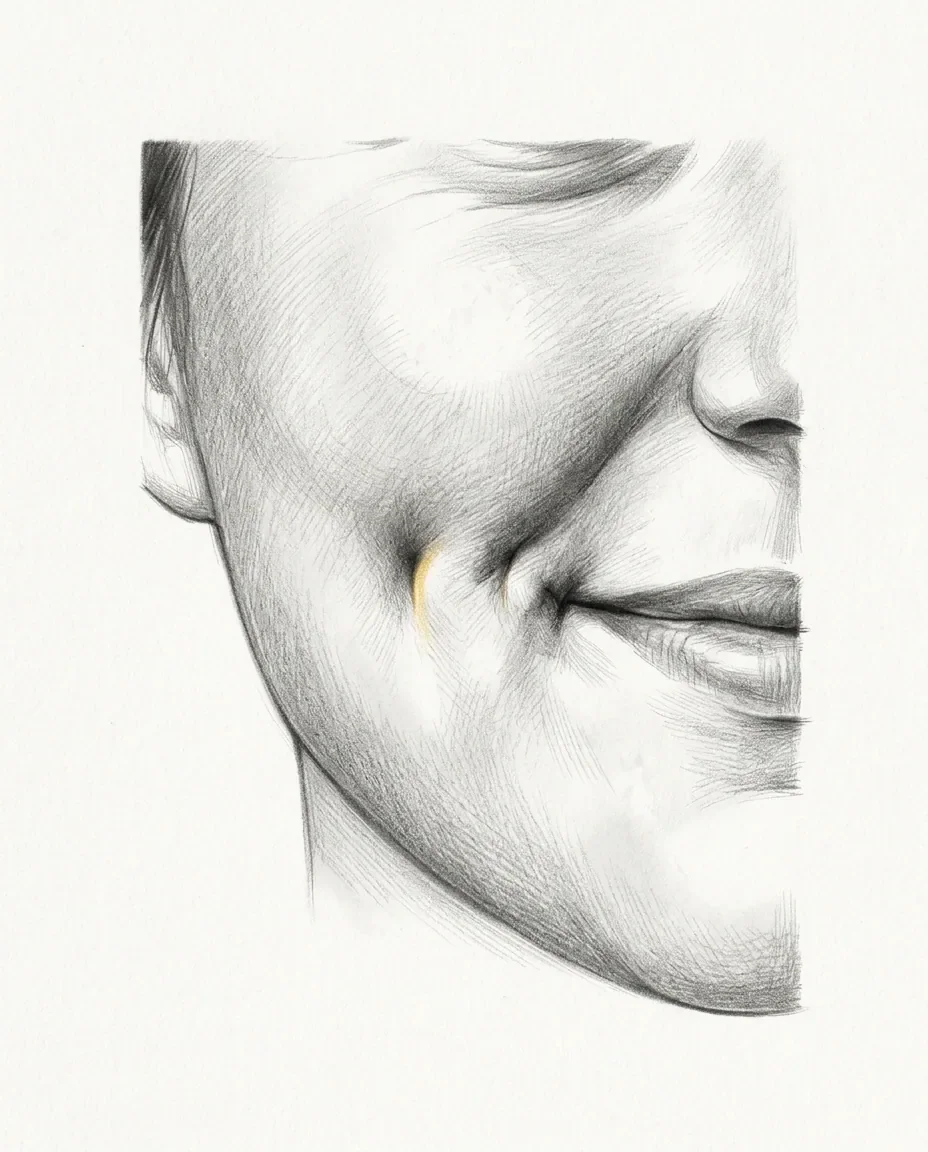
Dimple Fetish
Erogonophilia
Added 27 Jun 2026 · Updated 22 Aug 2026
Dimple partialism, sometimes labelled erogonophilia, is a focused erotic interest in dimples: the small natural indentations of the cheeks. For some it extends to the chin or the lower-back 'dimples of Venus'. It is a rare and benign body-feature interest.
- Prevalence
- Rare
- Category
- Body Parts & Partialism
- Clinical term
- Erogonophilia
- Domain
- Sexual interest · Paraphilia
- Confidence
- Low confidence
- Status
- Partialism; a benign paraphilic variation, not a disorder absent distress or impairment.
- Also known as
- erogonophilia, dimple partialism, dimples fetish
- Added
- 27 Jun 2026
- Updated
- 22 Aug 2026
Overview
Dimple fetish, sometimes labelled erogonophilia, is a partialism in which dimples become a primary focus of erotic attraction. Most often the interest centres on the small indentations that appear in the cheeks when a person smiles, though it can extend to a chin dimple or to the lower-back indentations known as the "dimples of Venus". As Wikipedia's article on partialism records, dimples are one of many specific non-genital features that can become a discrete site of arousal. This article covers the terminology, the anatomy behind the feature, its place in the partialism framework, how the interest is typically expressed, and why dedicated evidence on it is close to nonexistent.
Definition & scope
The feature itself is well described. A cheek dimple, sometimes called a gelasin or fovea buccalis, is generally attributed to a variation in the zygomaticus major muscle: a double or bifid muscle splits into superior and inferior bundles, and the skin is drawn inward between them when the face moves. That is why cheek dimples are bound up with smiling and expression rather than being a fixed feature of a face at rest. The lower-back dimples are a different structure entirely: the fossae lumbales laterales, shallow indentations lying over the sacroiliac joints, formed by a short ligament that tethers the skin to the posterior superior iliac spine.
The interest is a partialism, an erotic focus on a specific non-genital feature. It is not, in most cases, a fetish in the strict sense of an arousal requirement: it is usually a strong preference bound up with an appreciation of a face.
Examples
What the term covers. Most often the cheek dimples that appear only when someone smiles or speaks, which is what makes the interest inseparable from expression rather than from a face at rest. It also covers the chin dimple, and the pair of shallow indentations in the lower back popularly called the "dimples of Venus." The intensity described ranges from a stated preference strong enough that a person notices it in themselves, to the much rarer case where dimples are the organising focus of arousal.
What the term does not cover. A general fondness for a warm smile is not a dimple fetish; almost everyone has aesthetic preferences about faces, and the word is meant to pick out something narrower than that. It is not fetishism in the strict DSM-5-TR sense either, which requires arousal to depend on the feature rather than merely to favour it. It is not morphophilia, which is organised around overall body shape or build. And the two dimple types are anatomically unrelated despite sharing an English word: one is attributed to a split zygomaticus major muscle in the cheek, the other to a ligament tethering skin to the pelvis, so someone drawn to one is not automatically drawn to the other. The category it properly belongs to is partialism, erotic focus on a specific non-genital feature.
How the word is used. "Dimple fetish" is plain everyday phrasing. The clinical-sounding alternative, erogonophilia, circulates in popular listicles and reference compilations rather than in the peer-reviewed literature, with no documented coiner and no attested first use, so it is best read as a descriptive label rather than a diagnosis. Neither DSM-5-TR nor ICD-11 lists it under any name.
History & origins
A long-admired feature, a thinly documented label
Dimples have been prized for centuries as a marker of youth, warmth, and charm, and appear that way throughout Western literature and in Chinese tradition, where they are read as a sign of good fortune. As a named erotic focus, though, dimple interest has almost no independent documentary record, and its lineage is inherited from the broader category that contains it.
- 1886: Richard von Krafft-Ebing's Psychopathia Sexualis begins the systematic clinical cataloguing of erotic interest directed at specific bodily features: the seed of the modern concept of partialism.
- 1897–1928: Havelock Ellis, in his Studies in the Psychology of Sex, documents attraction to particular non-genital features and reframes such attractions as ordinary variations of eroticism.
- Mid-to-late 20th century: partialism, the channelling of sexual interest onto a specific non-genital body part, is consolidated as a clinical term and folded into the paraphilia literature.
- 2013 → 2022: DSM-5 and the DSM-5-TR treat partialism as a form of fetishistic interest that is a disorder only where it causes clinically significant distress or functional impairment. Applied to dimples, that threshold is essentially never met.
The label erogonophilia circulates mainly in popular and reference compilations rather than in the peer-reviewed clinical canon. No author is documented as having coined it and its first use is not attested, so the term should be treated as descriptive rather than diagnostic.
In practice
Expression is mild and centred on looking and gentle affection: appreciation of a dimpled smile, attention to the dimples during intimacy, a light touch, or simply finding a partner's dimples the most attractive thing about them. Because cheek dimples only appear with expression, the interest is tied to a partner's smile and mood as much as to a static feature, which gives it a warmer and more relational character than most partialisms. In practice it usually blends into a broader appreciation of facial features such as the cheek, lip, and nose rather than standing apart as a distinct behaviour.
Psychology
What causes it?
The usual explanation is associative learning acting on a feature that already carries strong social meaning. Dimples are widely read as enhancing a smile and signalling youth and approachability, and that positive social charge can reinforce an erotic association. Early intimate experiences, and the tie between dimples and a warm, expressive face, may consolidate the focus further. There is, however, no research treating dimple interest as a discrete category, so all of this is inferred from the broader partialism literature and the evidence base is correspondingly thin.
Is it normal?
Yes. A preference for dimples sits at the benign end of the partialism range, and clinical framing treats it as a variation rather than a condition unless it causes the person distress or interferes with their life.
Prevalence & culture
How common is dimple fetishism?
It is rare as a primary focus and common as a mild preference, and the two are easy to conflate. No population study isolates a dimple-specific rate. The nearest comparative anchor is Scorolli et al. (2007), which tabulated the relative frequency of fetishes across 381 online discussion groups with roughly 5,000 participants: body parts and features accounted for about 33% of fetish interest, with feet by far the dominant target, while fine facial features do not register as a major standalone category. Any figure given here for dimples as a primary focus is therefore an estimate, not a measured rate.
The feature itself is far from rare. Among people who have cheek dimples, bilateral dimples are the most common form at about 55.6%, and a Greek study cited by Wikipedia found dimples in 34% of adults against only 13% of children, which suggests many are transient rather than lifelong. Culturally, dimples remain a stock shorthand for charm in film, advertising and celebrity coverage, which keeps ordinary admiration of them highly visible while the explicit erotic label stays obscure.
Safety, consent & law
The interest is entirely benign. It involves consenting adults, ordinary non-injurious appreciation and contact, and raises no safety or legal concerns beyond mutual consent. The only sensible caution is the general one: attention to a partner's body is welcome when it is wanted, and worth checking rather than assuming.
Common questions
Is erogonophilia a real clinical term?
Not in the sense of being a diagnosis. It appears in popular articles and in wiki-style compilations of paraphilia names, but no author is documented as having coined it, its first use is unattested, and it does not appear in DSM-5-TR, ICD-11 or the peer-reviewed clinical canon. Treat it as a descriptive label someone invented for a real preference, not as a term a clinician would use.
What is the difference between a dimple fetish and just liking someone's smile?
Degree and specificity. Finding a dimpled smile charming is close to a cultural default, and it is not what the word names. The interest described here is narrower: dimples themselves are the feature attention keeps returning to, and their presence makes a substantial difference to how attractive someone finds a person. Even then it is almost always a strong preference rather than a requirement for arousal.
How common are dimples?
Common enough to be unremarkable, and not fixed from birth. Among people who have cheek dimples, bilateral dimples are the most frequent form at roughly 55.6 percent. A Greek study cited by Wikipedia found dimples in 34 percent of adults against only 13 percent of children, so the feature is not simply present or absent for life.
What causes cheek dimples?
They are generally attributed to a variation in the zygomaticus major, the muscle that pulls the corner of the mouth up and back. In some people the muscle is double, or bifid, splitting into an upper and a lower bundle; when the face moves, the skin is drawn inward in the gap between them. That is why cheek dimples appear with a smile rather than sitting on a resting face.
Do the "dimples of Venus" count as dimples?
Under the everyday word, yes, and some people with this interest include them. Anatomically they are a completely different structure: the fossae lumbales laterales, shallow indentations over the sacroiliac joints formed by a short ligament tethering the skin to the pelvis. They have nothing to do with the facial muscle that produces a cheek dimple, and interest in one does not predict interest in the other.
Is a dimple fetish a paraphilia or a disorder?
It is classed as a partialism, which sits within the fetishistic family, but that is a statement about where an interest is filed rather than about anyone's health. Under DSM-5-TR an atypical erotic focus becomes a disorder only where it causes clinically significant distress or functional impairment. For an interest in dimples, involving nothing but looking and ordinary affection, that threshold is essentially never met.
- Cheek Fetish16/100Buccalagnia · Body Parts & PartialismCheek fetishism (clinically buccalagnia) is a focused erotic interest in the cheeks of the face, their softness and fullness and the colour of a blush. The intimacy of cupping, stroking or kissing them is part of the appeal. A rare, benign body-part partialism.16
- Lip Fetish43/100Labia Oris Partialism · Body Parts & PartialismLip and mouth partialism is a pronounced erotic focus on the lips and mouth, typically centering on lip fullness, shape, color, and movement. Associated cues such as lipstick, glossy lips, or kissing are often part of it. A benign, mainstream-adjacent variation.43
- Nose Fetish21/100Nasophilia · Body Parts & PartialismNasophilia, or nose partialism, is an erotic interest centred on the nose: its shape, bridge, size, or profile, and sometimes on touch, breath, or proximity. A benign facial partialism, distressing only if it impairs or harms.21
- Stretch Mark Fetish16/100Body Parts & PartialismA partialism centered on stretch marks (striae), an erotic appreciation of the streaked skin texture they leave behind. Striae form when skin stretches faster than its connective tissue can adapt. The interest is often tied to pregnancy, weight change, or soft-body aesthetics.16
- Pubic Hair Fetish17/100Pubephilia · Body Parts & PartialismA focused erotic interest in pubic hair: its presence, density, or texture. Treated as a narrow subset of hair fetishism (trichophilia), not an independent clinical entity, and a benign variation among consenting adults.17
- Wrist & Forearm Fetish18/100Body Parts & PartialismA partialism in which the wrists and forearms, their shape, veins, tendons, or the fine bones at the wrist, are a primary focus of erotic attraction. It sits alongside hand fetishism as one of the lesser-documented upper-limb interests.18
A modern reference-compilation coinage paired with the Greek -philia ("love, affinity"); it circulates mainly in popular and wiki sources rather than the established clinical canon, and no documented first use or single coiner is attested. The feature itself has older names: the cheek dimple is called a gelasin (from the Greek gelan, "to laugh") or fovea buccalis (Latin, "pit of the cheek"), and the lower-back pair are the fossae lumbales laterales, popularly the "dimples of Venus" after the Roman goddess.
head and face · facial features
Prevalence is computed from the entry's cited population estimate. Rows marked ESTare indicative editorial estimates scored against a fixed anchor rubric, not measured quantities. Method & anchors: methodology.
Rare · ≈ 1 in 1,000
- 01Partialism, Wikipedia (Types table: Erogonophilia / dimple fetish)lists erogonophilia (dimple/dimples fetish) as a recognised partialism toward dimples
- 02List of paraphilias, Wikipediadefinition/existence of partialism toward specific non-genital body parts
- 03Scorolli et al. (2007), Relative prevalence of different fetishes, Int. J. Impotence Research 19(4):432-437, PubMedsurvey of 381 online fetish groups (~5,000 participants); body parts/features ~33% of fetish interest with feet dominant; facial features rank far below, supporting a very low estimate for dimples as a primary focus
- 04Sexual fetishism, Wikipedia (carries the Scorolli 2007 relative-frequency table)partialism context; facial features as recognised but minor body-part fetish foci; DSM framing
- 05Krafft-Ebing, Psychopathia Sexualis (1886)1886 origin of the partialism framework that catalogues attraction to specific body features
- 06Dimple, Wikipediaanatomy of the cheek dimple (double/bifid zygomaticus major muscle); alternative names gelasin and fovea buccalis; bilateral dimples ~55.6% of dimpled individuals; Greek study finding dimples in 34% of adults vs 13% of children; cultural perception of dimples as attractive and lucky
- 07Dimples of Venus, Wikipediathe lower-back indentations (fossae lumbales laterales) lying over the sacroiliac joints, formed by a ligament tethering skin to the posterior superior iliac spine
- 08Studies in the Psychology of Sex, WikipediaHavelock Ellis (1897-1928) documenting attraction to non-genital features as ordinary variation
- 09DSM-5-TR, Paraphilic Disorders (American Psychiatric Association, 2022)partialism as fetishistic interest; disorder status only with clinically significant distress or impairment