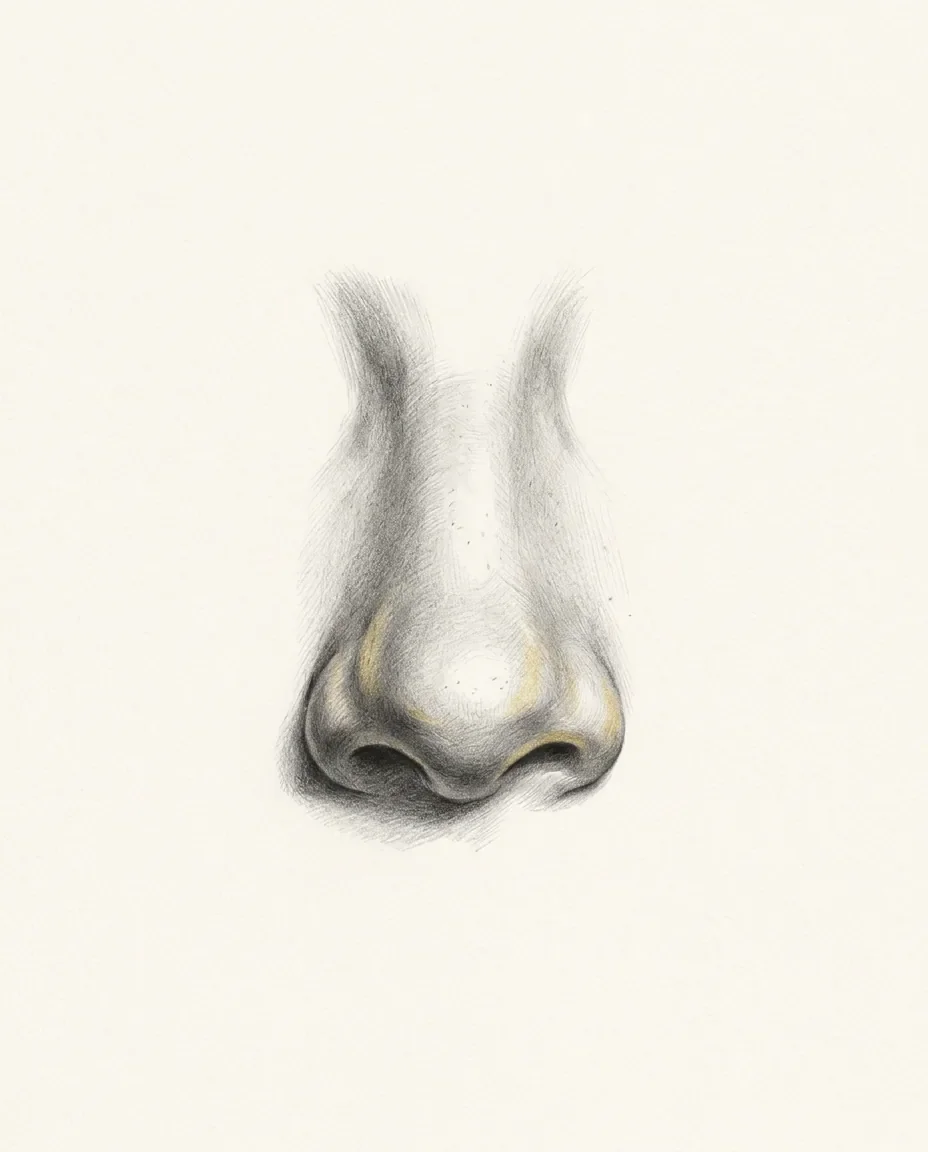
Nose Fetish
Nasophilia
Added 21 Jun 2026 · Updated 22 Aug 2026
Nasophilia, or nose partialism, is an erotic interest centred on the nose: its shape, bridge, size, or profile, and sometimes on touch, breath, or proximity. A benign facial partialism, distressing only if it impairs or harms.
- Prevalence
- Rare
- Category
- Body Parts & Partialism
- Clinical term
- Nasophilia
- Domain
- Sexual interest · Paraphilia
- Confidence
- Low confidence
- Status
- Partialism; benign variation unless distressing or impairing. Falls under fetishistic/partialism framing in DSM-5-TR.
- Also known as
- nasophilia, nasal fetish, nose partialism
- Added
- 21 Jun 2026
- Updated
- 22 Aug 2026
Overview
Nasophilia, also called nose fetishism or nose partialism, is an erotic interest in which the nose holds particular significance. Attention may concentrate on visual qualities such as a nose's shape, bridge, size, or profile, and for some individuals on touch, proximity, breath, or nose-related gestures. As with other facial partialisms, it is most often woven into ordinary attraction rather than experienced as something wholly separate from it. This article traces the documented clinical lineage of the interest, its strange place in the history of psychoanalysis, how it is typically expressed, its proposed psychology, and what little is known about its prevalence.
Examples
What the term covers. Most often a settled preference for a particular kind of nose (a high bridge, a strong profile, a small tip, a distinctive size) noticed first and weighted heavily in attraction. For others the interest is tactile or proximal rather than visual: nose-to-nose closeness, nuzzling, the warmth of a partner's breath, or attention to piercings and adornment. A small fantasy strand plays on exaggerated or lengthening noses, an idea borrowed directly from the Pinocchio motif.
What the term does not cover. Olfactophilia is arousal at scent, which uses the nose rather than being about it. Breath fetish centres on exhaled air: its warmth, sound and smell. Sneeze fetish is a body-function interest in the convulsion and the loss of composure it produces. The neighbouring facial partialisms (lips, teeth, eyes, ears) attach to different features of the same face. And Wilhelm Fliess's supposed nose-genital reflex was a discredited doctrine about anatomy, not an account of anyone's erotic preference: it explains why the nose is odd in the history of psychoanalysis, not why anyone finds one attractive.
How the word is used. "Nose fetish" is the everyday phrase; nasophilia is a modern compound found in paraphilia catalogues and glossaries rather than in clinical practice, with no well-documented first use. It is a named condition in neither DSM-5-TR nor ICD-11, and the DSM-5-TR reaches interests of this kind only through its general fetishistic and partialism framing.
History & origins
Clinical lineage
The idea behind nasophilia descends from the late-nineteenth-century medical project of cataloguing sexual variation. Richard von Krafft-Ebing's Psychopathia Sexualis (1886) introduced the framework of body-part "fetishism," and the British physician Havelock Ellis, in his multi-volume Studies in the Psychology of Sex (from 1897), gave sustained attention to the eroticisation of particular features, including the powerful role of smell and the face in attraction: early scaffolding for what later writers would call partialism, an erotic focus on a body part rather than on an object.
The nose holds a peculiar place in the history of psychoanalysis. The Berlin otorhinolaryngologist Wilhelm Fliess (1858–1928), Sigmund Freud's close friend and correspondent, advanced a theory of a "nasal reflex neurosis", a supposed physiological link between the nose and the genitals. He set it out in his 1892 book Neue Beiträge und Therapie der nasalen Reflexneurose and expanded it in the 1897 monograph Die Beziehungen zwischen Nase und weiblichen Geschlechtsorganen ("The Relationship between the Nose and the Female Sex Organs"), which identified "genital spots" on the nasal turbinate and proposed nasal surgery to treat sexual and menstrual complaints. Fliess operated on Freud's own nose more than once. The theory ended in disaster: in 1895 Freud referred the patient Emma Eckstein to Fliess for nasal surgery meant to cure a supposed sexual neurosis, and Fliess left a length of surgical gauze inside the wound, leaving her nearly dead from haemorrhage and permanently disfigured. The theory never found scientific favour, yet the Freud–Fliess correspondence embedded a symbolic nose–genital association in early psychoanalytic thought, and Freud is later cited as having read the nose as a substitute for the penis.
In contemporary classification the nose, as a focal body part, falls under the broad fetishistic/partialism framing of the DSM-5-TR, which treats such interests as disorders only when they cause distress, impairment, or harm. Reference catalogues such as Wikipedia's article on nose fetishism record nasophilia as a recognised but minor facial partialism; the specific compound nasophilia is a modern coinage whose precise first use is not well documented.
Cultural threads
The nose carries unusually heavy symbolic freight in folklore and literature: most famously through Pinocchio, whose lengthening nose recurs in some nasophilic fantasy, and through the long folk association between nose size and other anatomy. These motifs predate any clinical vocabulary and help explain the feature's small but persistent erotic charge.
In practice
Expression is typically mild and ordinary. Many people simply find certain noses strongly attractive and prioritise that feature in a partner; others associate the nose with intimacy through closeness, facial contact, scent, or shared breath. It rarely manifests as a behaviour distinct from normal courtship and affection, and for most it is one preference among many rather than a defining requirement.
Is a nose fetish normal?
Finding a particular nose strongly attractive is well within normal-range variation. It becomes a clinical concern only when it causes marked distress or impairment or drives non-consensual behaviour, the same threshold applied to any partialism.
Psychology
Partialisms are generally framed as normal-range variation in which a particular body region becomes erotically prominent, sometimes through early conditioning or idiosyncratic association. The face is a primary site of social attention, identity recognition, and signalling, which may help explain why individual facial features (including a distinctive nose, lips, or teeth) can acquire erotic weight. The evidence base specific to nasophilia is thin; mechanisms are inferred from the broader literature on partialism and fetish formation rather than from dedicated study.
Prevalence & culture
How common is a nose fetish?
It is rare and sparsely studied. Scorolli and colleagues' 2007 analysis of roughly 5,000 participants across online fetish communities found that fetishes for body parts or features made up about a third of all cases, but within that band feet alone accounted for some 47%: leaving facial features such as the nose as only a very small minority. The same relative-frequency table is widely reproduced, including in Wikipedia's overview of sexual fetishism. Nasophilia appears in catalogues of partialisms and has a modest online presence, but attracts little focused research and limited cultural visibility.
Safety, consent & law
Nasophilia is a benign, normal-range variation with no inherent safety or legal concerns beyond the ordinary requirement of mutual consent. It would become clinically relevant only if it caused the person marked personal distress, functional impairment, or led to non-consensual behaviour, the same threshold the DSM-5-TR applies to any paraphilic interest.
Common questions
What is the difference between a nose fetish and a smell fetish?
One is about the organ, the other about what it detects. Nasophilia is an interest in the nose as a feature: its shape, bridge, size, profile, or the intimacy of contact with it. Olfactophilia is arousal at scent itself, where the nose is the instrument rather than the subject. They can coexist, and closeness to a partner's face brings both into play, but someone can be drawn to a particular profile with no special interest in smell.
Is there any medical basis for a link between the nose and the genitals?
None. Wilhelm Fliess's "nasal reflex neurosis", set out in the 1890s and taken seriously by Freud for a time, claimed genital spots on the nasal turbinate and proposed nasal surgery for sexual and menstrual complaints. It never found scientific support, and its most notorious application (the 1895 operation on Emma Eckstein, in which Fliess left surgical gauze in the wound) nearly killed her. What survives is a symbolic association in early psychoanalytic writing, not a physiological one.
Why do some people find noses attractive?
The face is where most social attention, recognition and signalling happens, so it is unsurprising that individual features on it acquire erotic weight, and the nose is among the most identifying features a face has. Beyond that, partialisms are generally explained by idiosyncratic association and early conditioning: a feature that happened to be salient becomes charged. There is no research specific to noses, so any account is borrowed from the wider partialism literature.
Is a nose fetish a paraphilia?
It is catalogued as one in the technical sense, since a paraphilia means only an erotic focus outside the usual pattern. That is not the same as a disorder. Under DSM-5-TR an interest of this kind matters clinically only where it causes marked distress or impairment, or leads to non-consensual behaviour, and a preference for a particular kind of nose almost never does either.
What is the difference between a partialism and a fetish?
Partialism is an erotic focus on a body part: a nose, lips, feet, hands. Fetishism in the strict clinical sense covers nonliving objects, although DSM-5-TR groups partialism under the same diagnostic heading. Everyday speech uses "fetish" for both, which is why "nose fetish" and "nose partialism" name the same thing, one loosely and one precisely.
Does a nose fetish involve nose picking or mucus?
Usually not. Nasophilia as described in the reference literature concerns the nose as a visible feature, and the closeness that contact with it implies. Interests in nasal function or its products are catalogued separately, alongside body-function interests such as sneeze fetish or an interest in a partner's breath. Some people hold more than one of these, but they are kept apart because the focus is different.
- Lip Fetish43/100Labia Oris Partialism · Body Parts & PartialismLip and mouth partialism is a pronounced erotic focus on the lips and mouth, typically centering on lip fullness, shape, color, and movement. Associated cues such as lipstick, glossy lips, or kissing are often part of it. A benign, mainstream-adjacent variation.43
- Teeth Fetish24/100Odontophilia · Body Parts & PartialismOdontophilia is a partialism in which the teeth are a focal point of erotic interest. Attention may center on the appearance, shape, or arrangement of teeth, including features such as gaps, fangs, or braces.24
- Morphophilia22/100Morphophilia · Body Parts & PartialismA clinical term for sexual interest organized around a particular overall body shape or size rather than around a single body part. Slender, athletic, or heavyset builds are typical examples. It is a thinly documented catalog entry more than a described clinical syndrome.22
- Tongue Fetish22/100Glossophilia · Body Parts & PartialismA tongue fetish is a focused erotic interest in the tongue itself: its appearance, movement, or the sensations it produces. The tongue is a primary object of attraction, distinct from a general interest in kissing or the mouth.22
- Back Fetish23/100Dorsal Partialism · Body Parts & PartialismA focused erotic interest in the back and shoulders, where this dorsal region of the torso is a primary source of attraction rather than the body as a whole. It is generally a benign aesthetic preference, best understood as a form of partialism.23
- Ear Fetish19/100Auriculophilia · Body Parts & PartialismEar partialism is a sexual interest focused on the ears, their shape and appearance, and the heightened sensitivity of the region to touch or breath. Ear-related adornment is part of it, and it sometimes overlaps with arousal from whispered sound (auralism).19
Modern clinical compound joining the Latin nose sense (cf. Latin nasus, "nose") with the Greek suffix -philia (philia, "love, affection"), literally "love of the nose." A modern coinage whose precise first attestation is not well documented.
head and face · facial features
Prevalence is computed from the entry's cited population estimate. Rows marked ESTare indicative editorial estimates scored against a fixed anchor rubric, not measured quantities. Method & anchors: methodology.
Rare · ≈ 1 in 1,000
- 01List of paraphilias, Wikipediadefinition and existence of nasophilia as a facial-feature partialism
- 02Scorolli et al. (2007), Relative prevalence of different fetishes, Int. J. Impotence Research 19(4):432-437body-part fetish distribution showing facial features like the nose are a very small minority of cases
- 03Sexual fetishism, Wikipedia (carries the Scorolli 2007 relative-frequency table)carries the Scorolli relative-frequency table placing nose among rare partialisms
- 04Richard von Krafft-Ebing, Psychopathia Sexualis (1886)origin of the clinical concept of body-part fetishism that underlies feature partialisms such as the nose
- 05Nose fetishism, Wikipediadefinition of nasophilia / nose partialism and the cited interpretation of the nose as a substitute for the penis
- 06Wilhelm Fliess, WikipediaFliess's nasal reflex neurosis theory linking nose and genitals, his 1892 book and 1897 monograph, and the Freud-Fliess correspondence
- 07Emma Eckstein, Wikipediathe 1895 nasal surgery by Fliess on Freud's referral that left Eckstein haemorrhaging and permanently disfigured, illustrating the failure of the nasal reflex theory