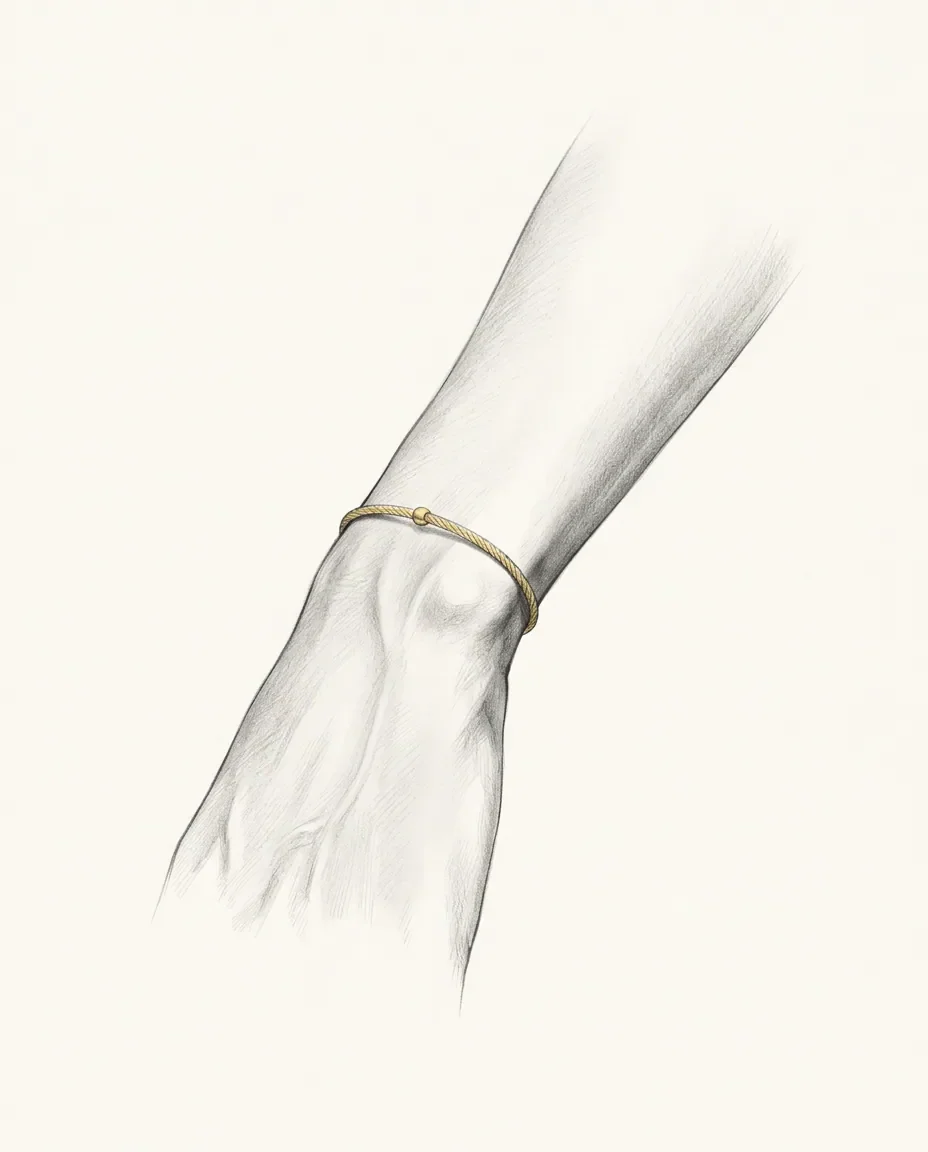
Wrist & Forearm Fetish
Added 26 Jul 2026 · Updated 22 Aug 2026
A partialism in which the wrists and forearms, their shape, veins, tendons, or the fine bones at the wrist, are a primary focus of erotic attraction. It sits alongside hand fetishism as one of the lesser-documented upper-limb interests.
- Prevalence
- Uncommon
- Category
- Body Parts & Partialism
- Domain
- Sexual interest · Paraphilia
- Confidence
- Low confidence
- Status
- Partialism; a benign variation of attraction with no dedicated clinical name or study, not a disorder unless it causes distress, impairment, or non-consent.
- Also known as
- wrist partialism, forearm partialism, arm fetish, forearm fetish, wrist fetish
- Added
- 26 Jul 2026
- Updated
- 22 Aug 2026
Overview
A wrist or forearm fetish is a form of partialism: sexual interest concentrated on a specific body part rather than the whole person. Here the focus falls on the lower arm, the visible tendons and veins that run along it, the turn of the wrist bones, or the movement of the forearm during ordinary gesture. It sits in the same territory as hand fetishism, which it frequently overlaps or extends, but unlike hands it has no dedicated clinical name and almost no direct research of its own. This article sets out what is known about the interest by way of the broader partialism literature, how it tends to be expressed, and how confidently its prevalence can be estimated.
Definition & scope
The wrist is the narrow joint connecting hand to forearm; the forearm is the segment between wrist and elbow. As an erotic focus, the two are usually treated together because attraction to one commonly extends to the other: a liking for slender wrist bones and prominent veins often accompanies an interest in forearm muscle definition or tendon movement. The interest is distinct from a wristwatch or bracelet fetish, where a worn object rather than the limb itself is the target, and distinct from a full hand fetish, where fingers and nails are the primary draw. Like other partialisms it is not, by itself, a paraphilic disorder: modern diagnostic frameworks reserve that label for cases involving significant distress, impairment, or a non-consenting party.
Examples
What the term covers. The fine bones and narrow turn of the wrist; tendons and veins standing out along the inner forearm; the flex of muscle when a hand grips, twists or writes; the way a rolled or pushed-back sleeve exposes the limb. It is reported both as an appreciation of a partner's arms and, less often, of one's own, and it is usually described as a strong aesthetic pull woven into ordinary attraction rather than a condition of arousal.
What the term does not cover. A hand fetish centres on fingers, palms and nails; the two overlap constantly and many people report both, but the wrist and forearm are anatomically and descriptively separate. A nail fetish is narrower again. A glove fetish, or an interest in a watch or a bracelet, attaches to a worn object, which makes it fetishism rather than partialism. Muscle worship and morphophilia concern overall development and build. And an interest in the wrist as the standard anchor point for cuffs and rope belongs to bondage, where the restraint rather than the limb is the object.
How the word is used. Entirely vernacular. People say "forearm fetish" or "a thing about wrists"; there is no Greek- or Latin-rooted clinical synonym, no entry in the standard paraphilia catalogues, and nothing in DSM-5-TR or ICD-11 beyond the general body-part specifier that covers every partialism at once.
History & origins
Neither "wrist fetish" nor "forearm fetish" has a documented coinage, a Greek- or Latin-rooted clinical name, or an entry of its own in the standard reference works on paraphilias. Wikipedia's list of paraphilias and its dedicated partialism article both catalogue body-part-specific interests, feet, hands, hair, the navel, the ear, but neither lists the wrist or forearm as a named category, which suggests the interest has never accumulated enough documented cases to be split out on its own. Its history therefore has to be read through the broader clinical concept it belongs to.
Clinical lineage
Richard von Krafft-Ebing's Psychopathia Sexualis (1886) was the first systematic catalogue of arousal fixed on discrete body parts, and Havelock Ellis, across his multi-volume Studies in the Psychology of Sex published between 1897 and 1928, extended the same associative account to a wide range of bodily features. The French psychologist Alfred Binet had, in 1887, given the field its governing word by using fétichisme in an erotic sense, a coinage recorded on Wikipedia's sexual fetishism article, and Sigmund Freud folded feature-specific fixations into his own theory of fetishism shortly after. None of these early sexologists singled out the wrist or forearm; they were writing about the general phenomenon of a part standing in for the whole.
The diagnostic category that would eventually cover such interests, partialism, only became a discrete label in the DSM-III-R (1987), was retained through the DSM-IV, and was folded back into fetishistic disorder as a body-part specifier in the DSM-5 (2013), a status the DSM-5-TR (2022) keeps. The ICD-11, finalised in 2018 and adopted by WHO member states from 2022, removed consensual fetishism from its list of disorders altogether. Under both systems, a focused liking for the wrist or forearm is, on its own, not a clinical matter.
A gap in the literature
The absence of a named term is itself informative. Popular kink glossaries and community lists occasionally mention wrist or forearm appreciation as an extension of hand attraction, but no peer-reviewed study has measured it as a separate category, and it has never appeared in a diagnostic manual under its own name. That makes it one of the more sparsely documented partialisms this directory covers.
In practice
Where the interest is reported, it usually centres on visual appreciation, touch, and the play of tendons and veins as the hand and fingers move. Some describe an added charge from the wrist's mobility and its role in gesture; the region is also closely tied, culturally and physically, to bondage, since the wrist is the most common point of restraint (cuffs, rope) in consensual kink, which can layer a wrist focus onto restraint-based arousal for some practitioners. For most people who report the interest, it is a mild aesthetic preference folded into ordinary attraction rather than a narrowly exclusive focus.
Psychology
No dedicated causal research exists for wrist or forearm attraction specifically, so any explanation is inferred from the general partialism literature. Associative learning, in which a body part becomes eroticised through repeated pairing with arousal, is the standard account offered for partialisms generally, following the line of reasoning Krafft-Ebing and Ellis both used. A speculative neurological angle, the adjacency of hand and genital representation on the brain's somatosensory map, has been proposed for foot and hand interest by V. S. Ramachandran and is noted on Wikipedia's sexual fetishism page; it has not been tested for the wrist or forearm specifically and should be treated as unproven even for the parts it was proposed to explain.
Prevalence & culture
Body-part interests as a whole are common, but the wrist and forearm do not appear as a named share of that total in the largest available survey. Scorolli et al. (2007), analysing membership across 381 online fetish communities, found feet and toes dominating body-part fetishes at about 47%, with the next-largest categories, body fluids and body size, at roughly 9% each and hair and muscles smaller again. Nails are named only among the unquantified "less popular" groups, and the wrist and forearm are not broken out at all, falling, if they were counted, into that unnamed residual. The survey's own structure is the evidence here: the interest is small enough that the largest study of its kind never gave it a line of its own. Dedicated communities specifically for wrist or forearm appreciation are correspondingly small and rarely distinguished from general hand-fetish spaces, cultural visibility is low, and no academic study has targeted the interest directly. Any prevalence figure here is a cautious extrapolation from the wider partialism data rather than a measured statistic.
Safety, consent & law
The interest carries no inherent physical or legal risk. Between consenting adults it requires nothing beyond the ordinary courtesies of attraction and touch, and it would only become a clinical concern in the rare case where an exclusive focus caused the person distress or impairment, or was directed at someone who had not consented.
Common questions
Is a forearm fetish the same as a hand fetish?
Not quite, though they travel together. A hand fetish focuses on fingers, palms and nails and has a documented literature of its own. Wrist and forearm interest focuses on the lower arm: its bones, tendons, veins and movement. Plenty of people report both and describe them in the same breath, but the wrist interest is regularly reported without any particular pull toward the hand itself.
Why do some people find veiny forearms attractive?
No study has ever asked, so the honest answer is that nobody knows. The general account offered for body-part interests is associative learning: a feature repeatedly present during arousal becomes arousing in its own right. Visible veins and tendons also read as cues of movement, exertion and physical capability, which may be doing some of the work. The neurological cortical-adjacency idea sometimes invoked for hands and feet is unproven even there.
Is having a wrist or forearm fetish normal?
Yes, in the sense that matters: body-part interests are among the most commonly reported forms of unusual attraction, and this is one of them. It carries no physical or legal risk and asks nothing of a partner beyond ordinary courtesy. It would become a clinical question only in the rare case where the focus was exclusive enough to cause the person distress or impairment.
How common is a forearm fetish?
Unmeasured. Scorolli et al. (2007), the largest study of relative fetish frequency, analysed 381 online communities and found feet accounting for roughly 47% of body-part interests, with body fluids and body size around 9% each. The wrist and forearm were never broken out at all and fall into an unnamed residual. That absence, in the biggest survey of its kind, is the clearest evidence available that the interest is small.
Is a wrist or forearm fetish a paraphilia?
In the technical sense, yes: it is a partialism, an erotic focus on a non-genital body part, and that is all the word paraphilia means: an atypical target, not an illness. Neither DSM-5-TR nor ICD-11 treats an interest of this kind as a disorder. The clinical threshold everywhere is distress, impairment, or a non-consenting person, and none of those follows from finding forearms compelling.
Does liking wrists mean I am into bondage?
No, though the overlap is easy to see. The wrist is the usual place cuffs and rope go, so someone drawn to bondage may find the region charged for reasons that have nothing to do with the limb, and someone drawn to the limb may find restraint imagery lands differently as a result. They are separate interests that happen to share an anatomical address, and either exists perfectly well without the other.
- Hand Fetish48/100Quirofilia · Body Parts & PartialismA focused erotic interest in hands: their shape, fingers, nails, veins, or expressive gestures. A recognised partialism, less common than foot interest but consistently reported alongside it.48
- Partialism46/100Partialism · Clinical ParaphiliasThe clinical term for an exclusive or near-exclusive sexual focus on a specific, usually non-genital body part: feet, hands, hair, legs, the navel. It is the umbrella concept under which interests such as foot or hand attraction are formally classified.46
- Skin Fetish29/100Integumentophilia · Body Parts & PartialismA focused erotic interest in human skin itself, its texture, smoothness, warmth, scent and sheen, rather than the body as a whole. The act of touching and being touched is part of it. It is generally a benign aesthetic and tactile preference.29
- Leg Fetish53/100Crurophilia · Body Parts & PartialismCrurophilia is a partialism in which the legs are the primary focus of sexual attraction. Interest may center on a leg's shape, length, line, or musculature, or on the way legs are framed by clothing such as stockings, skirts, or heels.53
- Bondage86/100Acts & ActivitiesConsensual binding or restraint of a partner with rope, cuffs, tape or other materials for erotic, aesthetic or sensory pleasure. It is the "B" of BDSM and one of the most widely fantasised-about kinks.86
- Glove Fetish34/100Glove fetishism · Clothing & GarmentsAn erotic interest in gloves as worn handwear, valued for their material (leather, satin, latex, lace) and for the way they cover the hands. Associations with elegance, formality, or restraint add to the appeal. An uncommon garment-and-material fetish, not a clinical disorder.34
"Wrist" descends from Old English wrist, related to the Germanic root wrīþan, "to twist or turn," describing the joint's rotating motion. "Forearm" is a plain English compound of "fore-" (in front of, before) and "arm," naming the segment of the limb between elbow and wrist. Neither word has a Greek- or Latin-rooted clinical synonym in established sexological use.
upper body · extremities
Prevalence is computed from the entry's cited population estimate. Rows marked ESTare indicative editorial estimates scored against a fixed anchor rubric, not measured quantities. Method & anchors: methodology.
Uncommon · ≈ 1 in 100
- 01Partialism, WikipediaConfirms the wrist/forearm is not listed among named partialisms (feet, hands, hair, navel, ear, etc.) and gives the DSM lineage of the partialism category.
- 02List of paraphilias, WikipediaReference catalogue of named paraphilias/partialisms, used to confirm no dedicated wrist/forearm term exists.
- 03Scorolli et al. (2007), Relative prevalence of different fetishes, Int. J. Impotence Research 19(4):432-437Relative-frequency data on body-part fetishes (feet ~47%, body fluids and body size ~9% each); the wrist/forearm is not broken out at all, the basis for treating it as a small unnamed residual share.
- 04Sexual fetishism, Wikipedia (carries the Scorolli 2007 relative-frequency table)Carries the Scorolli table and Binet's 1887 coinage of fétichisme; also notes Ramachandran's cortical-adjacency hypothesis for body-part attraction.
- 05Psychopathia Sexualis, WikipediaKrafft-Ebing's 1886 foundational cataloguing of arousal fixed on discrete body parts.
- 06Studies in the Psychology of Sex, WikipediaEllis's early associative-learning account of eroticized body features, cited as the historical framework for partialism generally.
- 07DSM-5-TR, Paraphilic Disorders (American Psychiatric Association, 2022)Current clinical framing: a non-genital body-part focus is a fetishistic-disorder specifier only with significant distress or impairment.
- 08ICD-11, Paraphilic disorders (World Health Organization)2018 removal of consensual fetishism from the WHO's list of disorders, supporting the benign, non-clinical framing of the interest.