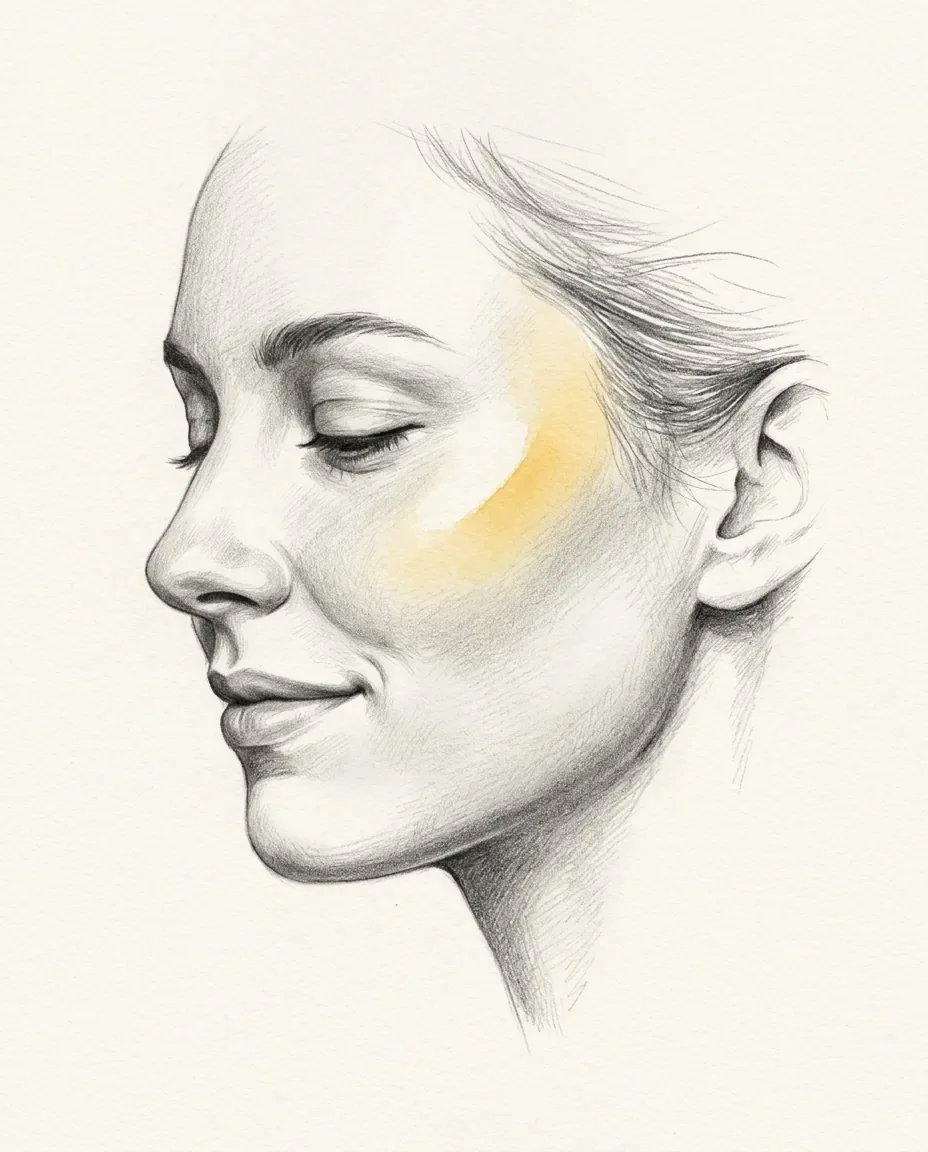
Cheek Fetish
Buccalagnia
Added 27 Jun 2026 · Updated 22 Aug 2026
Cheek fetishism (clinically buccalagnia) is a focused erotic interest in the cheeks of the face, their softness and fullness and the colour of a blush. The intimacy of cupping, stroking or kissing them is part of the appeal. A rare, benign body-part partialism.
- Prevalence
- Rare
- Category
- Body Parts & Partialism
- Clinical term
- Buccalagnia
- Domain
- Sexual interest · Paraphilia
- Confidence
- Low confidence
- Status
- Partialism; a benign paraphilic variation, not a disorder absent distress or impairment.
- Also known as
- buccalagnia, cheek partialism, facial cheek fetish
- Added
- 27 Jun 2026
- Updated
- 22 Aug 2026
Overview
Cheek fetishism, catalogued clinically as buccalagnia, is a partialism: a focused erotic interest in the cheeks of the face rather than in the genitals. The appeal usually rests on the cheek's soft fullness, its warmth and colour (the flush of a blush), the fine down of the skin, and the closeness of cupping, stroking or kissing a face. Wikipedia's partialism types table lists buccalagnia among roughly twenty named body-part interests. This article covers the term, its place in the partialism framework, how the interest is expressed, and how thin the dedicated evidence on it really is.
Definition & scope
In a partialism the body part carries erotic weight in its own right. People with such an interest often report that the anatomy of interest holds "equal or greater erotic attraction for them than do the genitals", as the Wikipedia entry on partialism puts it. That is the line between a partialism and ordinary aesthetic appreciation of an attractive face.
Cheek partialism is usually distinguished from:
- A general face preference: liking a face is not the same as the cheek being the focal site of arousal.
- Neighbouring facial partialisms: interest in the nose, the lips or the ears is catalogued separately, though overlap is common.
- Fetishistic disorder: a diagnosis requires distress or impairment, which a cheek interest almost never produces.
Examples
What the term covers. The attention usually falls on a specific set of qualities rather than on the face as a whole: the line of the cheekbone and the softness below it, the warmth and colour of a blush, the fine down on the skin, a dimple that appears with a smile. Expression follows the anatomy and stays inside ordinary affection: cupping or stroking a partner's face, resting cheek against cheek, a kiss placed on the cheek rather than the mouth. A narrower focus on the dimple itself is catalogued as a dimple fetish, and an interest in the texture or flush of skin generally belongs to skin fetishism.
What the term does not cover. In English "cheek" is ambiguous and buccalagnia is not: built on Latin bucca, it names the cheek of the face only, and an interest in the buttocks is a separate partialism catalogued here as butt fetish. Face slapping lands on the same anatomy but belongs to impact and power play, where the point is the sensation and the gesture rather than the feature. Interest in the eyes or the neck has its own listing, as the neighbouring facial partialisms noted above do.
How the word is used. Buccalagnia is a glossary term. It is regularly formed (Latin bucca plus Greek lagneia, "lust"), but it circulates in lists of -philia and -lagnia coinages rather than in the sexological canon, and its first attested use is not established. Neither it nor the plain phrase "cheek fetish" appears in DSM-5-TR or ICD-11. The category that does appear there, fetishistic disorder, requires distress or impairment that this interest almost never produces.
History & origins
Clinical lineage
The cheek has no independent clinical literature. Its lineage is inherited from the broader category that contains it.
- 1886: Richard von Krafft-Ebing's Psychopathia Sexualis begins the systematic medical cataloguing of erotic interest directed at particular bodily features, the seed of the modern concept of partialism.
- 1897–1928: Havelock Ellis, across his Studies in the Psychology of Sex, documents attraction to specific non-genital features and treats such attractions as ordinary variations rather than disease.
- DSM-IV (1994): partialism is listed as a paraphilia in its own right.
- DSM-5 (2013) and DSM-5-TR (2022): partialism is merged into fetishistic disorder and is a disorder only where it causes clinically significant distress or functional impairment. The same framing applies to interest centred on the cheek.
The label buccalagnia is a regularly formed compound of Latin bucca ("cheek") and Greek lagneia ("lust"). It circulates in glossaries of -philia terms rather than in the primary sexological canon, and its first documented use is not well attested.
The cheek in culture
Two cultural threads make the cheek an unusually loaded feature. The first is the blush: Charles Darwin devoted a chapter of The Expression of the Emotions in Man and Animals (1872) to it and called blushing "the most peculiar and most human of all expressions", tying reddened cheeks to modesty, shame and attraction. The second is the cheek kiss, a near-universal gesture of greeting and affection, which makes touching a cheek both socially ordinary and physically intimate. A rounded, high-coloured cheek is also read across many cultures as a marker of youth and health.
In practice
Expression is gentle and folds into ordinary affection: cupping or stroking the cheeks, cheek-to-cheek closeness, kissing the cheek, resting a face against a partner's, and appreciation of a dimple or a flush. Because those gestures are also everyday signs of tenderness, the interest tends to blend into intimacy rather than stand apart as a distinct behaviour. It is normally reported as one thread of attraction among others, not as an exclusive requirement.
Psychology
What causes it?
There is no cheek-specific research, so any account is borrowed from the wider partialism literature. The standard explanation combines associative learning with the feature's genuine social salience: the face is the body's main channel of emotional signalling, and the cheek in particular is bound up with affection, blushing and youth. Early intimate experiences in which cheek contact was prominent may consolidate the association. Neurological accounts of partialism (best known from work on foot interest and cortical adjacency) have not been extended to the cheek in any published study. Evidence here is thin, and the honest position is that the mechanism is inferred rather than demonstrated.
Prevalence & culture
How common is cheek fetishism?
Rare, on every available signal. No population survey isolates a cheek-specific rate. The nearest comparative anchor is Scorolli et al. (2007), which tabulated the relative frequency of fetishes across large online communities and found feet dominating body-part interest at roughly 47%, with facial features registering nowhere near that scale as a standalone focus. That is consistent with the cheek being a common incidental attraction and a very uncommon primary one. Community presence is correspondingly minimal: unlike foot or hair interest, there is little dedicated online subculture, and no separate research attention. Any percentage attached to this entry is an estimate, not a measured rate.
Variations & related interests
Cheek interest sits inside the family of facial partialisms and frequently coexists with them, notably the nose, the lips and the ears. Some people describe the attraction in terms of colour and blushing, others in terms of texture and softness, and others in terms of the intimacy of the gesture rather than the anatomy.
Safety, consent & law
The interest is benign. It involves consenting adults, ordinary non-injurious contact, and raises no legal or physical-safety questions beyond the mutual consent and basic care that apply to any affection.
Common questions
Does a cheek fetish mean the face or the buttocks?
The face. Buccalagnia is built on Latin bucca, which names the cheek of the face specifically, and the interest catalogued under that label concerns the cheekbone, the soft fullness below it and the colour of a blush. An interest in the buttocks is a separate partialism, listed here as butt fetish. The ambiguity is a quirk of English rather than of the terminology.
Is buccalagnia a recognised medical term?
Not in any manual. It appears in glossaries of -philia and -lagnia coinages and in reference tables of named partialisms, but not in the DSM-5-TR, the ICD-11 or the founding sexological literature, and no first use is documented. The underlying category (partialism, now subsumed under fetishistic disorder) is recognised; this particular label is a convenience.
What is the difference between a cheek fetish and simply finding a face attractive?
Whether the cheek carries erotic weight in its own right. Descriptions of partialism speak of the anatomy holding equal or greater attraction than the genitals do, which ordinary appreciation of an attractive face is nothing like. Most people notice cheekbones and blushes without either being a focus of arousal, which is why this interest is uncommon as a primary one and unremarkable as an incidental one.
Why are blushing cheeks so often described as erotic?
A blush is involuntary, which is most of the answer: it reports an inner state the person did not choose to disclose. Darwin devoted a chapter of The Expression of the Emotions in Man and Animals (1872) to it and called blushing the most peculiar and most human of all expressions, tying reddened cheeks to modesty, shame and attraction, the associations this interest still draws on.
Is a cheek fetish a paraphilia or a disorder?
It is catalogued as a partialism, which the DSM-5 and DSM-5-TR fold into fetishistic disorder, and which counts as a disorder only where it causes clinically significant distress or functional impairment. A gentle attraction to a facial feature, expressed through affection between consenting adults, meets no part of that threshold. It raises no safety, consent or legal question beyond the mutual consent any affection needs.
Is a cheek fetish the same as a dimple fetish?
They are close relatives, catalogued separately. A dimple fetish is fixed on the indentation itself and on the smile that produces it, while cheek interest is broader, taking in the cheekbone, the fullness of the cheek and the colour of a blush. Many people describe both together, and neither excludes the other or the neighbouring facial partialisms.
- Nose Fetish21/100Nasophilia · Body Parts & PartialismNasophilia, or nose partialism, is an erotic interest centred on the nose: its shape, bridge, size, or profile, and sometimes on touch, breath, or proximity. A benign facial partialism, distressing only if it impairs or harms.21
- Lip Fetish43/100Labia Oris Partialism · Body Parts & PartialismLip and mouth partialism is a pronounced erotic focus on the lips and mouth, typically centering on lip fullness, shape, color, and movement. Associated cues such as lipstick, glossy lips, or kissing are often part of it. A benign, mainstream-adjacent variation.43
- Ear Fetish19/100Auriculophilia · Body Parts & PartialismEar partialism is a sexual interest focused on the ears, their shape and appearance, and the heightened sensitivity of the region to touch or breath. Ear-related adornment is part of it, and it sometimes overlaps with arousal from whispered sound (auralism).19
- Stretch Mark Fetish16/100Body Parts & PartialismA partialism centered on stretch marks (striae), an erotic appreciation of the streaked skin texture they leave behind. Striae form when skin stretches faster than its connective tissue can adapt. The interest is often tied to pregnancy, weight change, or soft-body aesthetics.16
- Dimple Fetish15/100Erogonophilia · Body Parts & PartialismDimple partialism, sometimes labelled erogonophilia, is a focused erotic interest in dimples: the small natural indentations of the cheeks. For some it extends to the chin or the lower-back 'dimples of Venus'. It is a rare and benign body-feature interest.15
- Pubic Hair Fetish17/100Pubephilia · Body Parts & PartialismA focused erotic interest in pubic hair: its presence, density, or texture. Treated as a narrow subset of hair fetishism (trichophilia), not an independent clinical entity, and a benign variation among consenting adults.17
A modern clinical-style coinage from Latin bucca ("cheek") plus Greek lagneia ("lust"), literally "lust for the cheek". Unlike podophilia it traces to no single documented author, and its first attested use is not well established.
head and face · facial features
Prevalence is computed from the entry's cited population estimate. Rows marked ESTare indicative editorial estimates scored against a fixed anchor rubric, not measured quantities. Method & anchors: methodology.
Rare · ≈ 1 in 1,000
- 01Partialism, Wikipedia (Types table: Buccalagnia / cheek fetish)lists buccalagnia (cheek/cheeks fetish) as a recognised partialism toward the facial cheek
- 02List of paraphilias, Wikipediadefinition/existence of partialism toward specific non-genital body parts
- 03Scorolli et al. (2007), Relative prevalence of different fetishes, Int. J. Impotence Research 19(4):432-437relative-frequency table where facial features rank far below feet (47%), supporting a very low estimate
- 04Sexual fetishism, Wikipedia (carries the Scorolli 2007 relative-frequency table)partialism context; facial features as recognised but minor body-part fetish foci; DSM framing
- 05Krafft-Ebing, Psychopathia Sexualis (1886)1886 origin of the partialism framework that catalogues attraction to specific body features
- 06Blushing, Wikipedia (Darwin, The Expression of the Emotions in Man and Animals, 1872)Darwin's 1872 chapter on blushing and his description of it as 'the most peculiar and most human of all expressions', anchoring the cheek's cultural charge
- 07DSM-5-TR, Paraphilic Disorders (American Psychiatric Association, 2022)partialism is subsumed under fetishistic disorder in DSM-5/DSM-5-TR and is a disorder only with distress or impairment